
GET IN TOUCH
Ask For Sample?
What Is the Difference Between a Pool Clarifier and a Flocculant?
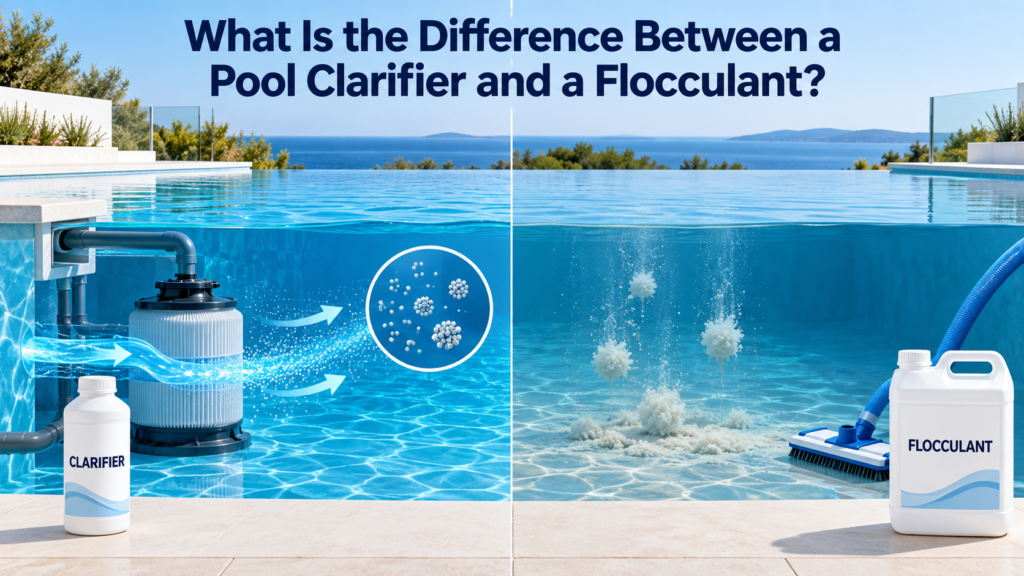
Cloudy pool water has a habit of appearing at the worst possible moment. The chemistry may look acceptable, the filter may be running, and yet the deep end still seems dull. At that point, two products often enter the conversation: a pool clarifier and a flocculant.
They sound similar because both help remove fine particles from water. They may even use related types of water-treatment chemistry. Still, they are not simply two labels for the same job.
A pool clarifier gathers tiny suspended particles into slightly larger clusters that the filter can capture. The circulation system normally stays on during treatment. A pool flocculant creates heavier masses that settle on the pool floor, where they must usually be vacuumed directly to waste. The pump is commonly switched off during the settling stage.
That difference changes almost everything: how the product is applied, how quickly the pool may recover, how much water is lost, and how much hands-on work follows. Choosing correctly can turn a frustrating haze into clear water. Choosing poorly can leave a clogged filter, a floor covered in disturbed sediment, or water that looks no better than before.
Let’s make the distinction clear—without turning a cloudy pool into a chemistry lecture.
The Short Answer: Filtration Support vs. Floor Settling
Here is the simplest way to remember it:
- A pool clarifier works with the filter.
- A pool flocculant works mainly through settling and vacuuming.
Clarifiers are generally suited to mild or moderate cloudiness, routine clarity support, and situations where the filtration system is operating properly. Flocculants are more often considered when the water is severely cloudy and a faster, more labor-intensive cleanup is justified.
Neither product replaces sanitation. Neither corrects the cause of cloudiness by itself. If the pool has low sanitizer, an active algae bloom, poor circulation, incorrect pH, damaged filter media, or a heavy load of organic debris, that underlying problem still needs attention.
Think of a clarifier as helping a fine fishing net catch particles that would otherwise slip through. A flocculant takes another route: it gathers the particles into heavy bundles and drops them to the floor for removal.
Why Fine Particles Make Pool Water Look Cloudy?
Pool water can contain particles too small to settle quickly and too small for the filter to capture efficiently. These may include dust, pollen, dead algae, skin cells, cosmetic residues, tiny mineral particles, and organic matter carried in by swimmers or rain.
Individually, many of these particles are almost invisible. Together, they scatter light. That light scattering produces the milky, hazy, or flat appearance people describe as cloudy water.
Some suspended particles also carry electrical surface charges that help keep them apart. Instead of joining and sinking, they remain dispersed. A suitable polymer treatment can reduce that stability and encourage particles to gather.
This is where clarification and flocculation begin to overlap. Both may involve particle charge effects, adsorption, and polymer bridging. Yet the desired result is different. A clarifier aims for filterable clusters that remain in circulation long enough to reach the filter. A flocculant aims for larger, heavier flocs that settle out of the water.
For a closer look at the product used for routine particle conditioning, see the Polymer Pool Clarifier page.
How Does a Pool Clarifier Work?
A pool clarifier is normally added while the circulation system is running. Its molecules interact with very fine suspended particles, helping them form loose clusters. These clusters are still small enough to circulate, but large enough for a properly working sand, cartridge, or diatomaceous earth filter to catch more effectively.
The treatment is usually gradual. Depending on the water condition, the product, the filter, and the circulation rate, visible improvement may take several hours or longer. The operator may need to clean or backwash the filter because captured debris increases the filter load.
This softer approach has several practical advantages:
- The pool normally stays in circulation during treatment.
- Little or no water needs to be discharged solely because of the clarifier.
- The process requires less manual vacuuming.
- A clarifier can fit into regular maintenance programs when the label permits it.
- It is well suited to polishing water that is slightly dull after the main water problem has been corrected.
There is a catch, though. More clarifier is not automatically better. An excessive dose may create too much polymer in the water, produce sticky deposits, load the filter, or make clarity worse. Small, accurate doses matter.
The filter matters too. A clarifier cannot repair torn cartridges, channeled sand, poor flow, a blocked skimmer, or an undersized circulation system. It assists particle removal; it does not perform magic around mechanical failure.
How Does a Pool Flocculant Work?
A flocculant is used when the goal is to create larger, denser flocs that fall to the bottom of the pool. The usual process includes distributing the product, allowing brief circulation if the label directs it, stopping the pump, and leaving the water undisturbed while the floc settles.
Once a visible layer has formed on the floor, the operator vacuums it slowly to waste. “To waste” is the crucial phrase. The sediment should not simply be pulled into the normal filter path unless the equipment and product directions specifically allow that method. Sending a heavy floc load through the filter can clog it, break the floc apart, or return cloudy material to the pool.
Flocculation can produce a dramatic result when it is performed correctly. It can also be fussy. The pool needs time without circulation. The vacuum head must move slowly. The water level may fall during waste vacuuming and need replacement. If the operator rushes, the settled blanket rises like dust from a workshop floor—and the job starts all over again.
Flocculants are therefore commonly associated with severe cloudiness, post-algae cleanup after the algae has been treated, or a situation where rapid settling is preferred over extended filtration. Exact uses vary by product, so the label remains the controlling instruction.
Pool Clarifier vs. Flocculant: The Practical Differences
| Point of comparison | Pool clarifier | Pool flocculant |
|---|---|---|
| Main purpose | Helps the filter capture fine suspended particles | Forms heavy flocs that settle on the pool floor |
| Typical water condition | Mild to moderate haze | Severe cloudiness or a large suspended-particle load |
| Pump during main treatment | Usually runs | Usually stops during settling |
| Primary removal route | Filtration | Vacuuming to waste |
| Labor required | Relatively low | Higher and more hands-on |
| Water loss | Usually minimal | Often significant during waste vacuuming |
| Speed | Gradual polishing | Can be faster after successful settling |
| Filter impact | Adds captured solids to the filter | Heavy floc should usually bypass the filter |
| Routine use | Possible when the product label permits | Usually an occasional corrective treatment |
| Main risk when misused | Overdosing and filter loading | Disturbed sediment, clogging, or improper vacuuming |
The table makes the choice look tidy. Real pools, of course, are rarely tidy. Water balance, temperature, particle type, sanitizer history, filter design, and operator skill can all affect the result.
Which Product Should You Use?
Start with the condition of the water and the condition of the equipment.
Choose a clarifier when the pool has a light haze, the sanitizer level is under control, water balance is acceptable, and the filter is working but needs help capturing very small particles. It is also a sensible candidate when conserving water matters or when vacuuming to waste is difficult.
Consider a flocculant when the water is extremely cloudy, the suspended load is high, the pool can remain out of service during settling, and the plumbing allows slow vacuuming directly to waste. The operator must also be willing to replace lost water and rebalance it afterward.
Do not reach for either product before asking a few basic questions:
- Is free chlorine or the chosen sanitizer within the correct range?
- Is the pH within the range required by the treatment label?
- Is algae still actively growing?
- Is the pump moving enough water?
- Is the filter clean and mechanically sound?
- Is the cloudiness caused by suspended matter, or could it be a dissolved mineral issue?
That last question deserves attention. A particle-removal aid may help with suspended calcium carbonate after precipitation has occurred, but it does not correct the water balance that caused scaling. Likewise, a clarifier may help collect dead algae, but it does not replace the sanitizer needed to kill living algae.
If recurring haze is linked to poor filter capture, it may also be useful to review PolyDADMAC cationic polymer technology, which is used in water-treatment and pool-clarification formulations.
Can You Use Clarifier and Flocculant Together?
Usually, adding both at the same time is unnecessary and may make the process harder to control. Each product has its own intended dose, mixing pattern, circulation requirement, and removal route. Combining them without a validated formulation or explicit label directions can add too much coagulant or polymer to the water.
The result may be sticky residue, excessive filter pressure, broken floc, or stubborn cloudiness. It can feel logical to “double up” when the water looks terrible. Chemistry does not reward impatience quite so generously.
A better approach is to diagnose the pool, select one method, follow its full treatment cycle, and reassess the water afterward. If a second treatment becomes necessary, confirm that the first product has been removed or has completed its intended function. Product suppliers should be able to provide directions on compatibility and retreatment intervals.
The Filter Type Can Change the Decision
Not every pool has the same filtration and waste-handling setup. That matters more than many product comparisons admit.
Sand Filters
Sand filters are robust and easy to backwash, but very fine particles can pass through them. A clarifier can help form filterable clusters. After treatment, pressure should be monitored and the filter backwashed when needed—not automatically every hour, but according to the equipment guidance and pressure reading.
Many sand-filter systems also have a waste setting, which can make floc removal practical. The operator should verify the valve position and discharge rules before starting.
Cartridge Filters
Cartridge systems can capture fine material, particularly when the cartridges are clean and in good condition. Clarifier use must still follow the product label because some formulations or overdoses may coat the cartridge fibers and shorten the cleaning interval.
Flocculant treatment can be awkward if the pool has no direct waste line. Vacuuming heavy floc through a cartridge is generally not the intended route. If there is no suitable bypass or external waste-vacuum arrangement, a traditional drop-out floc treatment may be a poor fit.
Diatomaceous Earth Filters
DE filters offer fine filtration and may clear suspended particles efficiently, but a heavy particle load can raise pressure quickly. Clarifier dosage and filter monitoring remain important. A settled floc blanket should not be sent through the DE filter unless the product and equipment instructions clearly support it.
In short, do not buy the treatment first and inspect the plumbing later.
Common Mistakes That Keep Cloudy Water Cloudy
The most common mistake is treating appearance without finding the cause. A bottle may improve particle removal, but the haze can return if circulation, sanitation, or water balance remains wrong.
Other frequent mistakes include:
- Overdosing the clarifier. Excess product may keep the water cloudy or coat surfaces and filter media.
- Running the pump during floc settling. Continuous flow can prevent heavy flocs from reaching the floor.
- Vacuuming too quickly. Fast movement breaks the settled layer and throws it back into suspension.
- Vacuuming floc into the filter. Unless specifically permitted, this can overload the filtration system.
- Backwashing too soon after clarifier addition. The product needs circulation and contact time before captured debris is removed.
- Ignoring pH and sanitizer. Treatment chemistry and particle behavior can change outside the recommended range.
- Using a particle aid against active algae. Green or slimy water needs effective algae control and sanitation, not merely cosmetic clearing.
- Copying a dose from another product. Concentration, active ingredient, and use directions can differ widely.
Good pool care is a sequence. Test, correct, treat, circulate or settle as directed, remove the debris, and test again. Skipping the middle steps rarely saves time.
Are All Clarifiers and Flocculants Chemically the Same?
No. “Clarifier” and “flocculant” describe functions, not one universal chemical identity.
Commercial products may be based on cationic polymers, inorganic salts, natural materials, or blended systems. Even within polymer products, molecular weight, charge density, active concentration, viscosity, and formulation additives can influence performance.
Some products are sold as dual-purpose clarifier/flocculants, with the dose and operating method determining the effect. That does not erase the practical distinction. At a lower dose with continuous filtration, the product may support clarification. At a different dose followed by still-water settling, it may act as a drop-out flocculant. Only follow this approach when the supplier’s directions clearly describe both methods.
For B2B buyers, a label claim is not enough. Ask for:
- The active ingredient and concentration
- A current technical data sheet and safety data sheet
- Recommended dose ranges for each application method
- Compatible pool and filter types
- Required pH and water conditions
- Mixing, settling, filtration, and vacuuming instructions
- Storage conditions and shelf-life information
- Batch quality-control data
- Packaging and private-label specifications
These details help a distributor avoid vague instructions that later become customer complaints.
Clarifier Is Not the Same as Algaecide
The terms can become muddled because some cationic polymers contribute more than one water-treatment effect. A dedicated pool clarifier is formulated and dosed to improve the removal of suspended particles. An algaecide is intended to prevent or control algae according to its approved label and local regulatory requirements.
Some polymeric algaecide formulations may also support water clarity, but that secondary benefit does not automatically make every algaecide a substitute for a dedicated clarifier. The reverse is also true: a clarifier does not become an algaecide merely because it makes green-treated water look clearer.
Where algae prevention is the main goal, review the intended function of a dedicated Polyquat 60 Algaecide. Where fine suspended matter is the problem, a purpose-designed clarifier is the more direct tool.
A Simple Decision Guide for Pool Operators
Still unsure? Use this quick sequence:
- Test and correct the water. Confirm sanitizer, pH, alkalinity, and any other values relevant to the pool.
- Rule out active algae. Treat algae before expecting a particle aid to finish the cleanup.
- Inspect circulation and filtration. Check baskets, flow, pressure, filter condition, and run time.
- Judge the severity. Light haze generally points toward clarification; dense cloudiness may justify flocculation.
- Check the waste route. If the system cannot vacuum to waste, a settling flocculant may not be practical.
- Read the exact product label. Do not transfer directions from another brand or concentration.
- Measure carefully. Guessing by the capful is not a treatment program.
- Give the process time. Clarification needs filtration; flocculation needs quiet settling.
This sequence is not glamorous. It is effective, though—and that matters far more when a customer is waiting for the pool to clear.
What B2B Buyers Should Look for in a Pool Clarifier?
Distributors and private-label brands need to evaluate more than the water in one demonstration pool. A commercial product must remain consistent from batch to batch and be practical for the target market.
Start with clarity and stability of the liquid itself. Confirm the active chemistry, concentration tolerance, pH, viscosity where relevant, and compatibility with the proposed bottle, cap, label, and color system. If a blue appearance is requested, the color package should be checked for storage stability and for compatibility with the base formulation.
Then examine real-world use. Are the directions simple enough for a homeowner yet precise enough to prevent overdosing? Are metric and local pool-volume units presented clearly? Does the packaging match the normal treatment volume? Can the supplier support 1 L, 5 L, or 25 L packs and private-label artwork?
Finally, compare claims with evidence. Laboratory particle-removal testing, application trials, retained batch samples, raw-material controls, and traceable production records all add confidence. A polished bottle may win the first glance. Consistent water performance earns the reorder.
The Bottom Line
A pool clarifier and a flocculant both address suspended particles, but they guide those particles to different destinations.
The clarifier helps the existing filter catch more of them. It is usually the gentler, lower-labor choice for mild or moderate cloudiness. The flocculant creates heavier material that settles to the floor and must normally be vacuumed to waste. It can suit severe cloudiness, but it demands still water, careful cleanup, and a suitable waste route.
Before using either one, correct the reason the pool became cloudy. Then match the treatment to the water condition, filtration system, plumbing, and product label. Clear water is not produced by the strongest-sounding bottle. It comes from choosing the right process and completing it properly.
Frequently Asked Questions
What is the main difference between a pool clarifier and a flocculant?
A pool clarifier forms small clusters that remain in circulation and are captured by the filter. A pool flocculant forms heavier flocs that settle on the floor and are normally vacuumed to waste.
Should I use pool clarifier or flocculant for very cloudy water?
A clarifier is often suitable for light or moderate haze. A flocculant may suit very cloudy water when the pool can be shut down for settling and the system can vacuum directly to waste. Correct sanitation and water balance first.
How long does a pool clarifier take to clear cloudy water?
The time varies with the product, dose, particle load, circulation, and filter condition. Improvement may appear within several hours, but some pools need a day or longer of effective filtration. Follow the product label rather than a universal time estimate.
Can I vacuum pool flocculant through the filter?
Most drop-out floc treatments are designed to be vacuumed slowly to waste so the heavy sediment bypasses the filter. Sending it through the filter may cause clogging or return debris to the pool. Check both the flocculant label and equipment instructions.
Can too much pool clarifier make the water cloudier?
Yes. Overdosing can leave excess polymer in the water, load or coat the filter, and reduce clarity. Measure the pool volume, use the stated dose, maintain circulation, and clean the filter when required.