
GET IN TOUCH
Ask For Sample?
Polyquat 60 Algaecide Sample Request Guide
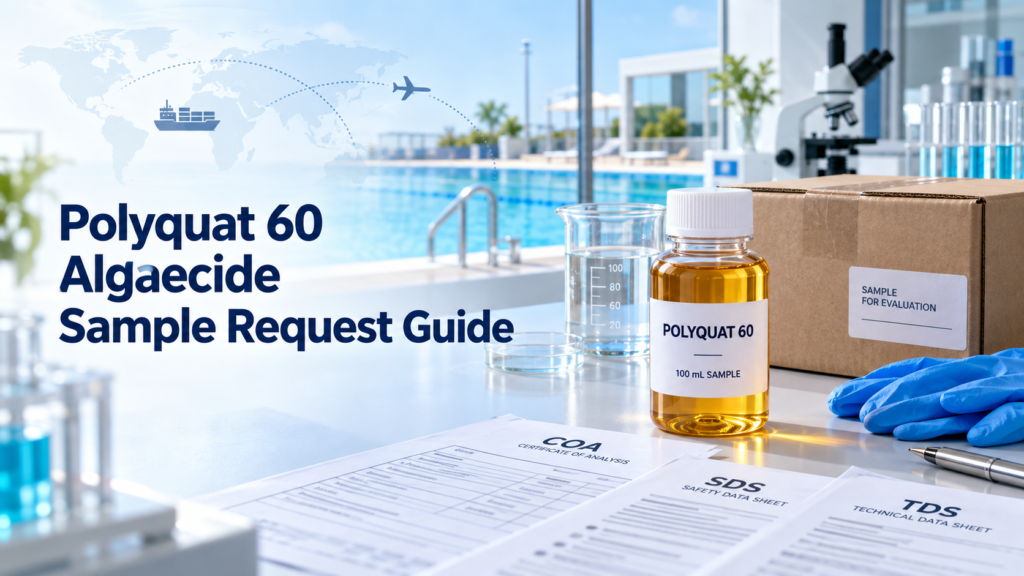
Requesting a Polyquat 60 algaecide sample may seem like a small step. Send an email, receive a bottle, run a quick test—simple enough, right?
Not quite.
A sample is more than a little bottle of chemical. It is your first chance to check the supplier’s technical knowledge, product consistency, documentation, communication, packaging, and export service. When handled properly, the sample stage can reveal problems long before they reach a full container, a private-label production run, or your customers’ swimming pools.
That is why a good sample request should never consist of only six words: “Please send your Polyquat 60 sample.”
The supplier needs to know what you intend to test. You need to know exactly what the supplier is sending. Both sides should also agree on concentration, chemical identity, sample quantity, documents, shipping terms, and the next steps.
This guide explains how pool chemical distributors, importers, brand owners, formulators, and service companies can request and evaluate a Polyquat 60 algaecide sample with fewer surprises.
Why Request a Polyquat 60 Sample Before Buying?
Specifications printed on a document are important, but they cannot tell the whole story.
A technical data sheet may state that the material contains 60% active ingredient. It may also list an acceptable pH, density, viscosity, and appearance. Yet you still need to know how the actual liquid behaves when it is poured, diluted, mixed, stored, and applied.
A sample lets you check practical questions such as:
- Does the appearance match the specification?
- Is the viscosity suitable for your filling equipment?
- Does the product dilute evenly in water?
- Is there unexpected sediment or separation?
- Does the material create foam during circulation?
- Will it work in your planned formulation?
- Does it remain stable under your local storage conditions?
- Can the supplier provide reliable technical documents?
- Does the sample match the product described in the quotation?
For a distributor, a sample helps reduce purchasing risk. For a formulator, it supports compatibility and stability testing. For a private-label pool chemical brand, it helps confirm whether the concentrated raw material can be turned into a reliable retail product.
There is another benefit that buyers sometimes miss: the sample process tests the supplier too.
Did the supplier ask about your application? Did the salesperson understand the difference between an active-ingredient concentrate and a ready-to-use formulation? Were the COA and SDS sent promptly? Was the sample bottle sealed and labeled correctly?
Those details give you a preview of what a commercial order may look like.
For an overview of the chemical, applications, packaging, and supply formats, first review the Polyquat 60 Algaecide product page.
First Things First: Confirm Which “Polyquat 60” You Need
The name “Polyquat 60” is widely used in the pool chemical market, but trade names alone can create confusion. Similar names may be used for different cationic polymers or different commercial formulations.
Therefore, your inquiry should identify the product by more than its common name.
For the Eautrix concentrated Polyquat 60 product, the chemical information includes:
- Chemical name: Poly(oxyethylene(dimethyliminio)ethylene(dimethyliminio)ethylene dichloride)
- Common names: Polyquat 60, Polixetonium Chloride, Polyquaternium-42, WSCP and Algaecide 60
- CAS number: 31512-74-0
- Active ingredient: approximately 60%
State the CAS number and requested concentration in your message. This prevents a supplier from sending a 10%, 20%, or 30% retail formulation when you are expecting a concentrated raw material.
It also helps to explain what you plan to make. Are you evaluating a concentrated commercial algaecide? A diluted maintenance product? A winter treatment? A combined algaecide and clarifier?
The more clearly you describe the application, the more useful the supplier’s response will be.
What Information Should a Sample Request Include?
A strong sample inquiry does not need to be long. It simply needs to answer the questions that affect product selection, testing, and delivery.
Include the following information.
- Your name, company, and website
- Your country and delivery address
- Your business type
- The requested product and CAS number
- Required active concentration
- Intended pool treatment application
- Desired sample quantity
- Tests you plan to perform
- Required technical documents
- Courier account, if available
- Expected annual or trial-order quantity
- Any registration or labeling requirements in your market
Your business type matters because different buyers test samples in different ways. A raw-material distributor may focus on identity and batch consistency. A private-label brand may care more about dilution, color, packaging, shelf life, and compatibility with other formulation ingredients.
A pool service company may want to perform a controlled field trial in a real swimming pool. A formulator may need enough material for several laboratory formulas.
Tell the supplier what you are doing. It makes the conversation faster and far more useful.
You can submit the details through the Eautrix sample and contact form.
A Sample Request Email You Can Actually Use
Subject: Request for 100 ml Polyquat 60 Algaecide Sample
Dear Sales Team,
We are evaluating Polyquat 60 for use in our swimming pool algaecide product line.
Please confirm whether you can provide a 100 ml sample with the following product information:
Product: Polyquat 60 Algaecide
Chemical identity: Polixetonium Chloride
CAS number: 31512-74-0
Required active ingredient: approximately 60%
Application: [routine algae prevention/private-label formulation/winter pool treatment]
We plan to evaluate the sample for appearance, pH, density, viscosity, dilution behavior, foaming tendency, formulation compatibility, and algae-control performance.
Please provide the following documents before shipment:
- Batch COA
- SDS
- TDS or product specification
- Sample label showing product name and batch number
- Available packaging information
- Sample shipping cost and courier method
Our estimated commercial requirement is [quantity] per [month/year]. The delivery address is shown below:
[Company name]
[Contact person]
[Full address]
[Postal code]
[Telephone number]
Please also confirm whether this sample represents your standard commercial-production material.
Kind regards,
[Name]
[Position]
[Company]
This message gives the supplier enough information to prepare the correct material without turning your inquiry into a small novel.
How Much Polyquat 60 Should You Request?
For an initial technical evaluation, a 100 ml sample is often enough. It can support basic inspection, laboratory measurements, dilution checks, and small compatibility trials.
Eautrix offers a 100 ml free sample for technical evaluation. The sample itself may be free, while international courier charges and destination-related fees should be confirmed before dispatch.
A 100 ml sample may be suitable for:
- Appearance and odor inspection
- pH testing
- Density measurement
- Limited viscosity testing
- Water-dilution observations
- Small formulation trials
- Foaming comparisons
- Short stability screening
However, 100 ml may not be enough for extended field testing or several formulation versions. If your evaluation includes multiple concentrations, packaging trials, accelerated stability testing, or a real swimming pool, explain the testing plan and request a larger quantity.
The supplier may offer a paid 500 ml, 1 kg, or larger trial sample. That is reasonable when the requested quantity goes beyond ordinary qualification work.
Here is the key: request enough material to reach a reliable decision, but do not ask for several kilograms without explaining why. A serious test plan builds confidence on both sides.
Which Documents Should Come with the Sample?
A sample without technical documents is only half a sample.
At minimum, request a Certificate of Analysis, Safety Data Sheet, and product specification or Technical Data Sheet. These documents serve different purposes.
The Certificate of Analysis, commonly called a COA, should relate to the actual sample batch whenever possible. It may include appearance, active content, pH, density, viscosity, or other agreed control items.
The Safety Data Sheet, or SDS, provides information about identification, hazards, handling, storage, personal protection, transport, and disposal. Make sure the product name and supplier information are clear.
The Technical Data Sheet, or TDS, explains the general product properties, uses, handling notes, and typical specifications. Unlike the COA, it normally describes the standard product rather than one individual batch.
You may also request:
- Product specification
- Recommended storage conditions
- Shelf-life information
- Packaging options
- Country-of-origin information
- Available regulatory statements
- Typical application guidance
- Private-label and custom-formulation information
Documents should support your review, not replace it. A polished COA does not prove that the liquid inside the bottle matches the listed results. That is why identification, batch traceability, and your own tests still matter.
Sample Labels: Small Bottle, Important Details
The sample bottle should carry enough information to remain traceable after it enters your laboratory.
A useful label includes:
- Product name
- CAS number
- Concentration
- Batch or lot number
- Sample quantity
- Production or sampling date
- Supplier name
- Basic storage instruction
If several products arrive together, weak labeling can cause an expensive mix-up. Imagine testing a diluted formulation while believing it is a 60% concentrate. The resulting data would be useless—and possibly misleading.
When the parcel arrives, photograph the unopened bottle, label, outer packaging, and courier condition. Save the shipping email and related documents in the same project folder as your test results.
It may feel slightly fussy. Still, good traceability is far easier than trying to reconstruct missing information three months later.
Who Pays for Sample Delivery?
International chemical sample delivery deserves early discussion.
A supplier may provide the product free of charge but ask the buyer to pay the courier cost. Some buyers use their own courier account. In other cases, the supplier arranges shipment and adds the freight charge to a sample invoice.
Before dispatch, confirm:
- Whether the sample is free
- Who pays courier charges
- The declared product description
- The stated sample value
- The courier company
- The tracking number
- Expected transit time
- Whether destination duties or handling fees may apply
- Whether the courier accepts the product on the planned route
Do not assume that “free sample” means “free delivered sample.” Freight, customs processing, remote-area surcharges, and local taxes may still arise.
Import requirements also vary by country. The buyer should confirm whether a small chemical sample requires any permit, registration, statement, or special customs document at the destination. The supplier can prepare export documents, but the importer remains responsible for local entry requirements.
What Should You Check When the Sample Arrives?
Do not open the parcel and pour the product immediately. Start with a receiving inspection.
Check the outer carton for crushing, wet spots, leakage, or signs that it was opened during transit. Then inspect the inner packaging and bottle seal.
Record:
- Delivery date
- Courier condition
- Bottle condition
- Label details
- Batch number
- Net sample quantity
- Product appearance
- Any leakage, swelling, sediment, or separation
- Documents received with or before the shipment
The concentrated product may be more viscous than a retail pool chemical. Do not reject it merely because it pours slowly. Compare its appearance and flow with the supplier’s specification and test it at a controlled temperature.
Temperature matters. A sample that has spent several cold days in an aircraft hold or delivery vehicle may behave differently immediately after arrival. Let it reach the agreed laboratory temperature before measuring viscosity or density.
Which Laboratory Tests Are Most Useful?
Your laboratory program should reflect the intended purchase. You do not need every analytical method on the first day, but basic tests should confirm that the sample fits the agreed specification.
Common checks include:
- Visual appearance
- Active content
- pH at the specified dilution
- Density
- Viscosity
- Water solubility
- Dilution clarity
- Foaming tendency
- Storage stability
- Formulation compatibility
Use the same methods, temperature, sample preparation, and equipment for every supplier comparison. Otherwise, small differences in testing conditions may look like product differences.
For example, viscosity can change with temperature and test method. A result measured with one spindle and speed should not be compared casually with a value produced under different conditions.
Active-content testing deserves particular care. Ask the supplier which method is used and whether the reported value refers to active polymer, solids, or another defined measure. Similar-looking percentages may represent different analytical concepts.
If the supplier lists both active content and total content, clarify what each term means before judging the result.
The Dilution Test: Simple, Yet Surprisingly Revealing
A basic dilution test can tell you a great deal about handling and formulation behavior.
Use clean water with a recorded temperature and quality. Add a measured amount of Polyquat 60 under controlled mixing. Observe how quickly it disperses and whether the solution remains uniform.
Look for:
- Lumps or gel-like particles
- Cloudiness
- Sediment
- Separation
- Unexpected color change
- Excessive foam
- Poor mixing
- Changes after standing
Repeat the test using the water type that matters to your business. Deionized laboratory water is useful for control work, but it does not represent every market. Hard water, warm water, high-salt conditions, or the water used in your local formulation plant may produce different observations.
If you plan to sell a ready-to-use algaecide, test the proposed finished-product concentration—not only the 60% raw material.
Compatibility Testing Comes Before a Finished Formula
Polyquat 60 is a cationic polymer. That positive charge is central to its function, but it also affects compatibility with other formulation ingredients.
Test it carefully before combining it with unfamiliar surfactants, dyes, fragrances, clarifiers, or other additives. Anionic materials deserve particular attention because they may interact with cationic polymers.
Compatibility testing should look for:
- Precipitation
- Haze
- Layer separation
- Viscosity changes
- Color instability
- Loss of performance
- Increased foaming
- Deposits after storage
Run a control formula and change one variable at a time. If three ingredients are changed together and the mixture fails, you will not know which change caused the problem.
When developing a broader pool care range, you may also compare the sample with products such as Polymer Pool Clarifier. These products serve different primary functions, so they should not be treated as interchangeable simply because both use polymer chemistry.
How to Plan a Real-Pool Trial
Laboratory work helps qualify the material, but a controlled pool trial shows how it behaves under practical operating conditions.
Begin with a clean pool and record the baseline conditions:
- Pool volume
- Water temperature
- pH
- Sanitizer level
- Total alkalinity
- Calcium hardness
- Filtration type
- Circulation time
- Water appearance
- Known algae condition
- Other chemicals recently added
Follow an agreed test dose and distribute the product with adequate circulation. Do not improvise a high dose simply because you want a faster result. More chemical does not automatically mean better performance.
Monitor water clarity, visible algae, surface condition, filter behavior, foam, and any deposits. Take photographs from the same position and under similar lighting.
A practical trial should also include a control whenever possible. Without a control, normal filtration, sanitizer activity, brushing, and weather changes may be mistaken for Polyquat 60 performance.
For general reference, the Eautrix product page provides application ranges for clean pools, maintenance treatment, and visible algae. Actual treatment levels should still reflect water conditions, local regulations, finished-product concentration, and the approved label.
One Good Sample Does Not Prove Batch Consistency
A supplier can send an excellent sample. The larger question is whether normal production will match it.
Once the first sample passes, ask whether the material came from a regular commercial batch or was prepared only for evaluation. Request the batch number and related COA.
For higher-value projects, consider comparing:
- The qualification sample
- A pre-shipment sample
- Material taken from the first commercial order
- A retained sample from later batches
Use the same core tests each time. Appearance, active content, pH, density, and viscosity can form a practical incoming-inspection set.
A golden sample can also help. This is a sealed, approved reference sample stored under suitable conditions. Future deliveries can be compared with it for appearance and basic physical behavior.
Still, remember that the reference itself may age. Record its storage conditions and review date.
For broader supplier checks beyond the sample, read How to Choose a Reliable Polyquat 60 Manufacturer.
Should You Test More Than One Supplier?
Comparing several samples can be useful, but only when the comparison is fair.
Ask each supplier for the same chemical identity, concentration, sample quantity, documents, and test conditions. Then compare commercial factors only after the technical results are understood.
A slightly cheaper sample is not necessarily the better purchase. Consider:
- Specification compliance
- Batch traceability
- Test results
- Document quality
- Communication speed
- Technical understanding
- Commercial packaging
- Lead time
- Export experience
- Response to quality questions
Avoid turning the process into a price-only contest. A low price can disappear quickly if the material causes filling problems, formulation instability, claims, returns, or repeated production delays.
The Polyquat 60 Algaecide Buyer’s Guide offers a wider purchasing checklist for commercial sourcing.
From Approved Sample to Trial Order
Sample approval should lead to a defined commercial specification.
Before placing the first trial order, confirm:
- Product name and CAS number
- Active concentration
- Accepted test limits
- Test methods
- Appearance
- Packaging type
- Net weight
- Label details
- Batch documentation
- Production lead time
- Shipping terms
- Shelf life
- Storage conditions
- Pre-shipment sample procedure
- Treatment of nonconforming material
Do not rely on messages scattered across several email threads. Put the agreed specification into the purchase contract, purchase order, or signed technical agreement.
If you plan to sell the material under your own brand, discuss formula concentration, bottle type, cap, induction seal, label dimensions, carton printing, pallet configuration, and local label rules before mass production.
A sample of concentrated raw material does not automatically approve the finished retail product. The diluted formula, packaging components, label, and storage stability should also be assessed.
If your range includes seasonal products, the concentrated sample may also support early work on a Winter Algaecide formulation, subject to separate compatibility and performance testing.
Common Sample-Request Mistakes
Many sample problems begin before the bottle leaves the factory.
The first mistake is requesting “Polyquat 60” without a CAS number or concentration. The second is failing to explain the application. The third is accepting a sample without a batch COA.
Other common mistakes include:
- Requesting too little material for the planned tests
- Asking for too much without giving a reason
- Ignoring courier and customs requirements
- Testing immediately after temperature-stressed delivery
- Comparing viscosity under different conditions
- Treating solids and active content as identical without confirmation
- Mixing the sample with several new ingredients at once
- Running a pool trial without baseline water data
- Approving a supplier after only a visual check
- Assuming the commercial batch will automatically match the sample
- Forgetting to retain part of the approved sample
The good news? These mistakes are easy to prevent. A clear request, a traceable sample, and a written test plan do most of the heavy lifting.
The Real Purpose of a Polyquat 60 Sample
A sample is not requested merely to see whether the supplier is willing to send something for free.
Its real purpose is to answer three questions:
Does the product match the agreed identity and specification? Does it perform in your intended application? Can the supplier reproduce and deliver that quality consistently?
If the answer to all three is yes, the sample has done its job.
Treat the process as the first stage of commercial qualification. Record what you receive, test it under controlled conditions, ask direct questions, and connect your approval to a written purchase specification.
That may sound more formal than opening a small courier parcel. Yet when the next step could be a pallet, an IBC, or a private-label launch, the extra care is well worth it.
Frequently Asked Questions
1. Can I request a free 100 ml Polyquat 60 algaecide sample?
Yes. Eautrix offers a 100 ml Polyquat 60 sample for technical evaluation. Confirm sample availability, courier cost, destination requirements, and the documents supplied before shipment.
2. Is 100 ml enough for Polyquat 60 quality testing?
It is generally enough for appearance, pH, density, limited viscosity, dilution, foaming, and small compatibility tests. A larger paid sample may be needed for multiple formulations, extended stability work, or real-pool trials.
3. Which documents should I request with a Polyquat 60 sample from China?
Request a batch-specific COA, SDS, TDS or product specification, sample label, storage information, and available regulatory statements. The product name, CAS number, concentration, and batch number should be consistent across the documents.
4. How should I compare Polyquat 60 samples from different suppliers?
Test samples with the same methods, water, temperature, equipment, dilution ratio, and storage conditions. Compare chemical identity, active content, pH, density, viscosity, dilution behavior, foaming, documentation, traceability, and supplier service.
5. What should I do after approving a Polyquat 60 algaecide sample?
Create a written commercial specification, confirm test methods and packaging, retain an approved reference sample, and arrange a manageable trial order. Test material from the first commercial batch to confirm that it matches the approved sample.