
GET IN TOUCH
Ask For Sample?
Polyquat 60 Algaecide Buyer’s Guide
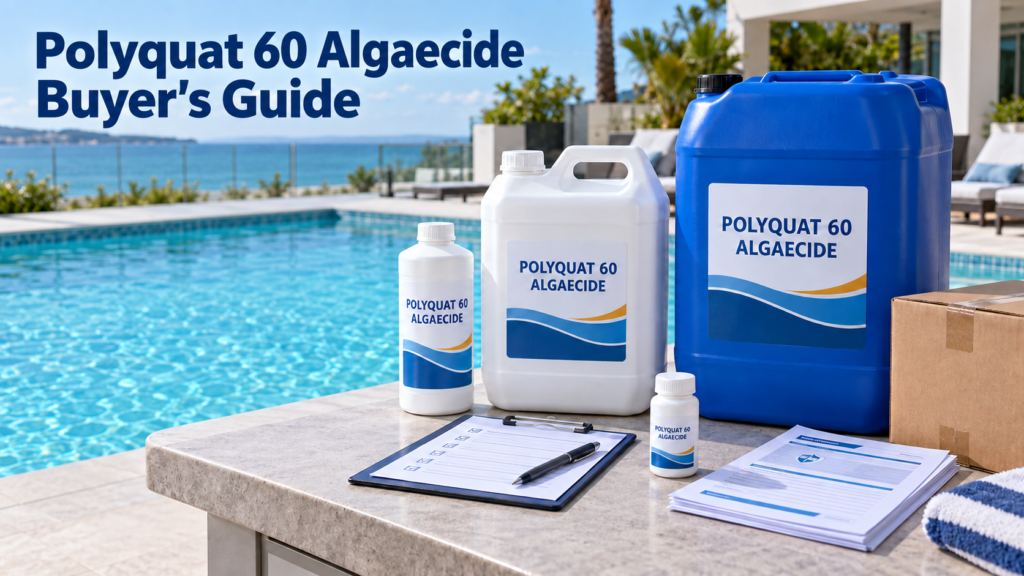
Buying Polyquat 60 Algaecide may look simple at first. Ask for a price, compare a few quotations, and place an order. Easy, right?
Not quite.
Two products carrying the same “Polyquat 60” name may have different active ingredients, test methods, viscosity ranges, packaging standards, shelf lives, or regulatory positions. One supplier may quote a concentrated raw material, while another offers a diluted, retail-ready formulation. Comparing their prices without checking these details is like comparing a concentrated fruit syrup with a finished drink. The numbers may look clear, but they are not telling the same story.
For pool chemical distributors, private-label brands, importers, and commercial pool suppliers, the purchasing decision affects far more than the landed cost. It influences product performance, label claims, customer complaints, freight efficiency, inventory stability, and brand reputation.
This Polyquat 60 Algaecide buyer’s guide explains what to examine before approving a supplier or shipment—from chemical identity and product specifications to packaging, quality control, documentation, and sample evaluation.
Start with the Most Important Question: What Are You Actually Buying?
“Polyquat 60” is widely used as a commercial product name, but buyers should never rely on the name alone.
In the swimming pool industry, Polyquat 60 commonly refers to a concentrated, non-foaming polymeric algaecide based on polixetonium chloride. Its chemical description is often given as:
Poly[oxyethylene(dimethyliminio)ethylene(dimethyliminio)ethylene dichloride]
Common identifiers include:
- CAS number: 31512-74-0
- Common name: Polixetonium Chloride
- Other names: Polyquaternium-42, Polyquat 60, polymeric quaternary ammonium compound
- Typical commercial concentration: Approximately 60% active ingredient
- Typical appearance: Clear amber to light amber viscous liquid
However, the Polyquat name is sometimes used loosely in commercial discussions. A supplier may use it for a different cationic polymer, a diluted pool formulation, or a mixed algaecide product.
That is why your first purchase document should state the chemical identity, CAS number, active concentration, and intended application. Do not approve an order based only on the phrase “Polyquat 60.”
Buyers who need concentrated material for pool formulations can review the Polyquat 60 Algaecide product specification before sending an inquiry.
Concentrated Raw Material or Finished Algaecide?
Before requesting prices, decide whether you need concentrated Polyquat 60 or a finished product.
This distinction changes almost everything: price per kilogram, freight cost, packaging, labeling, dosage instructions, and the amount of work required after importation.
Concentrated Polyquat 60
A concentrated product is generally more suitable for:
- Pool chemical manufacturers
- Local blending facilities
- Contract packers
- Large distributors with formulation capability
- Brands serving several price levels
- Buyers seeking lower freight cost per unit of active ingredient
Concentrated material gives the buyer greater control. It can be diluted, colored, packaged, or incorporated into a broader maintenance formula according to local demand.
It also places more responsibility on the buyer. The importer or formulator must manage dilution water quality, mixing procedures, preservatives where required, final-product testing, labels, and local compliance.
Ready-to-Use Algaecide
A finished product may suit:
- Private-label pool brands
- Smaller distributors
- Retail chains
- Online sellers
- Buyers without blending equipment
- Companies testing a new market with limited volume
A ready-to-use product may cost more per unit of active ingredient because the buyer is also paying for formulation work, packaging, labels, cartons, and the shipment of additional water.
Still, convenience has real commercial value. A retail-ready product can shorten launch time and reduce local production work. Sometimes the apparently more expensive offer becomes the more economical choice once labor, packaging, filling loss, and local quality control are counted.
The right question is not simply, “Which product is cheaper?” It is, “Which supply format gives us the lowest practical cost for the product we intend to sell?”
Check the Active Ingredient—Then Check the Test Method
Active ingredient concentration is one of the first figures buyers compare. A specification may state 60%, 59–61%, or another narrow range.
That figure matters, but it is not enough by itself.
Ask the supplier how active content is determined. Different analytical methods can produce figures that are difficult to compare directly. “Active matter,” “solids content,” and “total content” may also be treated as separate parameters rather than interchangeable terms.
A responsible supplier should be able to explain:
- What the reported percentage represents
- Which test method is used
- Whether the figure measures active polymer or total solids
- The acceptable batch range
- How frequently the test is performed
- Whether the result appears on the Certificate of Analysis
For a representative concentrated product based on CAS 31512-74-0, a purchasing specification may include an active range around 58–61%. The exact approved range should be agreed upon in writing and linked to a defined analytical method.
This small step prevents a surprisingly common problem: two parties using the same number but meaning different things.
Review the Full Technical Specification
Active content usually receives most of the attention, yet other physical properties can reveal changes in raw materials, manufacturing conditions, dilution, or storage.
A practical Polyquat 60 purchasing specification may cover the following parameters:
| Parameter | What the Buyer Should Check |
|---|---|
| Appearance | Clear amber or light amber viscous liquid, free from visible foreign matter |
| Active ingredient | Agreed concentration range and analytical method |
| pH | Test concentration, temperature, and acceptable range |
| Density | Test temperature and acceptable range |
| Viscosity | Instrument, spindle, speed, temperature, and acceptable range |
| Solubility | Compatibility with water under normal formulation conditions |
| Shelf life | Period, storage conditions, and unopened-package requirement |
| Identification | Chemical name and CAS number |
| Microbial or impurity limits | When required by the final formulation or local market |
Representative parameters sometimes used for concentrated polixetonium chloride include a pH of approximately 6.0–8.0 in a 10% solution, density near 1.15, and a controlled viscosity range. These figures should be treated as purchasing references, not universal limits for every producer.
Viscosity deserves extra attention. Polymer viscosity changes with temperature, concentration, and measurement conditions. A result without a stated method has limited value. “Viscosity: 250 mPa·s” sounds precise, but at what temperature? Which spindle and speed were used?
Ask. A serious supplier will understand why.
Confirm the Product Is Non-Foaming
Foam may look harmless in a small laboratory sample, but it can become highly visible in a swimming pool, spa, fountain, or circulation system.
Traditional monomeric quaternary ammonium algaecides can produce foam, especially where water passes through jets, spillways, or vigorous circulation. Polymeric algaecides are often purchased partly because they provide algae control without the same tendency to create persistent surface foam.
For buyers serving premium residential pools, hotels, resorts, wellness facilities, or pool service companies, non-foaming performance is more than a technical feature. It protects the user experience.
Request a sample and evaluate the product under circulation. Do not judge foaming only by shaking a bottle. A more useful comparison uses controlled dilution, equal active concentration, consistent water conditions, and the same agitation method.
If you are building a wider non-foaming maintenance range, a cationic Polymer Pool Clarifier may complement the algaecide by helping filtration systems capture fine suspended particles. The two products perform different jobs, so they should not be presented as substitutes.
Test Compatibility with Your Complete Pool Program
A Polyquat 60 product does not work in isolation. It becomes part of a chemical program that may include chlorine, bromine, pH adjusters, shock treatments, clarifiers, enzymes, stain-control products, and winterizing chemicals.
Compatibility should therefore be evaluated in the intended application—not merely in clean laboratory water.
Pay particular attention to strongly anionic products. Cationic polymers can interact with anionic materials, causing haze, precipitation, reduced performance, or filter-loading issues. The risk depends on concentration, dosing order, dilution, water chemistry, and the other ingredients present.
During formulation trials, check:
- Product appearance after mixing
- Immediate and delayed precipitation
- Water clarity
- Foaming
- Odor
- pH change
- Filter behavior
- Performance after chlorine or shock treatment
- Stability at expected storage temperatures
If a compatibility issue appears, do not assume the raw material is defective. The problem may come from dosing order, local concentration during mixing, or an incompatible ingredient elsewhere in the formula.
A small bench trial can save a full production batch. That is inexpensive insurance.
Evaluate Color, Odor, and Batch-to-Batch Appearance
Concentrated polixetonium chloride is commonly supplied as an amber liquid. The exact shade can vary within an approved range due to raw-material and process conditions.
A slight color difference does not automatically indicate poor performance. Still, large or unexplained variation deserves attention—particularly when the product will be packed in translucent bottles or sold as part of a visually consistent retail range.
Ask the supplier to define an appearance standard. This may be a written description, a retained reference sample, or an agreed color range.
Odor should also be evaluated. A strong or unusual odor could affect filling operations and customer perception, even if the active content passes inspection.
For private-label products, visual consistency matters. Consumers cannot measure active content at the poolside, but they notice color, clarity, leakage, damaged caps, and odd smells immediately. These sensory clues often become their shortcut for judging the entire brand.
Compare Price by Active Ingredient, Not Just by Kilogram
A low price per kilogram can be tempting. Yet it tells you very little unless all quotations cover equivalent products.
A more useful comparison is the cost per kilogram of active ingredient:
Cost per kilogram of active ingredient = Product price per kilogram ÷ Active ingredient fraction
If Product A costs $2.40/kg at 60% active, its raw-material cost per active kilogram is:
$2.40 ÷ 0.60 = $4.00 per active kilogram
If Product B costs $2.10/kg at 45% active, its cost becomes:
$2.10 ÷ 0.45 = $4.67 per active kilogram
Product B looks cheaper on the quotation, yet it costs more for the same amount of active material. It also carries more water, which takes up drum space, warehouse space, and freight capacity.
The calculation should then be expanded to include:
- Export packaging
- Pallets
- Inland transport
- Ocean or air freight
- Insurance
- Import duties
- Customs clearance
- Local delivery
- Testing costs
- Filling or repacking costs
- Expected product loss
- Financing and inventory time
This gives you the landed cost. For finished retail products, calculate the cost per saleable bottle or treatment dose as well. That number is much closer to commercial reality.
Packaging Is Part of Product Quality
Chemical performance matters, but a perfectly manufactured liquid inside a leaking package is still an unsuccessful shipment.
Packaging should match both the product and the buyer’s distribution model. Common formats can include:
- 1L bottles for retail or pool service use
- 5L jerrycans for professional users and small commercial accounts
- 25L stackable jerrycans for distributors and service companies
- IBC totes for local blending or high-volume industrial handling
- Customized packaging for private-label projects
Ask for packaging specifications rather than accepting a simple statement such as “packed in drums” or “export package.”
Confirm:
- Nominal and net filling quantity
- Container material
- Cap type and sealing system
- Inner seal or tamper-evident feature
- Carton quantity
- Pallet pattern
- Gross weight
- Stack height
- Container loading quantity
- Label material
- Resistance to moisture and chemical contact
- Drop or leak testing where required
If you plan to sell online, parcel delivery creates a different level of packaging stress from pallet distribution. A bottle that survives a full-container shipment may not survive repeated conveyor drops in an e-commerce network.
Request package photos, dimensions, and loading details before calculating freight. Packaging errors often hide inside seemingly attractive quotations.
Ask for the Right Documents Before Ordering
Do not wait until the cargo is ready to ask for technical and shipping documents.
Review them during supplier qualification. This leaves time to identify inconsistent product names, missing test data, outdated formats, or transport classifications that need further confirmation.
A normal document package may include:
- Technical Data Sheet
- Safety Data Sheet
- Batch Certificate of Analysis
- Product specification
- Commercial invoice
- Packing list
- Country-of-origin document when required
- Transport or dangerous-goods information
- Label artwork
- Regulatory statements requested for the destination market
- Third-party test reports when contractually required
Check whether the chemical name, CAS number, concentration, manufacturer information, and product code remain consistent across the specification, SDS, COA, label, and commercial documents.
Even a minor naming mismatch can delay customs clearance or trigger questions from a local regulator. Paperwork is not glamorous, but neither is a container waiting at port while storage charges accumulate.
Regulatory Approval Cannot Be Assumed
The fact that Polyquat 60 is sold in one country does not automatically authorize its sale as an algaecide in another.
Pool algaecides may fall under pesticide, biocide, chemical, consumer-product, labeling, or transport rules, depending on the market and the claims made on the label. Requirements may also differ between selling an active ingredient to a formulator and selling a finished product directly to consumers.
Before importing, establish:
- Who will be the local registrant or responsible party
- Whether the active ingredient is accepted for the proposed use
- Whether the finished formulation requires registration
- Which efficacy or stability data may be needed
- Which label statements are permitted
- Which warnings and precautionary phrases are required
- Whether local-language documentation is necessary
- Whether packaging requires child-resistant or tamper-evident features
A supplier can provide technical data and supporting documents, but the importer should verify destination-market requirements with the relevant authority or a qualified regulatory adviser.
Avoid making claims that go beyond approved uses. Phrases such as “kills all algae,” “completely safe,” or “works under every water condition” may sound persuasive, but they can create regulatory and commercial risk.
Run a Structured Sample Evaluation
A free sample is helpful only when the test has a clear purpose.
Begin by comparing the sample with the supplier’s specification and sample COA. Record its batch number and arrival condition. Then test it using the same methods you expect to use for incoming shipments.
A practical sample program may include:
- Identity and appearance check
Confirm color, clarity, odor, container condition, and chemical identity. - Basic physical testing
Measure active content where possible, along with pH, density, and viscosity. - Dilution test
Observe how the product disperses in water and whether it forms haze, lumps, or residue. - Foaming comparison
Compare equal active concentrations under controlled agitation. - Compatibility screening
Test the material with chemicals used in your intended formula or maintenance program. - Application trial
Evaluate performance under representative pool conditions with proper controls. - Storage observation
Hold samples at expected storage temperatures and inspect them over time for separation, color shift, odor change, or container distortion.
Do not build a commercial claim from one quick jar test. Pool conditions vary, and algae management also depends on sanitizer level, circulation, filtration, brushing, water balance, contamination, and dosing accuracy.
Audit the Supplier, Not Just the Sample
A strong sample proves that a supplier can produce one good sample. It does not prove that the tenth container will match it.
Supplier qualification should examine the system behind the product.
Ask questions such as:
- Is the supplier the manufacturer, an exporter, or a trading company?
- Where is the material manufactured?
- How are incoming raw materials checked?
- Which in-process controls are recorded?
- Is every finished batch tested?
- Are retained samples kept?
- How are nonconforming batches handled?
- Can the batch number be traced to production records?
- How are tanks and filling lines cleaned?
- Can third-party inspection be arranged?
- How are customer complaints investigated?
- What is the normal production and delivery lead time?
- Is backup capacity available during the pool season?
A trading company is not automatically a poor choice, and a manufacturer is not automatically a good one. What matters is control, transparency, technical understanding, and accountability.
If an intermediary manages formulation, inspection, export paperwork, packaging, and communication well, that service may reduce the buyer’s risk. The key is knowing who controls each step.
Approve a Pre-Shipment Quality Plan
Once the sample passes, convert your expectations into a written purchase specification or quality agreement.
It should define:
- Product name and code
- Chemical identity
- CAS number
- Active concentration
- Physical-property limits
- Test methods
- Packaging requirements
- Label version
- Required documents
- Sampling rules
- Acceptance and rejection conditions
- Procedure for out-of-specification results
- Retained-sample period
- Third-party inspection requirements
- Change-notification obligations
Request the actual batch COA before shipment, not a blank template. For larger orders, consider pre-shipment sampling or independent inspection.
Also ask the supplier to notify you before changing raw-material sources, manufacturing locations, analytical methods, packaging components, or major process conditions. A product can still meet a broad specification while behaving differently in your formulation.
Change control protects both sides.
Consider Seasonal Demand and Inventory Risk
Pool chemical demand is seasonal in many markets. A delayed shipment in January may be inconvenient; the same delay just before the spring opening season can cost an entire sales cycle.
Plan backward from the date when distributors or service companies need stock—not from the date when consumers begin swimming.
Allow time for:
- Sample approval
- Label review
- Registration or notification
- Packaging production
- Manufacturing
- Quality testing
- Export booking
- Transit
- Customs clearance
- Local repacking
- Warehouse distribution
Concentrated Polyquat 60 can reduce storage and freight volume, but buyers should still avoid ordering more than they can sell within the approved shelf life.
For colder markets, a dedicated Winter Algaecide can extend the sales season beyond routine summer maintenance. Its formulation and label should reflect off-season pool conditions rather than simply placing a winter-themed label on a standard maintenance product.
Look Beyond the First Order
A good purchasing decision should still make sense after the trial shipment.
Ask whether the supplier can support your expected growth. This does not mean demanding enormous capacity on day one. It means checking whether the supplier can handle repeat specifications, forecast communication, packaging continuity, and seasonal production pressure.
Discuss:
- Minimum order quantity for each package
- Mixed-package or mixed-product loading
- Repeat-order lead time
- Private-label minimums
- Artwork and printing costs
- Storage of unused labels or cartons
- Forecast arrangements
- Emergency replenishment
- Batch reservation
- Payment terms after a stable purchasing history
- Support for new concentrations or formulations
A supplier who understands your market may also help simplify the product range. More SKUs do not always create more sales. Sometimes one concentrated product, one maintenance-strength formulation, and one winter product cover the market more cleanly than six nearly identical bottles.
A Practical Polyquat 60 RFQ Checklist
A clear Request for Quotation helps suppliers return comparable offers. Include the following information:
- Product name: Polyquat 60 Algaecide
- Required chemical identity
- CAS number: 31512-74-0
- Required active concentration
- Estimated order volume
- Concentrated or finished formulation
- Required packaging sizes
- Private-label or neutral packaging
- Destination port or delivery location
- Incoterm
- Required documents
- Regulatory or label requirements
- Sample quantity
- Testing requirements
- Target delivery date
- Forecast annual volume
- Need for third-party inspection
- Any restrictions on color, odor, viscosity, or additives
Ask the supplier to separate product cost, packaging cost, printing charges, pallet cost, and freight when possible. This makes later negotiations clearer and helps you see where savings are realistic.
Warning Signs Buyers Should Not Ignore
Some problems appear before the first order. Watch for them.
Be cautious if a supplier:
- Cannot confirm the CAS number
- Uses “active,” “solid,” and “content” as if they always mean the same thing
- Refuses to share a representative COA or SDS
- Offers a very low price without explaining the concentration
- Changes product names across documents
- Cannot describe the test methods
- Avoids questions about the manufacturing site
- Guarantees regulatory approval in every country
- Makes absolute safety or efficacy claims
- Cannot provide packaging dimensions or loading data
- Sends a sample that cannot be linked to a production batch
- Changes specifications during price negotiations
- Pressures you to skip evaluation because other buyers “never ask”
One warning sign may have an innocent explanation. Several together usually point to a deeper problem.
The Cheapest Drum Can Become the Most Expensive One
Polyquat 60 purchasing is not merely a hunt for the lowest factory price. It is a decision about concentration, consistency, compliance, packaging, technical fit, and dependable supply.
Start with chemical identity. Compare active cost rather than price per kilogram. Review the test methods. Evaluate samples in your real formulation or treatment program. Confirm the documents before production. Then put the accepted requirements into the contract.
That process takes a little longer, yes. But it is far easier than explaining cloudy water, foaming, leaking packages, delayed customs clearance, or inconsistent batches to your customers later.
A reliable Polyquat 60 supply should help your business feel quieter—not busier. Fewer surprises. Fewer complaints. More confidence when the next order arrives.
Frequently Asked Questions
1. What should buyers check before purchasing Polyquat 60 Algaecide?
Buyers should confirm the chemical name, CAS number, active concentration, analytical methods, appearance, pH, density, viscosity, packaging, shelf life, batch COA, SDS, and destination-market requirements. A sample should also be tested before a commercial order.
2. Is every product called Polyquat 60 based on the same active ingredient?
No. Commercial naming can be inconsistent. Buyers should verify that the offered material is polixetonium chloride, commonly identified by CAS number 31512-74-0, rather than relying only on the name Polyquat 60.
3. How should importers compare Polyquat 60 supplier prices?
Compare the cost per kilogram of active ingredient and the full landed cost. Include concentration, package weight, freight, duties, testing, repacking, local delivery, and expected processing loss. A lower price per kilogram may not provide the lower final cost.
4. What documents should a Polyquat 60 Algaecide supplier provide?
A normal document set includes a Technical Data Sheet, Safety Data Sheet, product specification, batch Certificate of Analysis, invoice, packing list, transport information, and requested regulatory statements. Product identity should remain consistent across every document.
5. Can Polyquat 60 Algaecide be supplied with private-label packaging?
Yes. Depending on order volume and supplier capability, Polyquat 60 may be supplied in retail bottles, professional jerrycans, bulk containers, or customized private-label packaging. Buyers should confirm label responsibility, printing minimums, package compatibility, sealing, carton strength, and local regulatory requirements before production.