
GET IN TOUCH
Ask For Sample?
Documents Required for Polyquat 60 Import
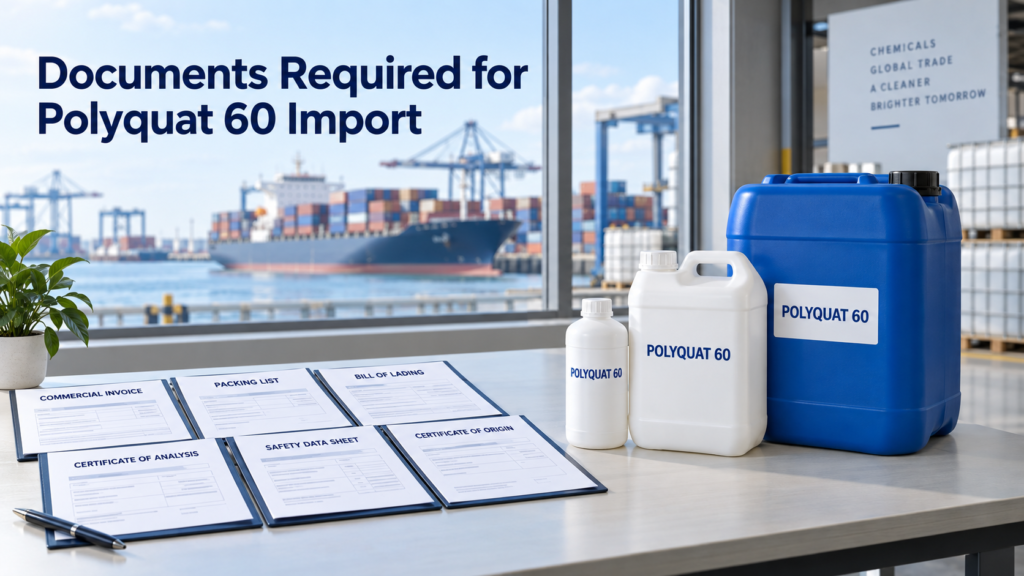
Importing Polyquat 60 should not feel like solving a paperwork puzzle at the port. Yet that is exactly what can happen when a buyer focuses on price and freight, then leaves the documents until the vessel is almost ready to sail.
The safer approach is simple: build the document pack before the shipment is booked.
For most Polyquat 60 imports, the core file includes a commercial invoice, packing list, bill of lading or air waybill, certificate of analysis, safety data sheet, and—when requested—a certificate of origin. However, that short list is only the starting point. The exact requirements change with the destination country, product identity, concentration, intended use, claims, packaging, tariff classification, and transport status.
That last point matters more than it may seem. “Polyquat 60” is a commercial name, not a complete customs or regulatory identity. Different polymeric quaternary ammonium compounds may be sold under similar market names. A concentrated raw material and a retail algaecide may also face different rules, even when both are described informally as Polyquat 60.
This guide explains which documents importers normally need, what each document should contain, and which extra records may apply to a particular market. It is written for pool chemical distributors, private-label brands, wholesalers, formulators, and industrial buyers sourcing Polyquat 60 from China.
Start with the Chemical Identity, Not the Product Nickname
Before discussing certificates, confirm exactly what you are importing.
Ask the supplier to state the following information in writing:
- Full chemical name
- CAS number
- Active ingredient or active matter
- Concentration
- Physical form
- Product grade
- Intended use
- Packaging type
- Manufacturer and exporter
Why start here? Because the same identity should appear, where relevant, on the quotation, specification, contract, certificate of analysis, safety data sheet, label, commercial invoice, and customs declaration.
A minor wording difference is not always a problem. A major identity conflict is. If the invoice shows one CAS number, the SDS shows another, and the COA uses only a trade name, a customs broker or carrier may pause the shipment while everyone tries to work out what is inside the container.
Importers can review the Polyquat 60 Algaecide product page when defining the requested concentration, packaging, and application. Still, the documents supplied for the actual order must match the actual batch and formulation—not merely a general webpage.
The Essential Commercial and Shipping Documents
Some documents move the goods. Others prove what the goods are. Let’s begin with the papers used for the international transaction and customs entry.
Commercial Invoice
The commercial invoice is one of the main customs documents. It describes the sale and gives customs authorities the information used to review the declared value, product description, parties, and trade terms.
A Polyquat 60 commercial invoice should normally show:
- Seller’s legal name, address, and contact details
- Buyer’s and consignee’s legal names and addresses
- Invoice number and date
- Purchase order or contract reference
- Clear product description
- Chemical name and CAS number, where appropriate
- Concentration or grade
- Quantity and unit of measure
- Unit price and total value
- Currency
- Country of origin
- Incoterm and named place or port
- Package count
- Gross and net weight
- Freight and insurance charges when relevant to the trade term
- Payment terms
- HS code used as a reference, subject to importer confirmation
Avoid descriptions such as “water treatment chemical” or “pool chemical” on their own. They are too broad. The description should be clear enough for a broker to connect the invoice to the SDS, COA, and tariff review.
The declared value must also reflect the real transaction. Samples, replacement goods, and no-charge items may still need a customs value. Writing “no commercial value” does not automatically remove valuation duties.
Packing List
The packing list tells the warehouse, carrier, customs broker, and buyer how the goods are physically arranged.
It commonly includes:
- Shipper and consignee
- Invoice or order reference
- Number and type of packages
- Product name by package
- Net weight and gross weight
- Package dimensions
- Pallet count
- Marks and numbers
- Batch numbers, when practical
- Container number and seal number, if available at issuance
The totals on the packing list should match the invoice, booking data, and bill of lading. If 800 jerry cans appear on the invoice but 780 appear on the packing list, the shipment may not pass a basic document check.
For mixed package sizes—perhaps 1 L bottles, 5 L jerry cans, and 25 L jerry cans—show each format separately. Buyers comparing pack configurations can also read 1L, 5L, and 25L Polyquat 60 Packaging Solutions before confirming the order.
Bill of Lading or Air Waybill
The bill of lading, or B/L, is issued for ocean freight. An air waybill, or AWB, serves a related transport role for air cargo. Courier shipments have their own waybill.
Depending on the shipment, the transport document may state:
- Shipper
- Consignee
- Notify party
- Port of loading
- Port of discharge
- Place of receipt and delivery
- Cargo description
- Number of packages
- Gross weight
- Container and seal numbers
- Freight terms
- Vessel and voyage information
The B/L description does not need to reproduce the entire SDS, but it should not contradict the commercial invoice or booking declaration.
The buyer should also agree early on whether the shipment will use an original B/L, sea waybill, or electronic release. A perfectly prepared chemical file can still be delayed if the cargo arrives before the document-release method is settled.
Quality Documents: Proof That the Batch Matches the Order
Customs clearance is only half the story. You also need records that connect the shipment to the approved quality standard.
Certificate of Analysis
The certificate of analysis, usually called the COA, reports test results for a specific production batch. It should not be confused with a general specification sheet.
A useful COA normally states:
- Supplier or manufacturer
- Product name and grade
- Batch or lot number
- Manufacturing date
- Test or release date
- Retest or expiry date, when applicable
- Test items
- Specification limits
- Actual batch results
- Test methods or method references, where needed
- Quality approval or authorized signature
For a Polyquat 60 concentrate, the agreed tests may include appearance, active content, pH, density, and viscosity. The exact specification depends on the product. Test conditions matter too. Viscosity without a defined temperature and method can be hard to compare.
Ask for a draft COA format before the first order. After production, obtain the final batch-specific COA before release or loading. That gives the buyer time to spot an unexpected result while the goods are still under the supplier’s control.
Technical Data Sheet or Product Specification
A technical data sheet, or TDS, describes the product’s typical properties, applications, handling guidance, and storage information. A signed specification defines the limits that the shipment is expected to meet.
The TDS supports technical evaluation, but it does not replace the batch COA. Think of the specification as the promise and the COA as the batch report against that promise.
The sales contract should identify which specification version applies. Otherwise, a buyer may approve one set of limits during sampling and receive a newer—or simply different—document after payment.
Retained-Sample and Inspection Records
These records may not be filed with customs, but they can be extremely valuable if a quality claim arises.
For a first order or a large shipment, consider retaining:
- Approved pre-shipment sample
- Supplier’s retained sample
- Batch photographs
- Filling and sealing records
- Leakage-test results
- Pallet and loading photographs
- Container inspection record
- Third-party inspection report, if ordered
Paperwork cannot replace testing. Still, good records make a later investigation far more factual and far less emotional.
The Safety Data Sheet: More Than a Booking Attachment
The safety data sheet, or SDS, communicates information about hazards, handling, storage, exposure controls, disposal, and transport. Carriers and freight forwarders often request it before they accept a chemical booking.
Check that the SDS:
- Covers the exact product and concentration being shipped
- Uses the correct supplier details
- Has a recent revision date
- Follows the format required in the destination market
- Uses the required local language or languages
- Provides consistent composition information
- Gives appropriate handling and storage measures
- Includes current transport information in Section 14
- Matches the product label where hazard communication applies
Do not borrow an SDS from another supplier simply because the trade name looks similar. Concentration, additives, impurities, test data, and classification decisions may differ.
For EU supply, the importer should review whether the SDS complies with the applicable REACH and CLP requirements and whether it must be supplied in the official language of the Member State. For other countries, local GHS implementation may require different wording, classifications, exposure limits, or emergency details.
One more practical point: “MSDS” remains common in everyday trade emails, but “SDS” is the current term in many regulatory systems. The document content matters more than the old or new label used in casual conversation.
Is Polyquat 60 Dangerous Goods? Let the Exact Product Decide
Importers sometimes ask whether all Polyquat 60 shipments are dangerous goods. That question cannot be answered safely from the product nickname alone.
Transport status should be determined for the exact composition and concentration, using the current SDS and applicable transport rules for sea, air, road, or rail.
Review Section 14 for:
- UN number
- Proper shipping name
- Transport hazard class
- Packing group
- Environmental or marine-pollutant status
- Mode-specific requirements
- Special precautions
If the product is regulated as dangerous goods, additional documents and controls may include:
- Dangerous goods declaration
- Approved packaging documentation
- Container packing certificate
- Required marks and labels
- Emergency contact information
- Carrier-specific acceptance forms
- Evidence that trained personnel prepared the shipment
If the product is not regulated for the chosen transport mode, a carrier may still request the SDS, a transport-classification report, or a non-dangerous-goods statement. A non-DG statement should support a sound classification; it should not be used to override inconvenient data.
Air and ocean rules are not identical. A product accepted for sea freight may require a separate review for air shipment, especially when samples are sent by courier.
Certificate of Origin: Required, Useful, or Both?
A certificate of origin states the country in which the goods originate under the relevant origin rules. It may be requested by customs, the buyer, a bank, or a trade-agreement procedure.
There are two broad types:
- Non-preferential certificate of origin, often used for general origin evidence
- Preferential proof of origin, used when the shipment qualifies for reduced or zero duty under a trade agreement
The correct form depends on the destination and applicable agreement. A generic certificate does not automatically grant a tariff preference.
Confirm before shipment:
- Whether origin proof is required
- Which form or declaration is accepted
- Who may issue it
- Whether an original, electronic copy, or certified copy is needed
- Whether the invoice wording must follow a prescribed format
Origin, country of export, and country of shipment are not always the same legal concept. Your customs broker should confirm which information belongs in the entry.
HS Classification and Customs Support Documents
An HS code is not a certificate, yet classification shapes the entire import entry. It can affect duty, taxes, permits, statistical reporting, and other controls.
Do not select a code from the commercial name alone. Classification may depend on:
- Chemical composition
- Whether the product is a separate chemical or a preparation
- Concentration
- Intended and presented use
- Bulk or retail form
- Label claims
- National tariff subdivisions
The exporter may provide the code used in China or in earlier shipments. Treat it as a helpful reference, not a binding decision for the importing country.
Give the customs broker a technical pack containing the chemical identity, CAS number, composition, SDS, TDS, product label, active content, packaging, intended use, and supplier’s proposed code. For repeat imports with uncertain classification, a written ruling from the local customs authority may be worth considering.
Regulatory Documents Depend on Where and How You Sell It
Here is where a simple checklist becomes a decision tree.
A bulk cationic polymer imported for further formulation may not follow the same market-access path as a finished retail bottle labeled to control algae. The destination authority may look at composition, claims, presentation, customers, and actual use—not just the words on the invoice.
United States
For US chemical imports, the importer should check whether Toxic Substances Control Act requirements apply and whether a TSCA positive or negative certification is required at entry.
If the product is marketed with pesticidal or algaecidal claims, Federal Insecticide, Fungicide, and Rodenticide Act requirements may also apply. Depending on the product and transaction, this can involve product registration, establishment-related requirements, compliant labeling, and an EPA Notice of Arrival before import.
Calling a product a “raw material” does not by itself settle the issue. Intended use and claims need regulatory review.
European Union and European Economic Area
EU importers should examine REACH obligations, including the status of relevant substances and the importer’s role. Polymer status does not mean every component or obligation can be ignored; monomers, other substances, restrictions, and supply-chain duties may still need review.
CLP classification, labeling, and packaging rules may apply before the product is placed on the market. A compliant local-language SDS may also be needed.
When a product is sold with an algaecidal or other biocidal claim, the Biocidal Products Regulation may apply. Substance approval and product authorization are separate questions. Importing a chemical substance does not automatically authorize a finished biocidal product for sale.
Other Markets
Many countries maintain their own chemical inventories, pesticide or biocide systems, local-agent rules, import permits, notification programs, label languages, and poison-center duties.
Possible market-specific documents include:
- Import permit or importer license
- Chemical inventory confirmation
- Product registration or authorization
- Local representative appointment
- Pesticide or biocide registration certificate
- Pre-arrival notification
- Product notification confirmation
- Local-language SDS
- Approved label
- Free-sale certificate, where accepted and genuinely applicable
- Ingredient statement or confidential composition submission
Not every item applies to every shipment. Ask a qualified local adviser to map the requirements before the deposit is paid—not when the container is waiting for clearance.
Private-Label Imports Need an Approved Label File
Private-label paperwork sits between compliance and production. The importer should approve the final artwork before the supplier prints bottles, labels, or cartons.
Depending on local rules, the label may need:
- Product identity
- Active ingredient and concentration
- Net contents
- Directions for use
- Hazard and precautionary statements
- First-aid guidance
- Storage and disposal instructions
- Batch code
- Manufacturing or expiry information
- Manufacturer details
- Importer or authorization-holder details
- Registration number
- Required local-language text
Keep a signed artwork approval, print proof, and version number. A one-digit error in a registration number can affect thousands of containers.
The Polyquat 60 import guide gives a wider view of supplier review, samples, packaging, freight, and arrival checks.
Extra Documents That May Be Needed
Several documents are conditional rather than universal:
- Insurance certificate when the contract or letter of credit requires it
- Wood-packaging or fumigation evidence when solid-wood packaging and destination rules make it relevant
- Inspection certificate under a buyer agreement, bank term, or destination program
- Weight certificate
- Health, sanitary, or free-sale certificate only when legally relevant and legitimately available
- Letter of credit documents with exact bank wording
- Import declaration data or pre-arrival security filing
- Power of attorney for the customs broker
- Product liability or quality declarations requested by a commercial customer
More documents do not always mean better compliance. Irrelevant certificates can create contradictions. Request what the shipment, market, contract, carrier, or bank actually needs.
How to Check the Whole Document Pack Before Loading
A good document review looks across the file rather than reading each sheet in isolation.
Compare these fields line by line:
- Seller, manufacturer, exporter, buyer, and consignee names
- Product name
- Chemical name and CAS number
- Concentration and grade
- Batch number
- Package count
- Net and gross weight
- Country of origin
- Incoterm and named place
- Invoice value and currency
- HS code references
- Container and seal numbers
- Transport classification
- Dates and document versions
Then ask four plain questions:
- Does the paperwork describe the exact goods being loaded?
- Can customs connect the invoice, packing list, SDS, COA, and transport document without guessing?
- Has the destination-market compliance review been completed?
- Has the broker and carrier accepted the required documents?
The sequence matters. Send drafts to the importer, broker, and forwarder before loading. Correcting a draft invoice takes minutes. Correcting a customs entry after arrival can take days and may add storage charges.
A Practical Document Timeline
Before the Purchase Order
Collect and approve:
- Chemical identity
- Product specification
- TDS
- Current SDS
- Sample COA
- Sample label
- Regulatory status information
- Proposed HS code for broker review
- Import permit or registration path, if applicable
Before Production Release
Confirm:
- Signed contract or purchase order
- Approved specification version
- Approved packaging
- Approved label artwork
- Testing and inspection plan
- Required certificates
- Shipping marks
Before Booking and Loading
Review:
- Final or draft batch COA
- SDS accepted by the forwarder
- Transport classification
- Dangerous goods declaration, if applicable
- Draft commercial invoice
- Draft packing list
- Booking description
- Permit or pre-arrival filing status
After Loading but Before Arrival
Obtain:
- Final commercial invoice
- Final packing list
- Bill of lading or air waybill
- Certificate of origin, when needed
- Insurance certificate, when needed
- Final inspection or loading report
- Container and seal details
- Complete customs-clearance set
This staged method prevents the usual last-minute scramble. It also gives each party a clear responsibility.
Work with a Supplier That Treats Documents as Part of the Product
A reliable Polyquat 60 shipment is not only a liquid inside a drum or jerry can. It is the product, package, test data, label, shipping record, and regulatory file moving together.
When requesting a quotation, tell the supplier the destination country, intended application, concentration, package format, Incoterm, and required documents. Share any broker or bank instructions early.
Eautrix can support product specifications, batch COAs, SDS files, commercial invoices, packing lists, and other shipment records based on the confirmed order and destination requirements. Importers should still verify local customs and market-access duties with their broker and regulatory adviser.
Need to review a planned shipment? Contact Eautrix with the destination, expected quantity, packaging, and intended use. A precise inquiry makes it much easier to prepare a precise document pack.
Frequently Asked Questions
1. What are the basic documents required to import Polyquat 60?
Most commercial shipments need a commercial invoice, packing list, bill of lading or air waybill, batch-specific COA, and current SDS. A certificate of origin, insurance certificate, import permit, regulatory approval, or dangerous goods declaration may also be needed depending on the country, contract, and transport classification.
2. Is a COA required for Polyquat 60 customs clearance?
Not every customs authority routinely requires a COA for every entry, but brokers, buyers, regulators, or inspection agencies may request it. A batch-specific COA is also essential for confirming that the supplied Polyquat 60 meets the agreed specification.
3. Does Polyquat 60 require a dangerous goods declaration?
Only when the exact product is classified as regulated dangerous goods for the chosen transport mode. Check the current SDS, especially Section 14, and ask the carrier or forwarder to review the classification before booking.
4. Do I need an import permit for Polyquat 60 algaecide?
Possibly. Requirements depend on the destination, chemical identity, concentration, intended use, and product claims. A finished product sold as an algaecide may fall under pesticide or biocide rules even when a bulk ingredient is treated differently.
5. Can the supplier choose the HS code for my Polyquat 60 import?
The supplier can provide a code used for earlier exports, but the importer is generally responsible for the destination-country declaration. Give your broker the composition, CAS number, concentration, SDS, TDS, label, packaging, and intended use so the code can be reviewed properly.