
GET IN TOUCH
Ask For Sample?
Polyquat 60 OEM and Private Label Manufacturing Guide
Launching a private label pool algaecide may look simple from the outside. Select a formula, place your logo on a bottle, order a few pallets, and start selling. Easy enough, right?
Well, not quite.
A successful Polyquat 60 private label project depends on far more than an attractive label. The active ingredient must meet the agreed specification. The packaging must survive storage and international transportation. The label must suit the regulations of the destination market. Production records, quality checks, shipment timing, and supporting documents all need careful attention.
Miss one detail and the consequences can travel through the whole supply chain. A leaking cap can damage cartons. A poorly written label can delay customs clearance. An inconsistent active concentration can generate complaints from pool service companies that depend on predictable dosing.
That is why choosing a Polyquat 60 OEM manufacturer should be treated as a product-development decision, not merely a purchasing exercise.
This guide explains how Polyquat 60 OEM and private label manufacturing works, what buyers should confirm before production, and how pool chemical brands can build a dependable product line around this widely used non-foaming algaecide.
A Quick Road Map
We will cover:
- The difference between OEM, private label, and bulk supply
- Common Polyquat 60 product formats
- Formula and concentration decisions
- Packaging choices for different markets
- Label artwork and regulatory responsibilities
- The complete manufacturing process
- Quality control and batch documentation
- Samples, minimum order quantities, and lead times
- Export packaging and logistics
- Common sourcing mistakes
- Questions to ask a Polyquat 60 manufacturer
Let’s start with a distinction that often causes confusion.
OEM, Private Label, and Bulk Supply Are Not Quite the Same
These three business models overlap, but they are not identical.
| Supply model | What the manufacturer supplies | What the buyer controls | Suitable for |
|---|---|---|---|
| Bulk supply | Concentrated product in industrial packaging | Dilution, filling, packaging, and local labeling | Formulators and established filling companies |
| Private label | An existing formula packed under the buyer’s brand | Brand name, label artwork, package selection, and market positioning | Distributors and pool chemical brands |
| OEM manufacturing | A product made according to an agreed commercial specification | Formula, concentration, color, package, label, carton, and other product details | Brands seeking greater product differentiation |
Under a basic private label arrangement, the manufacturer may already have a stable formula and several standard packaging choices. The buyer supplies the logo, contact information, language, directions, and other label content.
An OEM project can go further. The buyer may request a particular active concentration, package design, color, viscosity range, carton arrangement, or bundled product range.
Bulk purchasing is different again. A buyer may import concentrated Polyquat 60 in 25 kg containers, drums, or intermediate bulk containers and complete the blending and filling locally.
There is no single correct model. The sensible choice depends on local labor costs, transport expenses, order volume, regulatory duties, and whether the buyer has access to suitable blending and filling equipment.
What Exactly Is Polyquat 60?
Polyquat 60 commonly refers to a concentrated polymeric quaternary ammonium algaecide based on polixetonium chloride. Its active ingredient is often identified by CAS No. 31512-74-0.
It is valued in pool care because it is generally:
- Non-foaming or very low foaming
- Free from copper and other staining metals
- Water soluble
- Suitable for routine algae prevention
- Useful in seasonal pool-closing programs
- Compatible with many conventional pool care programs when used as directed
- Suitable for residential and commercial pool products
Unlike an oxidizing sanitizer, Polyquat 60 is not intended to replace chlorine or bromine. It serves as a supporting algaecide within a broader pool maintenance program.
That distinction matters. A finished label should not create the impression that an algaecide can take the place of a legally approved primary sanitizer unless the product has been registered and supported for that exact claim.
Buyers who need a technical introduction to the concentrated product can review the Polyquat 60 Algaecide product page before deciding on a finished formulation.
First Decision: Concentrate or Ready-to-Use Product?
One of the earliest OEM decisions is the product concentration.
A manufacturer may supply a concentrated Polyquat 60 raw material, a finished concentrated algaecide, or a diluted maintenance product. These formats serve different buyers and price levels.
Concentrated Polyquat 60
A concentrated product is attractive to professional distributors, formulators, and businesses with local filling facilities.
Its commercial advantages may include:
- More active ingredient shipped per container
- Lower packaging use per unit of active material
- Greater flexibility for local formulation
- Reduced storage space compared with diluted products
- More freedom to create several finished products from one concentrated input
However, concentration also affects handling. Viscous materials may need suitable pumps, mixing equipment, and temperature control. The buyer must also follow an accurate dilution procedure and confirm the quality of the dilution water.
Ready-to-Use Formulations
A finished formulation arrives at the requested sale concentration and can be packed directly under the buyer’s brand.
This format can reduce local production work. It may suit:
- Pool shops
- Regional distributors
- Online pool care brands
- Service companies
- Importers without blending equipment
- Businesses testing a new market
The trade-off is straightforward: water is being transported along with the active ingredient. This may increase freight, container use, and warehousing requirements.
Still, convenience has value. A ready-to-sell product can shorten the path between import and revenue, especially for a new brand.
One Concentrate Can Support Several Product Positions
Polyquat 60 does not have to appear as only one item in a catalog. Depending on local rules and verified product performance, it can support several commercial positions.
These may include:
- Concentrated professional algaecide
- Weekly maintenance algaecide
- Non-foaming pool algaecide
- Metal-free algae control product
- Seasonal pool-closing treatment
- Commercial pool maintenance product
- Private label product for service companies
The wording matters. “Weekly maintenance algaecide” and “kills every type of algae instantly” are very different claims. The second statement is far broader and would require substantial evidence as well as permission under the applicable regulatory system.
Good private label development begins with claims that are accurate, supportable, and suitable for the destination market. Loud promises might sell the first bottle. Reliable performance sells the second, third, and twentieth.
Formula Development: What Can Be Customized?
Customization may include more than changing the label. Depending on production capability and minimum volume, a Polyquat 60 OEM manufacturer may help adjust several product characteristics.
Active Concentration
A concentrated product provides more active material per kilogram, while a diluted product may offer easier dosing and a lower shelf price.
Before choosing a concentration, consider:
- The target retail price
- Expected dose per pool
- Package size
- Local competitor positioning
- Freight cost
- Consumer experience
- Label directions
- Regulatory limits
- Whether the product is for professional or household use
The manufacturer should express the concentration clearly. “Polyquat 60” is a common commercial description, but buyers should still confirm the actual active ingredient specification and the method used to test it.
Appearance
Concentrated polixetonium chloride is commonly supplied as an amber liquid. Its exact shade can vary within an agreed range.
A difference in color does not automatically mean the product has failed. Raw material characteristics, concentration, storage time, temperature, and production conditions can all affect appearance.
Still, the acceptable appearance should be documented. A simple written description such as “clear amber viscous liquid” helps prevent subjective arguments after delivery.
Viscosity
Viscosity affects pumping, filling, pouring, and the customer’s impression of the product.
A product that is much thicker than expected may fill slowly during production or become inconvenient in cold weather. A product that appears unusually thin may make buyers wonder whether the concentration is correct—even when visual judgment alone cannot answer that question.
For this reason, the purchase specification should state whether viscosity is controlled, how it is measured, and at what temperature.
Color and Fragrance
Some finished pool products are given a commercial color. Fragrance is less common for this type of algaecide and should be considered carefully because additional ingredients may affect stability, compatibility, labeling, or regulatory status.
Any added colorant should be assessed for:
- Stability during storage
- Compatibility with the formulation
- Possible staining
- Effect on product clarity
- Acceptance under local regulations
A visually appealing blue liquid may fit a pool care brand. Yet appearance must never come at the expense of stability or honest product identification.
Combination Products
Some brands want an algaecide that also supports water clarity. A combination formula may be considered, but ingredients cannot simply be mixed because they sound useful.
Compatibility testing is essential. The manufacturer should examine:
- Precipitation
- Haze
- Separation
- Viscosity change
- Color change
- Performance after storage
- Stability at low and elevated temperatures
- Packaging compatibility
For brands developing a wider range, a separate Polymer Pool Clarifier may be easier to position and explain than forcing several functions into one bottle.
Sometimes a focused product is commercially stronger. Customers know what it does, staff can explain it quickly, and dosage instructions stay clear.
Packaging: The Part Customers Actually Touch
Chemical performance may win the technical argument, but packaging shapes the daily customer experience.
A good bottle should be easy to hold, pour, store, and identify. The cap should remain sealed through truck vibration, container movement, temperature changes, and warehouse handling.
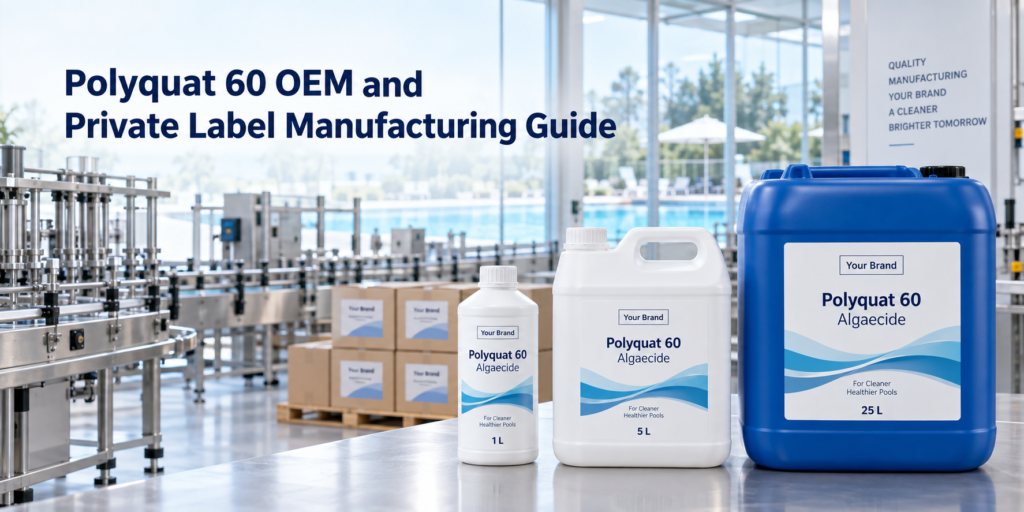
Common Polyquat 60 packaging formats include:
| Package | Common commercial role |
|---|---|
| 1 L bottle | Retail pool care and trial sales |
| 4 L or 5 L jerry can | Pool service companies and larger residential users |
| 20 L or 25 L jerry can | Commercial pool operators and distributors |
| Industrial drum | Local blending and filling |
| IBC | High-volume formulation or repacking |
Actual filling weight and container compatibility should be confirmed before the order is approved.
Bottle Material
Polyethylene packaging is widely used for liquid pool chemicals, but the manufacturer should still perform compatibility checks with the final formulation.
The review should cover:
- Container strength
- Cap compatibility
- Liner or sealing method
- Leakage resistance
- Handle strength
- Label adhesion
- Product stability in the selected package
- Performance during temperature changes
A bottle may look perfect on a sample table and behave very differently inside a hot shipping container. That is why packaging tests matter.
Cap and Tamper Evidence
Cap design is not a decorative detail. Buyers may request:
- Standard screw caps
- Tamper-evident caps
- Induction seals
- Inner plugs
- Child-resistant closures where required
- Measuring caps or dosing chambers
The appropriate closure depends on package shape, target market, sales channel, and regulatory requirements.
For online sales, leak resistance deserves extra attention. Parcels are turned, dropped, stacked, and sometimes treated with all the tenderness of airport luggage. A secure closure protects the product, the carton, and the brand’s reputation.
Cartons and Pallets
Secondary packaging should match the transport route.
Confirm:
- Bottles per carton
- Carton dimensions
- Gross and net weight
- Internal dividers
- Maximum stacking height
- Pallet material
- Pallet size
- Stretch wrapping
- Corner protection
- Shipping marks
- Fumigation or wood-treatment requirements
Ask the supplier for a packing proposal before production. This helps freight forwarders estimate volume and reduces last-minute changes.
Your Label Is a Legal Document, Not Just an Advertisement
The front panel attracts attention. The remaining panels carry the weight.
Depending on the destination and product classification, a private label may need information such as:
- Product name
- Active ingredient
- Active concentration
- Intended use
- Directions
- Dose
- Precautionary statements
- First-aid information
- Storage instructions
- Disposal instructions
- Net contents
- Batch number
- Production or expiry information
- Manufacturer or responsible company
- Country of origin
- Registration number, where applicable
- Emergency contact information
- Required hazard symbols and statements
The exact requirements vary by country. Products making pesticidal or biocidal claims may fall under registration systems that control the active substance, formula, claims, label, manufacturing site, importer, or product authorization.
For example, an algaecide marketed in the United States may fall under pesticide regulation. Products sold in the European Union may be affected by the Biocidal Products Regulation. Other countries have their own national approval systems.
A manufacturer can supply technical data and production documents, but the brand owner or importer should confirm local legal requirements with a qualified regulatory professional. Printing a label does not make its claims legal.
Translation also deserves care. Literal translation can produce confusing directions, especially when units, pool volume, dose frequency, or safety language are involved. A native technical reviewer is far more valuable than a quick machine translation.
From Idea to Finished Product: The OEM Process
A well-run project usually follows a structured sequence.
1. Define the Product Brief
The buyer should explain:
- Destination country
- Target customer
- Intended use
- Required concentration
- Desired package sizes
- Estimated annual volume
- Initial order quantity
- Preferred label language
- Required documents
- Target launch date
A detailed brief makes the quotation more meaningful. Without it, suppliers may quote completely different products under the same name.
2. Confirm the Technical Specification
The buyer and manufacturer agree on measurable requirements.
A specification may include:
- Active ingredient
- Active content
- Appearance
- pH
- Density
- Viscosity
- Packaging
- Net weight
- Storage conditions
- Retest period or shelf life, where supported
Test methods should also be clear. Two laboratories may report different results if they use different sample preparation or measurement conditions.
3. Request and Evaluate Samples
The sample should represent the proposed commercial product as closely as practical.
Evaluate:
- Appearance
- Odor
- Pouring behavior
- Dilution behavior
- Package compatibility
- Performance in representative pool conditions
- Stability during a suitable observation period
Do not judge a sample only by color or thickness. Ask for its batch information and certificate of analysis. If the project is important, compare laboratory data with application testing.
4. Approve Packaging Components
The buyer should review actual or representative samples of:
- Bottle
- Cap
- Seal
- Label material
- Printed label
- Carton
- Measuring accessory, if used
Physical samples are especially useful when package molds, colors, or closures differ from country to country.
5. Prepare Label Artwork
The artwork process should include a written approval step.
Before signing off, check:
- Brand spelling
- Product name
- Ingredient declaration
- Concentration
- Net contents
- Units
- Directions
- Warnings
- Barcodes
- Contact details
- Country of origin
- Batch-code area
- Print colors
- Label dimensions
- Registration information
Tiny errors become expensive once thousands of labels have been printed.
6. Approve a Pre-Production Sample
A pre-production sample brings the formula, package, label, and closure together. It lets the buyer see the product as the customer will receive it.
This is the right time to identify a crooked label, unsuitable adhesive, weak carton, awkward handle, or unclear direction—not after the shipment reaches the destination warehouse.
7. Begin Commercial Production
Production may involve:
- Raw material inspection
- Formula preparation
- Mixing
- In-process testing
- Filling
- Capping or sealing
- Labeling
- Batch coding
- Cartoning
- Finished product inspection
- Palletizing
The purchase order and approved specification should remain the controlling references throughout production.
8. Conduct Final Inspection
Final checks may cover:
- Quantity
- Net contents
- Batch code
- Label position
- Cap security
- Carton condition
- Pallet configuration
- Leakage
- Product appearance
- Required batch test results
For larger or first-time orders, a third-party pre-shipment inspection may provide useful independent evidence.
Quality Control: Consistency Beats a Beautiful Brochure
A professional Polyquat 60 manufacturer should be able to explain how each batch is checked.
Typical controls may include:
- Raw material verification
- Active content testing
- pH measurement
- Density measurement
- Viscosity testing
- Appearance inspection
- Filling-weight checks
- Seal or leakage checks
- Retained samples
- Batch traceability
Not every test belongs on every certificate. The key is that the agreed product characteristics are measured with suitable methods.
Buyers should ask how nonconforming material is handled. Is it isolated? Is the cause investigated? Are corrective actions recorded? Can the supplier trace finished packages back to production and raw material batches?
These questions may feel formal during the first conversation. They feel much less formal after a customer reports a problem.
Documents to Request
Documentation requirements depend on the product and destination, but a typical export package may include:
- Commercial invoice
- Packing list
- Certificate of analysis
- Safety data sheet
- Technical data sheet
- Bill of lading or air waybill
- Certificate of origin when requested
- Transport classification information
- Insurance documents when applicable
- Regulatory documents agreed before purchase
The SDS should correspond to the supplied formulation and destination requirements. A generic raw-material document may not accurately describe a diluted, colored, or otherwise modified finished product.
The COA should also identify the batch being shipped. A certificate with no connection to the actual production lot offers limited reassurance.
MOQ: Why the Smallest Bottle Can Create the Biggest Minimum
Buyers often expect a low minimum order because liquid blending appears simple. In reality, packaging components can determine the MOQ.
The formula may be available in a relatively small batch, but custom labels, printed cartons, colored bottles, molded caps, and induction seals may each have separate supplier minimums.
MOQ can be affected by:
- Mixing tank size
- Filling-line setup
- Bottle production quantity
- Label printing quantity
- Carton printing quantity
- Required laboratory tests
- Cleaning between products
- Storage space
- Manual versus automatic packing
A practical market test may use a standard bottle, standard carton, and customized pressure-sensitive label. Once sales become predictable, the brand can move to more specialized packaging.
That approach protects cash flow. It also prevents a new business from sitting beside a mountain of beautiful empty bottles that customers have not yet asked for.
Lead Time: Count Approvals, Not Just Production Days
Manufacturing time is only one part of the schedule.
A realistic OEM timeline may need room for:
- Sample preparation
- Sample transport
- Formula evaluation
- Stability observation
- Regulatory review
- Artwork preparation
- Artwork revision
- Label printing
- Bottle procurement
- Production scheduling
- Filling and packing
- Inspection
- Export booking
Standard packaging can usually move faster than a fully customized container. Repeat orders are also easier because the formula, artwork, and components have already been approved.
Seasonality matters. Pool chemical demand often rises before the warm season. Buyers who wait until demand peaks may face tighter production schedules, limited freight space, or delayed arrival.
A dependable launch plan works backward from the required warehouse date, not forward from the day the purchase order is placed.
Bulk Import or Finished Private Label—Which Makes More Sense?
Bulk importing may offer lower packaging and freight costs per unit of active ingredient. It also gives the buyer more control over local package sizes and replenishment.
However, it requires:
- Suitable storage
- Blending and filling equipment
- Trained operators
- Quality control
- Local packaging suppliers
- Batch records
- Compliance procedures
- Waste handling
- Production insurance
Finished private label manufacturing shifts much of this work to the supplier. It may suit companies that want to concentrate on sales, distribution, customer service, and brand development.
A hybrid model can work well too. A buyer may begin with finished private label products, learn which sizes sell, and later import concentrated material for local filling.
The right choice comes from total landed cost and operational capacity—not the factory price alone.
Building a Product Line Around Polyquat 60
One algaecide can open the door, but a coherent pool care range can raise average order value and make distributor conversations more productive.
Related products may include:
- Maintenance algaecide
- Concentrated algaecide
- Pool clarifier
- Winter algaecide
- Seasonal closing kit
- Water testing products
- Dosing accessories
The products should have clear roles. If every bottle claims to prevent algae, clear cloudy water, sanitize the pool, balance pH, and solve every seasonal problem, the range becomes difficult to trust.
A focused Winter Algaecide, for example, can be positioned around pool closing and off-season algae control rather than competing with the daily maintenance product.
Consistent label architecture also helps. Use recognizable colors, typography, dose tables, safety panels, and package shapes across the range. Customers should be able to recognize the brand from a few steps away.
Common Polyquat 60 Private Label Mistakes
Several problems appear repeatedly in OEM projects.
Buying Only by Price
A low quotation may exclude testing, suitable packaging, strong cartons, accurate filling, documentation, or responsive after-sales support.
Compare the complete offer, not only the price per kilogram.
Using “Polyquat 60” Without a Written Specification
The commercial name alone does not define every property. Confirm active content, appearance, pH, density, viscosity where relevant, packaging, and test methods.
Printing Labels Before Regulatory Review
Regulatory changes after printing can turn thousands of labels into waste. Review the legal text first, then approve printing.
Skipping Packaging Tests
Even a stable formula can leak through an unsuitable closure or damage a weak label adhesive.
Assuming the Sample Guarantees Every Future Batch
The approved sample should be connected to a written specification and a controlled production process. Otherwise, it remains only one good bottle.
Ignoring Cold and Hot Storage
Temperature can affect viscosity, pouring behavior, package shape, label adhesion, and product appearance. Ask how the product and packaging behave under expected transport and warehouse conditions.
Overcomplicating the First Launch
Too many concentrations, bottle sizes, colors, and label languages can spread the initial order too thin. A smaller, clearer launch is often easier to manage.
Start with the strongest commercial format. Add variations after real sales data appears.
A Practical Manufacturer Evaluation Checklist
Before choosing a supplier, ask:
- What is the exact active ingredient?
- What active concentration is guaranteed?
- Which test method is used?
- Can the supplier provide a recent COA and SDS?
- Is each production batch traceable?
- Are retained samples kept?
- Which package sizes are already available?
- Can packaging compatibility or leakage tests be provided?
- Who supplies and reviews the label artwork?
- Can the batch number be printed on each container?
- What is the MOQ for the formula, labels, bottles, and cartons?
- What is the sample process?
- How long does first production normally take?
- What happens if a batch does not meet the agreed specification?
- Can a third-party inspection be arranged?
- What export documents can be supplied?
- Has the product been shipped through the required transport route before?
- Who is responsible for destination-market registration and label approval?
The way a supplier answers is revealing. Precise answers usually indicate a controlled process. Vague answers such as “no problem, we can do everything” deserve follow-up questions.
What Should Be Included in Your Request for Quotation?
A detailed RFQ saves time and makes offers easier to compare.
Include:
- Product name
- Active ingredient or CAS number
- Required active concentration
- Estimated order quantity
- Package size
- Bottle color and shape
- Cap or seal requirement
- Label language
- Private label or neutral packaging
- Bottles per carton
- Destination port
- Required trade term
- Required documents
- Sample requirement
- Target delivery date
You can also ask suppliers to quote two formats—for example, bulk concentrate and finished 1 L private label bottles. Comparing both may reveal a very different cost structure.
A Private Label Product Is Really a System
The liquid inside the bottle matters, of course. But the commercial product is the whole system:
- Formula
- Specification
- Package
- Closure
- Label
- Carton
- Documentation
- Production control
- Logistics
- Regulatory position
- Customer support
A weakness in any one part can affect the rest.
That is why the strongest OEM relationships are built around clear specifications and repeatable processes. The buyer understands the destination market. The manufacturer understands production and product behavior. Both sides document what has been agreed.
It is not glamorous work. Yet this is precisely what keeps a private label program running when summer demand rises and customers need the same dependable product they purchased last season.
Final Thoughts
Polyquat 60 can be a strong foundation for a professional pool chemical brand. Its non-foaming, metal-free character supports clear market positioning, while concentrated and ready-to-use formats provide flexibility for different distribution models.
Still, successful private label manufacturing is not just a logo-printing service.
Buyers need to define the product, approve the specification, test the packaging, review the label, verify the documentation, and plan the production schedule carefully. A reliable manufacturer should support that process with clear answers, traceable batches, suitable quality checks, and realistic commitments.
Start with one well-defined product. Test it properly. Listen to distributors and pool professionals. Then expand the range with purpose.
That may sound slower than launching six products at once. In practice, it is often the faster route to a brand customers order again.
Frequently Asked Questions
1. What is the minimum order quantity for private label Polyquat 60?
The MOQ depends on the formula batch size, bottle type, label printing, carton requirements, and filling method. Standard bottles and adhesive labels usually support a lower starting quantity than custom-molded containers or printed packaging.
2. Can a manufacturer supply different concentrations of Polyquat 60?
Yes, a manufacturer may supply concentrated material or produce lower-concentration finished formulations. The requested concentration must be clearly defined, tested, and permitted under the destination market’s regulatory requirements.
3. Can I put my own brand on Polyquat 60 algaecide bottles?
Yes. Private label manufacturing can include the buyer’s logo, product name, colors, directions, contact information, and barcode. The label must still meet all applicable chemical, pesticide, biocide, and consumer-product rules.
4. What documents should a bulk Polyquat 60 supplier provide?
Buyers commonly request a certificate of analysis, safety data sheet, technical data sheet, commercial invoice, packing list, and transport documents. Additional documents may be required by the destination country or customer.
5. How long does custom Polyquat 60 manufacturing take?
Timing depends on formula approval, packaging availability, artwork review, label printing, production scheduling, inspection, and shipping. First orders normally require more preparation than repeat orders, so buyers should begin well before the seasonal sales period.