
GET IN TOUCH
Ask For Sample?
What to Ask Before Buying Polyquat 60 Algaecide in Bulk?
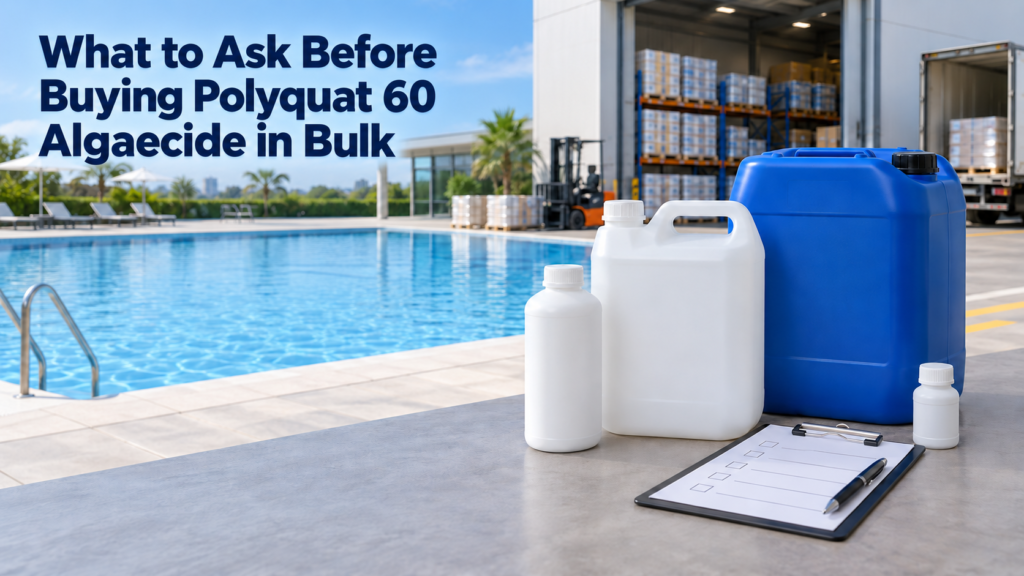
Buying Polyquat 60 in bulk is not simply a matter of comparing three prices and choosing the lowest one. The product name may look familiar, the concentration may say “60%,” and the quotation may seem attractive. Yet those details alone do not tell you whether two offers represent the same chemical, the same quality level, or even the same commercial package.
That is where careful sourcing begins.
A dependable bulk purchase should give you predictable product performance, consistent batches, suitable packaging, accurate documents, and a workable supply schedule. If you sell the material under your own brand, the stakes are even higher. One weak shipment can lead to cloudy water, dissatisfied pool professionals, leaking containers, delayed deliveries, and a rather uncomfortable conversation with your customers.
So, what should you ask before placing an order?
This guide walks through the key technical, commercial, quality, packaging, regulatory, and logistics questions that every distributor, private-label brand, formulator, or pool chemical importer should raise before buying Polyquat 60 algaecide bulk supply.
Start with the most basic question: What exactly is the product?
“Polyquat 60” is widely used as a commercial name for a concentrated, polymer-based algaecide. However, commercial names can create confusion. Similar-sounding products may have different active ingredients, CAS numbers, molecular structures, properties, and recommended applications.
Ask the supplier to provide the complete chemical identity, including:
- Active ingredient name
- CAS number
- Active concentration
- Chemical or polymer description
- Commercial synonyms
- Intended application
- Product grade
- Country-specific regulatory status, where applicable
For the product commonly supplied as Polyquat 60 algaecide, the active ingredient is usually polixetonium chloride, identified by CAS No. 31512-74-0. It is also described as poly[oxyethylene(dimethyliminio)ethylene(dimethyliminio)ethylene dichloride].
Yes, that chemical name is a mouthful. Still, it matters.
Some suppliers use “PQ 60” or similar language for other cationic polymers. Those materials may also be water-soluble, non-foaming, and used in water treatment, but they are not automatically interchangeable. Never rely on a shortened trade description alone.
Before comparing quotations, confirm that every supplier is quoting the same chemistry. Otherwise, you may be comparing apples with—well, another cationic polymer entirely.
Buyers can review the chemical identity and available packaging of Polyquat 60 Algaecide before preparing a bulk inquiry.
Is it really a 60% product?
A supplier may call the product Polyquat 60, but what does the “60” represent in its specification?
Ask whether the stated percentage refers to:
- Active ingredient
- Polymer solids
- Total solids
- Assay
- Commercial product content
- A nominal formulation name
These terms should not be treated as identical unless the supplier explains the test methods and specification limits.
A quoted concentration such as “60%” may be presented as a nominal value, while the actual release specification could cover a defined range. That range should appear on the technical data sheet and certificate of analysis.
Ask the supplier:
- What is the guaranteed active-content range?
- Which analytical method is used?
- Is the method applied to every production batch?
- What is the normal batch-to-batch variation?
- Can the supplier share recent certificates of analysis from different batches?
Why request several COAs rather than one perfect-looking document? Because one report shows a result. Several reports begin to show consistency.
A concentrated product can lower the amount of water shipped per unit of active ingredient. It may also give formulators more room to prepare different retail strengths. Yet concentration is valuable only when it is real, measurable, and repeatable.
Which specifications are controlled for every batch?
Active content is important, but it is not the whole story. A bulk buyer should request a complete product specification and ask which parameters are tested before batch release.
Typical checks may include:
- Appearance
- Color
- Active content
- Total solids or content, if relevant
- pH
- Density or specific gravity
- Viscosity
- Water solubility
- Odor
- Storage stability
- Microbiological or impurity controls, when required by the market
The supplier should also explain the test conditions. Viscosity, for instance, can change with temperature, instrument type, spindle, and rotational speed. A number without a method is less useful than it appears.
The same applies to pH. Ask whether it is measured on the undiluted material or on a defined dilution. If one supplier tests a 10% aqueous solution and another tests the original product, their results cannot be compared directly.
Density matters for commercial reasons as well as quality control. It affects filling calculations, container capacity, freight planning, and the conversion between kilograms and liters. If you plan to sell the product by volume, a misunderstanding here can quietly damage your margin.
Can the supplier prove batch-to-batch consistency?
A good sample is encouraging. It is not proof of reliable mass production.
This is a common sourcing trap: the sample performs well, the first shipment is acceptable, and later batches begin to drift. Perhaps the color becomes darker. Maybe the viscosity changes. Filling weights vary. Customers then say the product “doesn’t feel the same,” even when they cannot identify the exact cause.
Ask how the supplier controls:
- Raw material approval
- Production instructions
- In-process testing
- Finished-product testing
- Batch release
- Retained samples
- Nonconforming material
- Customer complaints
- Corrective actions
- Traceability from finished goods to raw materials
You do not need a theatrical factory tour with spotless floors prepared five minutes before your arrival. You need evidence of a repeatable system.
Request COAs from at least three recent production batches. Compare the values, dates, batch numbers, and specification ranges. If the figures are identical down to every decimal place, ask how the data were generated. Real production results normally show some controlled variation.
Third-party testing can also be arranged for the first commercial shipment or at agreed intervals. It does not replace factory quality control, but it adds another layer of verification.
Is the sample representative of commercial production?
A sample should come from standard production whenever possible. Ask whether it was taken from:
- A normal commercial batch
- A laboratory batch
- A pilot batch
- Retained production stock
- A specially prepared sales sample
This question may feel overly cautious, but it can prevent a costly surprise.
A laboratory-prepared sample can be useful during development. However, it may not represent the color, viscosity, filtration, or consistency of full-scale production. If your evaluation sample was specially made, request a pre-shipment sample from the actual production batch before the bulk order leaves the factory.
For technical evaluation, record:
- Sample batch number
- Production date
- Test date
- Storage conditions
- Water conditions during testing
- Dosage used
- Circulation time
- Sanitizer level
- pH and temperature
- Observed algae conditions
- Compatibility with the planned formulation
Do not judge the product from appearance alone. Polyquat 60 is bought for performance, not because it looks impressive in a clear bottle under office lighting.
What does “non-foaming” mean in real use?
One of the commercial advantages of Polyquat 60 is its non-foaming character. That makes it attractive for swimming pools, spas, fountains, circulation systems, and premium maintenance programs where visible foam would be unwelcome.
Still, ask the supplier how non-foaming performance has been evaluated.
A useful discussion may cover:
- The recommended application concentration
- Water agitation during testing
- Compatibility with surfactants
- Performance in spas or high-circulation systems
- Behavior when combined with other formulated ingredients
- Whether the supplied product contains added surfactants or defoamers
A raw active ingredient may be non-foaming, while a finished private-label formula can behave differently because of fragrance, dye, wetting agents, cleaners, or other additives. That distinction matters.
If you plan to dilute or blend the concentrated material, test the final formulation—not just the bulk raw material.
How should the product be used, and what claims can you make?
Ask for recommended dosage guidance for prevention, routine maintenance, and visible algae conditions. The supplier should explain that dosage can vary according to pool volume, contamination level, water chemistry, circulation, temperature, and local label requirements.
General supplier guidance can support product development, but it should not be copied blindly onto a retail label.
Claims such as “kills algae,” “controls black algae,” or “long-lasting algae prevention” may be regulated in your target market. Product registration, permitted active ingredients, label wording, and efficacy data can differ from one country to another.
Before approving packaging, establish:
- Which claims are allowed in the destination market
- Whether the active ingredient requires registration
- Who will hold the registration
- Whether efficacy data are required
- Which warning language must appear on the label
- Whether the supplier’s existing documents are accepted locally
- Who is responsible for final label compliance
A factory can provide technical information. It cannot automatically guarantee that every claim is legal in every country.
That responsibility should be discussed clearly before production. Regulatory questions are much cheaper to solve on a screen than after thousands of labels have been printed.
Is Polyquat 60 compatible with your complete pool treatment program?
A pool algaecide rarely works alone. It becomes part of a broader program involving sanitizers, pH control, filtration, oxidation, clarification, and seasonal maintenance.
Ask about compatibility with the chemicals used by your customers, including:
- Chlorine-based sanitizers
- Bromine systems
- Oxidizing shock treatments
- pH adjusters
- Alkalinity products
- Scale-control products
- Clarifiers
- Other cationic polymers
- Anionic treatment products
Polyquat 60 is cationic, meaning the polymer carries positive charges in water. Anionic materials carry negative charges. Under some conditions, combining the two can cause interaction, precipitation, reduced performance, or cloudy water.
That does not mean the products can never exist within the same maintenance program. Timing, dilution, concentration, and application sequence may make a major difference. Ask for compatibility testing when your planned formula or treatment method contains anionic ingredients.
For a broader pool care range, Polyquat 60 may be paired commercially with a separate Polymer Pool Clarifier. Each product should still be tested according to its formulation and intended application.
Are you buying a raw material or a finished algaecide?
This question changes almost everything.
A concentrated industrial material may be intended for further formulation, dilution, filling, or relabeling. A finished retail product should already have its target concentration, appearance, packaging, directions, and stability profile.
Clarify whether you require:
- Concentrated Polyquat 60 for local formulation
- A ready-to-fill product
- A ready-to-use retail algaecide
- A customized concentration
- A colored formulation
- A combined seasonal product
- A complete private-label package
If you buy concentrate, calculate the true cost of local processing. Include water quality, mixing equipment, labor, tanks, cleaning, quality testing, containers, labels, production losses, and local compliance.
Buying concentrate may reduce freight cost per kilogram of active ingredient. Buying a finished formulation may simplify operations. Neither approach is always better. The right model depends on your volume, technical capability, local costs, and control requirements.
Can the supplier support formulation and dilution?
If you plan to sell several strengths, ask whether the supplier can prepare them under controlled conditions.
Useful questions include:
- Which concentrations can be supplied?
- Is dilution performed with treated water?
- How is pH controlled?
- Are preservatives required after dilution?
- Does dilution change shelf life?
- Can color be added?
- Can the formula be supplied without fragrance?
- What mixing sequence is recommended?
- Can the supplier support a customer-owned formula?
- How will the formula be protected from unauthorized disclosure?
Dilution looks simple—add water and mix. In commercial production, it is not quite that casual. Water quality, contamination, mixing time, temperature, and filling hygiene can affect stability.
Ask for a specification for the finished diluted product, not merely the original concentrate.
Has storage stability been verified?
Bulk chemicals may spend weeks in transit and months in a warehouse before reaching the customer. Storage stability therefore deserves more than a single line on a data sheet.
Ask:
- What is the stated shelf life?
- Does shelf life apply to unopened original packaging?
- What storage-temperature range is recommended?
- Is freezing harmful?
- Can repeated freeze–thaw cycles affect the product?
- Can high container temperatures change color or viscosity?
- Should the product be protected from direct sunlight?
- What happens after the container is opened?
- Is the shelf life different after dilution or formulation?
- Is stability data available for the proposed retail formula?
The concentrated Polyquat 60 product described by Eautrix is supplied as a stable liquid and is available in both retail-ready and bulk packaging. Buyers should still confirm storage conditions and shelf-life terms for their exact concentration and package.
If your market has hot ports, uncooled inland transport, or outdoor storage, tell the supplier. A product that behaves well in a mild warehouse may face a much harsher journey inside a container exposed to summer heat.
Which packaging is suitable for your business?
Packaging should match how the product will be transported, stored, blended, and sold.
Common choices may include:
- 1-liter bottles for retail distribution
- 5-liter jerrycans for pool service companies
- 25-liter stackable jerrycans for professional users
- IBC totes for industrial blending or high-volume distribution
- Customized containers for private-label programs
Ask for the net weight, gross weight, container material, closure type, tamper-evident features, carton configuration, pallet quantity, and pallet dimensions.
Also confirm:
- Whether the container is compatible with the product
- Whether closures have been leak-tested
- Whether induction seals are available
- Whether cartons are suitable for export handling
- Whether pallets are fumigated or compliant with destination rules
- Whether containers can be stacked during storage
- Whether package drop or transport testing is available
- Whether labels resist moisture and chemical splashes
- Whether production codes remain readable throughout shelf life
A small leak rate can become a large commercial problem across thousands of containers. Ask the supplier how packaging integrity is checked and how leakage claims are handled.
For retail programs, the package also shapes how customers perceive the brand. A reliable closure, clean label, comfortable handle, and sensible dosage instructions can add more value than decorative wording ever will.
What is the real minimum order quantity?
MOQ can mean several things. Ask the supplier to separate them.
There may be different minimum quantities for:
- Standard bulk material
- Custom concentration
- Custom color
- Printed labels
- Printed cartons
- Custom-molded containers
- Mixed package sizes
- Mixed products in one shipment
- Trial orders
- Private-label production
A supplier might accept one pallet of standard product but require several thousand units for custom packaging. Labels may have their own printing minimum. Cartons may have another.
Ask whether unused labels and cartons can be stored for future orders, how long they will be kept, and who owns them. You should also ask what happens if the formula or regulatory wording changes while old packaging remains in stock.
For a new market, a smaller first order can reveal far more than a polished sales presentation. It allows you to test shipping, customs clearance, warehouse handling, customer response, and reorder speed without tying up too much cash.
How is private-label artwork approved?
Private labeling involves more than placing a logo on a bottle.
A controlled approval process should cover:
- Product name
- Active ingredient statement
- Net contents
- Directions
- Warning statements
- First-aid language
- Batch number
- Production date
- Expiry date
- Storage instructions
- Supplier or distributor details
- Country of origin
- Barcode
- Language requirements
- Required regulatory numbers
Ask who checks the artwork, who has final approval, and whether a signed artwork confirmation is required before printing.
Request a digital proof. For the first order, a physical printed label or filled-package sample may also be worthwhile. Colors seen on a monitor can look different on plastic, especially on blue containers or textured surfaces.
No production should begin from a casual email attachment named “final-new-revised-3.” Use a version number, approval date, and clear record of the approved file.
Which documents will be supplied?
Before ordering, request sample copies of the documents that will accompany the shipment.
Depending on the transaction and destination, these may include:
- Certificate of Analysis
- Safety Data Sheet
- Technical Data Sheet
- Commercial invoice
- Packing list
- Certificate of origin
- Transport documents
- Dangerous goods documents, if applicable
- Regulatory declarations requested by the importer
- Third-party inspection report
- Product registration support documents, where available
Check whether the product name, CAS number, concentration, manufacturer information, batch number, and packaging description remain consistent across all documents.
Document inconsistencies can delay customs clearance even when the material itself is acceptable. A missing decimal point is annoying; a different chemical identity is far more serious.
Ask for the current SDS revision date and the regulatory basis used for transport classification. Do not assume that a previous shipment’s classification applies automatically to every concentration, formulation, package size, or shipping route.
What quality protections should appear in the purchase contract?
The purchase contract should reflect more than quantity and price.
Consider including:
- Agreed product specification
- Approved test methods
- Packaging specification
- Label artwork reference
- Net-weight tolerance
- Required documents
- Production and shipment deadlines
- Pre-shipment sample requirements
- Inspection rights
- Rules for rejected material
- Claim-notification period
- Corrective-action process
- Replacement or credit terms
- Confidentiality requirements
- Formula ownership, if relevant
Define how quality disagreements will be resolved. Will both parties use an agreed independent laboratory? Which test method will control? How will samples be taken and sealed?
These details can sound overly formal when the relationship is friendly. Yet clear rules protect the relationship. When expectations are written down, fewer disagreements depend on memory or interpretation.
How should you compare bulk quotations?
The lowest price per kilogram is not always the lowest landed cost.
Build a comparison using the same basis for every quotation:
- Active ingredient
- Guaranteed concentration
- Net product weight
- Package size
- Packaging cost
- Pallet configuration
- Incoterm
- Freight
- Insurance
- Import duty
- Local tax
- Customs charges
- Port fees
- Inland delivery
- Testing cost
- Expected losses
- Payment terms
- Lead time
For concentrated products, calculate cost per kilogram of active ingredient:
Cost per kilogram of active ingredient = product price per kilogram ÷ active fraction
If Product A costs less per kilogram but contains less active material, its apparent advantage may disappear. Packaging and freight can shift the result again.
Payment terms also affect the real cost. A slightly higher quotation with dependable production, fewer complaints, and better credit terms may protect more profit than a cheap order that arrives late.
What lead time can the supplier actually maintain?
Ask for separate estimates for:
- Sample preparation
- Sample shipping
- Technical approval
- Artwork approval
- Packaging procurement
- Production
- Testing
- Filling
- Inspection
- Export booking
- Inland transport to port
A phrase such as “delivery in two weeks” is too vague. Does it mean the goods will finish production in two weeks, leave the factory in two weeks, or arrive at the destination in two weeks?
For seasonal pool products, timing has teeth. Missing the spring or early-summer sales window can turn useful inventory into stock that sits for months.
Ask about peak-season capacity, safety stock, raw material availability, and expected reorder times. If you need regular monthly quantities, discuss a forecast rather than placing disconnected emergency orders.
Can the supplier support mixed or seasonal product lines?
Many distributors do not want to import one algaecide forever. They want to build a coherent pool care range.
Ask whether the supplier can combine Polyquat 60 with other products in the same shipment, such as clarifiers, maintenance algaecides, or seasonal pool-closing treatments. Confirm that the products can be shipped together and that their packaging, documentation, and regulatory requirements are compatible.
For colder markets, a Winter Algaecide can extend the selling season beyond summer maintenance. That can help distributors build a more complete program rather than competing on a single container of algaecide.
Still, keep the range disciplined. Five clear products with distinct uses are often easier to sell than fifteen nearly identical formulas with confusing labels.
What happens when something goes wrong?
Every supplier sounds responsive before the deposit is paid. The stronger test is how problems are handled afterward.
Ask about the complaint process:
- Who receives technical complaints?
- How quickly are they acknowledged?
- What information must the buyer provide?
- Are retained samples kept from every batch?
- Can production and raw materials be traced?
- Is a written investigation report supplied?
- How are corrective actions recorded?
- Under what conditions will material be replaced or credited?
You may also ask for an anonymized example of how a past quality issue was investigated. The goal is not to find a supplier who claims never to have had a problem. It is to find one with a mature response when a problem appears.
Silence, vague explanations, or pressure to accept an unverified conclusion should make any bulk buyer uneasy.
A practical pre-order checklist
Before placing a bulk Polyquat 60 order, make sure you can answer each of these questions:
- Have we confirmed the chemical identity and CAS number?
- Is the active-content range written into the specification?
- Have we reviewed several recent COAs?
- Do we understand the supplier’s test methods?
- Was our sample taken from representative production?
- Has the final formulation been tested in relevant pool conditions?
- Have chemical compatibility concerns been reviewed?
- Are our product claims permitted in the destination market?
- Is the packaging suitable for transport and storage?
- Have we approved the label through a controlled process?
- Are all shipping and compliance documents available?
- Have we calculated landed cost on the same basis?
- Is the production schedule suitable for our sales season?
- Are quality and claim procedures written into the contract?
- Do we have an approved pre-shipment inspection plan?
If several answers remain uncertain, the order is not ready—even if the price expires tomorrow.
Good buying begins with better questions
Bulk chemical sourcing is rarely won by asking, “What is your lowest price?”
A stronger inquiry asks what the product is, how it is tested, how consistently it is produced, how it will be packed, and what support will be available after delivery. Those questions help both sides. They show the supplier what you require and give you a clearer basis for comparing offers.
A dependable Polyquat 60 supply should support more than one successful shipment. It should support stable formulations, repeatable pool performance, confident customer service, and a brand that buyers are comfortable ordering again.
That is the real goal, isn’t it? Not simply getting the drums, jerrycans, or IBCs through the door—but knowing that the next order can meet the same standard.
Suggested image alt text: Bulk Polyquat 60 algaecide packaging beside a pool and warehouse, with sealed bottles, jerrycans, sample container, and procurement quality checklist.
Frequently Asked Questions
1. What specification should I request when buying Polyquat 60 algaecide in bulk?
Request the active ingredient, CAS number, guaranteed active-content range, appearance, pH, density, viscosity, test methods, shelf life, and storage conditions. Ask for recent batch COAs as well as the standard product specification.
2. How can I verify the quality of a bulk Polyquat 60 supplier?
Review several production COAs, test a representative sample, confirm batch traceability, and consider third-party inspection for the first shipment. The purchase contract should also define specifications, sampling procedures, and remedies for rejected material.
3. Is Polyquat 60 concentrate suitable for private-label pool algaecide?
Yes, concentrated Polyquat 60 can be used for private-label products when the final formulation, dilution water, packaging, stability, efficacy, and label claims have been properly evaluated. Regulatory requirements must be checked in the destination market.
4. What packaging is available for Polyquat 60 bulk supply?
Common formats include 1-liter bottles, 5-liter jerrycans, 25-liter stackable jerrycans, and IBC totes. Availability, filling weight, pallet quantity, closure design, and minimum order quantity should be confirmed with the supplier.
5. Should I compare Polyquat 60 prices by kilogram or by active ingredient?
Compare both, but cost per kilogram of active ingredient gives a clearer technical comparison. You should then add packaging, freight, duty, testing, local delivery, financing, and expected losses to calculate the full landed cost.