GET IN TOUCH
Ask For Sample?
Custom Packaging Options for Polyquat 60 Products
A Polyquat 60 formula may work beautifully in swimming pools, yet the product can still struggle in the market if it arrives in the wrong package.
That sounds a little harsh, doesn’t it? After all, packaging does not control algae. It does not improve water circulation or balance pool pH. Still, it shapes almost every commercial moment surrounding the product—from the first warehouse inspection to the final pour beside the pool.
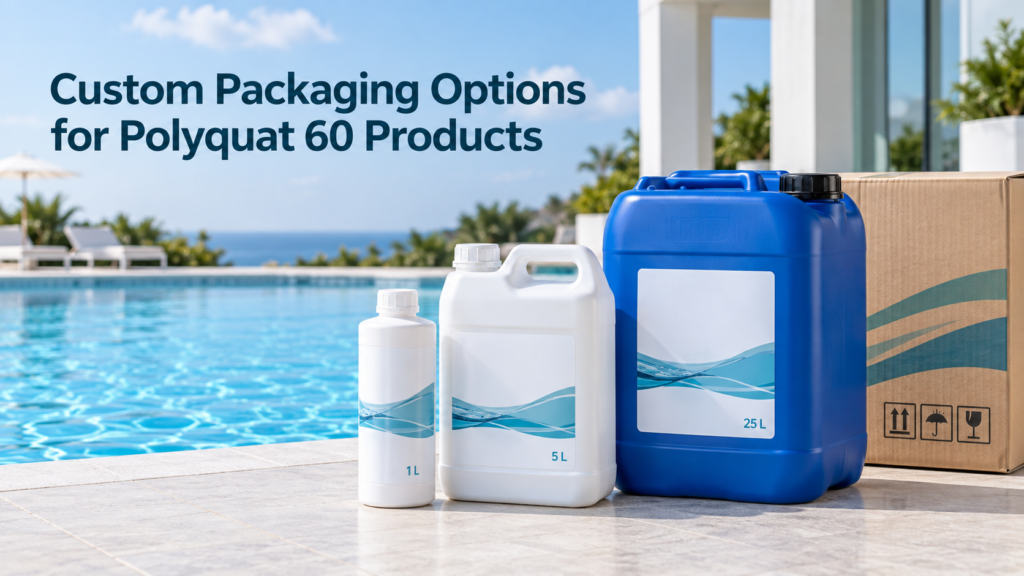
A one-liter bottle may work well for residential pool owners. A five-liter jerrycan can make far more sense for pool service companies. A 25-liter stackable container may suit distributors, hotels, water parks, and commercial maintenance teams. For companies that blend or repack locally, bulk packaging can reduce repeated handling and support a more efficient supply chain.
Custom packaging is therefore more than a cosmetic service. It connects the chemical formula with the person who will store, sell, carry, measure, and use it.
For pool chemical brands, importers, and regional distributors, the right packaging can:
- Make the product easier to identify and handle
- Support different customer groups
- Reduce leakage and transit damage
- Improve shelf presentation
- Communicate dosage and safety information
- Strengthen private-label brand recognition
- Simplify inventory planning
- Help a concentrated product travel more efficiently
The clever part is not simply offering more package sizes. It is matching each package to a real commercial purpose.
Start with the Customer, Not the Container
It is tempting to begin a packaging project by asking, “Which bottles can the factory supply?”
A better opening question is, “Who will use this product, and how?”
Consider three very different customers.
A homeowner with a small backyard pool may want a compact bottle that can be stored safely in a pool shed. The label must be easy to read, the cap must close securely, and the container should not feel awkward when the customer measures a maintenance dose.
A pool service technician may treat several pools each day. This user needs a larger container with a dependable handle, a secure closure, and a shape that fits reasonably well inside a service vehicle.
A regional distributor may buy concentrated material for local blending or repacking. Retail appearance matters less at this stage. Container strength, pallet efficiency, net weight, batch identification, and unloading conditions become much more important.
The chemistry might be similar, but the packaging jobs are completely different.
Before confirming a custom package, define:
- Target customer
- Sales channel
- Expected order volume
- Product concentration
- Typical dose
- Local climate
- Warehouse conditions
- Transport method
- Label language
- Retail shelf requirements
- Local regulatory expectations
This early work prevents an expensive problem: developing an attractive package that does not fit the market.
The 1L Bottle: Small Pack, Big Branding Opportunity
A one-liter bottle is a natural format for residential pool care, e-commerce orders, starter programs, and smaller retail outlets.
It is compact, familiar, and relatively easy for consumers to handle. It also gives a brand enough label area to communicate the product name, key features, directions, warnings, and contact information—provided the design is not overcrowded.
For concentrated Polyquat 60 Algaecide, a smaller package can represent a meaningful number of treatments. That gives the brand a useful marketing message: the bottle may look modest, but the contents are concentrated.
The bottle design should consider:
- A chemically suitable plastic
- A reliable tamper-evident closure
- Enough headspace for safe filling and transport
- A stable base
- A comfortable grip
- A label panel without deep curves
- Clear batch and date coding
- Carton protection during export
High-density polyethylene, commonly known as HDPE, is widely considered for liquid chemical packaging because it is strong, light, and available in many shapes. Even so, a container should not be approved by appearance alone. The bottle, cap, seal, label adhesive, and finished formulation should be checked together.
That last point matters. A diluted private-label product may behave differently from a concentrated raw material. Added fragrance, dye, supporting ingredients, or changes in pH can affect the packaging system. Compatibility testing should use the actual finished formulation whenever possible.
For retail presentation, white bottles offer a clean surface for blue, turquoise, or green pool-care graphics. A colored bottle can create a stronger shelf block, but it may increase purchasing complexity or require a higher quantity.
And there is a small practical detail that buyers sometimes miss: label placement. A beautiful label will not look beautiful if it wrinkles across a molded ridge or lifts near the handle.
The 5L Jerrycan: A Practical Middle Ground
The five-liter jerrycan sits between consumer convenience and professional economy. It is often suitable for:
- Pool maintenance companies
- Hotels and resorts
- Apartment pool operators
- Pool shops serving repeat customers
- Small commercial pools
- Professional cleaning teams
- Regional distributors offering trade-size products
This format gives users more product without making the container excessively difficult to lift or pour. A built-in handle improves control, while the larger label panel offers room for technical and commercial information.
The pouring experience deserves attention. Thick or moderately viscous liquids can “glug” when air cannot enter the container smoothly. That may cause splashing, wasted product, or an untidy work area. The neck design, opening diameter, container geometry, and optional dispensing accessories should therefore be considered during package selection.
Depending on the market, useful accessories may include:
- Measuring cups
- Dosing chambers
- Pouring spouts
- Child-resistant closures where required
- Induction seals
- Tamper-evident cap rings
- Printed dosage guides
- Outer cartons with carrying cutouts
Not every accessory is necessary. More parts can mean more cost, more sourcing work, and more opportunities for something to go missing. The package should remain simple enough for dependable production.
A five-liter unit also works well as a private-label “professional size.” The brand can keep a one-liter bottle for home users and use the same visual identity on the larger jerrycan. This creates a recognizable product family without forcing every customer into the same pack size.
The 25L Jerrycan: Built for Serious Pool Work
For larger commercial users, a 25-liter stackable jerrycan may offer a sensible balance between volume and handling flexibility.
It can serve:
- Commercial pool maintenance companies
- Water parks
- Hotels with several pools
- Public aquatic facilities
- Large residential communities
- Wholesalers
- Repacking businesses
- Institutional buyers
A 25-liter container generally uses less packaging material per kilogram of product than many small bottles. It can also reduce the number of units that warehouse staff must count, label, move, and inspect.
Still, bigger does not automatically mean better.
A filled 25-liter jerrycan is heavy. The handle, closure, base, and stacking surfaces must cope with warehouse movement and long-distance transport. Manual handling conditions should also be considered. If the customer cannot safely lift or pour the package, a dispensing pump, tap, or transfer system may be needed.
Stackability is especially important for export orders. Containers that fit neatly on a pallet can use shipping space more efficiently and remain more stable during movement. Poorly matched containers and pallets can leave empty gaps, create uneven loads, or allow units to shift.
A good 25-liter packaging discussion should cover:
- Container dimensions
- Nominal and usable capacity
- Net product weight
- Filled gross weight
- Closure specification
- Leak-prevention system
- Pallet quantity
- Layer arrangement
- Maximum stacking conditions
- Stretch-film and corner protection
- Forklift and warehouse handling
- Label size and position
For Eautrix supply, current published packaging includes 25L stackable jerrycans, with pallet arrangements confirmed according to the selected packing plan and order requirements. Final quantities should always be checked in the quotation and packing specification before an order is placed.
Bulk Packaging for Local Blending and Repacking
Some buyers do not need finished retail bottles at all. They need concentrated Polyquat 60 for local production.
Bulk packaging may suit companies that:
- Dilute concentrated material locally
- Produce several finished-product strengths
- Fill bottles under their own brand
- Supply contract customers in different formats
- Operate an established blending facility
- Want to reduce packaging shipped across long distances
An intermediate bulk container, commonly called an IBC, can hold a much larger amount of material than a retail package. This may reduce packaging cost per kilogram and simplify high-volume receiving.
Yet bulk supply shifts more responsibility to the buyer. The receiving company needs suitable storage, pumps, transfer equipment, trained staff, batch controls, and a documented blending process. Local repacking must also meet the legal and labeling requirements of the destination market.
Bulk material should not be treated as “just a bigger bottle.” It becomes part of a production system.
Before choosing bulk delivery, the buyer should review:
- Annual and seasonal demand
- Minimum practical production batch
- Storage capacity
- Local temperature conditions
- Transfer equipment
- Cleaning procedures
- Traceability records
- Finished-product testing
- Packaging inventory
- Local waste handling
- Operator training
For a newer brand with uncertain sales, finished 1L or 5L products may reduce operational complexity. For an experienced distributor with stable demand, concentrated bulk material may provide greater control over local filling and product positioning.
Container Color Is More Than Decoration
White, natural, blue, and other colored containers can create very different market impressions.
White packaging often looks clean and clinical. It works well with pool-blue labels and makes a product line feel organized. Blue packaging immediately connects with water care and may hide minor exterior marks better than white plastic.
Natural or translucent packaging can make the liquid level visible, but visibility is not always desirable. A brand may prefer an opaque bottle for a more uniform appearance or to reduce unnecessary light exposure.
Container color may also affect cost and purchasing quantity. A standard white container is often easier to source than a custom-colored bottle. Custom colors may require longer lead times or larger production runs.
The practical questions are straightforward:
- Is the color already available as a standard item?
- Will every package size use the same color?
- Does the color suit the label design?
- Can batch codes be read clearly?
- Will the container become hot in direct sunlight?
- Does the color remain consistent between production lots?
- Is the customer willing to accept a higher quantity for customization?
Brand consistency is valuable, but there is no prize for forcing every container into an expensive custom color. Sometimes a standard white bottle and a well-designed label create the cleanest result.
Closures, Seals, and the Quiet Work of Preventing Leaks
Customers notice the label first. Logistics teams notice the cap.
A closure system must protect the product through filling, carton packing, pallet movement, sea freight, customs inspection, warehouse storage, and final delivery. A small leak can damage neighboring labels and cartons. A larger leak may affect an entire pallet.
A packaging system may include:
- Screw cap
- Tamper-evident ring
- Inner plug
- Gasket or liner
- Induction seal
- Venting feature, if technically required
- Child-resistant mechanism, if required by the market
Each part must suit the container neck and the finished formulation. Cap torque—the force used to tighten the closure—also matters. Too little torque may allow leakage. Too much may damage threads, deform a liner, or make the product difficult to open.
Leak testing should reflect real transport conditions as closely as practical. A container that remains upright in a quiet room has not faced pallet vibration, temperature changes, repeated handling, or pressure variation.
For export orders, it is reasonable to request confirmation of the closure structure, sealing method, and packing configuration before mass production.
Private Labels Must Inform, Not Merely Impress
A private-label design has two jobs.
First, it must attract attention and support the brand. Second, it must communicate the information required for safe and lawful sale. The second job cannot be squeezed into whatever space remains after the designer finishes the front panel.
A typical label project may need to consider:
- Product name
- Product function
- Active ingredient statement
- Net contents
- Directions for use
- Precautionary language
- Storage instructions
- First-aid information
- Batch number
- Production or filling date
- Shelf-life statement
- Supplier or responsible-party details
- Country-of-origin statement
- Disposal information
- Barcode
- Local registration details
- Required hazard or transport elements
The exact content depends on the product, formulation, claims, destination, and applicable local rules. A label used in one country should not be copied blindly for another.
This is particularly important for algaecidal claims. A company may sell essentially similar chemistry into several markets, yet the permitted claims, registration route, label format, and responsible-party information may differ.
The manufacturer can provide technical documents and packaging support, but the brand owner or importer should verify the final label for the intended market. Local regulatory review is money well spent. A corrected PDF costs far less than relabeling a warehouse full of bottles.
Labels should also be tested physically. Ask whether the material and adhesive can tolerate:
- Warehouse humidity
- Occasional chemical splashes
- Cold storage
- Warm transport conditions
- Condensation
- Rubbing between bottles
- Extended shelf storage
A label that curls at the edges after two weeks can make a perfectly good product look old.
Cartons Carry More Than Bottles
Outer cartons protect the retail package, but they also carry information through the supply chain.
A carton may display:
- Product name
- Brand
- Number of units
- Net and gross weight
- Package size
- Batch reference
- Handling symbols
- Carton dimensions
- Shipping marks
- Destination information
- Country of origin
For example, smaller Polyquat 60 packages may be arranged as multiple bottles or jerrycans per carton. The correct arrangement depends on bottle dimensions, filled weight, carton strength, and the protection required during transport.
Printed cartons give a finished brand presentation, especially when distributors deliver sealed cases to retailers. Plain cartons with product labels or shipping marks can be more economical for smaller projects.
Neither approach is automatically superior. A new brand may begin with standard cartons and printed labels, then move to fully printed cartons after sales become more predictable. That is often a sensible progression—simple first, elaborate later.
Carton testing should consider stacking pressure, humidity, vibration, and handling. Internal dividers may help prevent bottles from rubbing together. Strong tape and sensible flap construction matter too. Glamorous? Not really. Essential? Absolutely.
Pallet Planning Can Change the Real Cost
Buyers often compare prices per kilogram or per bottle. Freight, however, responds to dimensions, weight, and loading efficiency.
Two packaging plans with the same amount of Polyquat 60 may produce different shipping costs because one uses pallet space more efficiently. Small differences in carton dimensions can affect the number of cartons per layer, the total pallet height, and the amount that fits in a container.
Before confirming an export order, review:
- Units per carton
- Cartons per pallet
- Containers per pallet
- Pallet dimensions
- Pallet type
- Gross pallet weight
- Total pallet height
- Stacking restrictions
- Container-loading quantity
- Whether pallets are required at all
- Destination warehouse requirements
Loose-loaded cartons may use container space efficiently, while palletized cargo may be easier and safer to unload. The right choice depends on the shipment size, destination, customer facilities, and handling priorities.
This is where packaging becomes a financial decision. A cheaper bottle may not be cheaper after carton changes, pallet losses, leakage risk, and warehouse labor are counted.
One Formula Can Support Several Market Positions
Custom packaging allows the same core chemistry to serve several commercial segments.
A brand might develop:
- A 1L concentrated algaecide for residential pools
- A 5L professional pack for service technicians
- A 25L trade pack for commercial maintenance
- A seasonal version for pool closing
- A coordinated clarifier in matching packaging
This creates a product family rather than a single isolated item.
A dedicated Winter Algaecide can use seasonal colors and pool-closing instructions while staying visually connected to the main algaecide line. A Cationic Polymer Pool Clarifier can use the same bottle shape with a different accent color, reducing confusion while preserving brand recognition.
The product names and label claims must remain accurate, of course. Similar packaging should unite the range, not make different formulas impossible to distinguish.
Useful ways to separate products include:
- Distinct accent colors
- Large, clear product names
- Numbered treatment steps
- Different cap colors
- Simple application icons
- Concentration displayed prominently
- Seasonal graphics used with restraint
Good packaging tells customers, “These products belong together—but they are not the same thing.”
How a Custom Packaging Project Usually Moves Forward
A well-managed private-label project follows a series of approvals.
The first stage is commercial definition. The buyer provides the target market, pack sizes, expected quantity, formulation needs, label language, and desired launch date.
Next comes packaging selection. Available bottles, jerrycans, caps, seals, cartons, and pallet arrangements are reviewed. Standard components are usually faster to source. Custom molds, unusual colors, or highly specialized closures take more time.
The label stage follows. The buyer may provide finished artwork, or the supplier may place the buyer’s content into a label template. Either way, the buyer should approve every word, symbol, color, barcode, and measurement.
Samples or packaging mockups may then be prepared. These help the buyer judge scale, color, label position, and handling. A digital drawing is useful, but holding the filled package often reveals things the screen does not.
After approval, production and filling can begin. Finished units should be checked for:
- Correct product
- Correct container
- Correct fill quantity
- Secure closure
- Label position
- Batch coding
- Carton count
- Shipping marks
- Visible leakage or damage
The final packing list should match the physical cargo. It sounds obvious, yet accurate counts and weights are vital for freight booking, customs paperwork, and warehouse receiving.
Common Packaging Mistakes That Are Easy to Avoid
The first mistake is selecting a package only by unit price. A low-cost bottle can become expensive if it leaks, dents, tips over, or wastes pallet space.
The second is approving label artwork before confirming the actual label panel. A design created for a flat rectangle may wrap badly around a curved bottle.
The third is treating every market as identical. Language, measurements, claims, warnings, and responsible-party details may need local adjustment.
The fourth is creating too many package sizes at launch. More sizes mean more containers, caps, labels, cartons, inventory records, and cash tied up in stock. Two carefully chosen sizes may perform better than six slow-moving ones.
The fifth is ignoring the person who pours the product. Handles, neck size, package weight, and dosing accessories directly affect the user experience.
The sixth is failing to distinguish concentrated material from ready-to-use formulations. Concentration should be communicated clearly to reduce misuse and customer complaints.
Finally, do not leave packaging until the last week before production. Labels, cartons, custom colors, and closures can have different lead times. Packaging should be planned alongside the formula and sales launch—not after them.
What to Ask a Polyquat 60 Packaging Supplier?
A serious packaging conversation should go beyond “Can you print my logo?”
Ask the supplier:
- Which standard package sizes are currently available?
- What container and closure materials are used?
- Can retail-ready and bulk formats be supplied?
- What is the quantity for each customization level?
- Are custom container colors available?
- Can the supplier apply buyer-provided labels?
- Is label design support available?
- Can printed cartons be produced?
- How are batch numbers and dates added?
- What is the carton packing arrangement?
- How many units fit on each pallet?
- Can packaging samples be provided?
- Has the finished package been checked for leakage?
- Which documents are supplied with the shipment?
- Can packaging specifications be confirmed before production?
Answers should be recorded in the quotation, approved artwork, product specification, or packing agreement. Memory is not a quality-control system.
Packaging Turns a Chemical into a Sellable Product
Polyquat 60 may begin as a concentrated polymeric algaecide, but customers do not experience it as a chemical specification alone.
They see the bottle. They lift the jerrycan. They read the label. They open the cap, measure the dose, store the remainder, and decide whether the product feels dependable.
That experience influences repeat purchases.
A strong custom packaging plan connects formulation, customer needs, brand design, transport, and local compliance. It does not add decoration for decoration’s sake. It makes the product easier to understand, easier to move, and easier to sell.
Eautrix supports retail-ready bottles, professional jerrycans, bulk supply, custom labels, container selections, carton printing, and formulation-related packaging discussions for Polyquat 60 products. Buyers can begin with their market, desired concentration, pack size, expected volume, and destination requirements.
The package can then be built around the business—not the other way around.
Frequently Asked Questions
1. What are the most common custom packaging sizes for Polyquat 60 products?
Common formats include 1L bottles for residential retail, 5L jerrycans for professional pool service, 25L stackable jerrycans for commercial users, and bulk containers for local blending or repacking. Availability should be confirmed for each order.
2. Can I order Polyquat 60 with my own private label?
Yes. Private-label Polyquat 60 packaging can include custom labels, brand colors, product names, carton printing, and selected container formats. The buyer should approve the final label content and confirm that it meets destination-market requirements.
3. Which packaging is suitable for concentrated Polyquat 60 algaecide?
Chemically compatible HDPE bottles and jerrycans are commonly considered for concentrated liquid pool chemicals. The complete packaging system—including container, cap, liner, seal, label, and finished formula—should be checked before commercial filling.
4. Should a new pool chemical brand begin with 1L or 5L packaging?
A 1L bottle usually suits residential retail and online sales, while a 5L jerrycan may fit pool service companies and professional users. Many brands use both, but a new launch should focus on the sizes supported by real customer demand.
5. What information is needed for a custom Polyquat 60 packaging quotation?
Provide the destination country, formulation or concentration, required package sizes, order quantity, label language, container color, carton requirements, pallet preference, and desired delivery schedule. These details allow the supplier to calculate a more accurate packaging and freight plan.