
GET IN TOUCH
Ask For Sample?
How to Choose a Reliable Polyquat 60 Manufacturer?
Meta Title: How to Choose a Reliable Polyquat 60 Manufacturer
Meta Description: Learn how to evaluate a Polyquat 60 manufacturer by checking chemical identity, active content, batch consistency, quality control, packaging, regulatory documents, production capacity, and supplier service.
Suggested URL Slug: /how-to-choose-a-reliable-polyquat-60-manufacturer/
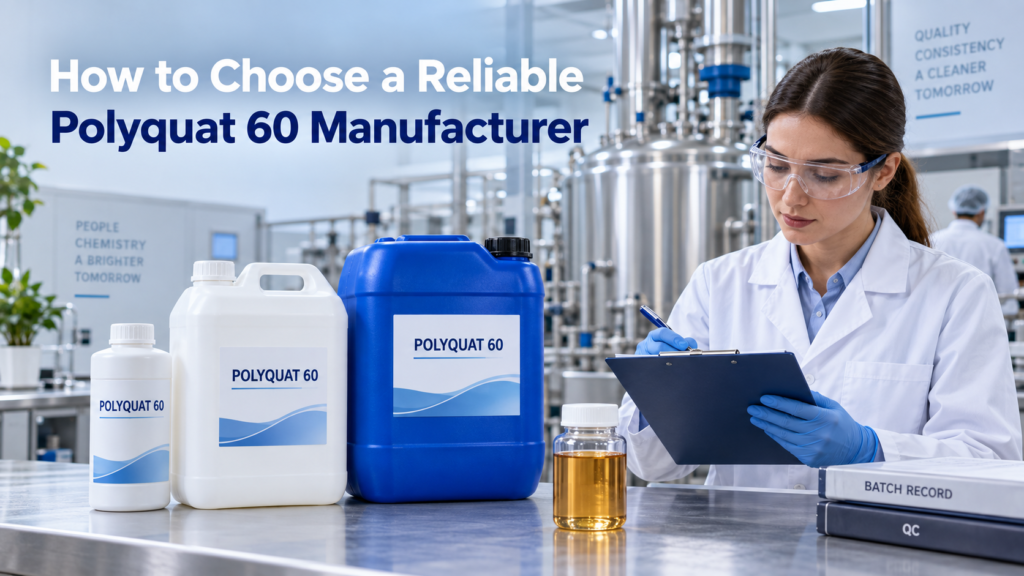
Image Alt Text: Quality-control specialist inspecting Polyquat 60 batch records beside 1 L, 5 L, and 25 L chemical packaging in a modern manufacturing facility.
Choosing a Polyquat 60 manufacturer may appear simple. You request specifications, compare prices, test a sample, and place an order.
That sounds reasonable. Yet it leaves plenty of room for expensive surprises.
Two suppliers may both describe their product as “Polyquat 60,” but the products may differ in chemical identity, active content, viscosity, color, storage stability, or batch consistency. Their documentation may also vary. One supplier might provide a clear Certificate of Analysis for every batch, while another sends a generic document that has not changed in years.
The difference may not become visible until the product is diluted, packaged, stored, shipped, or used in a customer’s pool. By then, changing suppliers becomes far more painful.
A reliable manufacturer does more than deliver a chemical with the right name. It provides a product that behaves predictably from one shipment to the next—and supports you when technical, packaging, or regulatory questions arise.
So, what should you check before choosing a Polyquat 60 supplier? Let’s work through the decision carefully.
First, Confirm What “Polyquat 60” Actually Means
“Polyquat 60” is widely used as a commercial description for a concentrated polymeric quaternary ammonium algaecide. It is commonly based on polixetonium chloride, identified by CAS No. 31512-74-0.
The U.S. Environmental Protection Agency lists this CAS number as a reviewed pesticide active ingredient under the longer chemical description poly[oxy-1,2-ethanediyl(dimethyliminio)-1,2-ethanediyl(dimethyliminio)-1,2-ethanediyl dichloride]. That long name is one reason buyers and formulators prefer shorter commercial terms such as Polyquat 60 or Polyquaternium-42.
Still, a commercial name alone does not establish identity.
Before discussing price, ask the supplier to confirm:
- Chemical name
- CAS number
- Active ingredient percentage
- Total solids or content percentage
- Product appearance
- pH test concentration
- Density
- Viscosity
- Recommended storage conditions
- Intended application
This step matters because “Polyquat” can refer to several cationic polymers. Products based on different polymer structures may not deliver the same algae-control, foaming, compatibility, or formulation performance.
A quotation saying only “Polyquat 60, 60%” is not enough. You need to know what makes up that 60%.
For a closer explanation of the active ingredient, visit Polixetonium Chloride.
Check the Active Content—But Don’t Stop There
Active content is one of the first numbers most buyers examine. That makes sense. A concentrated product should contain enough functional polymer to support the expected formulation and dosage.
However, active content is not the whole specification.
A manufacturer should be able to explain the difference between active content and total solids. These figures are related, but they are not always identical. Depending on the analytical method, a laboratory may measure ionic activity, polymer content, dry residue, or another defined property.
For example, a typical concentrated commercial grade may be controlled within ranges such as:
- Active content: approximately 58.0–61.0%
- Total content or solids: approximately 62.0–65.0%
- pH at a stated dilution: around neutral
- Density: controlled within a narrow range
- Viscosity: controlled according to an agreed method and temperature
The precise limits should be confirmed between buyer and manufacturer. More importantly, the test methods must be clear.
Ask these questions:
- How is active content measured?
- Is total solids tested separately?
- At what temperature is viscosity measured?
- Which spindle and rotation speed are used?
- Is pH measured on the concentrated product or a diluted solution?
- How often are laboratory instruments calibrated?
- Are retained samples stored for every batch?
Without defined methods, two laboratories can test the same material and report different results. That does not always mean one result is false. It may simply mean the methods were different.
A dependable manufacturer understands this and can discuss the method—not just the number printed on the COA.
Look for Batch Consistency, Not One Perfect Sample
A beautiful sample proves that a supplier can produce one acceptable kilogram. It does not prove that the company can deliver the same material month after month.
Consistency is the real test.
Pool chemical brands often dilute concentrated Polyquat 60, blend it with other compatible ingredients, or pack it into retail containers. A shift in viscosity, active content, color, or pH may affect pumping, filling, product appearance, dilution speed, and finished-product stability.
One slightly different batch might not sound serious. But imagine filling several thousand retail bottles before discovering that the liquid flows more slowly than expected. Production stops. Workers adjust the equipment. Delivery dates slip. Suddenly, a small raw-material variation becomes a commercial problem.
Ask the manufacturer for COAs from at least three recent batches. Compare:
- Active content
- Total solids
- pH
- Density
- Viscosity
- Appearance
- Production dates
- Batch numbering format
The results do not need to be identical. Chemical production naturally involves some controlled variation. What you want to see is a stable pattern inside sensible specification limits.
Be cautious if every historical COA shows exactly the same figures, right down to the final decimal place. Real laboratory results normally vary slightly. Perfect repetition may indicate that standard specification values were copied instead of actual batch data being reported.
A reliable manufacturer should also operate a traceable batch system. If a customer reports a problem, the supplier should be able to connect the shipment to its raw materials, production record, laboratory result, packaging date, and retained sample.
That traceability is far more valuable than a glossy factory brochure.
Evaluate the Manufacturer’s Quality-Control System
You do not need to turn every supplier evaluation into a week-long factory audit. Still, you should understand how quality is controlled.
Start with the incoming raw materials. Ask whether the manufacturer checks their identity and quality before production. Variation in raw materials can influence reaction control, color, residual components, viscosity, and final stability.
Then review the in-process controls. Does the production team monitor reaction temperature, addition rate, mixing, time, pH, or other critical conditions? Are these data recorded in a batch-production document?
Finally, examine finished-product testing.
A capable QC laboratory should have suitable equipment for the agreed specification. Depending on the test program, that may include:
- Analytical balances
- pH meters
- Viscometers
- Density measurement equipment
- Drying ovens or moisture-testing equipment
- Titration equipment
- Temperature-control devices
Equipment alone proves little, of course. A viscometer sitting in a spotless laboratory looks impressive, but the real questions are whether it is calibrated, whether staff follow a written method, and whether failed results are investigated.
Ask what happens when a batch falls outside specification. Is it isolated? Retested? Reprocessed? Rejected? Who approves its release?
The answer reveals a great deal about the manufacturer’s quality culture.
Request the Right Documents Early
Documentation should not be treated as a final shipping detail. Review it before approving the supplier.
At a minimum, request:
- Current product specification
- Representative Certificate of Analysis
- Safety Data Sheet
- Technical Data Sheet
- Product label information, where relevant
- Packing details
- Shelf-life statement
- Storage recommendations
- Country-of-origin information
- Regulatory statements required by your market
Check that the product name, CAS number, composition, and company details remain consistent across these documents.
An SDS should be prepared for the actual product being supplied. A document downloaded from an unrelated database may describe pure material or a different concentration. Its hazard classification, transport section, exposure guidance, and company contact information may not fit the commercial product you are buying.
The same applies to the COA. It should identify:
- Manufacturer or responsible supplier
- Product name
- Batch number
- Manufacturing or testing date
- Specification limits
- Actual test results
- Authorized approval
If the supplier sends a document showing only “Pass” for every property, request the numerical results for key parameters.
Don’t Confuse Manufacturing Quality with Market Registration
Polyquat 60 can be used as an active ingredient in pool algaecide formulations, but regulatory requirements depend on the destination country and the claims made for the finished product.
This distinction is important.
A manufacturer may produce a chemically consistent raw material without holding permission to sell your final branded algaecide in every market. Likewise, an acceptable raw material does not automatically make the finished formulation legally marketable.
For products sold with algae-control or pesticidal claims, review:
- Active-ingredient status
- Finished-product registration requirements
- Permitted claims
- Label language
- Packaging rules
- Import restrictions
- Local SDS format
- Record-keeping requirements
In the United States, for example, pesticidal claims are regulated. Buyers should verify federal and, where applicable, state requirements for their specific formulation and route to market.
Do not accept vague promises such as “This product can be sold everywhere.” Chemical identity, raw-material manufacture, formulation approval, and finished-product registration are separate matters.
A trustworthy manufacturer will acknowledge that distinction. It should provide available technical data while allowing your regulatory specialist, importer, or local consultant to confirm the legal route.
Test Performance in Your Own Formulation
A supplier’s sample may meet its specification and still behave differently in your finished product.
Why? Because formulations are systems. Water quality, dilution sequence, preservatives, dyes, fragrances, surfactants, clarifiers, salts, packaging materials, and storage temperature can all affect the final result.
Polyquat 60 is cationic. That positive charge is important to its function, but it also means formulators should pay attention to materials carrying a strong negative charge. Some anionic surfactants or polymers may cause incompatibility, loss of performance, cloudiness, or precipitation.
Before approving a manufacturer, run a small formulation trial using your real process.
Check:
- Dilution behavior
- Mixing time
- Appearance after dilution
- pH
- Odor
- Foaming
- Clarity
- Viscosity
- Low- and high-temperature stability
- Packaging compatibility
- Performance in representative pool water
Observe the sample immediately after preparation and again after storage. A formulation that looks clear on the first day may develop haze, sediment, color change, or separation later.
If you intend to sell a concentrated algaecide rather than a diluted finished product, test the material in its final container. Confirm that caps, liners, seals, labels, and container walls remain suitable during storage.
You can review a typical concentrated product format on the Polyquat 60 Algaecide page.
Ask for a Pre-Shipment Sample from the Actual Batch
An initial laboratory sample helps you screen a supplier. A pre-shipment sample gives you a stronger connection to the material being delivered.
For important first orders, ask whether the manufacturer can provide a sample drawn from the finished production batch. Compare it with the approved reference sample.
This is especially useful when:
- The first commercial order is large
- Your formulation has a narrow viscosity range
- Product color is commercially important
- You plan to fill transparent or translucent packaging
- The product will be stored for a long period
- Your customer has strict incoming-inspection limits
Keep your own approved sample under suitable conditions. Label it with the supplier, batch number, receipt date, and approval date.
That small bottle can settle a surprising number of later questions.
Inspect Production Capacity Without Being Distracted by Big Numbers
Manufacturers often promote annual capacity. The number may sound impressive, but capacity alone does not tell you whether your orders will receive reliable attention.
Ask more practical questions:
- How many production lines can make the product?
- What is the normal batch size?
- What is the minimum commercial order?
- How long does one batch require?
- What is the normal lead time during peak season?
- Is production made to order or held in stock?
- How is equipment cleaned between products?
- What happens if a production line stops?
- How much finished-goods storage is available?
- Can the manufacturer support repeat monthly orders?
For a pool chemical distributor, seasonal planning matters. Demand may rise sharply before the swimming season. A supplier that performs well in November may struggle in March or April when several customers place orders at once.
Discuss forecasts early. You do not have to make a binding commitment, but sharing an estimated purchasing schedule helps the manufacturer reserve raw materials, production time, packaging, and shipping space.
Reliability often comes from quiet planning months before the container leaves the port.
Examine Packaging as Part of Product Quality
Even excellent Polyquat 60 can become a customer complaint if the packaging leaks, deforms, or arrives with damaged labels.
Discuss the packaging specification in detail:
- Container material
- Nominal and net filling quantity
- Cap type
- Inner seal or liner
- Tamper-evident features
- Pallet configuration
- Carton strength
- Drum or IBC condition
- Label material
- Batch-code position
- Export markings
Commercial formats may include small retail bottles, 5 L jerry cans, 25 L jerry cans, drums, or IBCs. The correct choice depends on your market and whether you are buying a finished private-label product or concentrated raw material for local blending.
Request photographs of the exact packaging—not merely similar packaging used for another product.
For private-label orders, approve a digital label proof and, when practical, a physical printed sample. Small errors involving concentration, dosage, warnings, net contents, barcode placement, or company address can delay an entire shipment.
Packaging is not decoration. It is part of the product.
Find Out Whether the Supplier Can Support Your Business Model
Not every buyer needs the same type of manufacturer.
A formulator purchasing bulk raw material may care most about technical consistency and logistics. A new pool chemical brand may need formulation support, small-package filling, label application, cartons, and mixed-container loading.
Clarify whether the manufacturer can provide:
- Concentrated raw material
- Custom dilution
- Formulation and blending
- Private-label filling
- Custom packaging
- Trial quantities
- Mixed packaging sizes
- Neutral export packaging
- Batch-specific COAs
- Technical communication after delivery
If you plan to expand from one algaecide into a broader pool-care range, ask whether related products can be supplied under the same quality and packaging system. For example, a brand may combine Polyquat 60 with Algae Control 60 or other compatible pool-maintenance products.
There is a commercial advantage here. Working with a manufacturer that understands both concentrated raw materials and finished pool products can reduce repeated packaging development, documentation work, and shipment coordination.
Still, do not buy products merely because they can share a container. Each formulation deserves its own technical review.
Judge Communication Before You Judge the Price
Supplier communication often predicts what will happen after the order.
During the evaluation stage, notice whether the sales and technical teams:
- Answer the exact question asked
- Distinguish confirmed facts from estimates
- Explain test methods clearly
- Send consistent documents
- Respond within a reasonable time
- Admit when further checking is needed
- Keep records of agreed specifications
- Inform you quickly about delays or changes
Fast replies are helpful, but accurate replies matter more.
A salesperson who answers every technical question in two minutes may simply be guessing. It is often more reassuring to hear, “I need to confirm that with our laboratory and will reply tomorrow,” followed by a precise answer the next day.
Also establish how changes will be handled. Will the manufacturer notify you before changing raw materials, production methods, test methods, packaging components, or manufacturing locations?
A change-control agreement is especially valuable for repeat orders and private-label products.
Compare the Total Purchasing Cost
The lowest quoted price per kilogram is not always the lowest real cost.
Consider:
- Active ingredient concentration
- Usable yield after dilution
- Packaging cost
- Inland transportation
- Export charges
- Freight
- Import duties
- Inspection costs
- Payment terms
- Leakage or damage risk
- Rejected-batch risk
- Production delays
- Customer complaints
- Supplier-change costs
Suppose Supplier A is slightly cheaper, but its viscosity varies widely and every incoming batch requires formulation adjustment. Supplier B costs a little more but runs smoothly through your filling line every time.
Which one is truly less expensive?
Consistency saves labor, testing, rework, downtime, and worry. Those savings rarely appear on the original quotation, yet they are very real.
Ask for a quotation that clearly states the product grade, concentration, packaging, quantity, Incoterm, lead time, payment terms, and quotation validity. Otherwise, you may be comparing different offers without realizing it.
Use a Controlled Trial Order
After reviewing documents and testing samples, begin with a controlled commercial order when possible.
The trial should be large enough to test real production, packaging, shipping, receiving, and formulation conditions. At the same time, it should remain manageable if a problem occurs.
During the trial order, evaluate the full supplier experience:
- Was the order confirmation accurate?
- Did production begin on schedule?
- Was the batch documentation complete?
- Did the pre-shipment sample match expectations?
- Was the packaging clean and secure?
- Were labels and markings correct?
- Did the shipment leave on time?
- Did the received quantity match the documents?
- Did incoming test results match the COA?
- Did the material perform correctly in the final formulation?
A manufacturer should not be approved merely because the sample passed. The complete order cycle must pass as well.
After delivery, record the results in a supplier scorecard. Keep it simple: quality, delivery, documentation, communication, packaging, and corrective response. Over several orders, the pattern becomes easy to see.
Watch for Common Warning Signs
No single warning sign automatically disqualifies a supplier, but several together should make you pause.
Be careful when a supplier:
- Cannot confirm the CAS number
- Uses “Polyquat 60” for chemically different products
- Refuses to explain analytical methods
- Sends inconsistent specifications
- Provides identical results on every historical COA
- Avoids discussing active content versus total solids
- Cannot supply an SDS for the actual concentration
- Promises universal regulatory approval
- Offers an unusually low price without a clear reason
- Changes packaging without notice
- Will not provide a batch sample
- Cannot trace complaints to production records
- Gives technical answers that change from one email to the next
- Pushes for a large first order before sample testing
Trust is not built through cheerful promises. It is built through evidence, repetition, and sensible transparency.
A Practical Manufacturer Evaluation Checklist
Before approving a Polyquat 60 manufacturer, confirm the following points.
Product identity
- Correct chemical name
- CAS No. 31512-74-0, when polixetonium chloride is required
- Agreed active content
- Clear distinction between active content and total solids
Quality
- Defined specification
- Written test methods
- Recent batch COAs
- Batch traceability
- Retained samples
- Calibrated laboratory equipment
- Process for handling nonconforming batches
Performance
- Sample approved in your formulation
- Dilution and mixing performance checked
- Foaming evaluated
- Storage stability tested
- Packaging compatibility confirmed
Documentation
- Current SDS
- Technical Data Sheet
- Batch-specific COA
- Shelf-life and storage statement
- Suitable shipping and export documents
- Available regulatory information
Supply
- Realistic production capacity
- Agreed lead time
- Seasonal supply plan
- Suitable minimum order quantity
- Backup arrangements for production delays
Packaging and service
- Confirmed container specification
- Secure caps and seals
- Accurate labels
- Private-label capability, if required
- Clear complaint-handling process
- Change notification procedure
Reliability Is Proven One Batch at a Time
Choosing a reliable Polyquat 60 manufacturer is not about finding the company with the biggest factory photograph or the cheapest quotation.
It is about finding a partner that controls the details.
The chemical identity must be correct. Test methods must be clear. Batch results must remain inside agreed limits. Packaging must survive storage and transport. Documentation must match the actual product. Communication must stay accurate when something becomes difficult.
And yes, the price still matters. Of course it does. But a low price loses its charm rather quickly when a batch blocks a filling line, delays a seasonal launch, or creates customer complaints.
Begin with documents, verify the laboratory data, test the product in your formulation, and use a controlled trial order. Then watch what happens across repeated shipments.
That is how reliability becomes visible—not as a sales claim, but as a pattern.
Frequently Asked Questions
1. What specifications should I request from a Polyquat 60 manufacturer?
Request the chemical identity, CAS number, active content, total solids, appearance, pH, density, viscosity, storage conditions, and shelf life. You should also ask for the test methods used for each important parameter.
2. How can I verify whether a Polyquat 60 supplier offers consistent quality?
Compare COAs from at least three recent production batches, test a representative sample, and request a pre-shipment sample from the actual commercial batch. Check whether active content, pH, density, viscosity, and appearance remain within agreed limits.
3. Is the cheapest Polyquat 60 manufacturer usually the best choice?
Not necessarily. Compare usable concentration, batch consistency, packaging, freight, documentation, payment terms, delivery reliability, and the risk of production problems. A slightly higher material price may result in a lower total purchasing cost.
4. Should I test Polyquat 60 before placing a bulk order?
Yes. Test it in your actual formulation, dilution water, production process, and final packaging. Examine clarity, viscosity, foaming, pH, storage stability, and compatibility with other ingredients before approving a bulk order.
5. Can a Polyquat 60 manufacturer provide private-label pool algaecide?
Some manufacturers can provide dilution, formulation, filling, labels, cartons, and custom packaging. Confirm their minimum order quantity, available package sizes, label-review process, quality controls, and ability to support the regulatory requirements of your target market.