
GET IN TOUCH
Ask For Sample?
Why Pool Maintenance Companies Need Professional Algaecides?
A swimming pool can look perfect on Monday and develop a faint green tint by Wednesday. For a homeowner, that is annoying. For a pool maintenance company, it is something more serious: a service problem, an extra visit, additional chemical costs, and possibly an unhappy customer.
That difference matters.
Professional pool maintenance isn’t simply about making water look blue. Service companies have to keep dozens—or sometimes hundreds—of pools stable despite changing weather, swimmer loads, filtration conditions, water chemistry, and maintenance schedules. Chlorine remains central to pool sanitation, of course, but chlorine alone doesn’t always provide the margin for error that a commercial service operation needs.
That’s where professional algaecides earn their place.
A well-designed algaecide program can help prevent algae from gaining a foothold between service visits, support chlorine-based maintenance, reduce repeated corrective treatments, and make water conditions more predictable. For pool companies, predictability has real value.
One Green Pool Can Cost More Than a Bottle of Algaecide
It’s easy to think of algae as a water-quality issue. For a pool service business, however, algae is also an operational issue.
Imagine a technician servicing 15 pools in one day. The schedule works because each stop is reasonably predictable: inspect the water, test chemistry, make adjustments, clean as required, check equipment, and move on.
Then pool number six is green.
Suddenly, the routine disappears.
The technician may need to brush surfaces more extensively, adjust water chemistry, apply corrective treatment, inspect circulation, clean or backwash the filter, and schedule a follow-up visit. One troublesome pool can throw off the rest of the day’s route.
There may also be costs that don’t appear on the chemical invoice:
- Additional technician time
- Fuel for return visits
- Extra chlorine or shock treatment
- Filter cleaning
- Customer complaints
- Schedule disruption
- Damage to the service company’s reputation
That’s why professional algae management is usually more effective when viewed as prevention rather than rescue.
It’s a bit like maintaining a delivery van. Waiting until the engine stops on the highway isn’t really a maintenance strategy. Pool algae deserves similar thinking.
But Doesn’t Chlorine Kill Algae?
Yes. Chlorine is capable of controlling many microorganisms, including algae.
So why use an algaecide?
Because real swimming pools rarely operate under perfect laboratory conditions.
Free chlorine can be consumed by sunlight, organic contamination, heavy swimmer loads, leaves, debris, rainfall, and other chlorine-demanding materials. Poor circulation can also create areas where sanitizer distribution is weaker.
A pool may therefore have an acceptable chlorine reading during one service visit yet experience quite different conditions before the technician returns.
This becomes especially important for weekly maintenance routes.
Think about what can happen during those seven days: a thunderstorm rolls through, temperatures climb, a family hosts a pool party, leaves fall into the water, or a circulation problem develops.
The chemical environment isn’t standing still.
A professional algaecide can provide an additional layer of algae control within the broader maintenance program. It doesn’t replace proper chlorination, filtration, circulation, or brushing. Instead, it helps make the overall system less vulnerable when conditions become favorable for algae.
That distinction is important.
Professional Pool Care Is Really About Managing Variability
Homeowners usually care for one pool.
A service company may care for 50, 200, or 1,000.
And those pools aren’t identical.
One sits beneath trees. Another receives intense afternoon sunlight. One has a variable-speed pump running a carefully planned circulation schedule; another has aging equipment. Some pools see very little use, while others are packed every weekend.
This variability makes professional pool maintenance surprisingly complex.
A product that seems acceptable in occasional residential use may become inconvenient when technicians have to use it repeatedly across a large route.
Professional products therefore need more than algae-control capability. Pool companies often look at practical characteristics such as ease of dosing, compatibility with routine treatment programs, storage stability, foaming tendency, potential staining issues, and consistency from batch to batch.
In other words, chemistry matters—but field behavior matters too.
Prevention Is Usually Easier Than Fighting an Established Bloom
Once algae becomes visible, you’re already dealing with an established problem.
That usually means more work.
Corrective treatment can involve brushing, sanitizer adjustment, filtration, vacuuming, repeated testing, and follow-up inspection. Severe blooms can take considerable time to clear.
Preventive treatment is different.
The goal is to maintain conditions that make it harder for algae populations to become established in the first place.
For a maintenance company, that can be particularly useful during predictable high-risk periods, such as:
- Hot summer weather
- Heavy rainfall
- High swimmer loads
- Extended service intervals
- Pool opening
- Winterization
- Periods of recurring algae pressure
Of course, an algaecide can’t compensate for seriously neglected water chemistry. If sanitizer is consistently inadequate or circulation has practically stopped, pouring in more algaecide isn’t a magic fix.
Professional maintenance works as a system.
Sanitizer, pH control, circulation, filtration, brushing, cleaning, and algae prevention all have roles to play.
Foam: A Small Detail Until the Pool Looks Like a Bubble Bath
Foaming illustrates why formulation matters.
Some traditional quaternary ammonium compounds can generate noticeable foam, particularly where water is vigorously aerated. That may become visually obvious around return jets, waterfalls, spas, fountains, and other high-agitation areas.
Chemically, the product might still be doing its job.
Visually? The customer may disagree.
A homeowner who walks outside and sees foam floating across a freshly serviced pool probably isn’t thinking about cationic surfactant chemistry. They’re thinking, “What did the pool company put in my water?”
That’s not the conversation a service technician wants to have.
For this reason, low-foaming or non-foaming algaecides can be attractive for routine professional maintenance.
Polymeric quaternary ammonium compounds are particularly relevant here.
Unlike many simpler quaternary ammonium formulations, polymeric algaecides can provide algae control while greatly reducing the foaming problem associated with some traditional quat products.
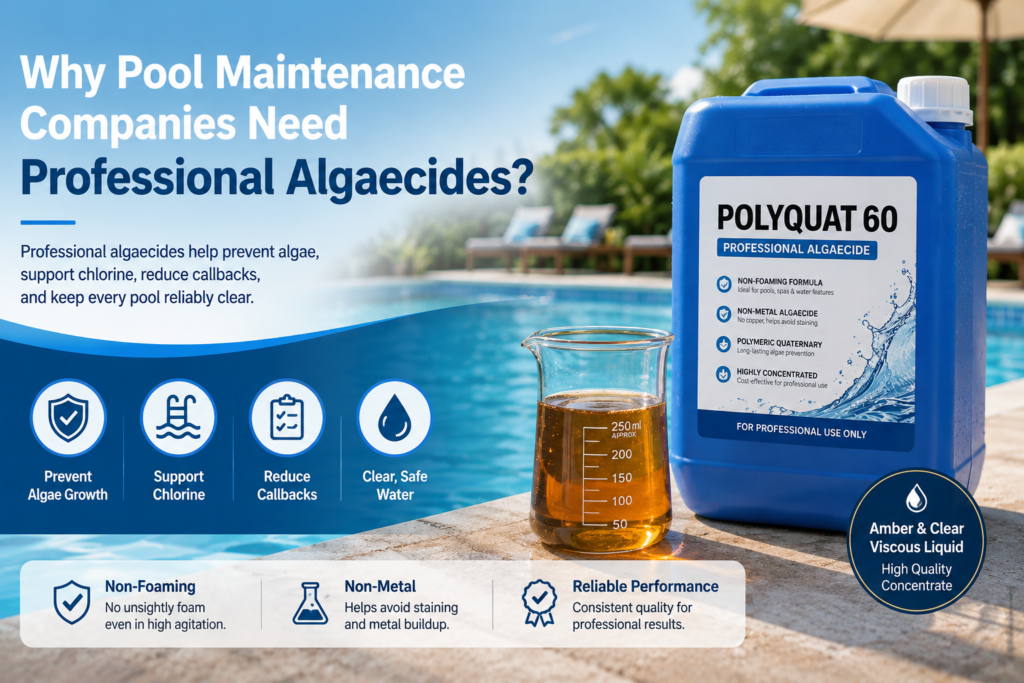
This is one reason Polyquat 60 Algaecide has become familiar in professional swimming pool maintenance programs.
Why Non-Metal Algaecides Get Attention?
Copper compounds have a long history in algae control. Copper ions can be effective against algae, and copper-based products remain available for pool treatment.
Yet effectiveness isn’t the only consideration.
Metal-containing treatments can introduce another variable into pool chemistry: dissolved metals.
Under unfavorable water conditions, metals may contribute to staining or discoloration. The actual risk depends on factors such as concentration, pH, water chemistry, surface type, and treatment practices, but professional pool companies naturally prefer to avoid unnecessary complications.
After all, solving algae only to create a staining complaint isn’t much of a victory.
This has helped drive interest in non-metal alternatives, including polymeric quaternary ammonium algaecides.
A non-metal algaecide doesn’t introduce copper as the active algae-control component. For maintenance programs concerned about metal accumulation, that can simplify treatment planning.
Again, there’s no single chemical that is automatically correct for every pool. Water conditions, treatment objectives, local regulations, product labels, and compatibility all matter.
Still, the movement toward non-metal algae-control programs makes practical sense for many service businesses.
So, Where Does Polyquat 60 Fit?
Polyquat 60 is a concentrated polymeric quaternary ammonium algaecide widely associated with swimming pool algae-control applications.
The “60” generally refers to the concentrated active-content format commonly supplied commercially.
Unlike many traditional quat algaecides, Polyquat 60 is valued for its non-foaming characteristics. It is also a non-metal treatment, so it doesn’t depend on copper ions for algae control.
These characteristics make it particularly interesting for preventive maintenance programs.
Rather than waiting until a pool turns green, technicians can incorporate an appropriate algaecide into a broader algae-management strategy based on the product label and actual pool conditions.
For buyers evaluating concentrated raw materials or private-label formulations, understanding the underlying chemistry is useful. Our Polyquat 60 Algaecide information explains the polymer-based approach in more detail, including how concentrated material can be used as the basis for professional pool-care formulations.
There’s another practical advantage here: formulation flexibility.
Commercial pool brands may want different active concentrations, packaging sizes, dosing concepts, or market positioning. A concentrated raw material provides room for manufacturers and formulators to develop products for different maintenance requirements.
Algaecide Should Support Chlorine, Not Compete With It
This point deserves emphasis because the word algaecide can create the wrong impression.
Professional algaecide isn’t supposed to become an excuse for poor sanitizer management.
Chlorine remains a primary part of swimming pool sanitation. Maintaining appropriate sanitizer levels, pH, circulation, and filtration remains essential.
Think of an algaecide as a supporting player.
A good goalkeeper doesn’t eliminate the need for defenders. In much the same way, algae-control products provide another barrier within a broader pool maintenance program.
That extra barrier becomes valuable when conditions fluctuate.
For example, suppose a pool normally receives weekly service. The technician leaves the water properly balanced on Tuesday. By Friday, unusually hot weather and heavy swimming have increased sanitizer demand.
A preventive algaecide treatment doesn’t make chlorine unnecessary. It simply gives the maintenance program another mechanism working against algae development.
For a professional company managing a large route, that additional margin can matter.
Fewer Callbacks Can Be More Valuable Than Lower Chemical Cost
Chemical purchasing decisions often focus heavily on cost per kilogram, liter, or gallon.
Fair enough. Cost matters.
But professional service companies should also consider cost per successfully maintained pool.
Those aren’t necessarily the same thing.
Suppose Product A is cheaper but contributes to frequent foaming complaints or doesn’t fit the company’s preventive maintenance strategy. Product B costs somewhat more but works smoothly within the service routine and helps reduce corrective visits.
Which one is actually cheaper?
The answer becomes clearer once labor enters the calculation.
A technician’s return visit involves wages, transportation, scheduling capacity, chemicals, equipment use, and administrative time. Even one avoided callback can offset a meaningful amount of preventive-treatment cost.
Customer retention matters too.
Most homeowners don’t judge a maintenance company by chemical theory. They judge what they see when they walk into the backyard.
Clear water feels effortless when everything works.
Green water feels like failure.
It’s harsh, perhaps, but that’s the reality of service businesses.
Summer Changes the Equation
Algae pressure isn’t constant throughout the year.
Warm water, strong sunlight, heavy swimming, summer storms, and increased organic contamination can make warm-season maintenance more demanding.
This is often when weaknesses in a maintenance program become visible.
A pool that stayed perfectly clear during mild spring weather may suddenly develop algae along steps, walls, corners, or areas with weaker circulation.
Professional companies can respond by adjusting the entire maintenance program rather than simply adding more of one chemical.
That might include checking:
- Free chlorine and sanitizer demand
- pH and other relevant water parameters
- Circulation time
- Filter performance
- Debris accumulation
- Brushing frequency
- Swimmer load
- Algaecide treatment strategy
Notice the pattern?
Algaecide is part of the answer, not the whole answer.
That mindset tends to produce much more reliable water management.
Pool Opening and Winterization Need Different Thinking
Seasonal pools create another challenge.
During opening, technicians may encounter water that has been sitting under a cover for months. Organic contamination, poor circulation, and changing sanitizer conditions can create favorable conditions for algae.
Winterization presents the opposite problem: how do you help keep algae under control during a long period when normal maintenance is reduced? In these cases, products such as Winter Algaecide are often considered as part of a professional closing program.
This is where longer-duration preventive strategies become useful.
Depending on the climate, pool type, winterization method, and approved product directions, professional companies may incorporate suitable algaecides into closing programs to reduce the chance of opening a green pool months later.
Anyone who has removed a cover in spring and discovered something resembling pea soup understands the appeal.
Not Every “Professional” Algaecide Is Automatically Better
The word professional on a label doesn’t tell you much by itself.
Pool maintenance companies, distributors, and private-label brands should look at the actual formulation.
Important questions include:
What is the active chemistry?
Is the formulation based on a traditional quat, polymeric quat, metal compound, or another active system?
Does it foam?
This matters considerably for pools with water features, spas, strong return flow, or other forms of agitation.
Does it contain metals?
If avoiding metal addition is important to the maintenance program, this becomes an obvious screening question.
What is the active concentration?
Concentrated products and ready-to-use products aren’t directly comparable based only on price per container.
How should it be dosed?
Always follow the applicable product label and regulatory requirements in the market where the finished product is sold and used.
Is the raw material consistent?
For formulators and private-label brands, batch consistency becomes especially important. Variations in active content, viscosity, appearance, or other specifications can affect manufacturing and finished-product quality.
Buyers working with polymeric algae-control chemistry may also find our Polixetonium Chloride technical information useful when comparing raw-material specifications and potential formulation applications.
Professional Algae Control Is Really About Reliability
It’s tempting to frame the question as “Do pool companies need algaecide?”
A better question may be:
How much variability can the maintenance business tolerate?
Pool companies make money by maintaining many pools efficiently and consistently. Every unexpected green pool consumes time that could have been spent servicing another customer.
Professional algaecides can help reduce that uncertainty.
They won’t fix broken pumps.
They won’t correct wildly inappropriate pH.
They won’t remove leaves from the bottom of a pool.
And they certainly don’t eliminate the need for proper sanitizer management.
What they can do is strengthen a preventive algae-control program.
For many professional operators, that’s the real value—not simply killing algae, but making algae less likely to become tomorrow morning’s emergency phone call.
A clear pool is nice.
A hundred consistently clear pools? That’s a business.
FAQs
1. Do professional pool maintenance companies need algaecide if they already use chlorine?
Chlorine remains essential for pool sanitation, but professional algaecides can provide additional preventive algae control when chlorine levels fluctuate because of sunlight, swimmer load, rainfall, organic contamination, or other factors. They should complement proper chlorination rather than replace it.
2. What type of algaecide is suitable for weekly pool maintenance?
The right choice depends on pool conditions and local product requirements, but low-foaming, non-metal polymeric algaecides are commonly considered for routine preventive maintenance. Compatibility, active concentration, dosing instructions, and water conditions should all be reviewed.
3. Why do pool professionals use non-foaming algaecides?
Foam can become highly visible in pools with strong circulation, waterfalls, fountains, or spas. Non-foaming algaecides help professional maintenance companies control algae without creating an unwanted bubble or foam problem under normal labeled use conditions.
4. Is Polyquat 60 suitable for preventive pool algae control?
Polyquat 60 is commonly associated with preventive swimming pool algae-control formulations because it combines polymeric quaternary ammonium chemistry with non-foaming and non-metal characteristics. Finished-product dosage should always follow the relevant product label and regulatory requirements.
5. What should a pool chemical company consider when sourcing Polyquat 60 algaecide?
Companies sourcing Polyquat 60 for professional pool maintenance products should examine active content, appearance, viscosity, consistency, packaging, quality documentation, formulation requirements, and regulatory status in the target market. For private-label products, finished-product concentration and packaging requirements should also be established before production.