
GET IN TOUCH
Ask For Sample?
How Hotels and Resorts Manage Pool Algae Problems?
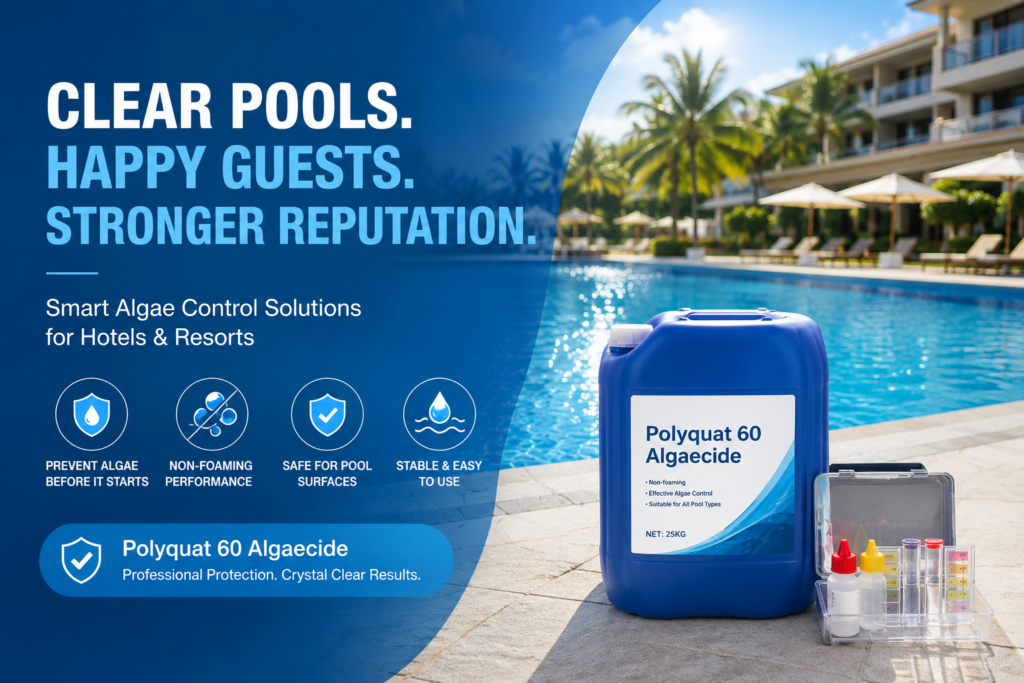
A hotel pool can look perfect at sunset and slightly cloudy by breakfast. Give it another warm day, a few hundred swimmers, and a struggling circulation system, and those harmless-looking changes may become the beginning of an algae problem.
For hotels and resorts, that matters.
A private pool owner can close the pool for a day, shock the water, brush the walls, and wait. A resort has a different problem. Guests expect the pool to be open. Families have planned their afternoon around it. Photos of the property may feature that same bright blue water. And nobody wants to explain why the centerpiece of the courtyard has suddenly turned green.
That is why commercial pool algae control is less about reacting to green water and more about keeping conditions unfavorable for algae every single day.
Hotels usually achieve this through a combination of filtration, circulation, sanitizer management, water testing, physical cleaning, preventive algaecides, and—perhaps most important—consistent operating routines.
Here is how the pieces fit together.
A Green Pool Is More Than a Water-Care Problem
For a hotel, pool appearance is part of the guest experience.
Imagine arriving at a resort after a long flight. You walk through the lobby, drop your bags, and head toward the pool. Instead of sparkling blue water, you see cloudy water with green patches around the steps.
Would you get in?
Probably not.
And even after the problem has been corrected, guests may remain cautious. Water quality is something people judge visually, even though appearance alone cannot confirm whether water is properly sanitized.
That makes algae control both an operational issue and a reputation issue.
Large hotels also face conditions that can make algae management harder than it is in many residential pools:
- High and rapidly changing swimmer loads
- Sunscreen, body oils, cosmetics, and organic contamination
- Long daily operating hours
- Warm water
- Strong sunlight
- Large water volumes
- Complex plumbing and circulation
- Decorative pool shapes with difficult circulation zones
- Frequent splashing and water replacement
- Outdoor contamination from dust, leaves, pollen, and rain
A resort pool might be almost empty at 8:00 a.m. and packed by 2:00 p.m. Water chemistry has to cope with both conditions.
That variability is one reason commercial pool operators rely on a system rather than a single chemical.
So, Where Does the Algae Come From?
Algae spores can enter outdoor pools from the surrounding environment. Wind, rain, dust, equipment, landscaping debris, and swimmers can all contribute material to the water.
Their presence does not automatically mean the pool will turn green.
The real question is whether pool conditions allow algae to establish and multiply.
A well-managed pool makes that difficult.
Problems tend to appear when several weaknesses occur at once. Sanitizer levels may fall during a busy afternoon. Circulation may be weak behind a ladder. Filters may be overdue for cleaning. A storm may introduce organic material and dilute the pool water.
Individually, each issue might be manageable.
Together? That’s where trouble starts.
Early algae growth may first appear on steps, corners, grout lines, walls, or other areas where water movement is weaker. These spots deserve special attention because circulation does not distribute treatment chemicals equally throughout every centimeter of a complex commercial pool.
This is especially relevant for resort pools with islands, shallow lounging shelves, curved walls, swim-up bars, waterfalls, and other architectural features.
Beautiful design can make circulation surprisingly complicated.
Chlorine Is Essential—but It Doesn’t Work in Isolation
Chlorine is a primary sanitizer in many commercial swimming pools, and maintaining the appropriate sanitizer residual is fundamental to pool operation.
Still, chlorine performance depends on the surrounding water chemistry and operating conditions.
pH matters. Stabilizer levels can matter in outdoor pools. Organic contamination creates additional sanitizer demand. Heavy swimmer loads can consume available sanitizer faster than expected.
Sunlight adds another challenge for outdoor facilities.
So while operators may have started the morning with acceptable readings, conditions can change considerably as hundreds of swimmers enter the water.
This helps explain Why Chlorine Alone Cannot Always Prevent Algae in demanding swimming pool environments.
The lesson isn’t that chlorine has failed or should be replaced. Quite the opposite. Sanitizer management remains central to safe pool operation.
The point is that algae prevention works better as a layered program.
Think of it like hotel security. You wouldn’t protect a large resort with one lock on the front door. You use locks, cameras, staff procedures, lighting, access control, and regular inspections.
Pool algae management follows a similar logic.
Circulation: The Part Guests Never See
Some of the most important algae-control equipment sits quietly behind a wall.
Pumps move treated water around the pool. Return inlets distribute it. Drains and skimmers remove water for filtration and treatment.
When this hydraulic system works properly, sanitizer and other treatment chemicals reach more of the pool.
When it doesn’t, dead spots develop.
These areas may include:
- Corners
- Steps
- Behind ladders
- Underwater benches
- Shallow shelves
- Areas around decorative structures
- Sections far from return inlets
Have you ever noticed algae repeatedly appearing in exactly the same corner of a pool?
That is a clue.
Adding more chemical without examining circulation may temporarily remove the visible algae while leaving the underlying problem untouched.
Professional pool teams therefore look at patterns. Where is the algae growing? Does it return in the same place? Are return jets positioned correctly? Is flow restricted? Is filtration operating for sufficient periods?
The location of algae can sometimes tell a surprisingly useful story.
Filtration Does Some of the Heavy Lifting
Filtration and algae control are closely connected.
A pool filter removes suspended material from circulating water. When algae have already developed, filtration also helps remove dead cells and fine debris after chemical treatment and brushing.
This is one reason an algae treatment can kill the organism without instantly making the water crystal clear.
Dead algae still have to go somewhere.
Depending on the facility and filter system, operators may need to monitor pressure, clean or backwash filters when appropriate, and continue filtration while the water clears.
Neglected filters create another headache. Poor filtration allows suspended material to remain in the water and can contribute to persistent cloudiness.
In a hotel environment, that difference matters. Guests don’t care whether cloudy water is caused by living algae, dead algae, fine particles, or another water-quality issue.
They simply see cloudy water.
Yes, Someone Still Has to Brush the Pool
Commercial water treatment can involve automated controllers, dosing equipment, sophisticated filtration, and carefully selected chemicals.
And then somebody still needs a pool brush.
There’s no glamorous way around it.
Algae can attach to surfaces and develop in small irregularities, grout lines, steps, corners, and other protected areas. Physical brushing disrupts this growth and exposes it more effectively to the surrounding treated water.
Routine brushing also allows maintenance staff to spot trouble early.
A faint slippery patch may not attract a guest’s attention. To an experienced pool technician, however, it can be an early warning.
Catching the problem at this stage is far easier than waiting until the whole pool develops a visible green tint.
Preventive Algaecides Add Another Layer of Protection
This is where algaecides enter the commercial maintenance program.
An algaecide is designed to control algae, but different chemistries behave differently. Some are more appropriate for routine preventive treatment, while others may have limitations related to foaming, staining, water chemistry, or compatibility.
Hotels and resorts are often particularly interested in products that can fit into an ongoing maintenance program without negatively affecting the appearance of the pool.
One chemistry used for this purpose is polymeric quaternary ammonium chemistry, commonly associated with products such as Polyquat 60 Algaecide.
Polyquat-type algaecides are non-oxidizing products. Rather than replacing chlorine as the primary sanitizer, they can serve as an additional algae-control component within a broader pool maintenance program.
That distinction is important.
A preventive algaecide shouldn’t become an excuse to ignore sanitizer residuals, circulation, filtration, pH, or cleaning. It works alongside those controls.
For a commercial pool operator, that’s often the more useful way to think about algaecide: another defensive layer.
Why Non-Foaming Performance Matters More at a Resort
Foam may sound like a small issue until you picture it floating around a luxury resort pool.
Then it suddenly isn’t so small.
Some traditional quaternary ammonium compounds can create foam under strong agitation. Swimming pools naturally provide plenty of agitation through return jets, swimmers, waterfalls, fountains, spa jets, and other water features.
This is one reason polymeric quaternary ammonium compounds have attracted attention in pool algae-control formulations.
Polyquat 60 is commonly described as a non-foaming or low-foaming polymeric algaecide when used appropriately.
For a hotel, this characteristic has obvious practical value.
The water needs to perform well, but it also needs to look right.
Foam around a resort pool can give guests the impression that soap or some unknown contaminant has entered the water—even when the actual explanation is different.
And perception matters.
This is particularly important for properties with waterfalls, fountains, hydrotherapy features, or high water turbulence.
Why Hotels May Prefer Non-Metal Algae-Control Programs?
Metal-based algaecides, particularly copper-containing products, have a long history in algae control. They can be effective when properly formulated and managed.
Yet commercial facilities may also consider the potential operational issues associated with metals.
Under certain conditions, dissolved metals can contribute to staining or discoloration. Water chemistry, concentration, pool surfaces, and other factors all influence the actual risk.
A stain on a private pool wall is annoying.
A visible stain across the floor of a five-star resort pool is a maintenance manager’s Monday morning nightmare.
This is one reason some commercial formulations use non-metal algaecides as part of their preventive programs.
Polymeric algaecides such as Polyquat 60 offer algae-control chemistry without relying on copper as the active algae-control component.
That doesn’t make every non-metal product automatically better for every pool. Treatment choices still depend on the system, local regulations, formulation, water conditions, and operating goals.
But for facilities concerned about metal accumulation and appearance, it is an important consideration.
What Happens When a Resort Actually Gets an Algae Outbreak?
Prevention is preferable. Still, outbreaks happen.
Maybe there was a pump failure.
Maybe several days of extreme heat coincided with unusually heavy guest traffic.
Perhaps a storm filled the pool with debris overnight.
Or perhaps sanitizer demand simply outran the treatment system.
Once visible algae appear, commercial operators usually need to identify and correct the underlying water-management problem rather than simply pouring in more algaecide.
The response may involve checking sanitizer levels, pH, circulation, filtration performance, chemical feed equipment, and the physical condition of the pool.
Affected surfaces may require thorough brushing.
Depending on the pool condition and applicable operating procedures, corrective sanitizer treatment may also be required. Filtration then helps remove suspended material and dead algae.
Water should be retested before normal operation continues, and commercial facilities must follow applicable local health codes and pool operating requirements.
The key point is simple:
Kill the algae, remove it, and correct the condition that allowed it to grow.
Skip the third step and it may come back.
Busy Weekend? Your Pool Chemistry Notices
Hotel pools don’t experience steady bathing loads.
They experience waves.
A Tuesday morning in May may be quiet. A holiday weekend in July is another story entirely.
More swimmers mean more contaminants entering the water: perspiration, body oils, cosmetics, sunscreen, dirt, and other organic material.
This increases treatment demand.
A maintenance schedule based only on the calendar can therefore miss what is actually happening in the water.
Commercial operators need testing and treatment routines that respond to real operating conditions.
The same principle applies after large pool parties, conferences, weddings, holiday periods, and other events that significantly increase facility use.
You know those beautiful resort photos where dozens of people are enjoying the pool at once?
The maintenance team sees the same photo rather differently.
They see bathing load.
Hot Weather Changes the Equation Too
Warm, sunny weather is exactly when hotel guests want to use outdoor pools most.
Unfortunately, those conditions can also make pool management more demanding.
Higher temperatures can support faster biological activity, while strong sunlight can affect available chlorine in outdoor pools. Warm periods also tend to coincide with heavier swimmer loads.
Then summer storms arrive.
Rain can carry dust, leaves, pollen, soil particles, and other material into an outdoor pool. Heavy rainfall can also alter water balance through dilution.
For resorts in tropical and subtropical regions, these pressures may continue for much of the year.
This is why preventive algae control should respond to seasons and operating conditions rather than follow one rigid chemical schedule regardless of circumstances.
The pool doesn’t read the maintenance calendar.
What About Resort Spas and Water Features?
The swimming pool may be the largest body of recreational water on the property, but it is rarely the only one.
Resorts can have:
- Spas and hot tubs
- Children’s pools
- Infinity pools
- Decorative fountains
- Waterfalls
- Splash areas
- Lazy rivers
- Swim-up bar pools
- Artificial lagoons
Each system has different hydraulic and operating characteristics.
A shallow decorative area exposed to intense sunlight, for example, behaves differently from a deep main pool. A spa operates at a much higher temperature. A waterfall introduces constant agitation.
These differences matter when selecting treatment chemistry and designing maintenance procedures.
One chemical concentration should never be blindly copied from one system to another.
Instead, commercial operators need to follow product labeling, local regulations, equipment requirements, and facility-specific water-treatment procedures.
Prevention Usually Costs Less Than Recovery
This may be the least exciting part of pool algae management—and the most important.
Consistency wins.
A hotel that waits for visible algae before acting is already behind.
A stronger commercial maintenance program combines routine monitoring with preventive action. Staff watch sanitizer levels, pH, circulation, filter condition, pool surfaces, weather, and bathing load.
Preventive algaecide treatment can then provide another margin of algae control where appropriate.
This approach can reduce the chance of sudden green-water events and the disruptive corrective work that follows.
Because once a large commercial pool turns green, treatment cost is only part of the problem.
There may also be pool downtime, additional labor, extra filtration, guest complaints, compensation requests, and damage to the property’s image.
One unhappy guest with a smartphone can make a green pool surprisingly expensive.
A Practical Commercial Pool Algae-Control Routine
Every facility is different, and commercial pools must follow applicable local regulations. Still, the overall management logic often looks something like this:
- Maintain the required sanitizer residual.
Sanitization remains the foundation of pool water management. - Monitor pH and overall water balance.
Chemical performance and swimmer comfort depend on properly managed water conditions. - Keep water circulating effectively.
Pay special attention to areas where algae repeatedly appear. - Maintain filtration equipment.
Filters need to remove the suspended material generated during normal operation and corrective treatment. - Brush vulnerable surfaces.
Steps, corners, grout lines, ladders, benches, and low-flow areas deserve extra attention. - Remove debris quickly.
Leaves, soil, pollen, and other organic material increase the burden on the treatment system. - Use preventive algaecide where appropriate.
A compatible non-oxidizing algaecide can provide additional protection against algae. - Adjust for weather and bathing load.
A packed holiday weekend shouldn’t be treated exactly like an empty weekday morning. - Keep operating records.
Patterns in test results, chemical consumption, equipment performance, and algae recurrence can reveal problems before they become obvious.
It sounds simple when written as a list.
Executing it every day is the real skill.
Choosing an Algaecide for Hotel and Resort Pools
Commercial buyers should look beyond a product name or a low price per kilogram.
The chemistry matters.
For routine algae prevention, buyers may consider factors such as active ingredient concentration, foaming characteristics, compatibility with other pool treatments, metal content, recommended application rate, storage stability, and available technical documentation.
Concentrated polymeric products can also be attractive to formulators and private-label pool chemical companies because they can serve as raw materials for different finished-product concentrations.
For example, Polyquat 60 commonly refers to a concentrated polymeric quaternary ammonium algaecide. The concentrated material can be used as the basis for commercial formulations intended for different maintenance programs, provided formulation and labeling requirements are properly addressed.
Buyers sourcing concentrated algaecide should therefore ask for clear specifications rather than relying on the product name alone.
Useful documentation may include:
- Product specification
- Certificate of Analysis (COA)
- Safety Data Sheet (SDS)
- Active-content information
- pH
- Density
- Viscosity
- Appearance
- Packaging information
For manufacturers, distributors, and private-label pool chemical brands, consistency between production batches is especially important. A formulation that behaves predictably in January should not suddenly behave differently in July.
Algae Control Is Really a Systems Problem
It’s tempting to search for one chemical that “solves algae.”
Commercial pools rarely work that way.
Algae usually gains a foothold because something in the overall system gave it an opportunity: sanitizer dropped, circulation weakened, filters struggled, surfaces weren’t cleaned, weather changed, or bathing load surged.
Effective hotels and resorts close those gaps one by one.
Chlorine handles primary sanitation. Pumps distribute treated water. Filters remove suspended material. Staff brush surfaces and remove debris. Testing identifies chemical changes. Preventive algaecides can add another barrier against unwanted algae growth.
None of those controls needs to work alone.
That is the real advantage of a well-designed maintenance program.
When everything works together, guests don’t notice any of it.
They simply see clear blue water, drop their towels on a lounge chair, and jump in.
For a hotel pool maintenance team, that’s exactly the point.
FAQs
1. What causes algae in hotel and resort swimming pools?
Hotel pool algae problems are often associated with a combination of insufficient sanitizer, poor circulation, inadequate filtration, warm weather, sunlight, organic contamination, and heavy swimmer loads. Low-flow areas such as steps and corners can be particularly vulnerable.
2. Can hotels use Polyquat 60 for preventive pool algae control?
Polyquat 60 is a polymeric quaternary ammonium algaecide commonly used in swimming pool algae-control formulations. It can be incorporated into preventive maintenance programs where permitted and appropriate. Actual treatment rates should always follow the finished product label and applicable local regulations.
3. Why are non-foaming algaecides useful for resort swimming pools?
Resort pools often contain return jets, waterfalls, fountains, spas, and other sources of agitation. An algaecide with low-foaming or non-foaming characteristics helps reduce unwanted foam, which is particularly valuable in highly visible guest-facing water features.
4. Can an algaecide replace chlorine in a commercial swimming pool?
No. An algaecide used for algae control should not automatically be treated as a replacement for the primary sanitizer required by the pool’s operating rules. Commercial facilities need to maintain required sanitizer levels while managing pH, filtration, circulation, cleaning, and other water-quality parameters.
5. What should hotel pool chemical buyers look for when sourcing Polyquat 60 Algaecide?
Buyers sourcing Polyquat 60 Algaecide for hotel and resort pool formulations should review active concentration, appearance, pH, density, viscosity, foaming characteristics, packaging, batch consistency, SDS, COA, and technical specifications. Private-label buyers should also confirm that the concentrated raw material is suitable for their intended finished-product formulation and target market.