
GET IN TOUCH
Ask For Sample?
Why Commercial Pools Need Reliable Algae Control?
A hotel guest walks toward the pool, towel over one shoulder, ready for a swim. Then they stop.
The water has a faint green tint.
Maybe there is a slippery patch near the steps. Perhaps the corners look slightly dull. Nothing dramatic has happened yet, but the impression has already been made: Is this pool clean?
For a backyard pool, algae are frustrating. For a commercial swimming pool, they can become an operational problem.
Hotels, resorts, gyms, schools, apartment communities, health clubs, public aquatic centers, and water parks deal with conditions that most residential pools rarely experience. More swimmers enter the water. More organic contaminants are introduced. Filtration systems operate for longer periods, and water chemistry can change surprisingly quickly.
That is why reliable algae control is not simply about keeping the water blue. It is part of maintaining consistent water quality, protecting the appearance of the facility, reducing corrective maintenance, and supporting a dependable sanitation program.
And there is an important distinction here: algae control does not replace proper disinfection.
Instead, it supports it.
Let me explain why that distinction matters.
Commercial Pools Aren’t Just Bigger Backyard Pools
It is tempting to think of a commercial pool as a residential pool with more water.
Operationally, that comparison falls apart pretty quickly.
Consider a busy hotel pool during a summer weekend. Dozens—or even hundreds—of people may use it during the day. Every swimmer introduces small amounts of sweat, skin oils, cosmetics, sunscreen, hair products, dirt, and other organic material.
Then add environmental contamination.
Outdoor commercial pools receive dust, pollen, leaves, insects, rainwater, and airborne debris. Warm temperatures and strong sunlight can make conditions even more demanding.
The pool treatment system has to keep up with all of this.
A residential pool may sit almost untouched for much of the week. A resort pool can go from relatively quiet at breakfast to packed by mid-afternoon.
That’s a completely different operating environment.
High bather loads can increase sanitizer demand and place more pressure on circulation and filtration. If water chemistry, circulation, cleaning, or sanitizer residual starts slipping, algae may find exactly the opportunity they need.
And algae rarely send a polite warning.
A slight haze can turn into visible green growth surprisingly fast when conditions are favorable.
Why Algae Love Busy Pool Environments?
Algae need several basic things to grow: water, light, nutrients, and suitable environmental conditions.
A swimming pool obviously supplies the water.
Outdoor pools provide plenty of sunlight. Warm summer temperatures can favor biological growth. Meanwhile, contaminants introduced by swimmers and the surrounding environment contribute material to the water.
This does not mean every busy pool will develop algae. A properly managed pool can remain clear even under substantial use.
The problem is that commercial facilities have less room for operational mistakes.
Think about circulation.
Areas around steps, ladders, corners, benches, decorative features, and other low-flow zones may receive less effective circulation than the main body of the pool. Algae can begin colonizing these areas even while the center of the pool looks perfectly clean.
Then there is filtration.
As filters accumulate contaminants, their operating conditions change. Poor circulation, inadequate brushing, filtration problems, incorrect water balance, and insufficient sanitizer can combine to create small pockets where algae gain a foothold.
Once established, the problem becomes harder to manage.
That is why professional pool maintenance is usually built around prevention rather than waiting for visible green water.
Chlorine Is Essential—but It Has a Lot of Work to Do
Chlorine remains one of the most important components of swimming pool sanitation. When properly maintained, it helps control microorganisms and oxidize many contaminants entering the water.
But chlorine is not sitting around waiting exclusively for algae.
It has other work to do.
Organic contamination introduced by swimmers and the environment can contribute to chlorine demand. Sunlight affects chlorine stability in outdoor pools. Water chemistry influences sanitizer performance. Heavy pool use can create rapid changes between routine testing intervals.
So the question isn’t, “Does chlorine kill algae?”
It can.
A better operational question is: Do you want your primary sanitizer carrying the entire algae-control burden under every condition?
For many commercial pool programs, the answer is no.
A dedicated algaecide can provide another layer of preventive control. It works alongside—not instead of—the sanitizer program.
This becomes especially useful during periods associated with increased algae pressure, such as:
- hot weather and strong sunlight
- unusually high bather loads
- heavy rainfall
- temporary circulation problems
- seasonal opening or closing
- periods when sanitizer levels fluctuate
- maintenance interruptions
A layered treatment strategy gives operators more breathing room when conditions change.
For a closer look at this relationship, our Why Chlorine Alone Cannot Always Prevent Algae guide explains why sanitizer performance and algae prevention should be considered as related—but not identical—parts of pool maintenance.
An Algae Outbreak Costs More Than a Dose of Chemicals
This is where commercial pools are very different from backyard pools.
When a homeowner finds algae, the weekend might be ruined.
When a hotel finds algae, revenue and reputation may be involved.
Visible algae can lead to corrective treatment, additional brushing, filter cleaning, chemical adjustment, increased testing, staff time, and potentially temporary pool closure depending on the facility’s condition and applicable operating requirements.
Then comes the less measurable cost.
Guest perception.
People judge swimming pools with their eyes long before they understand the water chemistry. Clear, sparkling water feels inviting. Greenish, cloudy, or visibly contaminated water produces the opposite reaction almost instantly.
A guest does not usually think:
“Perhaps today’s sanitizer demand temporarily exceeded the maintenance team’s expectations.”
They think:
“That pool looks dirty.”
Fair? Maybe not.
But commercial facilities live with that reality.
Photos and reviews can also spread that impression far beyond the people standing beside the pool. For hotels and resorts especially, the visual quality of the pool is part of the overall guest experience.
Reliable algae prevention therefore becomes partly a water-treatment issue and partly a facility-management issue.
Prevention Is Usually Easier Than Recovery
There is an old maintenance lesson that applies beautifully to swimming pools: small problems are cheap until they become big problems.
Early algae growth may exist before the water becomes visibly green.
Once a substantial bloom develops, however, the response becomes more demanding. Operators may need to combine chemical treatment with brushing, filtration, cleaning, water balancing, and repeated monitoring.
That consumes chemicals.
It consumes labor.
More importantly, it consumes time.
Preventive algae control aims to keep algal populations from reaching that stage.
This is one reason commercial operators often use maintenance doses of suitable algaecides rather than treating algae only after they become visible.
The goal isn’t to pour more chemicals into the pool.
Quite the opposite.
A well-designed maintenance program tries to keep water conditions predictable enough that aggressive corrective treatment becomes less frequent.
Consistency beats firefighting.
So, What Makes an Algaecide Suitable for Commercial Pools?
Not every algae-control product behaves the same way.
Commercial facilities should consider more than whether a product simply carries the word “algaecide” on the label. The chemistry behind the formulation affects how it behaves in a real pool.
Several characteristics deserve attention.
Effective algae prevention is the obvious starting point. The product needs to fit the algae-control requirements of the intended pool system.
Compatibility also matters. Commercial pools use multiple treatment chemicals, so operators and formulators need to consider how products interact. For example, cationic polymeric algaecides can be incompatible with certain anionic products.
Foaming behavior becomes especially important in pools with strong circulation, return jets, waterfalls, fountains, spa features, or other forms of water agitation.
Metal content deserves consideration because metal-based treatments can introduce their own water-quality concerns if poorly managed.
Ease of dosing matters too. A product that fits naturally into routine maintenance is generally easier for staff to manage consistently.
And then there is persistence.
Commercial operators usually prefer preventive treatment that supports stable algae control between scheduled maintenance visits rather than a product that creates a short-lived response followed by another problem.
This combination of requirements helps explain the interest in polymeric, non-foaming algae-control technologies.
Foam: A Small Chemical Detail That Becomes a Big Visual Problem
Imagine a resort pool with a decorative waterfall.
Now imagine a thick layer of foam collecting underneath it.
Not exactly the luxury experience the hotel manager had in mind.
Some traditional quaternary ammonium algaecides can produce noticeable foam, especially when water is heavily agitated. This may be less troublesome in certain simple residential pools, but commercial facilities often contain features that continuously disturb the water surface.
Waterfalls.
Jets.
Fountains.
Play features.
Spillways.
High circulation rates.
Foam can therefore become a practical and aesthetic issue.
This is one reason polymeric quaternary ammonium compounds have become useful in pool formulations. Certain polymeric algaecides are designed to provide algae control with very low foaming or non-foaming performance.
For commercial applications, that characteristic isn’t just nice to have.
It can simplify maintenance.
Why Metal-Free Algae Control Gets So Much Attention?
Copper-based algaecides have a long history in pool algae control and can be effective when used correctly.
Still, introducing metals into pool water requires careful management.
Excess dissolved metals can contribute to staining or discoloration under certain water conditions. Pool surfaces, fittings, and even hair can become part of the conversation when metal levels and water chemistry are not properly controlled.
This does not mean copper-based products are automatically unsuitable.
They simply bring a different set of formulation and maintenance considerations.
For operators who want algae control without intentionally introducing copper ions, metal-free polymeric algaecides offer another route.
That can be particularly attractive in commercial facilities where appearance matters enormously and maintenance teams want to reduce the number of variables they need to manage.
Where Polyquat 60 Fits Into the Picture?
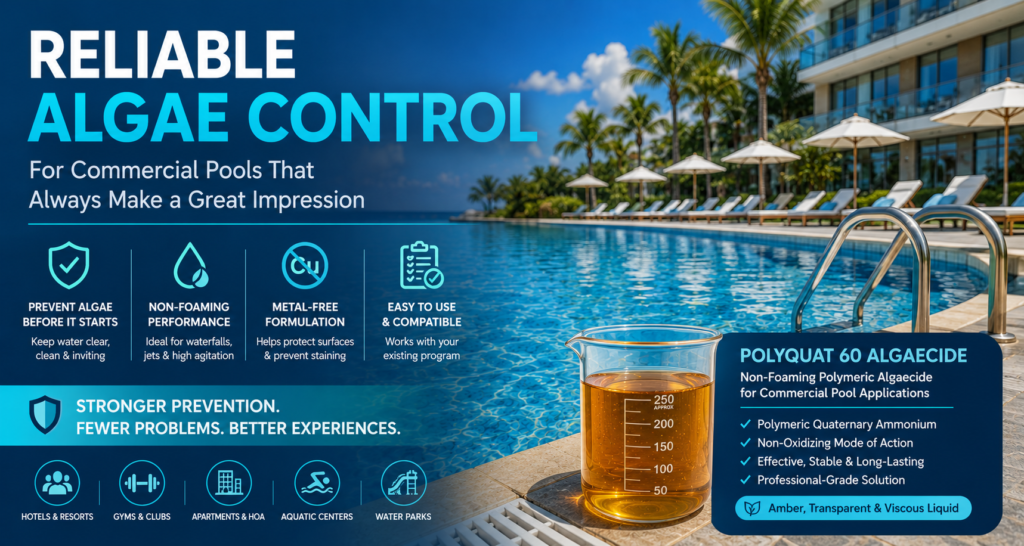
One well-known option for non-metal, non-foaming algae control is Polyquat 60.
Polyquat 60 Algaecide is based on a water-soluble polymeric quaternary ammonium compound and is commonly supplied as a concentrated liquid for swimming pool and spa formulations. Eautrix describes its Polyquat 60 product as a non-foaming polymer-based algaecide designed for preventive and routine pool treatment.
Chemically, Polyquat 60 belongs to a different family from conventional low-molecular-weight quaternary ammonium surfactants.
Its polymer chain carries multiple positive charges.
Algal cell surfaces generally carry negatively charged sites. The cationic polymer can interact with those surfaces, interfering with normal cell membrane function. This gives polymeric quaternary ammonium compounds a non-oxidizing mode of algae control.
That’s an important point.
Chlorine works primarily through oxidation.
Polyquat works through a different mechanism.
Used appropriately, the two can therefore perform different jobs within the same overall maintenance strategy.
For commercial pool formulators and chemical distributors, Polyquat 60 also has several practical characteristics worth considering: it is water soluble, non-foaming, metal-free, and suited to preventive algae-control formulations.
It isn’t magic water in a bottle, of course.
No algaecide compensates for neglected filtration, poor circulation, incorrect sanitizer levels, or badly managed water chemistry.
That point is worth repeating.
Reliable Algae Control Is a System, Not a Single Chemical
Pool maintenance occasionally gets reduced to a shopping list:
Chlorine? Check.
Algaecide? Check.
pH adjusted? Check.
Done.
Real commercial water management is more interconnected than that.
Effective algae prevention usually depends on several elements working together:
Sanitation: Maintain the sanitizer residual required for the facility and applicable local regulations.
Circulation: Ensure treated water reaches the entire pool, including areas where flow may be weaker.
Filtration: Remove suspended contamination efficiently and maintain the filtration system according to operational requirements.
Water balance: Monitor relevant parameters such as pH and other water-balance factors because chemistry affects treatment performance and pool surfaces.
Physical cleaning: Brush walls, steps, corners, and other surfaces where biological growth can begin.
Preventive algae control: Where appropriate, use a compatible algaecide as part of the scheduled treatment program.
This is the bit that sometimes gets missed: chemicals cannot fix a hydraulic problem.
If one corner of a commercial pool barely receives circulating water, adding more treatment to the opposite side isn’t a particularly elegant solution. Likewise, an excellent algaecide cannot make a neglected filter perform properly.
Reliable algae control comes from making the entire system work together.
Heavy Bather Loads Make Consistency Even More Important
Commercial pool conditions change throughout the day.
Picture a resort pool at 8:00 a.m.
The water has circulated overnight. Hardly anyone is swimming. Chemical readings may look excellent.
Now picture the same pool at 3:00 p.m.
The sun is beating down. Families have been swimming for hours. Sunscreen, perspiration, dirt, and other contaminants have entered the water. Children are jumping in and out. Water is being lost through splashing and replaced with fresh make-up water.
Same pool.
Very different chemical environment.
This variability is exactly why commercial pool maintenance cannot rely solely on what the water looked like yesterday.
Routine testing, good circulation, filtration, cleaning, and preventive treatment provide a buffer against changing conditions.
Algaecides can be part of that buffer.
The Economics of Prevention Are Easy to Miss
Suppose a facility saves a small amount of money by reducing preventive maintenance.
Nothing happens during the first week.
Or the second.
It looks like a smart saving.
Then a hot weekend arrives. Bather load increases. Water chemistry drifts. Algae appear.
Suddenly the facility may need additional chemicals, extra labor, filter attention, repeated water testing, brushing, vacuuming, and possibly downtime.
The earlier savings start looking rather small.
For commercial facilities, the cost of algae should therefore be considered in terms of total maintenance burden, not merely the price per kilogram or liter of algaecide.
Reliable preventive treatment may help reduce:
- emergency corrective treatments
- repeated brushing and cleaning
- unnecessary chemical adjustments
- additional filter maintenance
- staff workload
- disruption to pool availability
There is another benefit that is difficult to put into a spreadsheet: predictability.
Facility managers like predictable systems.
A pool that behaves consistently is easier to staff, easier to maintain, and easier to budget for.
Commercial Pool Operators Should Think Seasonally Too
Algae pressure isn’t constant throughout the year.
Outdoor pools may face their greatest challenges during hot, sunny periods with high swimmer traffic. Rainstorms can introduce contaminants and alter water conditions. Pollen seasons bring another wave of material into the pool.
Then the season ends.
For seasonal commercial pools, algae control still matters during closing and winterization. Water left untreated for long periods can become a rather unpleasant surprise when the cover comes off months later.
Preventive off-season treatment can help reduce algae buildup and make spring opening easier.
Specialized <u>Winter Algaecide</u> formulations, for example, can be built around non-foaming polymeric algaecides and incorporated into pool-closing programs. Eautrix’s winter formulations are designed around polymeric active ingredients for off-season algae prevention and can also be combined with clarification functions.
Commercial pool maintenance, in other words, does not really stop when swimming stops.
It just changes jobs.
What Should Pool Chemical Brands Look for in an Algaecide?
For pool chemical manufacturers, distributors, and private-label brands, selecting the active chemistry requires a slightly different perspective from that of the facility operator.
Performance still matters, naturally.
But formulation properties matter too.
A commercial ingredient should provide consistent active content, manageable viscosity, water solubility, storage stability, and predictable compatibility with the intended formulation.
Documentation matters as well.
Buyers should evaluate specifications, COA data, SDS information, active-content testing methods, packaging, batch consistency, and application requirements rather than buying purely by product name.
This becomes especially important with concentrated polymeric products.
A label saying “Polyquat 60” tells you something about the product category, but serious commercial evaluation should go further. Active content, appearance, pH, density, viscosity, formulation compatibility, and manufacturing consistency can all influence the finished product.
For example, commercial Polixetonium Chloride used for Polyquat 60 formulations is commonly supplied as a concentrated, amber, transparent viscous liquid. Eautrix lists typical technical parameters including active content, pH, density, viscosity, and complete water miscibility for its commercial grade.
That technical consistency becomes particularly important when the material is being diluted, blended, packaged, and sold under a private-label pool chemical brand.
Don’t Confuse “More Chemical” With “Better Control”
There is a slightly uncomfortable truth in pool treatment: adding more chemical can sometimes feel more reassuring than fixing the actual problem.
Green patch?
Add something.
Cloudy water?
Add something else.
Still cloudy?
Well…add another bottle.
You know how this story goes.
Professional water treatment should work in the opposite direction.
Identify the cause.
Check sanitizer.
Check circulation.
Check filtration.
Check water balance.
Inspect surfaces.
Then select the appropriate corrective or preventive treatment.
Algaecide dosage should follow the product label, formulation instructions, applicable regulations, and actual pool conditions. More is not automatically better.
This matters even more in commercial pools because treatment errors are multiplied across larger water volumes.
A reliable program is controlled, measured, and repeatable.
Reliable Algae Control Protects More Than Water
A commercial swimming pool is rarely just a tank of treated water.
At a hotel, it is an amenity guests may have specifically chosen the property for.
At a gym, it is part of the membership experience.
At a school or aquatic center, it is an essential operating facility.
At a resort, it may be one of the most photographed areas on the entire property.
That changes the value of algae prevention.
Clear water supports visual confidence. Consistent maintenance reduces operational surprises. Preventive treatment can decrease the likelihood that staff spend Monday morning fighting a problem that quietly developed over the weekend.
And yes, there will always be unpredictable variables.
A storm rolls through. A pump develops a problem. A holiday weekend brings twice the expected number of swimmers.
That’s precisely why a robust maintenance program needs more than one line of defense.
The Goal Isn’t More Chemicals—It’s More Stable Water
This is perhaps the most useful way to think about commercial algae control.
The objective isn’t maximum chemical consumption.
It is stability.
A well-managed commercial pool should move through busy afternoons, changing weather, seasonal temperature swings, and fluctuating bather loads without constantly lurching from one water-quality problem to another.
Proper sanitation provides the foundation.
Circulation and filtration keep the system functioning.
Physical cleaning removes deposits before they become established.
Water testing tells operators what is actually happening rather than what they think is happening.
And a suitable preventive algaecide can provide an additional layer of protection against unwanted algae growth.
For facilities where foaming, metal introduction, and frequent corrective treatment are concerns, polymeric algaecides such as Polyquat 60 can be particularly useful.
Reliable algae control, then, isn’t really about fighting green water.
It’s about preventing the pool from reaching that point in the first place.
And for a commercial facility, that difference can mean fewer headaches, cleaner-looking water, more predictable maintenance, and a much better experience for the people standing at the pool’s edge deciding whether to jump in.
Frequently Asked Questions
1. Why do commercial swimming pools need algaecide if they already use chlorine?
Chlorine is the primary sanitizer in many pool systems, but its demand changes with swimmer load, sunlight, organic contamination, water chemistry, and other operating conditions. A compatible commercial pool algaecide can provide an additional preventive layer against algae while chlorine continues performing its primary sanitation and oxidation roles.
2. What is the best type of algaecide for a high-traffic commercial pool?
There is no single product suitable for every pool. Operators should consider local regulations, sanitizer systems, water chemistry, algae pressure, foaming, metal content, compatibility, and facility design. Non-foaming polymeric algaecides are often considered where operators want preventive algae control without introducing metals or excessive foam.
3. Why are non-foaming algaecides useful for hotel and resort pools?
Hotel pools often contain waterfalls, jets, fountains, spillways, or other features that agitate the water. A non-foaming commercial pool algaecide helps avoid visible foam accumulation while supporting preventive algae control, making it particularly useful for appearance-sensitive facilities.
4. Can Polyquat 60 replace chlorine in a commercial swimming pool?
No. Polyquat 60 should not be treated as a replacement for the required pool sanitizer. It is a non-oxidizing polymeric algaecide that can complement a properly managed sanitation, filtration, circulation, cleaning, and water-balance program. Always follow the product label and applicable pool regulations.
5. How can commercial pool operators prevent recurring algae problems?
Start by identifying why algae keep returning. Check sanitizer residuals, circulation, filtration, water balance, low-flow areas, cleaning practices, and bather-load patterns. A compatible preventive algaecide can then be incorporated into the routine maintenance program rather than relying only on corrective treatment after visible algae appear.