
GET IN TOUCH
Ask For Sample?
How Weather Conditions Affect Pool Algae Growth?
A swimming pool can look perfectly clear on Friday and develop a suspicious green tint by Monday. Sometimes, the sanitizer level hasn’t changed much. The filtration system is still running. Nobody has done anything obviously wrong.
So, what happened?
Quite often, the answer is weather.
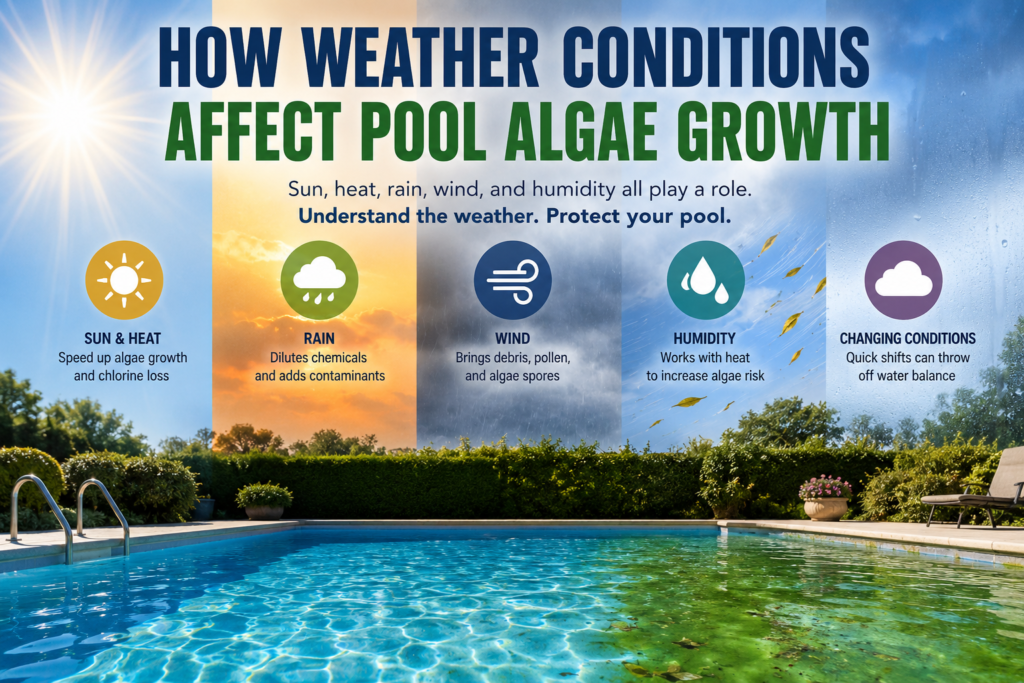
Pool algae growth is closely tied to environmental conditions. Heat speeds biological activity. Sunlight affects chlorine. Heavy rain changes water chemistry. Wind carries dust, pollen, and organic debris into the water. Even a few hot, humid days can shift a pool from stable to algae-friendly surprisingly fast.
Weather doesn’t create algae from nothing, of course. Algae spores are already common in outdoor environments and can enter pools through air, rainwater, swimmers, equipment, and debris. What weather does is change the conditions inside the pool—sometimes enough to give algae the opening it needs.
For pool owners, service professionals, and pool chemical brands, understanding this connection makes algae prevention much easier.
Here’s how it works.
Warm Water Gives Algae a Head Start
Temperature is one of the biggest environmental factors affecting biological activity in a swimming pool.
As pool water becomes warmer, many biological and chemical processes happen faster. Under suitable conditions, algae can reproduce more rapidly in warm water than in cold water.
That doesn’t mean every warm pool will turn green. A properly sanitized and circulated pool can remain clear throughout summer.
The problem is that warm weather often increases algae pressure while also making pool maintenance more demanding.
Think about a backyard pool during a heat wave. Water temperature rises. More people swim. Sunscreen, sweat, body oils, dust, and other contaminants enter the water. Chlorine demand may increase at the same time.
Suddenly, the sanitizer has more work to do.
If free chlorine slips below an effective level—even temporarily—algae may begin establishing itself on steps, walls, ladders, corners, or areas with weak circulation.
You may not see it immediately.
That’s the tricky part.
Early algae growth can begin as a thin film before the water develops the obvious green appearance most pool owners associate with an algae bloom.
This helps explain why algae problems sometimes appear to happen “overnight.” The visible bloom may be sudden, while the conditions leading to it have been developing for days.
Strong Sunlight Can Quietly Reduce Chlorine Protection
A bright summer day looks perfect for swimming.
For chlorine, though, intense sunlight can be challenging.
Ultraviolet radiation from sunlight can break down free chlorine in outdoor swimming pools. Cyanuric acid (CYA), commonly called chlorine stabilizer, is used to reduce this UV-related chlorine loss.
Still, stabilization doesn’t mean chlorine becomes immune to sunlight.
During long periods of strong sunshine, especially when combined with high temperatures and heavy pool use, chlorine levels can fall faster than pool owners expect.
And algae doesn’t need an engraved invitation.
Once the sanitizer concentration becomes inadequate for the pool’s conditions, algae has a better chance to gain a foothold.
This is why checking chlorine only according to a rigid calendar can sometimes cause trouble. A pool experiencing several days of intense heat and sunlight may need closer attention than the same pool during mild weather.
Weather changes. Pool chemistry responds.
Maintenance should respond too.
Hot Weather and Heavy Pool Use Are a Rough Combination
Temperature alone is only part of the story.
Hot weather usually means more swimmers.
More swimmers mean more contaminants entering the water, including:
- Sweat
- Body oils
- Sunscreen
- Cosmetics
- Hair products
- Dirt
- Organic material
These substances contribute to sanitizer demand.
Now combine that with strong UV exposure and warm water.
You have a pool where sanitizer can be consumed or lost more quickly just when biological activity is becoming more favorable.
This is one reason summer algae control should be viewed as a complete maintenance problem rather than simply an “add more algaecide” problem.
Sanitation, circulation, filtration, brushing, water balance, and preventive algae control all play different roles.
Then the Rain Comes—and Everything Changes Again
A heavy rainstorm can change pool conditions surprisingly quickly.
Rainwater itself isn’t automatically an algae problem. The bigger issue is everything that comes with it.
Storms can introduce or contribute to:
- Soil and fine particles
- Leaves and plant debris
- Pollen
- Organic contaminants
- Runoff around poorly protected pools
- Changes in water level
- Shifts in water chemistry
Large amounts of rainfall can also dilute the existing pool water.
Depending on local conditions and the chemistry of the incoming water, parameters such as sanitizer concentration, pH, alkalinity, and stabilizer concentration may shift.
Then there’s the debris.
A handful of leaves may not look dramatic, but decomposing organic material increases the burden on the water treatment system. Chlorine that would otherwise be available for microbial control now has additional material to oxidize.
The result?
Sanitizer effectiveness may decline just as additional contaminants are entering the pool.
That combination can create favorable conditions for algae growth.
Why Pools Sometimes Turn Green After a Storm
Pool owners often notice green or cloudy water shortly after heavy rain.
It’s tempting to blame the rain itself.
Usually, the situation is more complicated.
Imagine the pool as a small chemical ecosystem. Before the storm, everything may be reasonably balanced. Then several things happen within a short period:
- Rain dilutes the water.
- Wind introduces debris.
- Organic contamination increases.
- Sanitizer demand rises.
- Circulation may be interrupted during severe weather.
- Water chemistry may move outside its preferred range.
None of these factors alone guarantees an algae bloom.
Together, however, they can push a marginally maintained pool past its tipping point.
That is why post-storm maintenance matters.
Removing debris, checking sanitizer, testing water chemistry, cleaning baskets, inspecting filtration, and brushing vulnerable surfaces can help prevent a small problem from becoming a green one.
Wind Is More Important Than It Looks
Wind doesn’t change pool chemistry as directly as sunlight or rain, but it can deliver an impressive amount of unwanted material into an outdoor pool.
Dust.
Pollen.
Leaves.
Grass.
Tiny pieces of plant matter.
Soil particles.
Even microorganisms and algae spores can travel through the environment and eventually reach pool water.
A pool surrounded by landscaping may receive much more organic material during windy weather than during calm conditions.
The skimmer catches some of it. The filter catches more.
But not everything gets removed immediately.
Fine particles can settle on the floor or collect in areas where circulation is weaker. Organic debris can also increase sanitizer demand.
This is especially important around steps, corners, ladders, light niches, and other areas where water movement may be less effective.
Algae loves neglected real estate.
Pollen Season Can Make Pool Water Look Strange
Spring brings warmer weather, flowers, trees—and sometimes a yellow-green layer floating across the pool.
Pool owners may immediately think: algae.
Not necessarily.
Pollen can resemble certain forms of algae, especially when it accumulates on surfaces or along the waterline. Wind can carry huge quantities into outdoor pools during peak pollen periods.
The distinction matters because treatment should address the actual problem.
Pollen is generally introduced from outside and can often be captured through filtration, skimming, and cleaning. Algae, by contrast, grows and reproduces in the pool when conditions allow it.
Sometimes both problems occur together.
That’s when things get messy.
High pollen loads increase the amount of material the filtration and sanitation system must handle. If sanitizer levels are already marginal, the extra burden may indirectly make algae control more difficult.
Humidity Doesn’t Feed Pool Algae Directly—but Watch the Weather Pattern
People sometimes assume high humidity directly causes algae.
That’s too simple.
Humidity by itself is not usually the main driver of algae growth inside a properly maintained swimming pool. But humid weather often occurs alongside other conditions that matter: warm temperatures, thunderstorms, rainfall, and reduced evaporation.
So humidity can be a useful warning sign—not necessarily because algae “likes humid air,” but because the broader weather pattern may increase pool maintenance demands.
Warm, humid, stormy week ahead?
That’s a good time to pay closer attention to sanitizer levels and circulation rather than waiting for the water to tell you something has gone wrong.
Can a Pool Turn Green Even When It Still Has Chlorine?
Yes—and this causes plenty of confusion.
Finding measurable chlorine in a pool doesn’t automatically prove that algae cannot develop.
The more useful questions are whether the sanitizer concentration is appropriate for the pool conditions and whether it is being maintained consistently.
Water chemistry also matters.
For outdoor chlorine pools using cyanuric acid, the relationship between free chlorine and CYA is particularly important. Circulation, filtration, organic load, brushing, and local dead spots can influence results as well.
In other words, a test showing “some chlorine” shouldn’t create false confidence.
Pool chemistry works as a system.
Circulation Becomes Even More Important During Algae-Friendly Weather
Here’s something easy to overlook: algae problems don’t always begin evenly throughout the pool.
Certain locations can be more vulnerable because water movement is weaker.
Common trouble spots include:
- Behind ladders
- Around steps
- Near corners
- Under pool accessories
- Around lights and fittings
- Along shaded walls
- Areas with poor return-jet coverage
During warm weather, these areas deserve extra attention.
Why?
Even when the main body of water tests adequately, local conditions near surfaces can differ. Biofilm, debris, or weak circulation may create small protected zones where algae can begin establishing itself.
Regular brushing physically disturbs these areas and exposes attached material to circulating treated water.
Simple, yes. But remarkably useful.
Weather Changes Chlorine Demand—So Maintenance Shouldn’t Stay Frozen
Many pool maintenance routines are calendar-based.
Test on Tuesday. Add chemicals on Wednesday. Brush on Saturday.
That’s convenient, but weather doesn’t care about the calendar.
A better approach combines routine maintenance with condition-based adjustments.
After several days of extreme heat, check the pool more closely.
After heavy rainfall, test again.
After a windy day that fills the water with leaves and pollen, clean the pool rather than waiting for the next scheduled service.
After a busy weekend with ten swimmers instead of two, expect sanitizer demand to be different.
It sounds obvious when written down. Yet this small change in thinking can prevent many algae problems.
Don’t maintain yesterday’s pool.
Maintain the pool you have today.
Seasonal Changes Create Different Algae Risks
Algae pressure changes throughout the year, which is why pool maintenance programs often need seasonal adjustments.
Spring: The Pool Wakes Up
As water temperatures begin rising, biological activity increases.
Pollen, plant debris, rain, and rapidly changing weather can create additional challenges. Pools reopening after winter may also contain accumulated contaminants.
Spring is therefore a good time to establish stable water chemistry before consistently warm weather arrives.
Summer: Peak Algae Pressure
Summer usually brings the toughest combination:
warm water + strong sunlight + frequent swimming + higher contaminant load.
Chlorine consumption may increase, and algae can develop quickly if maintenance falls behind.
Consistent testing and cleaning become particularly important.
Autumn: Don’t Underestimate Falling Leaves
Air temperatures may decline, but pools can still experience algae problems.
Falling leaves and other organic debris increase the load on filtration and sanitation systems. Warm spells can also temporarily raise algae pressure.
A pool surrounded by trees may actually require considerable cleaning during this period.
Winter: Lower Risk Doesn’t Mean Zero Risk
Cold water generally slows algae activity, but winterized pools can still develop algae under certain conditions—particularly during unexpectedly warm periods or when sanitizer protection declines over a long closing season.
This is one reason winter algae prevention programs are used in some climates.
Where Does Algaecide Fit Into Weather-Based Pool Maintenance?
Algaecides can provide an additional layer of algae control, but they shouldn’t be treated as replacements for proper sanitation.
That distinction matters.
Chlorine performs the primary sanitation and oxidation work in most residential pools. An algaecide can be used as part of a preventive program to help control algae, particularly when conditions become challenging.
One commonly used category is Polyquat 60, a polymer-based, non-metal algaecide.
Unlike copper-based algaecides, Polyquat 60 does not rely on copper ions for algae control. It is also generally valued for its non-foaming characteristics, which makes it suitable for maintenance applications where excessive foam would be undesirable.
If you’re unfamiliar with this chemistry, What Is Polyquat 60 Algaecide? A Complete Beginner’s Guide explains how this type of polymer-based algaecide fits into swimming pool maintenance.
The key word here is support.
An algaecide can support a sound maintenance program. It cannot compensate indefinitely for inadequate sanitizer, poor filtration, neglected brushing, or seriously unbalanced water.
Preventive Algae Control Makes More Sense Than Fighting a Bloom
Once a pool has become visibly green, the maintenance job changes.
Now you’re dealing with established biological growth, dead organic material, cloudy water, increased filtration demand, and often a significant chlorine requirement.
Preventing that situation is usually easier.
A weather-aware preventive routine may include maintaining an appropriate sanitizer level, monitoring pH and other important water parameters, ensuring adequate circulation and filtration, brushing algae-prone surfaces, removing debris quickly, and using a suitable preventive algaecide where appropriate.
The exact chemical program should always reflect pool size, sanitizer system, water chemistry, local regulations, product labeling, and environmental conditions.
There is no magic bottle that makes those factors disappear.
And, frankly, that’s useful to remember whenever a product promises to solve every pool problem at once.
The Bigger Lesson: Watch the Weather, Not Just the Water
Pool maintenance is often described as water chemistry.
That’s accurate—but incomplete.
A swimming pool is an outdoor water system constantly interacting with its surroundings.
Sunlight changes sanitizer stability.
Heat affects biological and chemical activity.
Rain changes water volume and can introduce contaminants.
Wind brings dust, pollen, leaves, and other material.
Swimmers respond to the weather too. The hotter it gets, the more people enter the pool, adding another layer of contamination and sanitizer demand.
All these factors overlap.
That’s why weather-aware maintenance can be more effective than simply following the same chemical routine every week.
When conditions change, pay attention.
The pool usually gives warnings before a serious algae bloom appears: sanitizer consumption increases, surfaces become slightly slippery, water loses some sparkle, debris accumulates faster, or faint discoloration develops in poorly circulated areas.
Catch those signals early and algae control becomes much easier.
Miss them during a hot, stormy week?
Well, that crystal-clear pool may have other plans.
Frequently Asked Questions
1. Does hot weather make algae grow faster in swimming pools?
Warm pool water can create more favorable conditions for algae growth and increases biological activity. Hot weather also tends to increase swimming activity and sanitizer demand, so maintaining adequate chlorine and circulation becomes especially important.
2. Why does my pool turn green after heavy rain?
Heavy rain can dilute pool water, introduce organic debris and contaminants, alter water chemistry, and increase sanitizer demand. If chlorine protection becomes inadequate after a storm, algae may have an opportunity to grow.
3. Can strong sunlight cause pool algae?
Sunlight doesn’t directly cause an algae bloom, but UV radiation can accelerate chlorine loss in outdoor pools. If free chlorine drops too low relative to the pool’s conditions, algae growth becomes more likely.
4. Should I use algaecide before or after hot weather?
A preventive algaecide may be incorporated into a regular maintenance program before periods of increased algae pressure, depending on the product label and pool conditions. It should complement—not replace—proper sanitizer levels, filtration, circulation, and brushing.
5. What weather conditions create the highest risk of pool algae growth?
Several consecutive hot, sunny days combined with heavy pool use can create high algae pressure. Warm periods followed by storms can also be troublesome because rain, windblown debris, changing water chemistry, and increased sanitizer demand may occur together.