
GET IN TOUCH
Ask For Sample?
The Evolution of Non-Oxidizing Biocides in Water Treatment
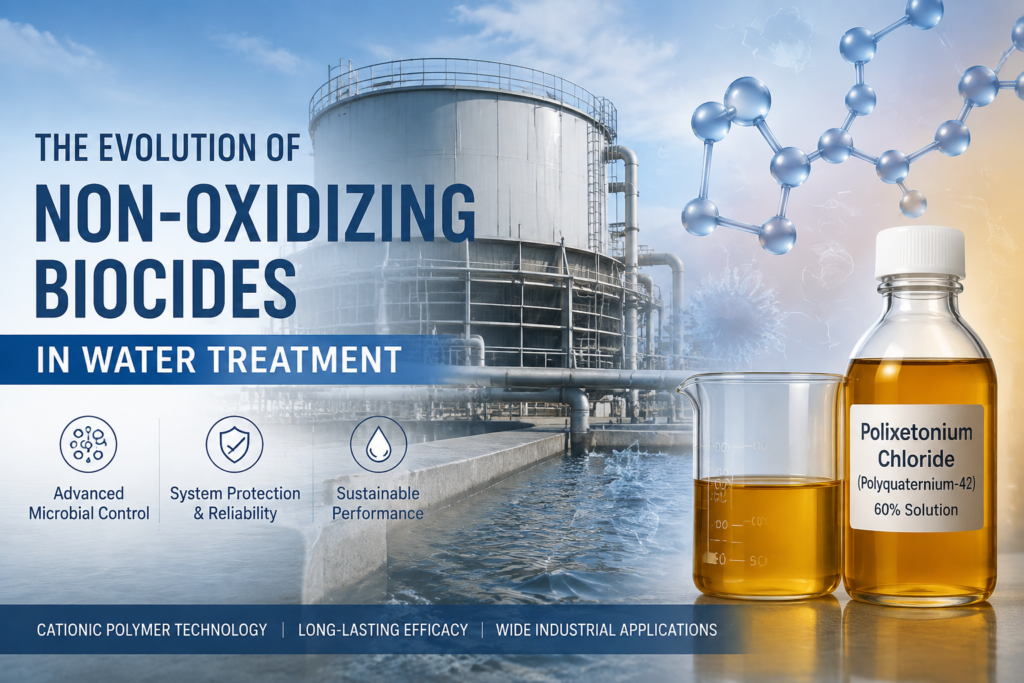
When people talk about water treatment, chlorine is often the first chemical that comes to mind. It has been used for decades, and for good reason. Chlorine-based oxidizing biocides are powerful, affordable, and widely available.
But here is the thing: industrial water systems are rarely simple.
A cooling tower is not just a tank of water. A metalworking fluid is not just a liquid. A process water loop is not just a pipe filled with water. These systems contain changing temperatures, organic materials, minerals, microorganisms, and surfaces where biofilms can quietly develop.
And that is where non-oxidizing biocides started to become increasingly important.
Instead of attacking microorganisms through oxidation reactions, non-oxidizing biocides work through different mechanisms, such as disrupting cell membranes, interfering with microbial growth, or preventing biological buildup on surfaces.
So, how did this technology evolve? Why are industries moving from traditional solutions toward newer polymer-based biocides? And what does the future look like for non-oxidizing microbial control?
Let’s take a closer look.
1. Why Water Treatment Needed More Than Traditional Oxidizing Biocides?
For many years, oxidizing biocides dominated industrial water treatment.
Chemicals such as chlorine, bromine, and chlorine dioxide became common choices because they could rapidly destroy microorganisms. They work by creating highly reactive compounds that damage cellular structures.
Sounds perfect, right?
Well, not always.
Industrial water systems often face problems that are more complicated than simply killing bacteria.
For example:
- Water chemistry can reduce biocide effectiveness.
- High organic loads can consume oxidizing chemicals quickly.
- Corrosion risks may increase under certain conditions.
- Some systems require longer-lasting microbial control.
- Sensitive equipment may not tolerate strong oxidation environments.
Imagine cleaning a delicate electronic component with a powerful industrial cleaner. It may remove contamination quickly, but the aggressive chemistry could also create unwanted damage.
Water treatment faces a similar challenge.
The goal is not simply “kill everything as fast as possible.”
The real goal is:
Maintain biological control while protecting the entire system.
That shift in thinking created demand for alternative technologies.
This is where non-oxidizing biocides entered the conversation.
2. The Early Stage: How Conventional Biocides Shaped Industrial Water Management
Before modern polymeric biocides appeared, industries relied heavily on several traditional non-oxidizing chemistries.
Among them, quaternary ammonium compounds (QACs) became one of the most recognized groups.
QACs are cationic surfactants containing positively charged nitrogen atoms. Their positive charge allows them to interact with negatively charged microbial cell membranes.
In simple terms:
The microbial cell surface is like a negatively charged wall. QAC molecules are attracted to that wall, attach themselves, and disturb the structure until the cell can no longer function normally.
This mechanism made QACs useful in many applications, including:
- Industrial water treatment
- Disinfectants
- Surface sanitation
- Pool and spa chemicals
- Process water systems
However, as industrial requirements became more demanding, traditional QAC technology also showed limitations.
Some systems required:
- Better persistence
- Lower foaming behavior
- Improved compatibility with other treatment chemicals
- Longer biological protection
- More stable performance under difficult conditions
The industry started looking for something beyond small molecules.
And this search led to polymeric biocides.
3. The Rise of Non-Oxidizing Biocides: A Different Way to Control Microorganisms
The development of non-oxidizing biocides was not simply about replacing chlorine.
It represented a different philosophy.
Oxidizing biocides are like a strong cleaning force — fast and direct.
Non-oxidizing biocides are more like a targeted control strategy — they interact with microorganisms through specific chemical mechanisms.
Depending on their structure, non-oxidizing biocides may:
- Damage microbial cell membranes
- Prevent reproduction
- Reduce biofilm formation
- Control algae growth
- Maintain longer residual activity
Several major chemical families have been developed over time, including:
- Quaternary ammonium compounds
- Isothiazolinones
- Glutaraldehyde
- Bronopol
- DBNPA
- Polymeric quaternary ammonium compounds
Each technology has its own advantages and limitations.
For example, isothiazolinones are valued for broad antimicrobial activity, while glutaraldehyde is known for rapid microbial control in certain industrial environments.
However, industries requiring long-lasting protection began showing increasing interest in polymer-based solutions.
Why?
Because molecular structure matters.
A small molecule behaves differently from a large polymer chain.
4. From Simple Quaternary Ammonium Compounds to Advanced Polymeric Biocides
The evolution from traditional QACs to polymeric biocides is one of the most interesting developments in microbial control technology.
A simple QAC molecule is relatively small. It can move quickly through water and interact with microorganisms efficiently.
A polymeric quaternary ammonium compound, however, contains repeating charged units along a larger molecular backbone.
Think of the difference between a single key and a keychain.
One key can open one lock.
A keychain carries multiple keys together, creating a different level of interaction.
Polymeric structures can provide several useful characteristics:
Longer-lasting interaction
Because polymer chains contain multiple active sites, they may maintain contact with microbial surfaces for extended periods.
Reduced mobility
Larger molecules behave differently in water systems compared with small molecules. This can influence how they interact with surfaces and suspended materials.
Improved system compatibility
Certain polymeric biocides can provide effective microbial control while being less aggressive toward equipment compared with some oxidizing treatments.
Lower foaming tendency
For applications such as cooling water and industrial processes, excessive foam can create operational problems.
Modern polymeric biocides are often designed with practical operating conditions in mind.
This evolution reflects a broader industry trend:
Chemical solutions are no longer judged only by their immediate killing ability.
They are evaluated by how well they perform inside a complete operating system.
5. Why Cationic Polymers Changed the Future of Microbial Control
Cationic polymers became increasingly important because they combine the microbial interaction of positive charges with the physical characteristics of polymer structures.
The positive charge plays a key role.
Most microbial cell surfaces carry negative charges due to components such as phospholipids and other cellular materials.
Cationic polymers are attracted to these surfaces.
Once attached, they can disturb normal microbial functions.
This principle explains why many cationic polymer products are used for:
- Algae control
- Bacterial control
- Biofilm management
- Water clarification support
However, their performance depends heavily on molecular design.
Factors such as:
- Molecular weight
- Charge density
- Polymer backbone structure
- Active concentration
- Water chemistry
can all influence practical results.
This is why two products that both belong to the “cationic polymer” category may perform very differently.
A buyer looking only at active percentage may miss important details.
For example, a 60% active polymer solution and another 60% active polymer solution are not necessarily identical in performance.
The polymer structure tells a much deeper story.
6. The Role of Non-Oxidizing Biocides in Modern Cooling Water Systems
Cooling water systems are one of the most important areas where non-oxidizing biocides have demonstrated their value.
A cooling tower may look simple from the outside — water circulating through a structure, releasing heat into the atmosphere. But inside the system, the environment is almost perfect for microbial growth.
Warm temperatures.
Constant moisture.
Nutrients from airborne particles and organic contamination.
A surface where microorganisms can attach.
It is almost like a comfortable home for unwanted biological activity.
Without proper control, microorganisms can create several operational problems:
- Biofilm formation on heat exchange surfaces
- Reduced heat transfer efficiency
- Increased maintenance requirements
- Blocked pipelines and equipment fouling
- Corrosion-related issues caused by microbial activity
You know what makes this challenging?
Microorganisms do not simply float around in water waiting to be removed.
Many of them attach themselves to surfaces and create protective communities known as biofilms.
A biofilm is like a tiny biological “city.” Microorganisms produce a protective matrix around themselves, making them much harder to control.
This is one reason why non-oxidizing biocides remain an important tool.
They can provide a different approach compared with traditional oxidation-based treatment programs.
In many industrial cooling systems, engineers combine oxidizing and non-oxidizing biocides as part of a broader treatment strategy.
The idea is not that one chemistry replaces everything else.
Rather, the right chemistry is selected according to:
- Water quality
- Operating conditions
- Microbial challenges
- Equipment sensitivity
- Treatment objectives
7. Beyond Cooling Towers: Expanding Applications Across Industries
Although cooling water remains one of the largest markets for non-oxidizing biocides, their applications have expanded significantly.
Modern industries require microbial control in many different environments.
Metalworking Fluids
Metalworking fluids provide lubrication and cooling during machining operations.
However, these fluids often contain organic components that can support microbial growth.
Bacterial contamination may lead to:
- Unpleasant odors
- Fluid degradation
- Reduced machining performance
- Shortened fluid service life
Certain non-oxidizing biocides, especially those with cationic structures, are used to help maintain microbial stability.
Oil and Gas Operations
Oilfield systems involve complex environments, including injection water, storage systems, and production facilities.
Microbial contamination can contribute to:
- Biofilm formation
- Equipment problems
- Microbiologically influenced corrosion (MIC)
Selecting the right biocide depends on many factors, including temperature, salinity, and compatibility with other chemicals.
Swimming Pool and Recreational Water
Pool professionals have also shown interest in polymer-based non-oxidizing algaecides.
Why?
Because pool owners do not only want algae removal.
They want water that looks clear, feels comfortable, and remains stable between maintenance cycles.
Polymeric algaecides based on cationic chemistry have become popular because they can provide:
- Effective algae control
- Non-foaming performance
- Compatibility with chlorine-based sanitizers
- Long-lasting preventative protection
For pool chemical suppliers, understanding the difference between traditional copper-based algaecides and polymeric alternatives is becoming increasingly important.
8. Polixetonium Chloride and the New Generation of Polymeric Biocides
Among modern cationic polymer technologies, Polixetonium Chloride has attracted attention from water treatment professionals because of its unique molecular structure and broad application potential.
Polixetonium Chloride is also known as:
- Polyquaternium-42
- WSCP
- Poly[oxyethylene(dimethyliminio)ethylene(dimethyliminio)ethylene dichloride]
CAS No.: 31512-74-0
Unlike traditional small-molecule quaternary ammonium compounds, Polixetonium Chloride is a polymeric quaternary ammonium compound.
Its polymer structure gives it different characteristics compared with conventional QAC products.
Typical commercial products are supplied as concentrated liquid solutions, commonly around 60% active content.
The material is usually a clear amber-colored viscous liquid.
Its applications include:
- Industrial cooling water treatment
- Algae control programs
- Swimming pool algaecides
- Certain industrial process water applications
One reason buyers are interested in Polixetonium Chloride is its combination of:
- Non-oxidizing microbial control
- Low corrosion concerns compared with some oxidizing systems
- Long-lasting biological activity
- Compatibility with many water treatment programs
For companies looking for specialty cationic polymers, understanding the relationship between structure and performance is essential.
Our related article:
Is Polyquaternium-42 the Same as Polixetonium Chloride?
explains why these two names often appear in different industries and markets.
9. What Makes Modern Non-Oxidizing Biocides More Attractive to Global Buyers?
The global water treatment market has changed.
Customers today are not simply asking:
“Does this chemical kill microorganisms?”
That question is too basic.
They are asking:
- How stable is the product?
- How does it perform in my system?
- Does it affect equipment life?
- Can it work with existing treatment chemicals?
- Is documentation available?
- Can the supplier provide technical support?
This shift has changed how buyers evaluate biocide suppliers.
A high-quality non-oxidizing biocide supplier should understand more than chemical production.
They should understand application.
For example, a cooling water customer may care about:
- Active content
- pH range
- Density
- Viscosity
- Compatibility data
- Microbial control performance
A pool chemical distributor may focus more on:
- Product consistency
- Packaging options
- Label requirements
- Regulatory support
- Market positioning
Different customers have different expectations.
That is why technical communication has become almost as important as the chemical itself.
A good supplier does not simply send a COA and disappear.
They help customers understand where and how the product works.
10. Looking Ahead: Where Is Non-Oxidizing Biocide Technology Going?
The future development of non-oxidizing biocides will likely focus on several key directions.
More Sustainable Chemistry
Environmental considerations are becoming increasingly important.
Future products may focus on:
- Lower environmental impact
- Improved biodegradation profiles
- Better application efficiency
More Specialized Polymer Design
Instead of one chemical working for everything, industries are moving toward more customized solutions.
Different systems may require different:
- Charge densities
- Molecular weights
- Polymer structures
A cooling tower, a swimming pool, and a metalworking fluid system do not face identical problems.
Why should they always use identical solutions?
Combination Treatment Programs
The future is unlikely to be about choosing between oxidizing and non-oxidizing biocides.
Many professional water treatment programs already combine multiple technologies.
Oxidizing biocides may provide rapid microbial reduction.
Non-oxidizing biocides may provide longer-term control.
Together, they can create more balanced treatment programs.
A Changing Industry Needs Changing Chemistry
The history of non-oxidizing biocides reflects a simple idea:
Water treatment has moved from basic microorganism elimination toward smarter system management.
Early solutions focused on strength.
Modern solutions focus on balance.
The best biocide is not always the strongest one. It is the one that fits the system, protects equipment, controls biological problems, and delivers reliable performance over time.
From traditional quaternary ammonium compounds to advanced polymeric technologies like Polixetonium Chloride, non-oxidizing biocides continue to evolve.
And as industrial systems become more demanding, this evolution will continue.
Because water treatment is not just about chemistry.
It is about keeping entire systems working.
Frequently Asked Questions (FAQ)
1. What are non-oxidizing biocides in water treatment?
Non-oxidizing biocides are antimicrobial chemicals that control microorganisms without relying on oxidation reactions. They include chemical families such as quaternary ammonium compounds, isothiazolinones, glutaraldehyde, and polymeric biocides used in cooling water, industrial processes, and pool applications.
2. How are non-oxidizing biocides different from chlorine-based treatments?
Chlorine-based treatments control microorganisms through oxidation, while non-oxidizing biocides use other mechanisms such as disrupting cell membranes or preventing microbial growth. The choice depends on system conditions, water chemistry, and treatment goals.
3. Why are polymeric biocides becoming popular in industrial water treatment?
Polymeric biocides are gaining attention because their larger molecular structures can provide different performance characteristics, including longer-lasting microbial control, reduced foaming behavior, and improved compatibility in certain industrial applications.
4. Is Polixetonium Chloride a non-oxidizing biocide?
Yes. Polixetonium Chloride (CAS No. 31512-74-0), also known as Polyquaternium-42, is a polymeric quaternary ammonium compound classified as a non-oxidizing biocide. It is commonly used for algae control and microbial management in water treatment applications.
5. What should buyers consider when selecting a non-oxidizing biocide supplier?
Buyers should evaluate product quality, technical documentation, application knowledge, consistency between batches, packaging options, and the supplier’s ability to provide technical support for specific water treatment requirements.