GET IN TOUCH
Ask For Sample?
How Industrial Water Systems Develop Algae and Microbial Problems?
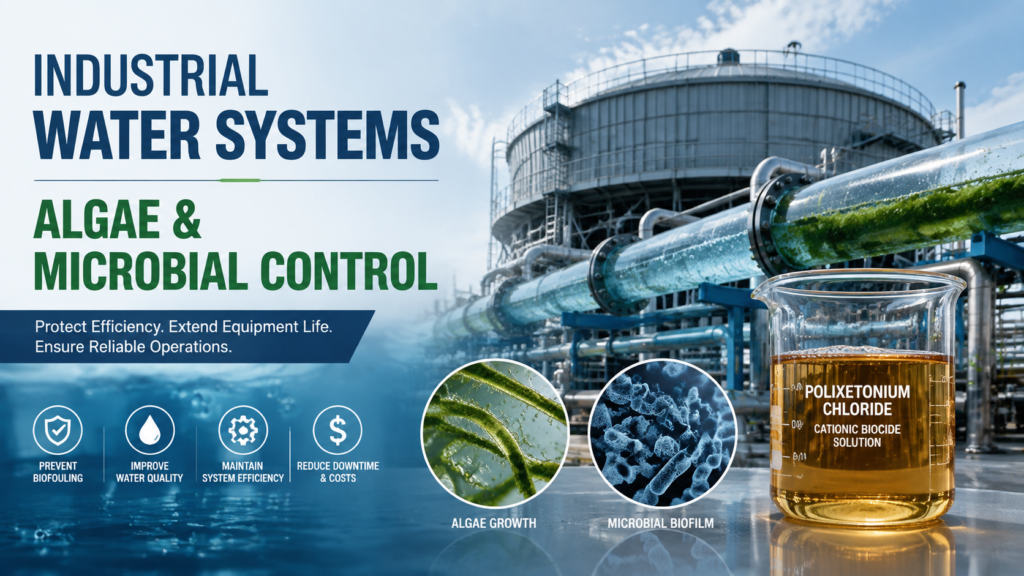
Water looks simple. It flows through pipes, fills tanks, cools equipment, and supports industrial processes. But the moment water becomes part of an industrial system, it turns into a small ecosystem.
And ecosystems have a habit of growing things.
Algae, bacteria, fungi, and other microorganisms do not need much to survive. Give them water, nutrients, sunlight or warmth, and enough time — they can slowly establish themselves inside cooling towers, storage tanks, process water loops, and other industrial equipment.
At first, the problem may seem harmless. Maybe the water becomes slightly cloudy. Maybe a green layer appears on a tank wall. Maybe filters need cleaning more often than before.
But microbial problems rarely stay small.
Understanding the causes of microbial contamination is the first step toward effective control. Many industrial operators are now exploring polymer-based biocides that provide reliable biological control without changing the overall water chemistry balance. Learn more about what Polixetonium Chloride is and why it is widely used in industrial water treatment applications.
Over time, biological growth can reduce heat transfer efficiency, block pipelines, create unpleasant odors, increase maintenance costs, and even affect product quality. This is why understanding how industrial water systems develop algae and microbial problems is the first step toward effective control.
So, how does clean industrial water become a breeding ground for microorganisms? Let’s take a closer look.
Why Does Industrial Water Become a Perfect Environment for Microorganisms?
You might think that industrial water systems are too controlled for biological growth. After all, many facilities monitor pH, temperature, conductivity, and chemical levels every day.
But microorganisms are surprisingly adaptable.
A cooling tower, for example, provides almost everything they need:
- Continuous water supply
- Warm temperatures
- Exposure to air and dust
- Organic nutrients
- Surfaces where microorganisms can attach
- Areas with slow water movement
It is almost like a small artificial pond — except nobody wants algae growing inside their cooling equipment.
The same applies to many industrial systems. Water that appears clean to the human eye may already contain thousands or millions of microorganisms.
The key issue is not whether microorganisms exist.
They almost always do.
The real question is whether the environment allows them to multiply.
The Hidden Conditions That Encourage Microbial Growth
Microbial growth does not happen randomly. It usually develops when several conditions come together.
Let’s look at the major factors.
1. Nutrient Availability
Microorganisms need food.
Industrial water can contain organic materials from many sources:
- Dust entering open systems
- Process contamination
- Oils and lubricants
- Natural organic matter
- Chemical residues
Even tiny amounts of nutrients can support microbial activity.
For example, a cooling tower exposed to outdoor air continuously collects airborne particles. These particles may introduce organic compounds that become food sources for bacteria and algae.
You know what is interesting? A system can look clean on Monday and show visible biological growth weeks later because microorganisms are quietly multiplying in places operators cannot easily see.
2. Temperature Conditions
Many industrial water systems operate at temperatures that microorganisms actually enjoy.
Cooling water systems are a good example.
Warm water helps industrial equipment exchange heat, but it can also accelerate microbial growth. Certain bacteria reproduce faster in warmer environments, especially when nutrients are available.
This creates a difficult balance:
The system needs water warm enough for efficient operation, but not so favorable that microorganisms take control.
3. Sunlight Exposure
Algae need light.
This means outdoor water systems are particularly vulnerable.
Common examples include:
- Cooling tower basins
- Open reservoirs
- Decorative industrial water features
- Water storage tanks
When sunlight reaches nutrient-rich water, algae can begin photosynthesis and multiply.
At first, the growth may appear as a thin green film. Later, it can become floating mats or thick deposits attached to surfaces.
That green color is not just an appearance issue. It is a sign that the water chemistry has changed.
How Do Algae Develop Inside Industrial Water Systems?
Algae growth often follows a predictable pattern.
First, algae spores enter the system through air, dust, or incoming water.
Then, when conditions are favorable, they attach to wet surfaces and begin growing.
A typical development process looks like this:
- Algae spores enter the water system.
- Cells attach to surfaces such as tanks, pipes, and cooling tower components.
- Photosynthesis allows algae populations to increase.
- Dead algae create additional organic nutrients.
- The cycle continues and becomes harder to control.
This creates a common industrial headache: the more algae grows, the easier it becomes for more microorganisms to survive.
It becomes a biological cycle.
Breaking that cycle early is much easier than removing heavy contamination later.
Why Biofilm Is Often More Difficult Than Visible Algae
Many people notice algae because they can see it.
But bacteria create another challenge: biofilm.
Biofilm is a protective layer created by microorganisms when they attach to surfaces. Think of it like a tiny biological shield.
Inside this layer, microorganisms can become much harder to remove.
Biofilms may develop on:
- Pipe walls
- Heat exchanger surfaces
- Storage tanks
- Cooling system components
- Filters
Because biofilms create a protective environment for microorganisms, simply removing visible deposits may not solve the root problem. A long-term biological control strategy requires understanding how certain cationic polymers interact with microbial cells and help maintain cleaner water systems. Read more about why Polixetonium Chloride provides long-lasting algae control in industrial and commercial water applications.
A system may have clear-looking water while biofilm is growing inside hidden areas.
This is why visual inspection alone is not enough.
A facility can have a serious microbial problem without obvious signs.
Some common warning signals include:
- Increased pressure drop
- Reduced heat transfer performance
- Slime deposits
- Unusual odors
- Higher cleaning frequency
- Filter blockage
These small signs often appear before a major operational problem occurs.
Which Industrial Water Systems Are Most Affected?
Different industries face different biological challenges, but some systems are especially vulnerable.
Cooling Water Systems
Cooling towers and circulating cooling water systems are among the most common areas affected.
They provide:
- Warm water
- Large surface areas
- Constant oxygen exposure
- Continuous circulation
Without proper biological control, algae and bacteria can reduce system efficiency and increase maintenance requirements.
You can learn more about this topic in our guide:
Understanding Industrial Cooling Water Treatment Challenges
Metalworking Fluids
Metalworking fluids contain water, oils, and organic components.
Unfortunately, these ingredients can also support microbial growth.
Bacteria may consume components of the fluid, causing:
- Bad odors
- Reduced lubricant performance
- Fluid degradation
- Shorter service life
Proper microbial control helps maintain stable fluid performance.
Oilfield Water Systems
Oil and gas operations often involve complex water environments.
Microbial contamination may contribute to:
- Slime formation
- Equipment fouling
- Operational difficulties
Water treatment programs often include biological control methods to maintain system stability.
Process Water Systems
Manufacturing facilities depend on consistent water quality.
Microbial growth may affect:
- Production efficiency
- Equipment cleanliness
- Product quality
Even when microorganisms do not directly damage products, they can create additional cleaning and maintenance requirements.
The Real Cost of Ignoring Microbial Problems
Some companies treat algae and microbial control as a cleaning issue.
But the impact can be much bigger.
Poor biological control may lead to:
Reduced Equipment Efficiency
Deposits on heat transfer surfaces reduce efficiency.
For cooling systems, this means equipment may need to work harder to achieve the same performance.
Increased Maintenance Costs
Frequent cleaning, downtime, and replacement of contaminated components all add expenses.
Shorter Equipment Life
Persistent microbial deposits may contribute to corrosion-related issues and surface deterioration.
Unstable Operations
Industrial systems depend on consistency.
Unexpected microbial problems can interrupt production schedules and create unnecessary operational pressure.
A small biological issue today can become an expensive problem tomorrow.
How Water Treatment Programs Control Biological Growth
Effective microbial control usually combines several strategies.
There is no single magic solution.
A complete program may include:
- Regular water monitoring
- Proper filtration
- Cleaning schedules
- Control of nutrients
- Appropriate biocide selection
- Routine system evaluation
The goal is not simply to kill microorganisms once.
The goal is to maintain a stable environment where uncontrolled growth does not return quickly.
The Role of Non-Oxidizing Biocides in Industrial Water Management
Non-oxidizing biocides are widely used in industrial applications because they work differently from traditional oxidizing treatments.
Selecting the right biological control product depends on the operating environment, target microorganisms, and treatment objectives. For facilities using cooling water, process water, or other industrial systems, understanding the specific application advantages of polymer-based biocides can help create a more effective treatment program. Explore the industrial applications of Polixetonium Chloride in water treatment systems.
Instead of relying on oxidation reactions, these products typically affect microbial cell structures or biological functions.
They are often considered for applications where operators need:
- Long-lasting biological control
- Compatibility with system materials
- Reduced impact on water chemistry balance
- Reliable performance under different operating conditions
One example is Polixetonium Chloride for Industrial Water Treatment, a cationic polymer-based biocide used in applications such as cooling water systems and algae control.
Its polymer structure allows it to interact with microbial cell surfaces, helping control unwanted biological growth.
However, selecting a biocide is not only about choosing a strong chemical.
The right product depends on:
- Water conditions
- System design
- Target microorganisms
- Application requirements
- Treatment frequency
Why Understanding the Root Cause Matters
A common mistake is treating microbial problems only after they become visible.
By that point, microorganisms may already be established inside the system.
A better approach is understanding why growth happens in the first place.
Ask these questions:
- Where are nutrients entering the system?
- Are there stagnant areas?
- Is sunlight reaching the water?
- Are current treatment levels sufficient?
- Are microorganisms becoming resistant to the current program?
These questions help create a more reliable water management strategy.
Because honestly, controlling biological growth is much easier when you understand the environment microorganisms need to survive.
Choosing the Right Biological Control Strategy
Every industrial water system is different.
A small closed-loop system and a large cooling tower do not face the same challenges.
Before selecting a treatment solution, consider:
- Water temperature
- pH range
- Flow conditions
- Equipment materials
- Existing treatment chemicals
- Regulatory requirements
Working with an experienced supplier can help companies evaluate the right chemical type and concentration.
For businesses looking for customized solutions, Custom Cationic Polymer Solutions for Water Treatment Applications can provide additional flexibility for specific industrial needs.
Frequently Asked Questions (FAQ)
1. Why do industrial water systems develop algae growth?
Industrial water systems develop algae because they often provide sunlight, nutrients, warm temperatures, and water circulation. Outdoor systems such as cooling towers and open tanks are especially vulnerable to algae formation.
2. How can companies prevent microbial growth in cooling water systems?
Companies can reduce microbial growth through regular monitoring, proper cleaning, filtration, and suitable biological control chemicals such as non-oxidizing biocides designed for cooling water applications.
3. What is the difference between algae problems and biofilm problems in industrial water?
Algae are visible photosynthetic organisms that often grow in light-exposed areas, while biofilms are protective microbial layers that attach to surfaces and may develop inside hidden parts of industrial equipment.
4. Are non-oxidizing biocides suitable for industrial water treatment?
Non-oxidizing biocides can be suitable for many industrial water applications because they provide biological control without relying on oxidation reactions. The correct choice depends on system conditions and treatment goals.
5. How often should industrial water systems be treated for algae and microbial control?
Treatment frequency depends on water quality, system design, operating conditions, and the selected chemical program. Regular monitoring helps determine the appropriate maintenance schedule.