
GET IN TOUCH
Ask For Sample?
Why Pool Water Can Turn Green Even with Regular Chlorination?
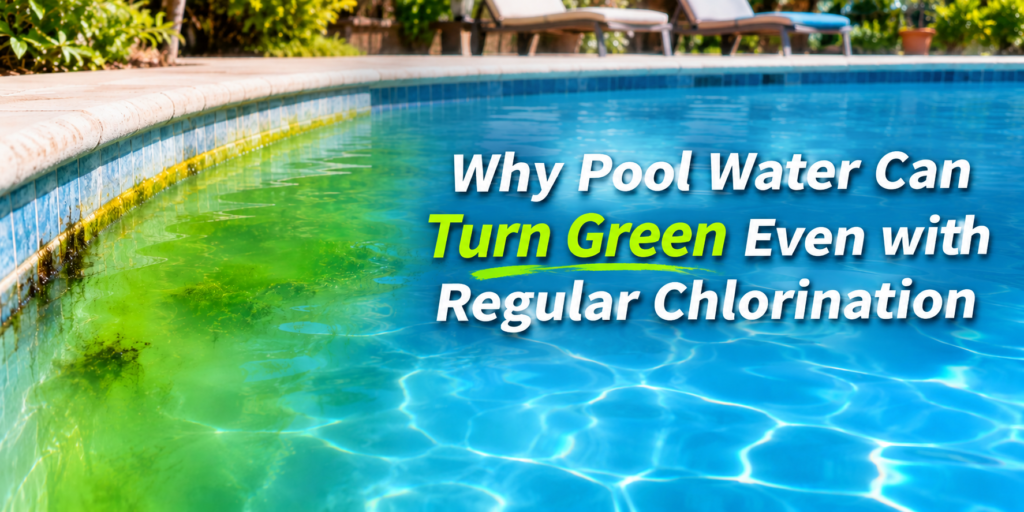
You check your swimming pool every week. You add chlorine as part of your normal maintenance routine. The filtration system runs, and the water looks fine—until one morning, you notice a faint green tint.
A few days later, the pool looks like a pond.
How can this happen when you’ve been adding chlorine all along?
It’s a common and frustrating problem for pool owners, service technicians, and commercial pool operators. Chlorine is one of the most effective tools for keeping pool water safe, but regular chlorination doesn’t always mean effective algae control.
The difference matters.
Green pool water can result from active algae growth, insufficient free chlorine, poor water circulation, unbalanced chemistry, or even dissolved metals. Sometimes, several of these factors work together.
The good news? Once you understand why pool water turns green despite regular chlorine treatment, you can find the cause, restore water clarity, and reduce the chance of another outbreak.
This guide explains the science behind green pool water, the most common maintenance mistakes, and how chlorine and polymer-based algaecides can work together in a well-managed pool care program.
Why Does Pool Water Turn Green in the First Place?
Green pool water usually points to one of two issues: biological growth or a chemical reaction.
Algae are the most familiar cause. These simple aquatic organisms grow when conditions favor them, especially when the pool lacks enough effective sanitizer.
But algae aren’t the only possible explanation.
Copper dissolved in pool water can also cause green or turquoise discoloration when water chemistry changes. This may happen after adding certain chemicals or when corrosion releases metals from pool equipment.
The appearance of the water offers useful clues.
| Water appearance | Possible cause |
|---|---|
| Cloudy, dull green | Suspended green algae |
| Green, slippery walls | Algae growing on pool surfaces |
| Clear green or turquoise | Dissolved metals, especially copper |
| Green with visible debris | Algae, organic contamination, or both |
| Dark green with poor visibility | Severe algae growth or heavy suspended contamination |
These signs aren’t a final diagnosis. Water testing is still essential.
For example, a pool may look green because of copper even when chlorine levels are adequate. Adding more chlorine without identifying the cause could make the discoloration worse.
That’s why the first step isn’t always adding more chemicals. It’s finding out what’s happening in the water.
Regular Chlorination Doesn’t Guarantee Enough Free Chlorine
Here’s a detail that catches many pool owners off guard: adding chlorine and maintaining an effective chlorine residual are two different things.
When chlorine enters pool water, it reacts with contaminants such as sweat, body oils, leaves, dirt, and other organic matter.
These reactions consume chlorine.
The remaining free chlorine is what helps disinfect the water and control algae.
Free Chlorine vs. Total Chlorine: What’s the Difference?
Pool water tests often measure three related values:
- Free chlorine (FC): Chlorine available for disinfection and oxidation.
- Combined chlorine (CC): Chlorine bound in compounds such as chloramines.
- Total chlorine (TC): The sum of free chlorine and combined chlorine.
The relationship is simple:
\[ TC = FC + CC \]
Suppose your pool test shows total chlorine of 3.0 ppm but free chlorine of only 0.5 ppm.
That means 2.5 ppm is combined chlorine.
The pool may contain a measurable amount of chlorine, yet the free chlorine residual is too low for reliable sanitation.
For many residential pools, the CDC recommends at least 1 ppm free chlorine, or at least 2 ppm when cyanuric acid is used. Local commercial pool codes may require different ranges.
These are minimums, not a promise that algae cannot grow. A pool with high chlorine demand or poor circulation can still develop problem areas.
Why Chlorine Levels Can Drop So Quickly
Several conditions increase chlorine consumption:
- Heavy swimmer use
- Rainstorms carrying dust and organic matter
- Leaves and grass clippings entering the water
- High water temperatures
- Strong sunlight
- Existing algae growth
- Poor filtration and accumulated debris
A pool may have adequate free chlorine in the morning but fall below its required level later in the day.
This is especially common during summer, when warm water, intense sunlight, and heavy pool use occur together.
The lesson? Test the chlorine residual, not just the amount of chlorine added.
Is Your Pool’s pH Making Chlorine Less Effective?
Chlorine chemistry changes with pH.
When chlorine dissolves in water, it forms hypochlorous acid (HOCl) and hypochlorite ion (OCl⁻).
Both contribute to disinfection, but hypochlorous acid is generally much more effective against many microorganisms.
Their balance depends on pH.
As pH rises, the proportion of hypochlorous acid falls.
Approximate HOCl fraction at different pH levels
0%25%50%75%100%7.07.27.57.88.08.5
Illustrative values for unstabilized chlorine at approximately 25°C, using pKa ≈ 7.5. Cyanuric acid changes chlorine speciation.
Calculated estimates for chlorine without cyanuric acid. The chart shows chemical speciation, not a direct measure of algae-killing performance in stabilized pools.
For swimming pools, the CDC generally recommends keeping pH between 7.0 and 7.8, while many routine pool care programs target a narrower range near 7.2–7.6.
However, pH is only part of the picture. Cyanuric acid, chlorine residual, temperature, and organic load also influence sanitizer performance.
If your pool stays green despite regular chlorination, check pH before assuming that chlorine itself has failed.
Too Much Cyanuric Acid Can Complicate Algae Control
Cyanuric acid (CYA), often called chlorine stabilizer, helps protect chlorine from sunlight.
Without stabilizer, outdoor pools can lose free chlorine quickly under strong ultraviolet radiation.
So stabilizer is useful.
But more isn’t always better.
Cyanuric acid binds much of the free chlorine into a reserve form, reducing the concentration of unbound active chlorine species at a given measured free chlorine level.
When CYA becomes excessive, the pool may need a higher free chlorine residual to maintain effective sanitation.
This is one reason a pool can test positive for chlorine yet continue to struggle with algae.
How Does Cyanuric Acid Build Up?
Two common stabilized chlorine products contain cyanuric acid:
- Trichlor tablets
- Dichlor granules
With repeated use, these products add CYA to the water.
Chlorine is consumed, but cyanuric acid can remain and accumulate unless water is replaced or removed through other processes.
For outdoor pools, the appropriate CYA level depends on the sanitizer program and applicable guidance. The CDC advises against exceeding 100 ppm and recommends keeping CYA at or below 15 ppm in pools where diarrhea-related contamination is a concern.
If stabilizer is too high, partial water replacement may be needed, subject to local water discharge rules.
Simply adding more chlorine without considering CYA can lead to higher costs and recurring algae problems.
Poor Water Circulation Creates Hidden Algae Hotspots
Imagine cleaning your kitchen floor but never moving the chairs.
The open floor looks spotless. Under the furniture? Not so much.
A similar problem occurs in swimming pools.
Even when chlorine is present in the water, poor circulation can leave certain areas with inadequate sanitizer distribution.
Common trouble spots include:
- Behind ladders and steps
- Corners and recessed areas
- Shallow ledges
- Around decorative features
- Areas far from return jets
- Behind lights and inside niches
These locations may collect debris and support algae growth.
Why Filtration and Circulation Matter
A pool pump moves water through the circulation system, while the filter captures suspended particles.
But the system only works well when water moves through the pool effectively.
A filter may be clean, and the pump may be running, yet circulation can still be poor because of incorrect return-jet positioning, blocked baskets, low flow, or equipment problems.
Algae can begin growing on surfaces before the entire pool looks green.
That’s why brushing walls, steps, and other hard-to-reach areas remains an important part of pool maintenance.
Brushing helps remove deposits and exposes attached algae to circulating sanitizer.
The filter then helps remove suspended material, including dead algae and other debris.
Chlorine, circulation, brushing, and filtration work as a system. None should be treated as a complete replacement for the others.
Warm Weather and Sunlight Can Accelerate Algae Growth
Summer is peak swimming season. Unfortunately, it’s also a time when algae problems become more common.
Warm water can favor the growth of many algae species, while higher temperatures and increased swimmer activity can raise chlorine demand.
Strong sunlight creates another challenge.
Ultraviolet radiation breaks down free chlorine in outdoor pools. Without sufficient stabilizer, chlorine levels may decline faster than expected.
Now add a few leaves, some dust, and a busy weekend with family and friends.
Suddenly, the pool has more organic contamination, higher chlorine demand, and favorable conditions for algae growth.
This combination helps explain why pools that remain clear during spring can develop green water during a summer heatwave.
Does Rain Make Pool Water Turn Green?
Rain itself doesn’t automatically cause algae.
However, heavy rainfall can introduce dirt, organic matter, and nutrients. It may also dilute pool chemicals, change water chemistry, or cause contaminated runoff to enter the pool.
After a storm, check free chlorine, pH, and other relevant water parameters.
Remove debris and inspect the filtration system before normal swimming resumes.
A little extra attention after bad weather can prevent a much larger cleaning job.
Different Types of Pool Algae Present Different Challenges
Not all algae behave in the same way.
Some grow quickly and spread through the water. Others cling to surfaces, forming deposits that are harder to remove.
Understanding the type of growth can help pool operators select a suitable treatment approach.
Green Algae: The Most Familiar Problem
Green algae are among the most common algae encountered in swimming pools.
They may appear as:
- Green or cloudy water
- Slippery green deposits on walls
- Green patches on steps
- Fine green material suspended in the water
Green algae can spread when sanitizer residuals remain too low.
Early treatment, brushing, filtration, and proper sanitizer management often prevent a small outbreak from becoming a major problem.
Yellow or Mustard Algae: Easy to Mistake for Dirt
Mustard-colored algae-like growth often appears on shaded pool surfaces.
It may look like yellow dust or sand.
Because it can brush away easily, pool owners sometimes assume it’s ordinary dirt. But if it repeatedly returns to the same areas, biological growth may be involved.
Careful cleaning of pool surfaces and equipment is important.
Black Algae: A Stubborn Surface Problem
Black algae-like spots are particularly troublesome in porous pool finishes.
They can form dark patches that resist casual brushing.
Surface growth may be protected by biofilms or embedded in small cracks and rough areas, making sanitizer contact more difficult.
These deposits require careful mechanical cleaning and a treatment program suitable for the pool surface.
Not every black spot is algae, though. Metal stains and other deposits can look similar.
Accurate identification matters before applying aggressive treatments.
Can a Pool Turn Green Even When Chlorine Tests Normal?
Yes.
A normal chlorine reading doesn’t always prove that every part of the pool has been adequately sanitized.
For example, a pool may have:
- A temporary drop in chlorine between tests
- High cyanuric acid that changes chlorine effectiveness
- Poor circulation near certain surfaces
- Established algae deposits or biofilms
- Inaccurate test results
- Metal contamination rather than algae
This is why a single test result shouldn’t be used to explain the entire condition of a swimming pool.
Could Your Chlorine Test Be Misleading?
Test kits have limitations.
Old reagents, incorrect sampling, or improper testing procedures can produce unreliable readings.
Some color-comparison tests may also behave unexpectedly at very high chlorine concentrations.
Professional operators often use DPD-based testing methods, while FAS-DPD titration provides a useful way to measure free and combined chlorine over a broad range.
If the water appearance conflicts with the test result, repeat the test using a reliable method.
A fresh sample and a second test can save time, chemicals, and frustration.
How Polymer-Based Algaecides Can Support Chlorine Treatment
Chlorine remains the primary sanitizer in most conventional swimming pools.
However, an appropriately registered and labeled algaecide can provide an additional method of algae control.
One category used in pool maintenance is polymer-based algaecides, including products based on Polyquaternium-42.
These products are often called polyquat algaecides.
What Is Polyquat 60 Algaecide?
Polyquat 60 Algaecide is a concentrated polymer-based algae control product.
A common active ingredient is Polixetonium Chloride, also known as Polyquaternium-42, CAS No. 31512-74-0.
The concentrated material is typically an amber-colored, transparent, viscous liquid.
It is a non-oxidizing biocidal polymer, meaning its algae-control mechanism differs from chlorine’s oxidation-based chemistry.
Cationic polymers contain positively charged groups along their molecular chains.
These groups can interact with negatively charged sites on biological surfaces, including algal cell structures.
Such interactions can disrupt cellular functions and contribute to algae control.
The actual performance depends on the formulation, active ingredient concentration, algae species, dose, and water conditions.
Why Are Polyquat Algaecides Used in Pool Maintenance?
Properly formulated polyquat algaecides can offer several useful characteristics.
1. Low-foaming performance
Polyquat products are commonly valued for their low-foaming or non-foaming behavior, which can be useful in pools with return jets and other circulation features.
2. Metal-free formulations
A polyquat formulation that contains no added copper or other metal-based algaecidal ingredients avoids introducing those metals as part of the treatment.
This may help reduce concerns about metal-related staining, although existing metals in pool water still require attention.
3. Compatibility with chlorine-based programs
Suitable polyquat formulations can be incorporated into chlorine-based pool maintenance programs when permitted by the product label.
However, chemical compatibility doesn’t mean concentrated products should be mixed directly.
Always add chemicals separately according to their labels.
4. Preventive algae management
A registered polyquat algaecide may help reduce algae growth when used at the labeled maintenance dose.
This can be useful for outdoor pools, seasonal maintenance, and facilities with recurring algae concerns.
For more information on polymer-based algae control, see Polyquat 60 Algaecide and the product information available from Eautrix.
Can Polyquat Replace Chlorine?
No.
A polyquat algaecide isn’t a substitute for an approved pool sanitizer.
Chlorine helps control a broad range of microorganisms and provides a measurable disinfectant residual.
Algaecides target algae control and may serve as supplemental products.
The most effective maintenance strategy uses each chemical for its intended purpose.
And there’s another important point: algaecides must be registered or otherwise authorized for their intended use in markets where such approval is required. In the United States, for example, antimicrobial pool products generally fall under EPA pesticide requirements.
A product’s chemical composition alone doesn’t establish that it’s approved for sale or use as a swimming pool algaecide.
What About Pool Clarifiers? Can They Remove Green Water?
A polymer pool clarifier serves a different purpose from an algaecide.
Clarifiers help collect fine suspended particles into larger aggregates that may be more readily captured by filtration.
One commonly used cationic polymer for clarification is PolyDADMAC, CAS No. 26062-79-3.
For example, a PolyDADMAC-based 10% pool clarifier may help improve water clarity when the cloudiness comes from fine suspended particles.
However, a clarifier isn’t a substitute for controlling active algae growth.
If algae are multiplying, removing suspended particles alone won’t solve the underlying problem.
Algaecide vs. Clarifier vs. Chlorine
| Product | Main function | Role in green water treatment |
|---|---|---|
| Chlorine | Sanitization and oxidation | Controls microorganisms and helps eliminate algae |
| Polyquat algaecide | Supplemental algae control | Helps control or prevent algae when used as labeled |
| Polymer pool clarifier | Particle aggregation | Helps filtration remove fine suspended matter |
| Metal sequestrant | Metal management | May help control metal-related discoloration |
These products aren’t interchangeable.
A pool with living algae needs effective sanitation and algae treatment. A pool with dead algae suspended in the water may benefit from better filtration and, where suitable, a clarifier.
A pool with copper-related green discoloration may require a completely different approach.
How to Fix Green Pool Water Step by Step
ILLUSTRATIVE HERO BANNER
Restoring green pool water starts with identifying the cause.
Adding chemicals without testing can waste money and make the problem harder to solve.
Here’s a practical approach.
Step 1: Test the water thoroughly
Measure free chlorine, combined chlorine, pH, cyanuric acid, and other relevant parameters. If the water is clear green rather than cloudy, consider testing for copper and iron.
Step 2: Inspect circulation and filtration
Check the pump, filter, skimmer baskets, and return jets. Correct low-flow conditions and clean or backwash the filter when required by the equipment manufacturer.
Step 3: Brush pool surfaces
Brush walls, steps, corners, and other affected surfaces using a brush suitable for the pool finish. This helps loosen attached algae and debris.
Step 4: Correct water chemistry and treat the cause
If algae are confirmed, restore the required sanitizer residual and follow an appropriate, label-approved algae treatment procedure. Account for CYA and pH. Don’t use algae shock-treatment doses based on guesswork.
Step 5: Remove suspended material
Continue filtration, clean the filter as needed, and vacuum settled debris. A compatible clarifier may help when fine particles remain suspended, provided the label and filter system support its use.
Step 6: Confirm the pool is safe before reopening
Recheck water clarity, sanitizer residual, pH, and other required parameters. Keep swimmers out while the water is green or visibility is inadequate, and until all applicable reopening criteria are met.
If metals are responsible for the discoloration, follow a metal-specific treatment plan instead of assuming that an algae treatment will solve the problem.
How to Prevent Green Pool Water from Returning
Once the pool is clear, the next challenge is keeping it that way.
Prevention is usually less expensive than treating a major algae outbreak.
The most reliable approach combines routine water testing, effective filtration, surface cleaning, and appropriate chemical treatment.
A Simple Pool Maintenance Checklist
| Maintenance task | Suggested frequency |
|---|---|
| Test free chlorine and pH | Daily or more often as required |
| Inspect pump and circulation | Daily during operation |
| Empty skimmer baskets | As needed |
| Brush walls and steps | Weekly, or more often if deposits appear |
| Vacuum pool floor | As needed |
| Inspect filter condition | Weekly and after heavy contamination |
| Check CYA and other chemistry | Periodically, based on pool conditions |
| Review supplemental algaecide use | According to the approved product label |
Commercial and public pools may require more frequent testing under local health regulations.
For residential pools, maintenance frequency should reflect weather, swimmer load, water temperature, and equipment performance.
A pool that receives heavy use every afternoon may need a different schedule from one used only on weekends.
Why Consistency Beats Occasional Heavy Treatment
It’s tempting to add a large amount of chlorine whenever water starts looking dull.
But repeated emergency treatments are often a sign that the routine maintenance program needs improvement.
Stable water chemistry, adequate circulation, and regular cleaning reduce the conditions that allow algae to establish themselves.
Supplemental algaecides may support this program where appropriate, but they can’t compensate for poor sanitation or neglected equipment.
Think of pool maintenance like brushing your teeth.
Regular care is more effective than waiting until a serious problem develops.
Why Green Pool Water Matters for Commercial Pool Operators
For hotels, resorts, fitness centers, and public swimming facilities, green pool water is more than an appearance issue.
It can affect operations, customer confidence, and maintenance costs.
Imagine arriving at a hotel after a long journey. The pool is one of the features you’ve been looking forward to.
Then you see cloudy green water.
Would you feel comfortable swimming?
Probably not.
Even if the discoloration turns out to be metal-related rather than biological, poor water appearance can damage guests’ confidence.
The Hidden Costs of Recurring Algae Problems
Commercial facilities may face:
- Temporary pool closures
- Additional labor for brushing and cleaning
- Higher chemical consumption
- Increased filter maintenance
- Guest complaints and refund requests
- Greater pressure on maintenance staff
Poor visibility also creates a serious safety concern because lifeguards and other staff may be unable to see swimmers clearly.
For pool service companies, reliable water care is therefore both a technical responsibility and a business priority.
A preventive maintenance program can help reduce avoidable disruptions while maintaining the required public health standards.
Choosing the Right Algae Control Products for Different Markets
For pool chemical distributors and private label brands, understanding the causes of green pool water helps identify what customers actually need.
Some customers require a preventive algaecide for routine maintenance.
Others need products suitable for seasonal pool closure, while professional service companies may prefer larger packaging for repeated use.
These needs can influence product concentration, packaging, labeling, and marketing.
Product Concentration and Packaging
Eautrix offers polymer-based pool chemical solutions for professional buyers, including Polyquat 60 Algaecide and PolyDADMAC-based pool clarifier formulations.
Typical packaging configurations include:
| Packaging | Common target market |
|---|---|
| 1L bottle | Residential pool retail |
| 5L container | Pool service professionals |
| 25L drum | Commercial maintenance and distributors |
| 200L drum | Bulk chemical supply |
| 1000L IBC | Industrial-scale distribution and formulation |
Private label programs may also involve customized packaging and concentration requirements.
However, changes to formulation, concentration, or labeling can affect regulatory obligations. Buyers should confirm local registration requirements before introducing any algaecide into their market.
For professional buyers, product quality also matters.
Consistent active ingredient concentration, stable appearance, suitable packaging, and reliable technical documentation can help reduce supply problems.
A supplier should provide relevant specifications, safety data sheets, certificates of analysis, and other documentation required for the intended market.
Final Thoughts: Chlorine Is Essential, but It Isn’t the Whole Story
Green pool water doesn’t necessarily mean someone forgot to add chlorine.
Often, the problem is more subtle.
Chlorine may be consumed faster than expected. Cyanuric acid may be excessive. Poor circulation may allow algae to develop in hidden areas. Or dissolved metals may be changing the water’s color.
The solution starts with accurate testing and identifying the actual cause.
For algae-related problems, chlorine sanitation, good circulation, regular brushing, and effective filtration form the foundation of treatment.
Properly approved polymer-based algaecides can provide additional algae control, while clarifiers may help remove fine suspended particles once the underlying problem has been addressed.
The goal isn’t simply to make pool water look blue again.
It’s to keep the water clean, clear, properly sanitized, and safe for swimming—day after day.
Frequently Asked Questions (FAQ)
1. Why is my pool green even though the chlorine level is high?
A pool may remain green despite a high chlorine reading because of established algae, poor circulation, excessive cyanuric acid, or dissolved metals. Test free chlorine, pH, CYA, and metals before choosing a treatment. A high reading alone doesn’t prove that the water is safe.
2. Can too much chlorine turn swimming pool water green?
Chlorine itself doesn’t normally turn water green. However, adding chlorine can oxidize dissolved metals such as copper, causing green or turquoise discoloration. This is different from green water caused by algae.
3. Will Polyquat 60 Algaecide help prevent green pool water?
An appropriately registered Polyquat 60 Algaecide may help control or prevent algae when used according to its approved label. It should supplement, not replace, chlorine sanitation, filtration, and routine pool cleaning.
4. How long does it take to clear a green swimming pool?
The time depends on the cause and severity. Mild algae problems may improve within one or two days of effective treatment, while severe outbreaks can take several days or longer. Metal-related discoloration requires a different treatment approach. Always confirm water quality before reopening.
5. Should I use a pool clarifier or algaecide for green water?
Use the product that addresses the underlying problem. An approved algaecide can help control algae, while a pool clarifier helps filtration remove fine suspended particles. If the water is green because of dissolved copper, neither product may be the correct primary treatment.