
GET IN TOUCH
Ask For Sample?
Why Polymeric Quaternary Ammonium Compounds Are Used in Pool Care?
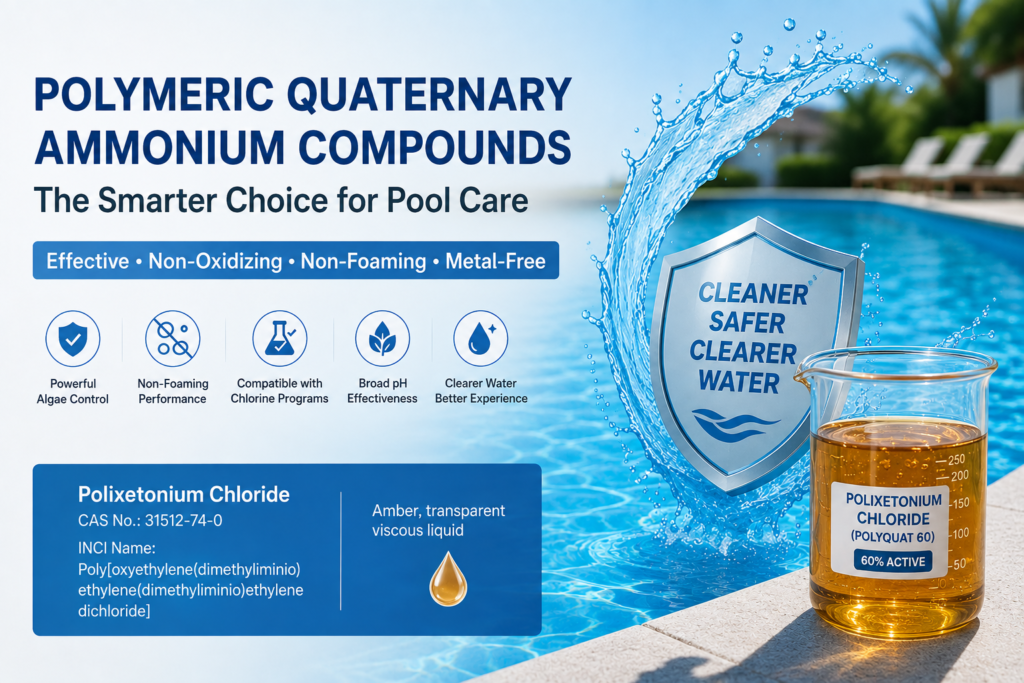
Keeping a swimming pool clear sounds simple: maintain the sanitizer, balance the pH, run the filter, and enjoy the water.
Then algae show up.
Sometimes it begins as a faint green tint. Sometimes a slippery film develops on a step or wall. In more stubborn cases, dark spots appear in areas with weak circulation. The frustrating part? A pool can develop algae problems even when chlorine is being used.
That is one reason polymeric quaternary ammonium compounds, commonly called polyquats, have become useful tools in modern pool care.
These compounds aren’t intended to replace chlorine. Instead, they provide another way to control algae—one that is non-oxidizing, metal-free, and, with commonly used pool-grade polyquat chemistries, non-foaming. Certain polymeric quaternary ammonium compounds are specifically registered or approved for algae control in swimming pools. For example, regulatory documents identify poly[oxyethylene(dimethyliminio)ethylene(dimethyliminio)ethylene dichloride] as an active constituent for swimming-pool algae control.
So, what makes polymeric quats different from ordinary quaternary ammonium compounds? And why do pool chemical formulators keep coming back to them?
Here’s the chemistry behind it—without making it feel like a chemistry lecture.
What Is a Polymeric Quaternary Ammonium Compound?
A quaternary ammonium compound contains positively charged nitrogen centers. In a polymeric quat, these cationic groups are incorporated into a larger repeating molecular chain.
Think of an ordinary quat as a small tool with a positive charge. A polymeric quat is more like a long chain carrying many cationic sites.
That difference matters.
Many biological surfaces, including algae cells and suspended organic particles, carry an overall negative surface charge under typical water conditions. A cationic polymer can therefore interact strongly with these surfaces.
This electrostatic attraction is one of the basic reasons polymeric quaternary ammonium compounds work well in water treatment.
One important pool-care example is Polixetonium Chloride, also commonly associated with Polyquaternium-42 and Polyquat 60 terminology.
Its chemical name is:
Poly[oxyethylene(dimethyliminio)ethylene(dimethyliminio)ethylene dichloride]
CAS No.: 31512-74-0
Commercial concentrated material is commonly supplied around 60% active content. Eautrix’s technical specification, for example, lists an active content of approximately 59–62% for its Polixetonium Chloride product.
For buyers who want to look more closely at the raw material rather than the finished pool formulation, see Polixetonium Chloride for its chemistry, specifications, and applications.
Why Are Polymeric Quats Used in Swimming Pools?
The short answer is balance.
Pool operators need algae control, but they also have to think about foam, stains, sanitizer demand, water clarity, filtration, swimmer experience, and the condition of pool surfaces.
Solving one problem while creating two new ones isn’t much of a win.
Polymeric quaternary ammonium compounds are useful because they can fit into an existing pool-treatment program without relying on oxidation or adding metals to the water.
Their main practical advantages include:
- Non-oxidizing algae control
- Non-foaming performance with appropriate pool-grade polyquat chemistry
- No added copper or other algaecidal metals
- Good performance across a broad pH range
- Compatibility with common pool-treatment programs when used according to the product label
- Suitability for preventive maintenance
- Potential water-clarification benefits associated with cationic polymer behavior
That’s quite a list for one family of chemicals.
But the real story starts with algae.
1. Polymeric Quats Attack the Algae Problem Differently
Chlorine is an oxidizing sanitizer.
Polymeric quaternary ammonium compounds are not.
That distinction is central to understanding why both can have a place in the same pool-care program.
An oxidizer chemically attacks susceptible contaminants through oxidation. A cationic polymeric algaecide instead interacts with negatively charged biological surfaces. These interactions can disrupt normal cell functions and help inhibit algae growth.
This gives pool formulators a second mechanism for algae control rather than asking chlorine to do every job by itself.
And chlorine already has plenty to do.
It reacts not only with microorganisms but also with swimmer waste and other oxidizable contaminants entering the water. Sunlight can also contribute to chlorine loss in outdoor pools, depending on water chemistry and stabilization.
When sanitizer conditions deteriorate, algae may gain an opportunity to establish themselves.
A preventive algaecide can provide another layer of protection.
That doesn’t mean you should simply pour more chemicals into the pool. Far from it. Good circulation, filtration, brushing, appropriate sanitizer levels, and balanced water remain fundamental.
Polyquat is a supporting player—not an excuse to ignore the basics.
2. The Positive Charge Is a Big Part of the Story
Why are these compounds cationic?
Because charge affects how materials behave in water.
Polymeric quaternary ammonium compounds contain permanently positively charged sites. Algal surfaces and many suspended particles can exhibit negative surface charges.
Opposites attract. Basic chemistry, right?
The cationic polymer is therefore attracted toward negatively charged surfaces. This promotes interaction between the polymer and algae cells.
The polymeric structure also distinguishes these materials from simpler, lower-molecular-weight quaternary ammonium compounds.
Instead of one small molecule moving through the water, you have a chain containing multiple charged sites.
This helps explain why polymer chemistry has become important not only in algae control but also in many industrial water-treatment applications.
3. They Solve One Annoying Problem: Foam
If you’ve ever seen a pool or spa covered with persistent chemical foam, you’ll understand why this point matters.
Traditional quaternary ammonium algaecides can foam, especially when water is heavily agitated. Pool-operation guidance specifically distinguishes conventional quats, which are commonly associated with foaming, from polyquat products, which are described as non-foaming.
Polymeric quaternary ammonium algaecides were developed with a different performance profile.
Pool-grade polyquats such as Polixetonium Chloride are valued for non-foaming algae control. This is particularly useful where pumps, returns, water features, or other equipment continuously agitate the water.
It sounds like a small advantage until you’ve dealt with foam complaints.
Then it doesn’t sound small at all.
For pool chemical brands, non-foaming behavior also makes formulation easier. You can address algae without intentionally introducing a product characteristic that makes otherwise clean water look problematic.
4. Polymeric Quats Don’t Depend on Copper
Copper-based algaecides have a long history in pool treatment, and copper can be effective against algae.
But metals introduce another consideration: they remain in the water until they are removed, precipitated, filtered, or otherwise managed.
Under unfavorable conditions, dissolved metals can contribute to staining or discoloration.
Polymeric quaternary ammonium compounds provide a metal-free route to algae control.
This is especially attractive for pool programs where formulators want to minimize the addition of metals.
It also gives private-label pool chemical brands another product-positioning option: algae control based on cationic polymer chemistry rather than metallic active ingredients.
Polyquat isn’t automatically “better” in every conceivable pool situation. Different algae problems, water conditions, regulatory requirements, and maintenance programs call for different approaches.
Still, avoiding added algaecidal metals can be a meaningful advantage.
5. They’re Useful for Prevention, Not Just Rescue Jobs
Here’s a common mistake in pool care: waiting until the water turns green before thinking about algae.
By then, you’re already playing catch-up.
Once algae establish themselves on surfaces, in low-flow areas, or within accumulated debris, treatment can require more work—brushing, cleaning, filtration, sanitizer correction, and sometimes repeated chemical treatment.
Preventive maintenance is usually easier.
EPA-approved labeling for a polyquat product, for example, includes both initial treatment and subsequent maintenance additions for pools. The same label stresses cleaning heavy algae growth before treatment and distributing the product uniformly through the pool.
That tells us something important about how polyquats should be viewed.
They’re not magic green-water erasers.
They work especially well as part of a routine algae-management program.
This is why you’ll often find polymeric quaternary ammonium compounds positioned in weekly or periodic maintenance products.
6. They Can Work Alongside Chlorine-Based Pool Programs
Pool chemistry is a team sport.
A well-maintained pool may involve sanitizer, pH adjustment, alkalinity control, filtration, occasional oxidation, algae prevention, and sometimes clarification or scale control.
The chemicals have to coexist sensibly.
Registered polyquat labeling states that the product can be used in pools treated with chlorine-based chemicals and is compatible with chemicals normally used to treat pools. However, the same label warns against directly mixing polyquat with concentrated dry or liquid chlorine products.
That distinction is worth remembering.
Compatible in a properly treated body of pool water does not mean concentrated chemicals should be mixed together.
Always follow the label and SDS for the specific formulated product being used.
When used correctly, polymeric quats can complement rather than replace the sanitizer program.
If you’d like a closer look at a concentrated raw material used for this type of formulation, Polyquat 60 Algaecide is based on a 60% polymeric quaternary ammonium active designed for pool algae-control formulations.
7. Broad pH Performance Makes Pool Formulation More Forgiving
Pool pH should still be controlled. That’s non-negotiable.
But an algaecide that becomes useless after a modest pH movement wouldn’t be especially convenient.
Polyquat chemistry has an advantage here.
EPA-approved product labeling describes polyquat as effective under both acidic and alkaline conditions, while technical information for Polixetonium Chloride likewise describes performance over a broad pH range.
Why?
The positive charge of a quaternary ammonium group is permanent. Unlike certain amines whose charge state changes considerably with pH, quaternary ammonium centers remain cationic across the normal pool pH range.
That doesn’t mean pH suddenly stops mattering.
pH still influences sanitizer performance, swimmer comfort, scale formation, corrosion tendencies, and overall water balance.
It simply means the polyquat itself is less dependent on a narrow pH window for maintaining its cationic character.
For real-world pool care, that’s handy.
8. The Polymer Can Also Influence Suspended Particles
Here’s where the chemistry gets more interesting.
Cationic polymers aren’t only interesting because of their interaction with microorganisms. Similar charge interactions can also affect suspended negatively charged particles.
This is why certain polyquats are associated with both algaecidal and water-clarification functions.
Tiny suspended particles can remain dispersed because their surface charges help keep them apart. A cationic polymer can interact with those particles and alter their electrostatic behavior, potentially helping particle aggregation and subsequent removal through filtration.
Don’t confuse this with saying every polyquat algaecide is automatically a full-strength pool clarifier. Formulation, molecular structure, molecular weight, dosage, and the rest of the water chemistry matter.
Still, the connection is useful.
It helps explain why polymer chemistry appears repeatedly across both pool care and industrial water treatment.
9. Why “Polymeric” Matters Compared with Traditional Quats
Traditional quaternary ammonium compounds and polymeric quats belong to the broader cationic chemistry family, but they shouldn’t be treated as identical products.
A conventional quat is generally a relatively small cationic surfactant molecule.
A polyquat is a polymer containing repeating cationic groups.
That structural change affects practical behavior.
One of the clearest differences in pool applications is foaming. Conventional quat algaecides are commonly associated with foam, while polymeric quats used for pool treatment are known for non-foaming performance. Pool-industry guidance makes this distinction explicitly.
So when a buyer asks:
“Is Polyquat 60 just another quat?”
The useful answer is: not quite.
It belongs to the broader quaternary ammonium family, but its polymeric architecture gives it a different performance profile.
That little prefix—”poly”—is doing more work than it seems.
10. Why 60% Polyquat Is So Common?
You may have noticed names such as Polyquat 60 or Algaecide 60.
The “60” generally refers to the approximate active concentration of the concentrated raw material, not a recommended concentration in finished pool water.
This distinction matters enormously.
A 60% concentrated raw material is typically supplied to formulators, manufacturers, and sometimes professional chemical blenders. It can then be incorporated into finished formulations at concentrations suited to the intended product.
For Polixetonium Chloride, commercial concentrated material around 60% active is well established. Eautrix lists its material at approximately 59–62% active, while other technical and regulatory references likewise document this chemistry as a concentrated polymeric quaternary ammonium product.
So don’t read “Polyquat 60” as “put 60% into your pool.”
Definitely not.
The actual dose of a finished product should always follow its approved label.
Where Do Polymeric Quats Fit into a Complete Pool-Care Program?
This is probably the most important practical question.
Polymeric quaternary ammonium compounds shouldn’t be viewed as standalone substitutes for everything else in the chemical room.
A sound pool program still depends on several fundamentals:
- Maintain an appropriate sanitizer residual.
- Keep pH and alkalinity within the required operating ranges.
- Maintain adequate circulation.
- Keep filtration equipment operating correctly.
- Brush surfaces and remove accumulated debris.
- Address visible algae rather than simply masking the symptoms.
- Use a registered algaecide according to its approved label where required.
Polyquat adds another layer of algae protection to that system.
Imagine locking your house. The chlorine program is the main lock. Filtration and circulation are the doors and windows being properly maintained. A preventive algaecide is another layer of security.
Would you remove the front door because you installed a better lock?
Of course not.
Pool chemistry works the same way. The pieces support each other.
When Does Polyquat Make Particular Sense?
Polymeric quat algaecides can be especially attractive when a pool-care program needs effective algae prevention without adding metals or creating the foam associated with some conventional quaternary ammonium products.
They may be considered for routine algae prevention, seasonal pool maintenance, startup treatment after cleaning, pools where metal addition is undesirable, and formulations designed around non-foaming performance.
They can also be useful when a pool chemical manufacturer wants a concentrated active ingredient that can be formulated into different finished-product strengths.
This flexibility matters for private-label products.
One distributor may want a concentrated professional treatment. Another may want a lower-active maintenance algaecide for residential users. The underlying polymer chemistry may be similar, while concentration, instructions, packaging, registration, and market positioning differ.
A Quick Word About Safety and Regulation
“Non-oxidizing” does not mean “unregulated” or “harmless.”
That’s an important distinction.
Algaecides are biocidal products, and regulatory requirements differ by country and intended use. In the United States, pool algaecide products making pesticidal claims generally fall under pesticide regulation, and specific products must carry appropriate EPA registration and labeling.
Other markets have their own regulatory systems.
Manufacturers, importers, formulators, and private-label brands therefore need to evaluate the requirements of the country where the finished product will be sold.
The SDS, approved product label, active concentration, application instructions, packaging, and local registration status should all be checked before commercial use.
Chemistry is only half the job. Compliance is the other half—and it’s the half nobody wants to discover after a container has already arrived at the port.
Polymeric Quats Aren’t Magic, and That’s Actually a Good Thing
Pool marketing sometimes makes chemicals sound almost supernatural.
Pour this in. Problem gone.
Real pool water doesn’t behave that way.
Algae control depends on water chemistry, sanitizer residual, sunlight, temperature, circulation, filtration, nutrient loading, pool cleanliness, and treatment history. A badly neglected pool won’t become perfect simply because a premium algaecide was added.
Polymeric quaternary ammonium compounds are valuable precisely because they don’t need to be magical.
They have a clear job.
They provide a cationic, non-oxidizing approach to algae control that can complement the normal pool-treatment system. Common pool-grade polyquats avoid the foaming associated with traditional quat algaecides and avoid introducing copper as an active algae-control metal.
That’s practical chemistry.
And practical chemistry tends to stick around.
Why Pool Chemical Manufacturers Keep Using Polymeric Quats?
For a pool chemical brand or formulator, choosing an active ingredient isn’t simply a matter of asking, “Does it kill algae?”
There are other questions.
Will it foam?
Will it introduce metals?
Can it fit alongside a chlorine program?
Can concentrated material be formulated into different product strengths?
Will it remain useful across realistic pool conditions?
Does the chemistry have an established history in recreational-water treatment?
Polymeric quaternary ammonium compounds answer many of those questions well.
Polixetonium Chloride, in particular, has an established role as a polymeric cationic microbicide and is used as an active chemistry for swimming-pool algae-control products.
For manufacturers developing concentrated or private-label pool algaecides, this combination of properties explains why Polyquat 60 chemistry continues to attract attention.
The Bottom Line
Polymeric quaternary ammonium compounds have earned their place in pool care because they solve a very specific problem in a practical way.
They provide non-oxidizing algae control without relying on metals, while commonly used pool polyquats also avoid the troublesome foaming associated with conventional quat algaecides.
Their cationic polymer structure encourages interaction with negatively charged algae and suspended matter. Their chemistry remains useful across the normal operating pH range of pool water. And, when a product is formulated and applied according to its label, polyquat can work alongside the sanitizer, circulation, filtration, and cleaning program rather than trying to replace them.
That’s really the key.
A good pool-care program isn’t about finding one chemical that does everything. It’s about giving each chemical the job it does well.
For polymeric quaternary ammonium compounds, that job is clear: help keep algae under control while avoiding some of the practical drawbacks associated with other algaecide chemistries.
And for pool owners, service professionals, distributors, and private-label chemical brands, fewer unwanted side effects can make a surprisingly big difference.
Frequently Asked Questions
1. What is a polymeric quaternary ammonium compound in pool care?
A polymeric quaternary ammonium compound is a positively charged polymer used in certain pool algaecides. Pool-grade polyquats interact with algae and help prevent or control growth without depending on oxidation. Polixetonium Chloride (CAS 31512-74-0) is one example used in pool algae-control formulations.
2. Is Polyquat 60 the same as a traditional quaternary ammonium algaecide?
No. Although both belong to the broader quaternary ammonium family, Polyquat 60 is polymeric. This structural difference contributes to its characteristic non-foaming performance, whereas many conventional quat algaecides can produce foam in agitated water.
3. Can Polyquat 60 be used with chlorine in swimming pools?
Polyquat products can be used as part of chlorine-treated pool programs when the specific product label permits it. EPA labeling for one polyquat formulation states that it can be used in chlorine-treated pools, but concentrated polyquat should not be directly mixed with concentrated chlorine products. Always follow the finished product’s label.
4. Why is Polyquat 60 considered a non-foaming pool algaecide?
Its polymeric structure gives it different behavior from conventional low-molecular-weight quaternary ammonium surfactants. Pool-operation references specifically describe polyquat as non-foaming, which is one reason it is widely considered for recreational-water algae control.
5. Why do pool chemical manufacturers use Polixetonium Chloride 60%?
Polixetonium Chloride at around 60% active provides manufacturers with a concentrated polymeric quaternary ammonium raw material that can be incorporated into algae-control formulations. Its non-oxidizing, non-foaming, water-soluble, cationic properties make it particularly relevant to pool algaecide development.