
GET IN TOUCH
Ask For Sample?
What Makes High-Quality Poly(2-hydroxypropyldimethylammonium chloride)? A Buyer’s Complete Guide
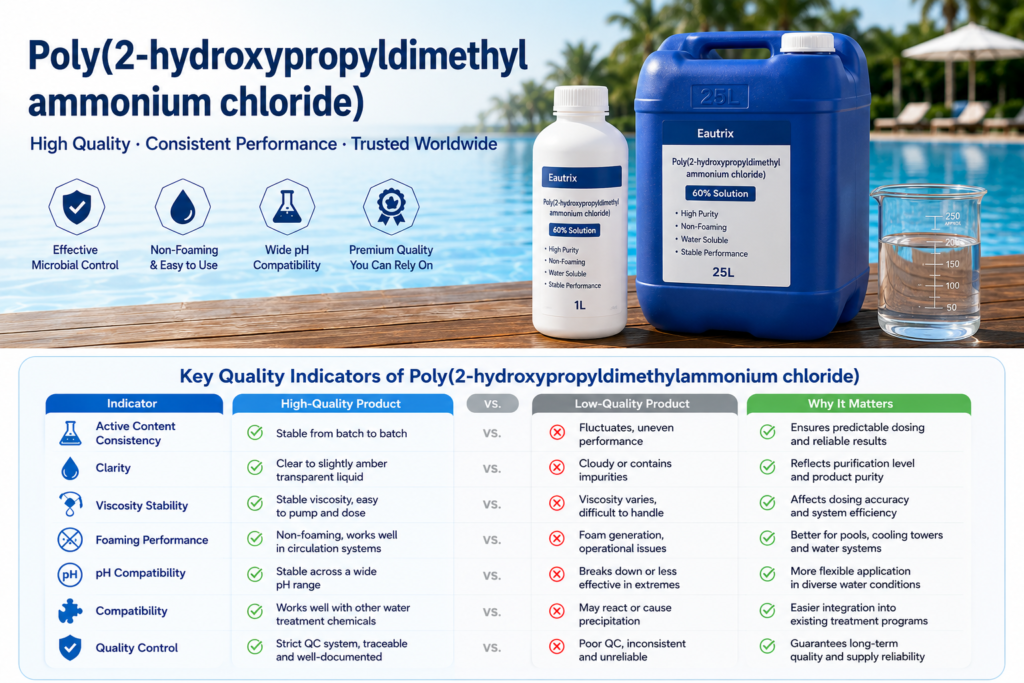
When you’re sourcing Poly(2-hydroxypropyldimethylammonium chloride), the lowest quotation rarely tells the whole story.
Two suppliers may offer products with nearly identical specifications on paper. Both list a similar solid content. Both promise excellent antimicrobial performance. Both provide a COA.
Yet once the product reaches your production line—or your customer’s swimming pool—the difference quickly becomes obvious.
One product performs consistently batch after batch. The other may show weaker algae control, slight foaming, color variations, or poor storage stability.
Why does that happen?
The answer lies in quality—not just the specification printed on the label.
This guide explains what truly defines a high-quality Poly(2-hydroxypropyldimethylammonium chloride) and what professional buyers should evaluate before choosing a supplier.
What Is Poly(2-hydroxypropyldimethylammonium chloride)?
Poly(2-hydroxypropyldimethylammonium chloride), known as PQ-60, is a water-soluble cationic polymer widely used for microbial control and water treatment.
Because of its permanent positive charge, the polymer readily adsorbs onto negatively charged microorganisms, disrupting their cell membranes and helping prevent algae and bacterial growth.
Typical applications include:
- Swimming pool algaecides
- Industrial cooling water
- Decorative fountains
- Water recycling systems
- Commercial water features
- Process water preservation
- Specialty water treatment formulations
One of its biggest advantages is its non-foaming performance, making it particularly attractive where circulation systems operate continuously.
Why Does Product Quality Differ Between Manufacturers?
At first glance, producing this polymer may appear straightforward.
In reality, several manufacturing variables directly affect performance.
These include:
- Monomer purity
- Polymerization process
- Molecular weight control
- Residual raw materials
- Catalyst selection
- Temperature management
- Purification process
- Filtration quality
- Storage conditions
- Packaging cleanliness
Even small differences during production can significantly influence the final product.
That’s why experienced buyers evaluate much more than concentration alone.
10 Characteristics of High-Quality Poly(2-hydroxypropyldimethylammonium chloride)
1. Consistent Active Content
The active polymer concentration should remain stable from batch to batch.
Inconsistent solids content often leads to:
- Unpredictable dosing
- Variable antimicrobial efficiency
- Customer complaints
- Higher operating costs
Reliable manufacturers maintain tight process control rather than simply meeting minimum specifications.
2. Excellent Clarity
A premium product typically appears as a clear to slightly amber transparent liquid.
High clarity usually indicates:
- Better purification
- Fewer impurities
- Proper filtration
- Stable formulation
Cloudiness or suspended particles may suggest contamination or incomplete processing.
3. Low Residual Monomer Levels
Residual raw materials can influence product stability and long-term performance.
Lower residual monomer levels generally offer:
- Better storage stability
- Improved formulation compatibility
- Higher product consistency
This becomes especially important for long-distance international shipping.
4. Stable Viscosity
Viscosity is often overlooked.
However, it reflects polymer consistency and molecular weight distribution.
Stable viscosity makes:
- Pumping easier
- Metering more accurate
- Mixing more uniform
- Production more predictable
Unexpected viscosity changes often indicate inconsistent polymerization.
5. Strong Algae Control Performance
Ultimately, customers care about results.
A high-quality polymer should provide effective control against common algae while maintaining performance over repeated treatments.
Laboratory testing should support field performance rather than replacing it.
6. Non-Foaming Characteristics
Foam can create operational headaches.
Well-manufactured Poly(2-hydroxypropyldimethylammonium chloride) should remain virtually non-foaming under normal application conditions.
This makes it suitable for:
- Swimming pools
- Cooling towers
- Decorative fountains
- Water circulation systems
7. Wide pH Compatibility
Premium products maintain stability across a broad pH range.
This flexibility allows easier integration into existing water treatment programs without frequent formulation adjustments.
8. Long Shelf Life
Storage stability matters, particularly for distributors.
A quality product should maintain:
- Appearance
- Viscosity
- Activity
- Homogeneity
after extended storage under recommended conditions.
9. Excellent Compatibility
Poly(2-hydroxypropyldimethylammonium chloride) is frequently blended with other water treatment chemicals.
High-quality products demonstrate good compatibility with:
- Chlorine systems
- Polymer clarifiers
- Scale inhibitors
- Water conditioning chemicals
Poor compatibility may lead to precipitation or reduced effectiveness.
10. Reliable Manufacturing Quality Control
Perhaps the most important factor isn’t the polymer itself.
It’s the manufacturing system behind it.
Professional manufacturers typically implement:
- Incoming raw material inspection
- In-process monitoring
- Finished product testing
- Batch traceability
- Retained samples
- Documented quality procedures
These systems reduce variability and improve long-term supply reliability.
How to Evaluate a Supplier
Choosing the right supplier goes well beyond comparing prices.
Consider asking the following questions:
Can they provide consistent batch data?
Compare multiple COAs rather than reviewing only one.
Look for consistency over time.
Do they manufacture or merely trade?
Manufacturers usually have better process control, stronger technical knowledge, and greater flexibility for custom production.
Can they support private labeling?
Many distributors value suppliers capable of offering:
- Custom packaging
- Private labels
- OEM formulations
- Customized concentrations
These services simplify brand development.
Do they provide technical documentation?
Professional suppliers should readily provide:
- COA
- SDS
- TDS
- Product specifications
- Storage recommendations
- Application guidance
Quick responses often indicate strong technical support.
Common Buying Mistakes
Even experienced buyers sometimes focus too heavily on price.
Common mistakes include:
- Choosing the lowest quotation without evaluating consistency
- Ignoring storage stability
- Comparing only active content
- Overlooking packaging quality
- Failing to review manufacturing capabilities
- Not requesting recent production data
- Assuming all cationic polymers perform identically
A slightly higher purchase price often results in lower overall operating costs through improved performance and fewer customer complaints.
Why Long-Term Consistency Matters
Imagine receiving excellent material for your first shipment.
Six months later, the next container behaves differently.
Your customers notice.
Production settings require adjustment.
Quality complaints begin.
Sound familiar?
Long-term consistency is one of the most valuable characteristics of a trusted supplier.
Reliable manufacturing reduces risk throughout your supply chain and strengthens confidence in your own brand.
Final Thoughts
High-quality Poly(2-hydroxypropyldimethylammonium chloride) is defined by much more than its concentration.
True quality comes from consistent manufacturing, controlled polymerization, reliable purification, stable performance, and comprehensive quality management.
When evaluating suppliers, focus on the complete picture:
- Product consistency
- Manufacturing capability
- Technical support
- Documentation
- Packaging quality
- Supply reliability
Doing so helps reduce operational risk, improve customer satisfaction, and build stronger long-term partnerships.
FAQ
1. What is the typical appearance of high-quality Poly(2-hydroxypropyldimethylammonium chloride)?
It is usually a clear to slightly amber transparent liquid with no visible suspended particles or sediment, indicating good purification and filtration.
2. Why is viscosity important when purchasing Poly(2-hydroxypropyldimethylammonium chloride)?
Stable viscosity reflects consistent polymerization and molecular weight distribution, helping ensure reliable pumping, dosing, and application performance.
3. Can Poly(2-hydroxypropyldimethylammonium chloride) be used with chlorine?
Yes. High-quality products are generally formulated to be compatible with chlorine-based water treatment programs when used according to recommended dosing practices.
4. What documents should a professional supplier provide?
A reliable supplier should be able to provide a Certificate of Analysis (COA), Safety Data Sheet (SDS), Technical Data Sheet (TDS), product specifications, and storage guidelines.
5. How can buyers identify a reliable Poly(2-hydroxypropyldimethylammonium chloride) manufacturer?
Look for manufacturers with consistent batch quality, documented quality control procedures, technical support capabilities, complete documentation, and experience supplying international water treatment markets.