
GET IN TOUCH
Ask For Sample?
What COA and SDS Documents Should Pool Clarifier Suppliers Provide?
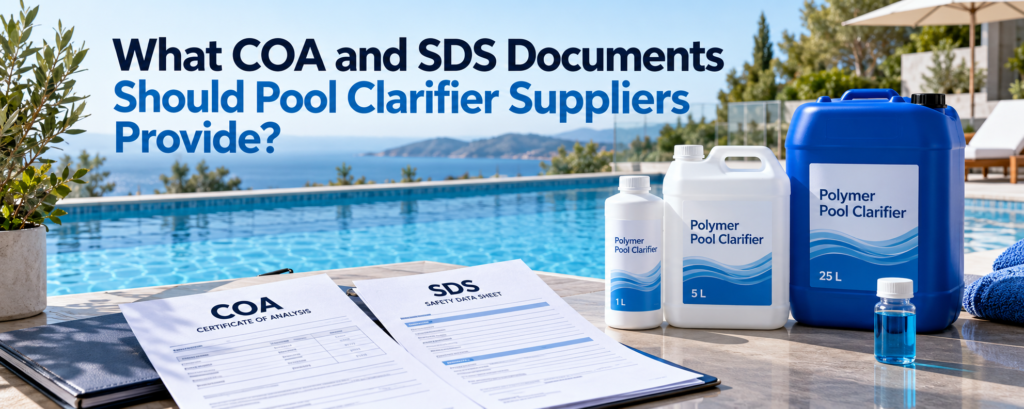
A pool clarifier sample can look great. The price may fit your market, and the packaging may be just what your brand needs. But before you place a bulk order, there’s another part of the purchase worth checking: the documents.
Two deserve close attention—the Certificate of Analysis (COA) and the Safety Data Sheet (SDS).
They answer different questions. A COA reports whether a specific batch meets agreed quality requirements. An SDS communicates the product’s hazards and safe handling information under the rules that apply to the market.
For distributors, pool service suppliers, and private label brands, both matter. A missing batch number can make a complaint hard to trace. An SDS for the wrong concentration can leave your warehouse team working from the wrong information.
So, what should a reliable pool clarifier supplier provide? And how can you tell whether the documents support the product you’re buying?
Let’s work through the checks that make a real difference.
Start Here: A COA and an SDS Have Different Jobs
It’s easy to put every technical document into one folder and call the paperwork complete. Yet each document serves a separate purpose.
| Document | Main purpose | What buyers should check |
|---|---|---|
| Certificate of Analysis | Reports batch quality against agreed specifications | Batch identity, test results, limits, and methods |
| Safety Data Sheet | Communicates hazards and safe handling information | Correct product, formulation coverage, market requirements, and revision |
| Technical Data Sheet | Describes product properties and application guidance | Concentration basis, dosage, storage, and supported uses |
| Product label | Identifies the packaged product and gives required user information | Product name, instructions, warnings, and traceability |
These documents should tell a consistent story.
If your purchase order calls for a blue, nominal 10% PolyDADMAC-based pool clarifier, the supplier should explain how the COA, SDS, technical sheet, and label relate to that product.
An SDS for a concentrated raw material does not automatically cover a diluted finished formulation. Likewise, a general specification sheet does not tell you what was measured in the batch being shipped.
The practical question is simple: Can you connect the documents to the goods you’ll receive?
What Should a Pool Clarifier COA Include?
For purchasing purposes, request a batch-specific COA issued by the manufacturer or responsible supplier. Agree on its contents before production, so the final document doesn’t become a last-minute surprise.
A useful COA should identify:
- The supplier or issuing company.
- The product name and grade or product code.
- The batch or lot number.
- The production date.
- The test or release date.
- The agreed quality specifications.
- The corresponding results.
- Units and relevant test conditions.
- Test method references, where needed.
- The person or system responsible for quality release.
A document number can also help with record control. If the supplier uses electronic approval, ask how the document’s authenticity can be checked.
A handwritten signature or company stamp may form part of the supplier’s process, but appearance alone proves little. Traceable results and clear specifications carry more weight than a large stamp.
For a shipment containing several production lots, request results for each lot or a clearly structured document that identifies them separately. One COA should not leave you guessing which drums it covers.
Check the Batch Number Before the Test Results
This may sound dull, but start with identity.
The COA batch number should match the batch markings on the supplied containers. Your receiving team should also be able to connect it to the shipment records.
Why put this first?
Because even a detailed laboratory report has limited value if nobody can connect it to the stock in your warehouse.
Imagine receiving several pallets of private label clarifier. Two months later, a customer reports an unusual appearance. If the bottle code leads to the production lot, its COA, and a retained sample, the investigation has a clear starting point.
Without that connection, everyone ends up searching through emails.
For repacked goods, ask how the packing lot relates to the original manufacturing batch. A new bottle code is useful only if the supplier keeps the link behind it.
Good traceability makes routine work easier, too. It helps you rotate stock, check older inventory, and answer customer questions without a long detective story.
Which Quality Tests Belong on a Pool Clarifier COA?
The right test panel depends on the formulation and the purchase agreement. There is no single set of numerical limits that fits every pool clarifier.
For a PolyDADMAC-based liquid product, buyers can discuss the following checks with the supplier:
| Quality item | What it helps buyers assess | Detail to clarify |
|---|---|---|
| Appearance | Visible consistency and condition | Expected clarity, color, and acceptable variation |
| Polymer content or agreed concentration measure | Formulation strength | Definition, units, and method |
| pH | Consistency with the approved grade | As supplied or diluted, plus test conditions |
| Viscosity | Handling and grade consistency | Temperature, instrument, and settings |
| Density | Supporting identity and consistency | Test temperature and units |
| Additional agreed tests | Specific market or customer needs | Method, acceptance limit, and test frequency |
Not every property needs to appear as a numerical result. Appearance, for example, may be recorded as a descriptive observation.
But important measured properties should be reported in a way that allows a useful comparison. A page filled with “Pass” can leave too much hidden.
Where testing is periodic rather than performed on every batch, ask the supplier to state that clearly. Buyers should be able to distinguish a current batch result from a typical value or an earlier qualification test.
“10% Active” Needs a Clear Definition
Here’s a small phrase that can cause a large misunderstanding: “10% active.”
Does it mean polymer content by mass? Nonvolatile matter? A concentration calculated from the raw material charge? Something else?
These descriptions should not be treated as interchangeable without evidence.
A finished product may contain components other than the polymer that remain after a drying test. A solids result, by itself, may therefore fail to show the exact amount of the polymer you intended to buy.
Before comparing offers, ask:
“What does your stated concentration measure, and how do you determine it?”
For example, if your purchasing specification says “PolyDADMAC content, % w/w,” the supplier should explain how its reported value supports that statement. If the value is calculated from formulation records, it should be identified as calculated rather than presented as a direct analytical measurement.
This isn’t about making a simple purchase complicated. It’s about comparing like with like.
A lower price per kilogram means little if two suppliers use different definitions of concentration.
Test Conditions Matter More Than They First Appear
Two laboratories can test the same material and report different values when their conditions differ.
Viscosity is a good example. A result without temperature and method details can be hard to interpret. Instrument type, spindle, and speed may also matter for the agreed procedure.
The same principle applies to pH. Was the product tested as supplied, or as a water dilution? If diluted, what concentration and preparation method were used?
Ask the supplier to make these points clear before you set acceptance limits.
You don’t need a full laboratory manual printed on every COA. A method code may be enough if both parties have access to the controlled method it refers to.
The aim is repeatability. When your team checks incoming goods, it should know how to make a fair comparison with the supplier’s result.
Otherwise, a difference caused by test conditions can turn into an unnecessary quality dispute.
What Should the Pool Clarifier SDS Cover?
The SDS should apply to the product being supplied and meet the relevant market’s requirements.
For international purchasing, a complete 16-section SDS is a useful document to request. However, a familiar layout alone does not prove that the classification, language, contacts, or content meet local rules.
In the United States, OSHA’s current Appendix D specifies required information for Sections 1–11 and 16; Sections 12–15 may be included but are not mandatory under that appendix. Requirements elsewhere can differ.
For buyers, the key areas to review are:
- Product and supplier identification.
- Hazard classification and related warnings.
- Ingredient information required by the applicable rules.
- First aid and spill response.
- Handling, storage, and protective measures.
- Physical and chemical properties.
- Stability and reactivity.
- Toxicological and ecological information.
- Disposal and transport information.
- Regulatory information and revision details.
Treat this as a review of useful content, rather than a quick count of headings.
A document can have sixteen sections and still describe the wrong product.
Make Sure the SDS Matches the Finished Formula
A pool clarifier supplier may work with several concentrations, original and blue appearances, and more than one polymer grade.
That makes formulation coverage a key question.
Ask whether the SDS applies to:
- The exact product code you’re ordering.
- The supplied concentration.
- The clear or dyed formulation.
- Any relevant additives.
- The intended market and language.
A shared SDS may be suitable for a defined group of similar products under applicable rules. Still, the supplier should be able to explain that coverage. “We use this for everything” is not a useful technical answer.
For blue pool clarifier, the presence of a dye does not automatically mean the hazard classification changes. It does mean that the finished formulation should have been assessed with the dye included.
The same care applies when a product is diluted. Do not assume that replacing a concentration figure on an old SDS is enough. The preparer should review the mixture and its properties.
Can Suppliers Protect Their Formula?
Yes, commercial confidentiality can be legitimate. An SDS is not always a public recipe for every component in a mixture.
However, confidentiality must follow the applicable disclosure rules.
For example, OSHA specifies ingredient disclosure requirements for mixtures and conditions for trade secret claims. A buyer’s wish to hide a chemical name does not, by itself, establish a valid exemption.
The sensible approach is to separate two needs.
Your commercial team may want to protect the product’s sourcing and formulation. Your safety team still needs accurate hazard information, and the responsible parties must meet the rules that apply.
A nondisclosure agreement may help with technical exchanges between buyer and supplier. It cannot replace information that must legally be disclosed.
So, if a supplier removes ingredient details on request, ask what lawful basis supports that decision. A blank section is not a confidentiality strategy.
Is an English SDS Enough for Export Orders?
English can be useful during sourcing and technical review. It may not satisfy the requirements of the destination market.
ECHA publishes country-specific language information for labels and safety data sheets in European markets. Buyers should check the language required for the country where the product will be supplied.
Before approving the document, agree on:
- The destination country.
- The required language or languages.
- The applicable SDS framework.
- The responsible supplier or importer details.
- The emergency contact arrangements.
Translation also needs care. Chemical names, warning statements, and emergency instructions should retain their technical meaning.
And remember: translating a document does not correct a flawed hazard assessment. First establish that the underlying SDS is suitable for the formulation and market. Then prepare the required language version.
It’s much easier to settle this before labels are printed and shipping is booked.
Should Suppliers Issue a New SDS for Every Batch?
Usually, the COA changes with the production batch. The SDS is controlled around the product and its safety information.
For routine orders of an unchanged formulation, ask for confirmation that you hold the current applicable SDS. A new batch number alone does not necessarily call for a new SDS.
Updates may be needed when the formulation, hazard information, protective measures, or relevant requirements change. ECHA states that an SDS should be updated without delay when new hazard information or a need for more stringent risk management measures becomes available. ECHA
Avoid judging an SDS only by the year on its front page.
A recent date does not guarantee accuracy. An older date does not automatically prove that a document is invalid. What matters is whether the responsible supplier has kept it current under the applicable rules.
For repeat purchasing, establish a clear process for receiving revised documents.
Private Label Documents Need a Clear Product Link
Private label supply adds another layer: your brand name may differ from the factory’s product name.
That’s manageable when the relationship is clear.
Ask the supplier to connect your finished product name or SKU with the manufacturing grade. The COA should identify the supplied goods clearly, while the SDS and label should use consistent product identification.
Agree on the responsible party details required for the destination market. Changing the logo on a supplier’s SDS is not enough if the contact information and regulatory responsibilities have not been reviewed.
The same principle applies to product changes.
If you approve a particular concentration, color, and polymer grade, ask the supplier to notify you before making a relevant change. The agreement should explain when a new sample, document revision, or further testing is needed.
For reference, Eautrix’s Polymer Pool Clarifier page describes a nominal 10% PolyDADMAC-based product with original and blue appearance options. Buyers should specify which version their requested documentation must cover.
Does the SDS Settle the Shipping Question?
An SDS provides information that supports transport review. It should not be treated as the whole shipping file.
Ask the supplier and your logistics provider to confirm the transport status of the finished formulation for the planned route and mode.
Do not decide this from the words “water-based,” from the polymer’s name, or from the classification of a different concentration.
When relevant, review the stated UN number, proper shipping name, hazard class, packing group, and environmental hazard information. If the product is described as not regulated for a transport mode, the supplier should have a defensible basis for that statement.
Depending on the shipment, carriers or authorities may also require supporting assessments, packaging evidence, or separate transport documents.
The useful purchasing habit is to raise this early. Send the applicable SDS to the logistics team while the order is still being planned, so any questions can be resolved before collection.
Don’t Ask the COA to Prove Pool Performance
A COA helps you check agreed batch properties. It does not automatically demonstrate how quickly a pool will clear.
Even a product that meets its concentration, pH, and viscosity limits needs application guidance and suitable testing.
For a new supply relationship, request a technical sheet that explains the intended use, dosage basis, storage conditions, and any supported filter compatibility claims. If the dosage is given in ppm, clarify whether it refers to the finished product or the active polymer.
Then test the sample under conditions relevant to your customers.
Keep the water conditions, treatment amounts, observation times, and filtration setup consistent when comparing products. Record both useful results and any handling or filtration concerns.
A laboratory check, a controlled application trial, and a COA each answer part of the purchasing question. Together, they provide a stronger basis for a decision.
The same restraint applies to compliance claims. Neither a COA nor an SDS alone proves that every intended claim or market use is authorized.
A Simple Document Review Before You Buy
You don’t need a mountain of paperwork. You need a small set of documents that agree with each other.
Before placing the order, request the proposed specification, a representative COA, the applicable SDS, and the technical sheet. A representative COA shows the reporting format; it should be clearly distinguished from the final shipment’s results.
Before shipment, review the actual batch COA and confirm the product identity against the approved order and label.
On receipt, check the container codes and retain the records in a way your team can find later.
Pause when you see unexplained differences such as:
- A different product code.
- A concentration basis that keeps changing.
- A blue product described as colorless without explanation.
- Missing batch identification.
- Results reported without units.
- An SDS for a raw material rather than the finished product.
- Conflicting storage or handling guidance.
A typo can happen. What matters is whether the supplier investigates it, issues a controlled correction, and gives you a clear answer.
Reliable documentation makes purchasing calmer. It gives your warehouse, sales, technical, and customer service teams the same dependable information—and gives you a firmer basis for the next order.
Frequently Asked Questions
1. What is the difference between a pool clarifier COA and SDS?
A pool clarifier COA reports results for a specific batch against agreed quality limits. An SDS communicates hazards, safe handling, and related safety information for the product. Professional buyers should review both.
2. Should a PolyDADMAC pool clarifier COA show active content or total solids?
It should report the concentration measure agreed in the purchasing specification. Polymer content and total solids should not be assumed to mean the same thing. Ask the supplier to define the reported value and its method.
3. Does blue polymer pool clarifier need a separate SDS?
The SDS must cover the blue finished formulation. A separate document may be needed, or a properly defined shared SDS may cover it. The supplier should confirm that the dye and other ingredients were considered.
4. Can private label pool clarifier use the manufacturer’s SDS?
It may provide the technical foundation, but the finished document needs suitable product identification, responsible party information, language, and market-specific content. Simply changing the logo may be insufficient.
5. Should pool clarifier suppliers provide a COA with every shipment?
Buyers should agree to receive a COA covering every supplied batch. If one shipment contains several lots, each lot should have traceable results. The current applicable SDS should also be available, even when it has not changed since the previous order.