
GET IN TOUCH
Ask For Sample?
How to Import Private Label Polymer Pool Clarifier from China?
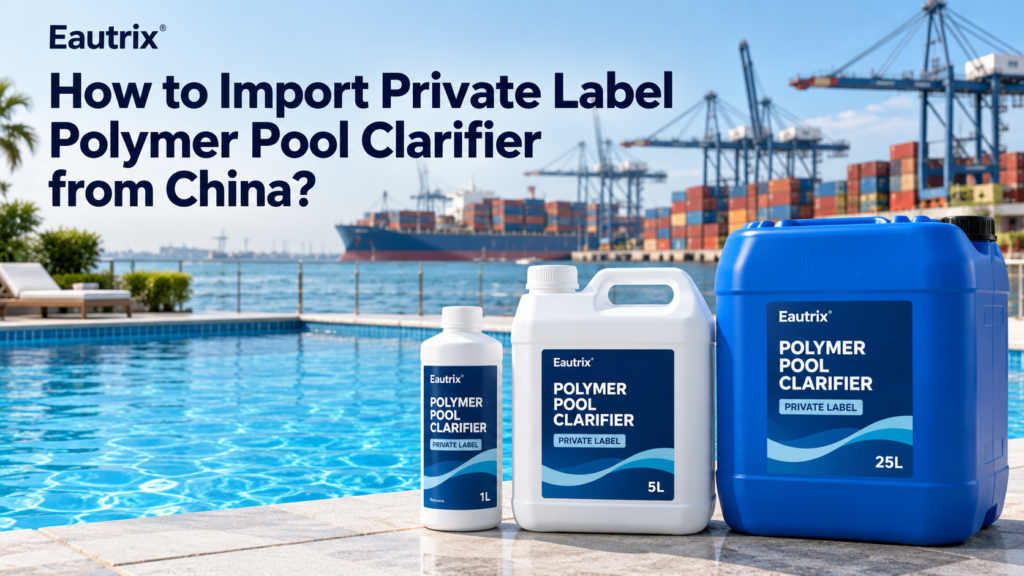
Importing private label polymer pool clarifier from China starts with a clear product brief. You need to define the formula, test a representative sample, approve the packaging, confirm destination-market requirements, and agree on shipping terms before production begins.
That sounds straightforward. Yet small gaps can turn a promising purchase into a costly first order.
A quotation may say “10% clarifier” without explaining how that figure is measured. A bottle may look right but leak during transport. A label may promise more than the product has been tested to deliver. And a low freight quote may leave out charges at the destination port.
The good news? These problems are easier to manage before the goods leave China.
This guide walks pool chemical distributors, service companies, and brand owners through the process—from the first supplier inquiry to the first shipment arriving at your warehouse.
Start With the Product You Want to Sell
Before asking for a price, decide where your clarifier will fit in your product range.
Will it sit on a retail shelf? Travel in a pool technician’s service vehicle? Supply hotels and leisure centers? Each route calls for a slightly different brief.
A household buyer may need a small bottle with clear measuring instructions. A service company may care more about treatment cost, easy pouring, and carton strength. A commercial distributor may prefer larger containers that reduce handling.
Write down these points first:
- Destination country and sales channel.
- Polymer type and intended concentration.
- Clear or blue appearance.
- Bottle or jerrycan size.
- Estimated first-order quantity.
- Required label language.
- Target launch date.
- Intended product claims.
This gives suppliers something solid to quote against. It also helps you compare offers fairly.
“Please quote your cheapest pool clarifier” leaves too much room for interpretation. A short, specific brief usually saves several rounds of email.
Know What “Polymer Pool Clarifier” Means
Polymer pool clarifier is a product category, not a complete chemical specification.
Different suppliers may use different polymers, concentrations, and formulation methods. Even products based on the same polymer can differ in molecular characteristics, viscosity, and performance.
For a PolyDADMAC-based product, ask the supplier to identify the polymer as poly(diallyldimethylammonium chloride), CAS 26062-79-3. Then confirm what else is in the finished formula and which details need to be disclosed for safety, transport, and market compliance.
The basic purpose is to help a suitable filtration system remove fine suspended matter that contributes to cloudy water. However, a clarifier does not repair a damaged filter or replace a proper sanitation program.
That distinction should guide your purchasing brief and your marketing.
Eautrix’s Polymer Pool Clarifier page provides a starting point for discussing PolyDADMAC-based formulations and private label requirements.
Make Sure “10%” Means the Same Thing to Both Sides
A percentage looks precise. Sometimes it isn’t.
If a supplier offers a 10% polymer pool clarifier, ask whether that means:
- Active polymer by weight.
- Total solids by weight.
- A dilution made from a specified raw material.
- Another defined measurement.
Those descriptions should not be treated as interchangeable without supporting information.
For example, using 10% of a polymer solution in a blend does not necessarily produce a finished product with 10% active polymer. The concentration of the starting material matters.
Your purchase specification should state the agreed basis, test method, and acceptable range. It should also define relevant properties such as appearance, pH, density, and viscosity, with test conditions where needed.
The goal is simple: the supplier’s production team, your quality team, and any testing laboratory should all understand the same requirement.
Choose a Supplier You Can Verify
A tidy website is useful. It is only one part of supplier assessment.
Ask who makes the polymer, who blends the final product, who fills the containers, and who exports the order. One company may handle all four jobs. Several companies may share them.
Either arrangement can work when responsibilities are clear.
Request the supplier’s legal company name, business details, production information, and payment instructions. Check that the contracting party and receiving bank account make sense together.
For a private label project, also ask:
- Can the supplier repeat the approved formula?
- How are batches identified?
- Are retained samples kept?
- How are filling weights or volumes checked?
- Who approves labels before printing?
- What happens when a batch fails the agreed specification?
If a certificate is offered, check its holder, scope, issuing body, and validity. A certificate held by a raw material producer does not automatically cover the company filling your finished bottles.
For a substantial first order, a factory visit, remote audit, or independent inspection can add useful evidence.
Check Market Requirements Before Printing Labels
This step belongs near the start of the project.
The destination country determines which import, chemical, language, labeling, and sales requirements apply. Supplier export experience can help, but it does not replace a review for your specific market and formula.
The importer should give its customs broker or regulatory adviser enough information to assess:
- Chemical identity and composition.
- Intended use.
- Proposed label and website claims.
- Product concentration.
- Packaging size.
- Available safety information.
For example, U.S. importers have responsibilities for accurate entry information, including customs classification and value. Hiring a broker does not remove the importer’s duty to exercise reasonable care.
For EU supply, polymer status also needs careful review. ECHA explains that importers of polymers may have registration obligations concerning monomers or other substances used to make them. “It’s a polymer” is not a complete REACH assessment.
Resolve these questions while changes are still easy to make.
Keep Clarifier Claims Separate From Pest-Control Claims
A few words on a label can change the regulatory picture.
A claim about improving water clarity is different from a claim about killing algae, controlling bacteria, or disinfecting pool water.
In the United States, EPA guidance distinguishes water-clarity claims from claims that a product prevents, destroys, or controls pests. Algae-control and antibacterial claims can bring a product within pesticide requirements. The assessment also considers the wider marketing context.
That means your review should cover more than the printed bottle.
Check product pages, brochures, sales presentations, and promotional statements too. EPA notes that claims made through websites and other sales activities can matter when determining a product’s intended pesticidal purpose.
Choose claims that match the product’s intended function, evidence, and legal status. A familiar phrase copied from another pool chemical can create an avoidable problem.
Test a Sample That Represents Your Order
A sample should answer a practical question: will this product work for your intended customers?
Request the concentration, color, and polymer grade proposed for commercial supply. If possible, obtain a sample in the intended packaging as well.
Begin with basic checks:
- Does the appearance match the description?
- Is the liquid uniform?
- Are there particles, layers, or deposits?
- Does the container seal well?
- Can the product be measured and poured with ease?
Then assess performance under controlled conditions.
Use representative pool water and record the starting conditions. Keep treatment doses, mixing, observation times, and filtration conditions consistent. Include an untreated control.
A jar test can help compare responses, but it cannot fully reproduce a working pool filter. Follow it with a controlled filtration trial when practical.
Watch for changes in clarity, filter pressure, cleaning needs, and any unwanted effects. Avoid judging performance from one attractive “before and after” photograph.
Agree on Dosage Instructions Before Label Approval
Dose instructions are part of product development.
They should come from evidence for the finished formula and intended application. Copying the dose from another brand can produce the wrong treatment level, especially if polymer concentration differs.
Also clarify whether a technical dose refers to the finished product or the active polymer. Confusing the two can cause a large error.
For customer-facing directions, measurable units are usually easier to follow than an unexplained ppm figure. Instructions might use milliliters of finished product per stated pool volume, provided that dose has been supported.
The directions should also explain the role of filtration and any relevant limits.
Avoid assuming that every formula suits every sand, cartridge, or diatomaceous earth filter. Ask what compatibility evidence is available and identify any restrictions before making broad claims.
Clear instructions protect product performance. They also give your service team a sound basis for answering questions.
Choose Packaging Around How Customers Buy
The best container size depends on the sales route.
| Packaging size | Potential sales channel | Main points to assess |
|---|---|---|
| 1L bottle | Retail and household pool care | Measuring, shelf presentation, closure security |
| 5L jerrycan | Pool service companies | Pouring, handle strength, vehicle storage |
| 25L jerrycan | Commercial supply and distributors | Handling, stacking, dispensing |
| Bulk packaging | Local filling or blending | Filling equipment, traceability, local compliance |
These are starting points, not fixed rules.
You may find strong retail demand for 5L packs or a service market that prefers smaller bottles. Let customer needs guide the choice.
For each container, confirm the material, closure, seal, label area, and carton arrangement. Ask how the packaging has been assessed for the formula and expected journey.
Also separate nominal container capacity from declared net contents. A container described as “1L” does not automatically establish a 1kg fill. Density and the agreed filling basis matter.
Treat the Label as a Controlled Document
Private labeling involves more than placing your logo on a bottle.
The finished artwork needs to combine brand design with accurate product information and destination-market requirements.
Depending on the market and product classification, relevant content may include:
- Product name and intended use.
- Net contents.
- Directions and limitations.
- Safety and first-aid information.
- Storage and disposal statements.
- Responsible business details.
- Batch identification.
- Required language and hazard elements.
Confirm which items are mandatory for your product.
Ask for a printed proof on the actual container. Screen artwork cannot show every issue. Small text, curved surfaces, label edges, and poor contrast can make a good design hard to use.
Approve the artwork in writing and assign a version number. If the formula or required wording changes, the label should go through review again.
Build a Document Pack Before Shipment
Do not leave document review until the vessel is about to sail.
Request draft versions early enough for your broker and internal team to check them. Commercial names, addresses, quantities, and shipping details should agree across the set.
A typical project may involve the following documents:
| Document | Main purpose |
|---|---|
| Commercial invoice | Records the sale, description, value, and commercial details |
| Packing list | Shows packages, quantities, weights, and shipment arrangement |
| Bill of lading or air waybill | Records transport details |
| Certificate of analysis | Reports results for the supplied batch |
| Safety data sheet | Communicates relevant hazards and safe-handling information |
| Technical data sheet | Describes product properties and application guidance |
| Origin documentation, where required | Supports an origin declaration or applicable trade requirement |
The exact set varies by destination and shipment. Import licenses and special documentation can be product- and country-specific. trade.gov
A COA and an SDS serve different purposes. A good batch result does not establish market authorization, and an SDS does not prove that the product meets your purchase specification.
Keep Private Branding Consistent With Accurate Disclosure
Private label buyers often want to protect supplier relationships and formula details. That is understandable.
Still, confidentiality needs a workable structure.
Use a confidentiality agreement to protect commercial information. Give authorities, carriers, laboratories, and advisers the information they legitimately need through appropriate channels.
A trade name can appear on documents, but it should not obscure a required goods description or conflict with the supporting safety information.
Likewise, private labeling does not change the country where the goods were made. Review origin wording before approving invoices, labels, or customer documents.
The aim is to build a brand that can stand behind its paperwork.
Confirm Customs and Transport Classification Separately
A customs tariff code and a dangerous goods classification answer different questions.
The tariff code concerns customs treatment. Transport classification concerns the hazards and conditions of carriage.
Neither should be selected solely from the phrase “pool clarifier.”
Ask your broker to review tariff classification against the actual composition, presentation, and intended use. Do not assume that a code used for an industrial raw polymer applies to every formulated retail product.
For transport, obtain classification information for the finished formula and proposed shipping mode. Have the forwarder review the SDS and any additional evidence needed for acceptance.
Do not assume that all polymer clarifiers are dangerous goods—or that all are unrestricted cargo.
The booking needs to match the actual product, packaging, route, and carrier requirements.
Compare Quotes on the Same Basis
A low unit price can hide an incomplete offer.
Check whether each quotation includes the same formula, fill quantity, container, label, carton, pallet arrangement, and inspection requirements.
Also confirm the minimum order quantity for each part of the project. The chemical batch minimum may differ from the minimum for printed labels or custom bottles.
Your purchase order should record:
- Approved specification and formula reference.
- Packaging and artwork versions.
- Quantity and filling basis.
- Price and currency.
- Named delivery term and location.
- Payment schedule.
- Production lead-time trigger.
- Acceptance criteria.
- Procedure for shortages or defects.
State the applicable Incoterms edition where used, and name the place or port precisely. “FOB China” is too vague for a clear agreement.
Payment terms are also a commercial choice. Check the beneficiary details independently before sending funds, especially if bank instructions change.
Work Out the Landed Cost Per Sellable Unit
The supplier’s price is only one part of the cost.
Build your calculation around goods that arrive ready to sell.
Include the product, packaging, origin handling, freight, insurance, destination charges, customs clearance, duties, applicable taxes, inland delivery, and any testing or relabeling.
For example, suppose a hypothetical shipment has total costs of $6,000 and yields 2,000 sellable bottles:
Landed cost per sellable bottle = $6,000 ÷ 2,000 = $3.00
That figure still needs room for warehousing, sales costs, credit terms, and profit.
Treat recoverable taxes according to your local accounting position rather than automatically treating every tax payment as a permanent cost.
Then test the assumptions. What if freight rises? What if the shipment sells more slowly than planned? What if some bottles arrive damaged?
A simple cost sheet can reveal whether the first order still works when conditions are less than perfect.
Inspect Before Dispatch—and Again on Arrival
Pre-shipment inspection should refer to the approved purchase requirements.
Check the batch identity, COA, container count, net contents, closures, labels, cartons, and pallet condition. If independent sampling or laboratory testing is required, agree on the method and acceptance criteria before production.
Photos help, but they cannot verify every quality point.
Ask for loading records that show how the goods were secured. Keep copies of the final shipping documents and know when they must reach your broker.
On arrival, inspect the shipment before releasing it for sale. Record damage, leakage, shortages, or label problems promptly. Retain photographs and relevant transport records.
Quarantine affected stock while the issue is assessed. It is much easier to manage a problem in one warehouse than after cartons have reached several distributors.
Make the First Order Useful for the Second One
A first shipment should give you more than inventory. It should give you evidence.
Track how customers use the product, which pack sizes sell, how often dosing questions arise, and whether the instructions are clear. Keep feedback linked to batch numbers.
Use that information when planning the next order.
Perhaps the formula performs well but the bottle is hard to pour. Perhaps service companies prefer a larger pack. Perhaps a label needs a clearer pool-volume example.
These are manageable improvements when the underlying specification and records are sound.
For an Eautrix inquiry, share your destination, sales channel, preferred concentration, packaging sizes, estimated quantity, and launch timing through the contact page. Those details give the supplier a practical basis for a sample and quotation discussion.
Frequently Asked Questions
1. Can I import private label polymer pool clarifier without owning a factory?
Yes. A distributor or brand owner can buy finished private label products from a supplier. You still need to confirm the importer, responsible seller, labeling, and chemical compliance arrangements required in your destination market.
2. What is the minimum order quantity for private label pool clarifier from China?
There is no universal MOQ. It depends on batch size, container availability, label printing, and customization. Ask for separate minimums for the formula, each pack size, and any custom packaging.
3. Is blue polymer pool clarifier better than clear clarifier?
Color alone does not establish performance. Compare the polymer, concentration, dosage, and test results. A dyed version should also be assessed for stability, packaging compatibility, and suitability at the intended use level.
4. Which documents should I request when importing PolyDADMAC-based pool clarifier?
Start with the specification, TDS, finished-product SDS, batch COA, invoice, packing list, and transport document. Have your broker confirm any additional origin, licensing, chemical, or transport documentation required for the shipment.
5. Should I import finished bottles or bulk polymer pool clarifier?
Finished bottles can simplify your local packing work. Bulk supply may suit a business with suitable filling equipment, quality controls, and local compliance arrangements. Compare total landed costs and operational needs before choosing.