
GET IN TOUCH
Ask For Sample?
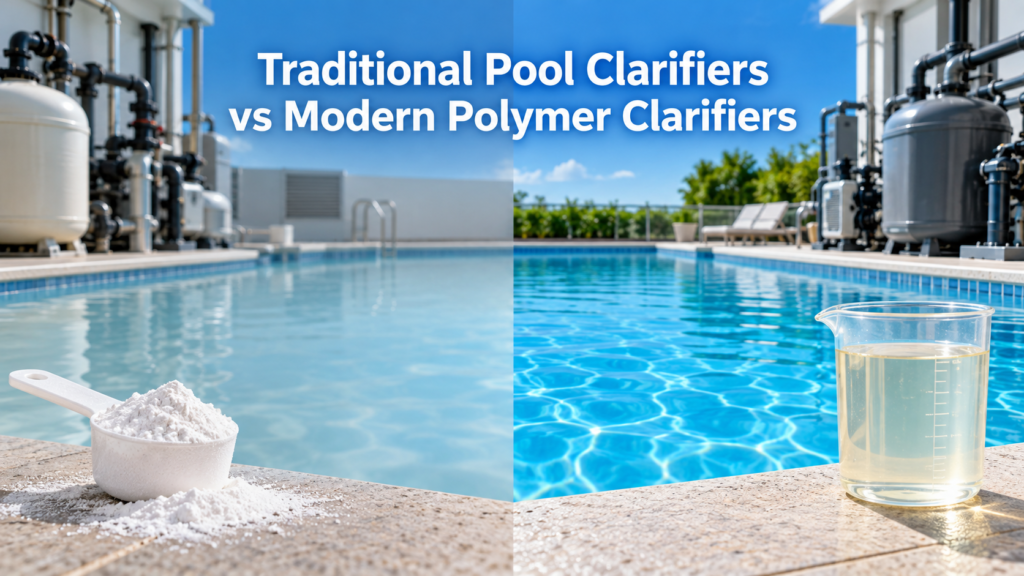
Traditional Pool Clarifiers vs Modern Polymer Clarifiers
Cloudy pool water is rarely just a cosmetic problem. It can hide the pool floor, reduce swimmer confidence, increase pressure on the filtration system, and make an otherwise well-maintained facility look neglected.
For decades, pool operators have used clarifying chemicals to remove the tiny suspended particles that filters struggle to capture. Traditional products—especially alum and other inorganic coagulants—have played an important role in this work. They still have their place.
Yet pool treatment has changed. Commercial facilities now face heavier bather loads, tighter maintenance schedules, variable source water, and growing pressure to reduce downtime. Modern polymer clarifiers were developed with these operating realities in mind.
So, how do traditional pool clarifiers compare with modern polymer clarifiers? And does “modern” automatically mean better?
The honest answer is more nuanced. Both technologies can produce clear water, but they behave differently inside the pool. Understanding those differences helps operators choose a treatment that fits their filtration system, maintenance routine, and water conditions.
First, What Does a Pool Clarifier Actually Do?
Many particles responsible for cloudy water are much smaller than they appear. Dust, pollen, body oils, cosmetic residues, dead algae, and fine organic debris may remain suspended even when chlorine and pH readings look normal.
These particles often pass through the filter because they are too small to be trapped efficiently. Some also carry similar electrical charges, so they naturally repel one another. Instead of joining together and settling, they stay dispersed throughout the water.
A clarifier changes that behavior.
It neutralizes or reduces the forces keeping the particles apart. The small particles then gather into larger clusters, sometimes called microflocs. These clusters are easier for the filter to capture.
A clarifier does not replace filtration. It helps the filter do its job.
That distinction matters. Adding more clarifier cannot compensate for poor circulation, a dirty filter, weak sanitizer residual, or an untreated algae problem. Clarification works best as part of a complete water-management program.
What Are Traditional Pool Clarifiers?
Traditional clarifiers are generally based on inorganic mineral salts. Aluminum sulfate, commonly called alum, is the best-known example. Other formulations may use aluminum-based or iron-based coagulants.
These chemicals have a long history in municipal water treatment and pool maintenance. When introduced under suitable water conditions, they react with alkalinity and form a gelatinous precipitate. This precipitate captures suspended matter as it develops.
The resulting material can be removed by filtration or, when used as a flocculant, allowed to settle before being vacuumed to waste.
It is a proven process. It is also sensitive to how the pool is operated.
Alum: Old-Fashioned, but Far from Useless
Alum can be very effective when a pool has severe cloudiness or when operators want suspended contamination to settle to the floor. It is widely available and usually inexpensive on a cost-per-kilogram basis.
However, alum treatment requires careful control.
Its performance is affected by:
- Pool-water pH
- Total alkalinity
- Water temperature
- Mixing conditions
- Product dosage
- Filtration method
- Operator experience
As alum reacts, it can consume alkalinity and lower pH. If water chemistry moves outside the suitable range, floc formation may become weak or unpredictable.
The pool may also need to remain undisturbed while the floc settles. Afterward, the settled material must be vacuumed slowly to waste. Move too quickly and the soft floc can break apart, returning the pool to its cloudy starting point. Frustrating? Very.
For a trained operator managing a planned recovery treatment, that process may be acceptable. For a busy hotel pool that must reopen the next morning, it can be inconvenient.
What Are Modern Polymer Clarifiers?
Modern polymer clarifiers use long-chain organic molecules to bring fine particles together. Many pool formulations rely on positively charged, or cationic, polymers because a large share of suspended contamination carries a negative surface charge.
One commonly used cationic polymer is PolyDADMAC, identified by CAS No. 26062-79-3. It may be formulated at a suitable concentration—such as 10% active content—for routine pool-water clarification. The finished liquid can be supplied clear or adjusted to a blue appearance, depending on the buyer’s market and private-label requirements.
Polymer clarifiers usually work through two related mechanisms:
- Charge neutralization: The cationic polymer reduces the electrical repulsion between negatively charged particles.
- Particle bridging: Long polymer chains attach to several particles at once, connecting them into larger clusters.
Think of the polymer as a very small net moving through the water. It does not simply push particles to the bottom. It gathers them into filterable groups.
These microflocs can then be removed during normal circulation, provided the filter is operating correctly.
Traditional and Modern Clarifiers: The Main Differences
The biggest difference is not simply “mineral versus polymer.” It is how each treatment interacts with pool chemistry, suspended particles, and the filtration process.
| Comparison Area | Traditional Inorganic Clarifiers | Modern Polymer Clarifiers |
|---|---|---|
| Typical chemistry | Alum or other metal salts | Cationic organic polymers |
| Main mechanism | Precipitation and coagulation | Charge neutralization and particle bridging |
| Effect on pH | May lower pH | Usually limited at the recommended dosage |
| Effect on alkalinity | May consume alkalinity | Generally minimal |
| Floc character | Larger, softer floc or settled blanket | Smaller, more filterable clusters |
| Operating method | May require settling and vacuuming | Often works during normal circulation |
| Dosage sensitivity | Sensitive to chemistry and application conditions | Still dose-sensitive, but often easier for routine use |
| Downtime | Can be significant during floc treatment | Usually lower for routine clarification |
| Handling | Often supplied as powder or granular material | Commonly supplied as a liquid |
| Typical role | Corrective treatment or severe cloudiness | Routine maintenance and moderate cloudiness |
This table gives a practical overview, but it does not mean every polymer formulation behaves in exactly the same way. Molecular weight, charge density, active concentration, viscosity, and compatibility all influence performance.
“Polymer clarifier” is a chemical category—not a single universal product.
Which One Is Easier to Use?
For routine maintenance, liquid polymer clarifiers are generally easier to dose and distribute.
A measured amount can often be added while the circulation system is running. The product disperses through the pool, brings fine particles together, and sends them toward the filter.
There is usually no heavy powder to handle and no need to prepare a slurry. The operator also avoids the dust associated with certain dry inorganic products.
This simplicity matters in commercial settings. A pool technician may be responsible for several properties in one day. A treatment that works with normal circulation can reduce labor and simplify scheduling.
Traditional flocculation may involve more steps:
- Adjust the water chemistry
- Prepare or disperse the treatment
- Circulate it for a specified period
- Stop the pump
- Allow the floc to settle
- Vacuum the pool to waste
- Refill lost water
- Rebalance the pool chemistry
That process can be worthwhile when the water is extremely cloudy. It simply does not fit every maintenance situation.
The pH and Alkalinity Question
Traditional aluminum-based treatments depend heavily on pH and alkalinity. These water conditions influence hydrolysis—the reaction that allows the coagulant to form the precipitate responsible for capturing particles.
If pH is too high or too low, coagulation may become less effective. Excessive dosing can also reduce alkalinity and cause an unwanted pH shift.
Modern organic polymer clarifiers generally have less effect on the pool’s acid–base balance when applied at the recommended dosage. They do not rely on forming a large metal-hydroxide precipitate in the same way alum does.
That is a practical advantage, particularly in pools where chemistry is already balanced.
Still, “less effect” does not mean “no need to test.” Operators should confirm pH, sanitizer level, filtration condition, and circulation before treating cloudy water. A clarifier performs far better when the rest of the system is working properly.
What Happens Inside the Filter?
A good clarifier should make particles easier to capture without rapidly overwhelming the filter.
Traditional coagulants can produce a relatively large amount of precipitated material. This can be helpful for sweeping contamination from the water, but it may also raise filter pressure quickly. Backwashing or cleaning may be needed after treatment.
Polymer clarifiers usually create smaller aggregates designed to move with the circulating water and become trapped by the filter media. This makes them useful for sand, cartridge, and diatomaceous earth filtration systems—subject, of course, to the product’s specific directions.
The filter should be monitored during either treatment.
As captured solids accumulate, pressure can rise and flow can fall. That does not always mean the clarifier has failed. Quite the opposite: it may mean the filter is collecting the material that previously floated through the pool.
The technician must then remove that captured load by backwashing or cleaning the filter.
Can Polymer Clarifiers Be Overdosed?
Yes. More clarifier does not always produce clearer water.
This is one of the most common mistakes in pool maintenance. When water remains hazy, the natural reaction is to add another dose—and then perhaps another. But excessive polymer may restabilize particles, leave the water looking dull, or create sticky deposits inside the filtration system.
A polymer works well when enough charged sites are available to connect particles. If too much is added, particle surfaces can become coated. Instead of forming larger clusters, they may become dispersed again.
The result can feel baffling: the operator has added extra clarifier, yet the pool looks worse.
Accurate dosing matters with traditional coagulants too. Excess alum can create more precipitate than the system can manage, disturb water balance, and leave residual material behind.
Whichever chemistry is used, the label dosage should be treated as a working limit—not a casual suggestion.
Clarifier or Flocculant? They Are Not Quite the Same
The words clarifier, coagulant, and flocculant are often used loosely. Their functions overlap, but the way they are applied may differ.
A routine pool clarifier usually forms small particle clusters that remain suspended long enough to reach the filter. Circulation continues during treatment.
A pool flocculant is generally used to create larger, heavier flocs that settle on the pool floor. The pump is then stopped, and the sediment is vacuumed to waste.
Some traditional inorganic products, especially alum, are commonly used for settling treatments. Certain polymer formulations can also function as flocculants, depending on their chemistry, dosage, and application method.
The product name alone does not tell the whole story. Always check whether the formulation is designed for:
- Continuous or routine clarification
- Filter-assisted removal
- Corrective flocculation
- Settling and vacuuming
- Commercial or residential pool systems
Using a settling flocculant as though it were a routine clarifier can create a maintenance headache. The reverse can be equally disappointing.
Where Traditional Clarifiers Still Make Sense?
Modern polymer technology has several operating advantages, but traditional treatments have not become obsolete.
An alum-based floc treatment may be suitable when:
- The pool has severe turbidity
- Large amounts of dead algae remain after treatment
- The operator can close the pool temporarily
- Vacuum-to-waste equipment is available
- Water loss is acceptable
- The technician understands pH and alkalinity control
- Rapid settling is more important than uninterrupted circulation
For major cleanup work, the visible blanket of settled floc can be useful. It gives the operator a direct way to remove a heavy contaminant load rather than sending everything through the filter.
Traditional treatment is a tool. It simply requires the right conditions and a skilled hand.
Where Modern Polymer Clarifiers Have the Advantage?
Polymer clarifiers are especially well suited to routine pool maintenance and commercial operations where closure time must be kept low.
They may be useful for:
- Mild or recurring water haze
- Fine dust and pollen
- High-bather-load residue
- Small particles that repeatedly pass through the filter
- Maintenance after rain or windy weather
- Hotels, resorts, clubs, and public pools
- Service companies managing several pools
- Preventive clarification programs
Their liquid form also supports convenient private-label packaging. Depending on the market, a manufacturer may supply the formulation in 1-liter bottles, 5-liter containers, or 25-liter jerry cans.
Color can be adjusted for brand presentation, but appearance should never be mistaken for performance. A blue clarifier is not necessarily stronger than a clear one. The active polymer, concentration, dosage, and formulation quality matter much more than the dye.
What About Water Loss and Operational Downtime?
This is an increasingly important part of the comparison.
A settling treatment often requires vacuuming to waste. That removes the floc, but it also removes treated pool water. The lost volume must be replaced, reheated when necessary, and chemically rebalanced.
For a small residential pool, the cost may be manageable. For a large heated commercial pool, the water and energy loss can become meaningful.
Filter-assisted polymer clarification generally avoids a full settling-and-vacuuming cycle. The treatment works through the existing circulation and filtration system, although filter cleaning or backwashing may still be required.
That can mean:
- Less water sent to waste
- Shorter service interruptions
- Lower reheating demand
- Less time spent rebalancing fresh water
- Easier integration into routine maintenance
The actual savings depend on pool size, contamination level, filter type, and local water costs. Still, the operational difference deserves attention. Chemical price alone rarely tells the full cost story.
Does a Modern Polymer Replace Chlorine?
No—and this cannot be stressed enough.
A clarifier is not automatically a sanitizer or algaecide. Its primary role is to improve particle removal and water appearance.
Clear water can still contain harmful microorganisms. Conversely, properly sanitized water can remain cloudy because of fine suspended matter, poor filtration, high calcium levels, or environmental debris.
A complete treatment program may include:
- Sanitizer control
- pH and alkalinity management
- Filtration and circulation
- Algae prevention
- Oxidation when needed
- Routine clarification
- Physical cleaning
Each component has a different job. Asking a clarifier to solve every water problem is rather like asking the pool filter to manage pH—it is the wrong tool for the task.
Choosing Between Traditional and Polymer Clarifiers
The right choice begins with the condition of the water, not the age of the technology.
Before selecting a product, ask:
- Is the cloudiness mild, moderate, or severe?
- What caused it?
- Is the filter working correctly?
- Can the pool remain closed while solids settle?
- Can the system vacuum directly to waste?
- How sensitive is the water to pH or alkalinity changes?
- Is this a one-time recovery treatment or routine maintenance?
- How much operator time is available?
- Will the treatment be used in a hotel, residential pool, club, or public facility?
For severe contamination with planned downtime, a traditional settling treatment may be appropriate. For routine clarity management, modern polymer clarifiers are often more convenient.
Some professional programs use both—but at different times and for different reasons.
What Buyers Should Check in a Polymer Clarifier?
Not every polymer clarifier offers the same quality or consistency. Professional buyers should review the formulation and supporting documents rather than comparing products only by color and price.
Important points include:
- Active polymer identity
- Active-content range
- Recommended dosage
- pH of the finished product
- Appearance and viscosity
- Storage stability
- Compatibility with common pool chemicals
- Suitable filter types
- Packaging integrity
- Batch-to-batch consistency
- Certificate of Analysis
- Safety Data Sheet
- Private-label and packaging capability
A concentrated product may look economical, but only if it can be diluted, dosed, and handled consistently. A low-cost formulation that varies between batches may create more service calls than it saves.
Reliable clarification depends on predictable chemistry. Pool technicians should not have to guess how the next container will behave.
The Verdict: It Is About Control, Not Fashion
Traditional clarifiers helped establish the science of particle removal in swimming pools. Alum remains valuable for specific corrective treatments, particularly when heavy contamination must be settled and vacuumed away.
Modern polymer clarifiers answer a different operational need. They are designed for efficient particle capture, limited disturbance to balanced water chemistry, convenient liquid dosing, and closer integration with normal filtration.
That makes them particularly attractive for routine maintenance and professional pool service.
Still, no clarifier can rescue a neglected circulation system or replace proper sanitation. The clearest results come from diagnosis first, treatment second.
So, traditional or modern?
For major recovery work, traditional flocculation may still earn its place. For steady, practical clarity control, a well-formulated cationic polymer clarifier usually offers the more manageable route.
The chemistry has changed, but the goal remains beautifully simple: clear water, reliable filtration, and a pool people feel confident stepping into.
Frequently Asked Questions
1. Are polymer pool clarifiers better than alum?
Polymer pool clarifiers are often more convenient for routine treatment because they usually have less effect on pH and alkalinity and can work during normal filtration. Alum may be more suitable for severe cloudiness when settled solids can be vacuumed to waste.
2. Can a PolyDADMAC pool clarifier be used with a sand filter?
A properly formulated PolyDADMAC pool clarifier can help a sand filter capture fine suspended particles. Dosage must follow the product directions, and filter pressure should be monitored during treatment.
3. How often should a modern polymer pool clarifier be added?
Frequency depends on bather load, environmental debris, filtration performance, and water condition. Some pools need only corrective treatment, while high-use commercial pools may include a low-dose clarifier in routine maintenance.
4. Why did my pool become cloudier after adding clarifier?
Possible causes include overdosing, poor circulation, an overloaded filter, incorrect water chemistry, active algae, or adding incompatible chemicals too close together. Test the water and inspect the filtration system before adding more product.
5. Is a cationic polymer clarifier the same as a pool flocculant?
Not necessarily. A routine cationic polymer clarifier usually forms filterable microflocs during circulation. A flocculant produces heavier material intended to settle before vacuuming. The formulation and application instructions determine how the product should be used.