
GET IN TOUCH
Ask For Sample?
The Evolution of Swimming Pool Water Clarification Chemicals
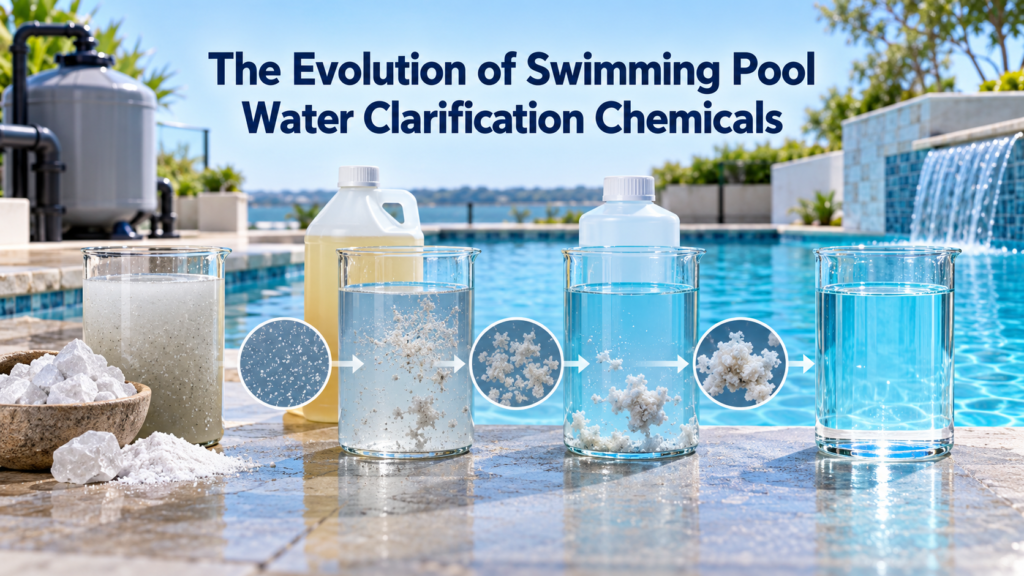
A swimming pool can be chemically balanced and still look dull, hazy, or slightly gray. That small contradiction has shaped the history of pool water clarification.
For decades, pool operators have learned the same frustrating lesson: a filter cannot catch every particle simply because water passes through it. Dust, pollen, body oils, cosmetic residue, organic debris, and tiny mineral particles may remain suspended. Many are so small that they slip through the filter media again and again. Some also carry electrical charges that help them stay apart, almost as if they are politely refusing to gather in one place.
Clarification chemicals were developed to change that behavior. Rather than removing particles by themselves, they help small contaminants join into larger groups that a filter can capture—or, in more intensive treatment, that can settle for vacuum removal.
The chemistry has changed greatly over time. Early treatment relied heavily on settling and inorganic mineral salts. Later systems adopted preformed coagulants, synthetic organic polymers, and purpose-made liquid pool clarifiers. Today, manufacturers can adjust charge density, molecular structure, concentration, appearance, packaging, and dosage for specific markets.
That journey is more than a chemistry lesson. It explains why some products work gently during routine maintenance while others are better kept for severe cloudiness. It also helps buyers understand what they are really purchasing when a label says “clarifier,” “coagulant,” or “flocculant.”
Before Specialty Clarifiers, Pools Relied on Time and Filtration
The earliest approach to clearer water was refreshingly simple: remove visible debris, allow heavier matter to settle, and pass the water through some form of filtration.
Gravity did part of the work. Large dirt particles eventually reached the bottom. A net, brush, or vacuum handled the rest. Sand filtration improved the process by catching suspended solids as water moved through a granular bed.
But there was a stubborn gap. Fine colloidal particles could stay suspended for long periods. A colloid is a very small particle dispersed in water. It may be too light to settle quickly and too small for the filter to retain. The water can therefore remain cloudy even while the circulation system runs for hours.
This was not a failure of filtration in the ordinary sense. The filter was being asked to catch targets smaller than its practical capture range. Imagine trying to collect flour with a kitchen colander. The tool may be working exactly as designed; the particles are simply the wrong size.
The answer was to change the particles before they reached the filter.
Mineral Coagulants Brought Chemistry into the Picture
Inorganic coagulants, especially aluminum- and iron-based salts, have a long history in water treatment. Alum became one of the best-known examples. When added under suitable conditions, such chemicals form metal hydroxide precipitates. These gelatinous solids can destabilize fine particles and sweep suspended matter from the water as they form.
In plain English, the treatment creates a kind of chemical net.
This approach made an important leap possible. Operators no longer had to wait for every contaminant to settle on its own. They could encourage tiny particles to combine, form heavier floc, and either become filterable or fall to the floor for removal.
Mineral coagulants can still be valuable. They may produce strong floc and can be effective when water is severely cloudy. Yet they also require care. Their performance is influenced by pH, alkalinity, dosage, mixing, and contact time. An overdose may create more suspended material rather than less. A large, soft floc may also load or block a filter rapidly.
There is another operational distinction. A chemical that produces heavy settling may behave more like a flocculant treatment than a routine filter-aid clarifier. The pool may need to remain still, and the settled material may need to be vacuumed to waste. That is workable during a recovery procedure. It is far less convenient when a hotel pool needs to reopen for breakfast guests.
So the industry kept looking for chemicals that were easier to dose, more predictable, and better suited to normal circulation.
Preformed Inorganic Coagulants Improved Consistency
As water-treatment chemistry matured, pre-hydrolyzed inorganic coagulants became more widely available. Products based on polymerized aluminum species could offer more consistent coagulation across a useful operating range than traditional mineral salts in certain systems.
The improvement was not magic. Water conditions still mattered. Yet a more controlled chemical structure gave formulators another way to influence particle destabilization without relying entirely on reactions that occurred after the product entered the pool.
For commercial operators, consistency matters almost as much as raw treatment strength. A chemical that works brilliantly on Tuesday but behaves differently after a rainstorm on Friday is difficult to build into a maintenance program. Preformed products helped move clarification from a corrective event toward a more repeatable process.
Still, inorganic chemistry came with familiar trade-offs: added dissolved solids, possible pH effects, bulky floc, and the risk of filter pressure rising quickly. These limitations opened the door for a different family of materials.
Synthetic Polymers Changed the Scale of Clarification
The arrival of synthetic water-soluble polymers changed how formulators approached fine particles.
Instead of depending only on a mineral precipitate, a polymer could interact directly with suspended matter. Some polymers carry a positive charge. Since many particles found in pool water tend to have a negative surface charge, a cationic polymer can reduce the electrical repulsion that keeps them separated.
Once that repulsion weakens, the particles can approach one another. Long polymer chains may also attach to more than one particle, forming bridges between them. The resulting clusters are larger and easier for the filter to retain.
Two mechanisms are often discussed:
- Charge neutralization: The polymer reduces the surface charge that helps particles remain dispersed.
- Polymer bridging: Sections of a polymer chain attach to different particles, linking them into larger groups.
The actual result depends on the polymer, the contaminant, the dose, and the water conditions. A product may rely more strongly on one mechanism than the other. Often, both contribute.
This was a major practical change. A relatively small amount of active polymer could treat a large volume of water. Liquid products could be easy to measure and distribute. They could support the existing filter rather than forcing the operator to shut down circulation and wait for everything to settle.
That last point deserves emphasis. The modern routine clarifier is not meant to replace a filter. It makes the filter’s job easier.
The Rise of Cationic Polymer Pool Clarifiers
Cationic polymers became especially useful for pool clarification because many common suspended contaminants respond well to positively charged treatment agents. Fine dust, clay, pollen fragments, dead algae residue, and some organic matter can contribute to persistent haze. A suitable polymer helps gather this mixed population into filterable clusters.
PolyDADMAC-based formulations are one example used in water clarification. PolyDADMAC, often identified by CAS No. 26062-79-3, is a cationic polymer supplied in different concentrations and grades. In a formulated pool clarifier, it may be diluted to a practical active level and adjusted for the intended dosage, packaging, market, and labeling requirements.
A common commercial concept is a liquid clarifier containing about 10% of the polymer active ingredient, although product specifications can vary. The finished liquid may be clear or given a blue appearance to match market expectations. Typical retail and professional packages include 1 L, 5 L, and 25 L containers.
Why did this product format become attractive?
- It is convenient to dose during regular maintenance.
- It can work with normal pool circulation and filtration.
- It does not need to create a thick blanket of settled floc.
- It can be supplied as an OEM or private-label product.
- Its concentration, color, viscosity, and package size can be tailored to the buyer’s program.
The real advance was not merely replacing one chemical with another. It was creating a clarifier that fit the daily rhythm of pool care.
Clarifier and Flocculant Took Different Paths
The words clarifier and flocculant are sometimes used as if they mean the same thing. Historically, the technologies overlap—but their operating roles have grown apart.
A routine pool clarifier normally creates smaller agglomerates that can travel through the circulation system and be captured by the filter. It is usually applied at a modest dose while the pump runs.
A pool flocculant is generally chosen when the operator wants larger, heavier floc to settle. Circulation may be stopped after distribution. Once the solids reach the floor, they are vacuumed to waste rather than sent through the filter.
Neither category is universally superior. They solve different problems.
For mild haze after a busy weekend, a filter-aid clarifier may be the sensible choice. For a pool with severe suspended contamination and a suitable waste-vacuum setup, a settling treatment may be faster. Calling every product a “powerful clarifier” hides this operational difference and can lead to poor results.
The evolution of clarification chemistry therefore became an evolution of use cases too: routine maintenance, post-storm recovery, high-bather-load support, seasonal opening, and emergency cleanup.
Modern Formulations Became More User-Friendly
As the market expanded, performance was no longer the only requirement. Products also had to be easy to ship, store, pour, explain, and sell.
Modern liquid clarifiers are often formulated for direct addition or simple predilution. Their appearance can be controlled. Their active concentration can be adjusted for retail consumers, pool service companies, or commercial facilities. Manufacturers may supply neutral packaging or apply a customer’s private label.
Even the color tells a small marketing story. A clear product emphasizes purity and technical simplicity. A pale-blue liquid feels familiar in the pool-care aisle and creates an immediate visual link with clean water. The color itself does not prove performance, of course. It is presentation, not mechanism.
Packaging evolved as well. A 1 L bottle suits retail shelves and residential pools. A 5 L container works well for service technicians. A 25 L package may be more practical for distributors, hotels, aquatic centers, and contract maintenance businesses.
Behind the package, serious buyers still need technical information: active content, appearance, pH, density, shelf life, recommended storage, dosage guidance, compatibility, a certificate of analysis, and a current safety data sheet. Attractive packaging may win the first glance. Reliable documentation wins the second order.
Better Chemistry Did Not Remove the Need for Better Diagnosis
Clarifiers have improved, but they are not a cure for every form of cloudy water.
That may sound slightly disappointing. It is actually useful news, because correct diagnosis prevents wasted chemicals and delayed recovery.
A clarifier is most helpful when suspended fine particles are the main problem and the circulation and filtration system can remove the clusters that form. It may offer limited benefit when cloudiness is caused by:
- Active algae growth
- Calcium carbonate precipitation
- Badly unbalanced pH or alkalinity
- Insufficient circulation
- A damaged, channeled, or undersized filter
- Excessive organic contamination
- Incorrect sanitizer control
Clarification and sanitization are also different jobs. A clarifier improves particle removal and visual water quality. It should not be presented as a substitute for an approved sanitizer or a complete disinfection program.
Clear-looking water can still be microbiologically unsafe, while properly disinfected water can still look hazy because fine particles remain suspended. Recreational water can transmit illness, which is why appearance alone is never a complete safety test.
That distinction has become more important as product labels and online listings compete for attention. The strongest technical message is often the simplest: first identify the problem, then choose the chemical.
Dosage Control Became Part of Product Performance
Older treatment habits sometimes favored the “more is better” approach. Polymer chemistry taught the industry otherwise.
At an effective dose, a cationic polymer can destabilize particles and help them form filterable groups. Too little product may leave much of the particle surface untreated. Too much may coat particles excessively, restabilize them, create sticky residues, or load the filter unnecessarily.
In other words, dosage has a useful window.
The correct amount depends on active concentration, pool volume, turbidity, contaminant type, filter design, water balance, and whether the product is intended for routine or corrective treatment. This is why copying a dose from a different product can be risky even when both labels say “polymer clarifier.”
Good product development connects formulation strength with clear field instructions. The dose printed on the bottle is not an afterthought; it is part of the chemistry.
Filtration Technology and Clarifier Chemistry Grew Together
Clarification chemicals did not evolve in isolation. Filters, circulation systems, automated dosing equipment, and water-testing methods improved alongside them.
Sand, cartridge, and diatomaceous earth filters have different operating characteristics. A clarifier that performs well in one system may require a different dose or operating procedure in another.
Filter condition matters too. Dirty cartridges, compacted media, channeling, poor backwashing, and inadequate turnover can erase the gains made by a well-designed chemical.
Modern pool care therefore treats clarification as a system:
- Water balance supports predictable chemical behavior.
- The clarifier gathers very fine suspended particles.
- Circulation carries those particles toward the filter.
- The filter captures the enlarged clusters.
- Backwashing or cleaning removes the collected contamination from the system.
Miss one step and the water may improve slowly—or not at all.
This systems view is perhaps the most mature stage in the history of pool clarification. The chemical is important, but its setting determines its success.
Sustainability Is Shaping the Next Generation
The next phase is likely to focus on doing more with less: lower effective doses, concentrated shipping formats, recyclable packaging, better biodegradability profiles where technically possible, and clearer instructions that prevent overdosing.
Bio-based and modified natural polymers continue to attract research interest across water treatment. Yet “natural” should not be treated as automatic proof of safety, compatibility, or superior pool performance.
Any new material still needs stable quality, suitable shelf life, controlled microbiology, dependable clarification, and evidence that it behaves well with pool surfaces, filters, and treatment chemicals.
Automation will influence the category too. Commercial facilities increasingly value repeatable dosing and documented maintenance. A clarifier that can be applied through a controlled program—without clogging lines, separating during storage, or varying from batch to batch—offers practical value beyond a dramatic before-and-after photograph.
Buyers are also asking sharper questions. What is the active chemistry? What is the actual concentration? Is the product a routine clarifier or a settling flocculant? Which filters can use it? Can the manufacturer provide consistent batches, private labeling, and export documents?
Those questions are healthy. They move the market away from vague promises and toward products that can be compared on real technical and commercial terms.
What This Evolution Means for Pool Chemical Buyers?
The history of clarification chemicals shows a clear direction: from heavy corrective treatment toward precise, convenient support for filtration.
Mineral coagulants demonstrated that fine particles could be destabilized and removed. Preformed inorganic products improved consistency. Synthetic polymers introduced efficient charge control and particle bridging. Purpose-made liquid pool clarifiers then turned those principles into products suitable for weekly service, commercial maintenance, and retail sale.
For a distributor or private-label buyer, the newest product is not automatically the right product. The right choice depends on the promised use.
A sound supplier discussion should cover:
- Target customer and pool type
- Routine versus corrective treatment
- Active ingredient and active concentration
- Recommended dosage and treatment frequency
- Filter compatibility
- Finished-product color and viscosity
- Bottle, jerry can, cap, seal, and label requirements
- COA, SDS, stability, and shipping documentation
- Local regulatory and labeling responsibilities
This is where chemistry meets the market. A formula may perform beautifully in a beaker, but the customer experiences the bottle, the instructions, the filter pressure, and the final sparkle of the water.
Clear Water, Smarter Chemistry
Pool clarification has moved a long way from simply waiting for dirt to sink. The industry learned to control particle charge, build filterable clusters, tailor polymer concentration, and match treatment strength to real maintenance routines.
Yet the basic goal has stayed wonderfully ordinary: water that looks clean, inviting, and professionally cared for.
Modern polymer clarifiers meet that goal with precision rather than brute force. Used at the right dose, in balanced water, with a healthy circulation and filtration system, they help remove the fine haze that filters may miss on their own.
That is the quiet achievement behind the evolution. The chemistry became more sophisticated, while the operator’s task became simpler.
Frequently Asked Questions
1. What were the earliest chemicals used to clarify swimming pool water?
Traditional clarification commonly relied on inorganic coagulants such as aluminum-based salts. These chemicals formed floc that trapped fine suspended material so it could settle or be removed by filtration.
2. How do modern polymer pool clarifiers work?
Modern polymer pool clarifiers destabilize very fine particles through charge neutralization and particle bridging. The particles gather into larger clusters that the pool filter can capture more easily.
3. Is a cationic pool clarifier the same as a pool flocculant?
Not always. A routine cationic pool clarifier usually forms filterable particle clusters while circulation continues. A pool flocculant generally creates heavier floc that settles and must be vacuumed from the pool floor.
4. Can a polymer clarifier replace chlorine or another pool sanitizer?
No. A polymer clarifier supports suspended-particle removal; it does not replace an approved sanitizer or a complete disinfection program. Clear water and microbiologically safe water are related goals, but they are not the same thing.
5. What should private-label buyers check when sourcing a liquid pool clarifier?
Buyers should confirm the active chemistry, concentration, dosage, filter compatibility, appearance, packaging, shelf life, batch specifications, COA, SDS, and local labeling requirements. A representative sample and application test are also wise before a large order.