
GET IN TOUCH
Ask For Sample?
How Weather Conditions Influence Swimming Pool Algae Growth?
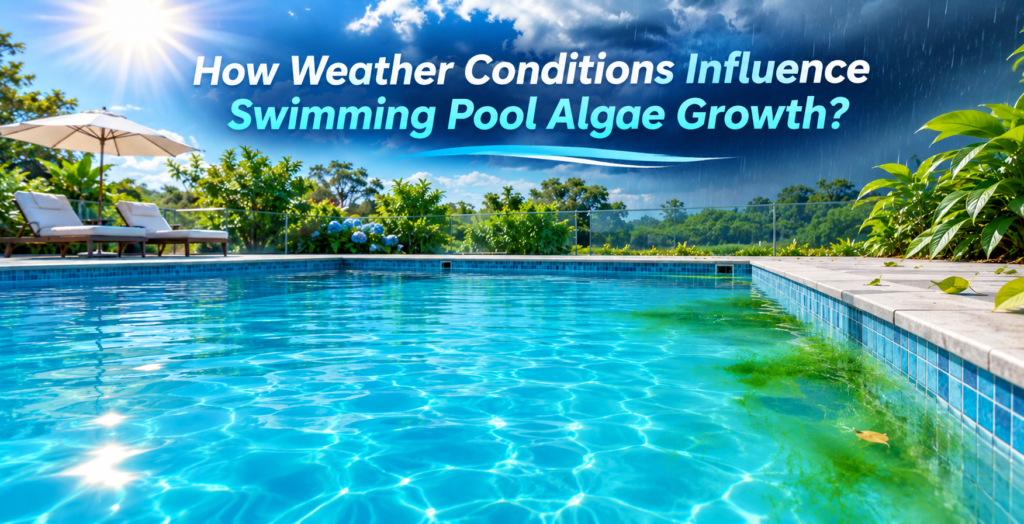
A swimming pool can look crystal clear on Monday and turn cloudy green by Thursday. What happened? Sometimes, the answer isn’t poor cleaning or a faulty filter. It’s the weather.
Hot sunshine, heavy rainfall, strong winds, and sudden changes in temperature can all affect swimming pool algae growth. Even a well-maintained pool may face algae problems when weather conditions change faster than its water treatment routine.
Here’s the tricky part: weather doesn’t just influence algae directly. It also changes chlorine levels, water chemistry, nutrient loads, and filtration needs. These changes can create the perfect conditions for algae to spread.
For pool owners, maintenance professionals, and chemical distributors, understanding this relationship is essential. It helps prevent algae outbreaks, reduce chemical waste, and keep swimming pools clean throughout the year.
This guide explains how different weather conditions influence pool algae growth, why some pools turn green after storms, and how preventive treatments—including Polyquat 60 Algaecide—can support a reliable pool maintenance program.
Why Does Weather Have Such a Strong Effect on Pool Algae?
Algae are simple, photosynthetic organisms that can grow in swimming pool water when conditions allow. They need light, nutrients, and suitable temperatures, but their growth is also strongly influenced by the pool’s sanitation system.
In a properly maintained swimming pool, free chlorine helps keep algae under control. Problems begin when chlorine becomes too low, circulation is poor, or algae find protected areas where treatment is less effective.
Weather can disturb this balance in several ways:
- Temperature: Warm water can support faster algae growth and increase chlorine demand.
- Sunlight: Sunlight provides energy for many algae species while ultraviolet radiation breaks down unprotected chlorine.
- Rainfall: Heavy rain can introduce debris, change water chemistry, and dilute treatment chemicals.
- Wind: Dust, leaves, pollen, and organic matter may enter the pool and increase sanitizer demand.
- Humidity: Humid conditions can accompany warm, rainy weather, although humidity alone is not a major direct cause of algae growth.
- Seasonal changes: Shifts in temperature, sunlight, and pool use can change the risk of algae outbreaks.
According to Health Canada, hot weather, sunlight, and low sanitizer levels can encourage algae growth. Canada.ca+1
This explains why weather-related algae problems often appear suddenly. A pool may have adequate chlorine one day but insufficient protection after an intense period of heat, sunshine, or rainfall.
1. Hot Weather: Why Summer Is Prime Time for Pool Algae
Summer brings warm water, longer swimming sessions, and more sunshine. Unfortunately, these conditions can also favor algae.
Warm water can accelerate algae growth
Many algae species grow more quickly in warm water than in cold water, provided that light and nutrients are available.
Swimming pools that remain above approximately 28°C (82°F) may need closer monitoring, especially when chlorine levels are already low. This is not a universal temperature threshold for algae growth. Different species respond differently, and adequate sanitation remains the deciding factor.
Warm weather also changes the way pool chemicals behave.
Higher temperatures can increase chemical and biological activity. Meanwhile, pools often experience more frequent swimming, more sunscreen contamination, and greater chlorine demand.
The result? The pool’s normal treatment schedule may no longer provide enough protection.
Why hot weather increases chlorine demand
Chlorine is essential for controlling algae and harmful microorganisms.
During hot summer weather, several factors may increase chlorine consumption:
- Greater swimming activity introduces sweat, oils, and other organic matter.
- Strong sunlight accelerates the breakdown of unprotected free chlorine.
- Warm conditions may increase biological activity and chlorine demand.
- More frequent pool use may require additional filtration and chemical adjustment.
Consider a hotel swimming pool during a summer holiday.
The pool receives intense sunlight throughout the day. Guests swim continuously, bringing sunscreen, sweat, and organic contaminants into the water. By late afternoon, the chlorine level may be much lower than it was in the morning.
If staff don’t adjust the treatment program, algae may begin growing on steps, walls, or poorly circulated surfaces.
How to prevent algae during heat waves
A few changes can make a significant difference.
Test free chlorine and pH more often during prolonged hot weather. Check the pool’s circulation system and increase filtration time when required by actual operating conditions.
Brush steps, corners, and other areas where algae may attach.
For outdoor chlorine pools, maintain an appropriate cyanuric acid level when permitted by local rules. Cyanuric acid helps protect chlorine from sunlight, but excessive concentrations can reduce its disinfecting effectiveness.
A suitable algaecide may also provide supplemental algae prevention when used according to its approved label.
The key is consistency. Waiting until the water turns green usually means more work and greater chemical consumption.
2. Strong Sunlight: A Double Challenge for Pool Water
Sunshine is one of the main reasons people enjoy outdoor swimming pools. Yet it can create two separate problems for algae control.
First, many algae use sunlight as an energy source through photosynthesis.
Second, ultraviolet radiation can break down free chlorine in pool water.
That second effect is particularly important.
How sunlight affects chlorine
When chlorine is exposed to ultraviolet radiation, some of the available chlorine is lost through photochemical reactions.
This process is known as photodegradation.
As free chlorine decreases, the pool may become more vulnerable to algae growth if chlorine isn’t replenished.
A pool receiving direct sunlight for most of the day may therefore require more careful sanitizer management than a shaded pool.
Cyanuric acid, often called chlorine stabilizer, helps reduce this loss in outdoor pools. However, stabilizer must be managed carefully because high levels can slow chlorine’s disinfection action. healthywa.health.wa.gov.au+1
Can algae grow in shaded swimming pools?
Yes.
Shade may reduce the light available for photosynthesis, but it doesn’t guarantee an algae-free pool.
Some algae can grow under relatively low light conditions. Shaded corners may also have poor circulation or collect debris.
That’s why algae sometimes appear behind ladders, around steps, or in areas that receive little direct sunlight.
The solution isn’t simply more sunshine or less sunshine. It’s adequate sanitizer, circulation, brushing, and filtration.
Practical sunlight management
Pool operators should pay particular attention to free chlorine readings during sunny periods.
The CDC recommends maintaining pool pH between 7.0 and 7.8 and at least 1 ppm free chlorine in pools without cyanuric acid. When cyanuric acid is used, the recommended minimum rises to 2 ppm. Local codes and operating conditions may require higher levels. CDC+1
Testing should guide chemical adjustments rather than relying on a fixed dose every day.
3. Heavy Rainfall: Why Pools Sometimes Turn Green After a Storm
Have you ever noticed that a swimming pool looks worse after several days of rain?
Rainwater itself doesn’t automatically cause an algae bloom. The problem is what heavy rainfall can do to pool chemistry and cleanliness.
Rain can dilute pool treatment chemicals
When significant rainfall enters a swimming pool, it adds water without adding a corresponding amount of sanitizer.
Depending on overflow, drainage, and the pool’s treatment system, this can reduce chemical concentrations.
If water overflows or is drained after a storm, dissolved treatment chemicals may also leave the pool.
The amount of dilution depends on the pool’s volume and the rainfall received.
For example, consider a pool with an average depth of 1.5 meters. If 75 mm of rain falls directly into the pool and all the rainwater is retained, the added water represents approximately 5% of the original pool volume.
That may seem small, but dilution can become significant when the sanitizer level was already near its minimum.
Rainwater brings more than water
Heavy rain can wash contaminants from surrounding surfaces into the pool.
These may include:
- Soil and dust
- Leaves and grass clippings
- Pollen and other organic debris
- Nutrients from surrounding landscaping
- Algae cells and other microorganisms
Such materials can increase chlorine demand and create additional maintenance work.
The pool may become cloudy before visible algae appear.
Rainfall can disturb pH and alkalinity
Rainwater is often mildly acidic, but the effect of rainfall on pool pH isn’t always predictable.
It depends on the rainwater composition, pool alkalinity, runoff, and existing water chemistry.
A pool with adequate total alkalinity may resist pH changes better than one with poor buffering capacity.
That’s why testing after heavy rain is more reliable than automatically adding a pH-adjusting chemical.
What should you do after heavy rain?
Start by removing leaves and visible debris.
Then check the water level, free chlorine, pH, and total alkalinity. If significant water replacement occurred, reassess stabilizer concentration as well.
Clean or backwash the filter when required by the manufacturer’s instructions and pressure readings.
Brush the pool surfaces and restore sanitizer levels before reopening the pool for swimming.
If an algaecide is part of the regular maintenance program, check whether the approved product label calls for reapplication following dilution or water replacement.
4. Windy Weather: The Hidden Source of Algae Nutrients
Wind doesn’t directly make algae multiply. Instead, it can carry contaminants into the water.
A windy afternoon may leave a swimming pool full of leaves, pollen, dust, and small particles.
Some of these materials contain nutrients that can support algae growth as they break down. Others increase the amount of organic matter that chlorine must oxidize.
Either way, the treatment system faces a greater workload.
Why debris matters
Imagine two outdoor swimming pools.
One is surrounded by a clean stone deck. The other sits beneath several large trees.
After a windy day, the second pool may contain far more leaves and organic debris.
If those materials remain in the water, they can contribute to higher chlorine demand and create areas where algae can attach.
Pollen can also collect along the waterline, making the pool appear yellow or cloudy.
It’s worth remembering that yellow deposits aren’t always mustard algae. Pollen and fine dust can look similar, so visual appearance alone isn’t enough for a firm diagnosis.
Preventing wind-related algae problems
Regular skimming becomes particularly important during windy weather.
Empty skimmer baskets, remove settled debris, and check whether the filtration system is working effectively.
A pool cover may reduce debris entry when the pool isn’t in use, provided that it is suitable for the installation and used safely.
After a dust storm or strong wind event, test sanitizer levels rather than assuming the previous day’s readings are still valid.
5. Humidity and Cloudy Weather: Do They Really Encourage Algae?
Humidity is often blamed for algae growth, especially in tropical and coastal climates.
But the relationship is more subtle.
High humidity doesn’t directly feed algae in a swimming pool. The water is already there, regardless of the moisture in the surrounding air.
Instead, humid weather often occurs alongside other conditions that can influence algae growth.
These include warm temperatures, frequent rainfall, and reduced evaporation.
Why tropical climates need careful pool maintenance
Consider a swimming pool in a tropical resort.
The weather may remain warm for most of the year. Rainstorms are frequent, and swimming activity can be high.
Even without intense sunshine every day, the pool may experience repeated chemical dilution, organic contamination, and high sanitizer demand.
These combined conditions can increase algae risk.
Does cloudy weather prevent algae?
Not necessarily.
Cloud cover reduces direct sunlight, but many algae can still receive enough light to grow.
Cloudy conditions may slow chlorine loss caused by UV radiation, yet they don’t eliminate the need for proper disinfection.
In fact, an operator who reduces chemical monitoring simply because the sun isn’t shining may overlook a developing water quality problem.
Weather should influence maintenance decisions, but actual water test results must remain the main guide.
6. Cold Weather and Winter: Can Algae Survive?
Many pool owners assume that algae disappear when temperatures fall.
Unfortunately, that’s not always true.
Cold water generally slows the growth of many algae species, but it doesn’t necessarily kill them.
Algae cells may survive through winter and begin multiplying when conditions become favorable again.
This is one reason pools sometimes develop green water shortly after spring opening.
Why winter pools can still develop algae
Several factors can contribute to winter algae problems.
First, sanitizer levels may gradually decline if the pool isn’t monitored.
Second, leaves and other organic debris may remain beneath the pool cover.
Third, warmer periods during winter can temporarily create conditions more favorable for algae growth.
Finally, poor circulation may leave certain areas inadequately treated.
In climates with mild winters, these problems can persist throughout the colder months.
The importance of winter algaecide treatment
Winter algaecides are designed to provide supplemental algae control during periods when pools receive less frequent maintenance.
Polymer-based products, including certain Polyquat 60 formulations, may be used as part of winter pool care programs where approved.
However, a winter algaecide doesn’t replace proper closing procedures.
Pool operators should balance the water, remove debris, clean the filter, and follow the chemical manufacturer’s closing instructions.
For additional product information, visit Eautrix swimming pool chemical solutions.
7. Sudden Weather Changes: Why Algae Problems Can Appear Overnight
Sometimes, the greatest risk isn’t one particular weather condition. It’s a rapid change between several conditions.
Imagine the following situation.
A swimming pool experiences three days of intense sunshine. Free chlorine gradually decreases because of UV exposure and heavy swimming activity.
Then a thunderstorm arrives.
Rainwater and debris enter the pool. Water chemistry changes, and the filtration system faces additional contamination.
The next day, the sun returns, and temperatures rise.
Now the pool has warm water, available light, additional organic matter, and potentially insufficient chlorine.
That’s a favorable combination for algae growth.
The water may appear to turn green overnight, although the algae could have been developing for some time before becoming visible.
Why reactive treatment isn’t always enough
Many pool owners begin treatment only after algae become visible.
By then, algae may have attached to pool walls, steps, and other surfaces.
Removing an established outbreak may require brushing, corrective chlorination, filtration, and repeated testing.
A preventive maintenance routine can reduce the likelihood of reaching that stage.
The most useful habit is to check the pool after major weather changes rather than waiting for visible signs of trouble.
8. How Weather Affects Different Types of Pool Algae
Not all algae behave in exactly the same way.
Pool professionals often describe algae problems using three common categories: green algae, mustard algae, and black algae.
These are practical maintenance terms rather than precise scientific classifications.
Green algae
Green algae are among the most familiar problems in outdoor swimming pools.
They may produce greenish water, slippery surfaces, or visible deposits along pool walls.
Warm temperatures, sunlight, low sanitizer levels, and poor circulation can favor their growth.
Green algae may spread rapidly when pool maintenance falls behind during summer.
Mustard algae
Mustard algae typically appear as yellowish or brownish deposits on pool surfaces.
They may be confused with pollen, sand, or fine dust.
Some types can persist in shaded areas and return after incomplete cleaning.
Weather-related debris can make identification more difficult, especially during pollen season.
Black algae
Black algae is a common pool-care term for dark, strongly attached growth, often involving cyanobacteria rather than true algae.
It may form stubborn spots on plaster or other porous surfaces.
Because these growths can be difficult to remove, brushing and appropriate sanitation are especially important.
Weather can contribute to the conditions that favor growth, but surface characteristics and maintenance history also matter.
9. Weather Conditions and Pool Algae Risk: A Quick Comparison
The following table summarizes how common weather conditions can affect swimming pool algae prevention.
| Weather condition | Main effect on pool water | Recommended response |
|---|---|---|
| Hot weather | Higher biological activity and sanitizer demand | Increase testing frequency |
| Strong sunshine | Faster UV-related chlorine loss | Monitor chlorine and stabilizer |
| Heavy rainfall | Chemical dilution and added contamination | Retest and rebalance water |
| Strong wind | More debris, dust, and organic matter | Skim, vacuum, and inspect filtration |
| Humid weather | Often accompanies warm, rainy conditions | Monitor actual water chemistry |
| Cold weather | Slower algae growth, but possible survival | Maintain winter treatment |
| Rapid weather changes | Multiple disturbances in a short period | Test water after each major event |
These are general risk patterns, not fixed predictions.
A well-maintained pool can remain clear through difficult weather, while a poorly maintained pool may develop algae even during mild conditions.
10. How Polyquat 60 Algaecide Supports Weather-Related Algae Prevention
Weather-related algae problems create an important question for pool chemical suppliers and professional maintenance companies:
Can an algaecide provide an additional layer of protection when environmental conditions change?
In some pool maintenance programs, the answer is yes.
Polyquat 60 is a polymer-based algaecide commonly associated with Polixetonium Chloride, CAS No. 31512-74-0, also known as Polyquaternium-42.
It belongs to a class of cationic polymers used in certain non-oxidizing algae control formulations.
How Polyquat 60 works
Polyquat 60 carries positively charged groups along its polymer structure.
These cationic groups can interact with negatively charged components of algae cells.
Depending on the formulation and treatment conditions, these interactions can disrupt normal cellular functions and inhibit algae growth.
Unlike chlorine, Polyquat 60 is a non-oxidizing treatment.
It should therefore be viewed as a supplemental algae control product rather than a substitute for chlorine or another approved primary sanitizer.
Why pool maintenance professionals consider Polyquat 60
Properly formulated Polyquat 60 products may offer several useful characteristics:
- Low-foaming performance: Suitable formulations are designed to minimize foaming in circulating pool water.
- Metal-free formulation: Polyquat 60 doesn’t rely on copper as its active algaecidal ingredient, avoiding the copper staining concerns associated with some metal-based products.
- Non-oxidizing action: Provides a different algae control mechanism from chlorine.
- Routine maintenance applications: Approved formulations may be used in preventive algae control programs.
- Seasonal treatment applications: Some formulations are suitable for winter closing or periodic maintenance.
Performance depends on the finished formulation, concentration, water chemistry, and approved application instructions.
It’s also important to distinguish between the 60% polymer concentrate supplied as an industrial raw material and a finished, registered swimming pool algaecide.
A concentrated raw material must not be treated as an automatically approved consumer pool product.
Where Polyquat 60 fits into a weather-responsive program
During hot, sunny weather, an approved Polyquat 60 algaecide may supplement routine sanitation and cleaning.
After heavy rainfall, pool operators should first assess water chemistry and contamination. Any algaecide reapplication should follow the product label.
During winter closing, a suitable winter algaecide formulation may help reduce the risk of algae developing while the pool is not in regular use.
The most important principle is simple: an algaecide supports a well-maintained pool. It doesn’t correct poor circulation, inadequate filtration, or insufficient sanitizer.
11. A Practical Pool Maintenance Schedule for Changing Weather
A weather-responsive maintenance program doesn’t need to be complicated.
It simply needs to recognize that the pool’s treatment requirements change with environmental conditions.
Here’s a practical approach.
During normal weather
Maintain the required free chlorine level and appropriate pH.
Operate the circulation and filtration system according to the pool’s design and usage.
Remove visible debris, brush surfaces, and inspect equipment.
Test water at the frequency required for the pool type. Public facilities often need testing at least twice daily or more often during heavy use.
During heat waves
Increase chlorine and pH testing frequency.
Pay attention to afternoon sanitizer readings, especially in outdoor pools.
Monitor water temperature and adjust circulation or treatment according to actual demand.
Inspect areas where algae commonly attach, including steps, corners, and ladders.
Before heavy rain
Remove loose debris from surrounding areas.
Check the drainage system and make sure pool equipment is protected against flooding.
Confirm that the pool’s sanitizer level is within the required range.
Avoid unnecessary chemical additions based solely on a weather forecast.
After heavy rain or storms
Remove debris and inspect the pool for runoff contamination.
Test free chlorine, pH, and alkalinity.
Check the filtration system and restore proper circulation.
If floodwater or sewage has entered the pool, follow applicable public health guidance before reopening; ordinary chemical adjustment may not be sufficient.
During winter
Clean the pool before closing.
Balance the water and follow the equipment manufacturer’s winterization instructions.
Use an approved winter algaecide if it is part of the closing program.
Inspect the cover and water condition periodically where practical.
12. Why Weather-Responsive Algae Control Matters for Commercial Pools
For hotels, resorts, water parks, and public swimming facilities, algae growth is more than an appearance problem.
Green or cloudy water can affect customer confidence, interrupt operations, and increase maintenance costs.
A pool closure during a busy holiday period can be particularly disruptive.
Weather-responsive maintenance helps operators anticipate changes before they become serious.
Reducing unexpected pool closures
Frequent water testing and timely treatment adjustments can help operators identify problems early.
This is especially valuable in tropical resorts and outdoor commercial pools that experience high temperatures, heavy rainfall, and intensive swimming activity.
Managing chemical consumption
Adding excessive chemicals isn’t an efficient way to prevent algae.
A better approach is to measure water conditions, understand sanitizer demand, and apply treatment according to actual requirements.
This helps avoid unnecessary chemical use while maintaining appropriate water quality.
Improving customer confidence
Guests expect pool water to look clean and inviting.
Consistent maintenance helps preserve that appearance, even when weather conditions are challenging.
However, clear water alone doesn’t prove that a pool is safe. Proper disinfectant levels, pH, and microbiological controls remain essential.
13. What Pool Chemical Distributors Can Learn from Seasonal Algae Problems
Weather-related algae growth also influences the demand for swimming pool treatment chemicals.
For distributors and private label pool chemical brands, seasonal differences can create distinct product requirements.
A distributor serving tropical markets may focus on products suitable for year-round algae prevention.
In contrast, a distributor serving regions with cold winters may see stronger seasonal interest in winter closing treatments.
Different climates create different product needs
For example, distributors may encounter the following market patterns:
| Market climate | Common maintenance challenge | Potential product focus |
|---|---|---|
| Hot and sunny | High chlorine demand and algae risk | Routine algae prevention |
| Tropical and rainy | Frequent contamination and dilution | Maintenance algaecides |
| Temperate | Seasonal changes in pool use | General-purpose algae control |
| Cold winter | Extended periods of limited maintenance | Winter algaecide formulations |
| High-use commercial | Heavy bather loads and variable demand | Professional pool treatment programs |
These patterns are useful for product planning, but they don’t replace local market research or regulatory review.
Private label Polyquat 60 opportunities
For businesses developing their own swimming pool chemical brands, Polyquat 60 may be considered as a raw material for suitable algaecide formulations.
Eautrix supplies Polixetonium Chloride-based products and supports discussions about concentration, packaging, and private label requirements.
Common packaging formats include 1L bottles, 5L containers, 25L drums, and larger industrial packaging for bulk buyers.
The appropriate formulation and label depend on the intended market, product registration requirements, and customer specifications.
For distributors, product consistency is especially important.
Changes in active concentration, viscosity, or formulation quality may affect dosing instructions and customer experience.
A reliable supply program should therefore include clear product specifications, quality documentation, and appropriate regulatory review.
14. Common Mistakes That Make Weather-Related Algae Problems Worse
Even experienced pool owners sometimes make mistakes when responding to changing weather.
One common mistake is adding algaecide without checking chlorine.
If the sanitizer level is inadequate, the pool may still face microbiological risks despite receiving an algae control product.
Another mistake is assuming that rain always lowers pH.
Rainfall can change water chemistry, but the direction and size of the change depend on several factors. Testing is essential.
Some pool owners also run the filtration system for too little time during periods of heavy debris or increased swimming activity.
Others rely on a fixed chemical schedule throughout the year, even when water temperature and usage change substantially.
Finally, it’s important not to confuse cloudy water with algae.
Cloudiness may result from fine suspended particles, poor filtration, calcium precipitation, or other water quality problems.
Identifying the cause helps prevent unnecessary treatment.
Conclusion: Weather Changes, but Good Pool Care Shouldn’t Stop
Weather plays an important role in swimming pool algae growth.
Hot temperatures can favor biological activity. Strong sunlight can reduce available chlorine. Heavy rainfall can dilute treatment chemicals and introduce contaminants. Wind carries debris into the water, while seasonal changes influence how frequently pools need attention.
Yet weather alone doesn’t determine whether a pool turns green.
The real difference often comes down to how well the maintenance program responds.
Regular testing, proper sanitation, effective filtration, and timely cleaning provide the foundation for algae prevention.
Supplemental treatments, including appropriately formulated Polyquat 60 Algaecide, may provide additional support when used according to approved product instructions.
For pool owners, the goal is simple: enjoy clear, well-maintained water despite changing weather.
For professional operators and distributors, understanding these environmental factors can help build more reliable treatment programs and better serve customers across different climates.
Frequently Asked Questions (FAQ)
1. Why does my swimming pool turn green after heavy rain?
Heavy rain can dilute pool chemicals, introduce organic debris, and disturb water chemistry. If free chlorine becomes too low, algae may grow. Test chlorine and pH, remove debris, and restore proper filtration and sanitation.
2. Does hot weather make swimming pool algae grow faster?
Yes. Warm water can support faster growth of many algae species, especially when sunlight and nutrients are available. Hot weather may also increase chlorine demand, making regular water testing more important.
3. Can algae grow in a swimming pool without direct sunlight?
Yes. Some algae can grow in shaded areas with limited light. Poor circulation, low sanitizer levels, and accumulated debris may allow growth around steps, corners, and pool walls.
4. Should I add more algaecide after a rainstorm?
Not automatically. First test the pool water and assess whether dilution or contamination has occurred. If your approved algaecide label calls for additional treatment after heavy rain or water replacement, follow those instructions.
5. Is Polyquat 60 Algaecide suitable for year-round swimming pool algae prevention?
Certain registered Polyquat 60 formulations can support routine or seasonal algae prevention, including winter pool maintenance. Suitability depends on the finished product, local regulations, and label instructions. Polyquat 60 should supplement—not replace—proper chlorine sanitation, filtration, and water testing.