
GET IN TOUCH
Ask For Sample?
Request a Polyquat 60 Algaecide Quote for Your Market
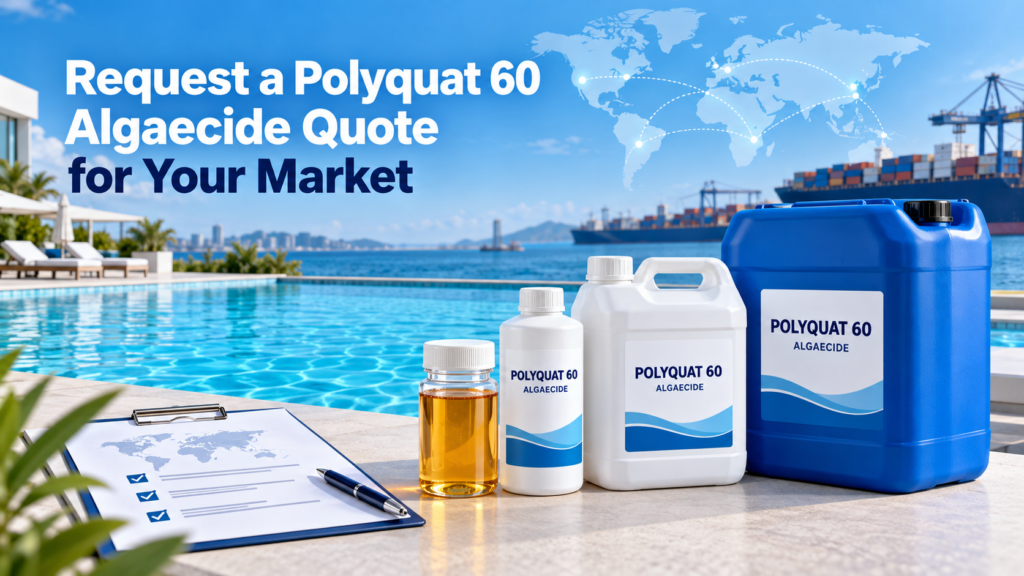
A request for quotation may look simple: product name, quantity, destination, and a quick question about price. Yet with Polyquat 60, those four details rarely tell the whole story.
Are you buying a 60% active concentrate for local formulation? Do you need a ready-to-sell algaecide under your own brand? Will the product go to a pool chemical distributor, a service company, or a retail chain? Is your target market hot and humid, strongly seasonal, tightly regulated, or highly price-sensitive?
Each answer changes the quotation.
That is why a useful Polyquat 60 algaecide quote should be more than a number per kilogram. It should connect the chemical specification, packaging, documentation, order size, delivery term, and destination-market requirements. When these pieces fit together, the quote becomes a working commercial plan—not just an attractive price that may fall apart later.
This guide explains what to send, what to check, and how to request a Polyquat 60 quotation that your purchasing, technical, logistics, and sales teams can actually use.
First Things First: Which Polyquat 60 Product Do You Need?
“Polyquat 60” is a familiar name in the pool industry, but it can be used rather loosely in commercial conversations. One buyer may mean concentrated polixetonium chloride at about 60% active ingredient. Another may mean a diluted, finished pool algaecide. A third may be looking for a private-label product with a custom concentration, bottle, label, and carton.
Those are three different purchasing projects.
For concentrated raw material, buyers should confirm the chemical identity rather than relying on the trade name alone. The material commonly sold for pool formulation is:
- Common name: Polixetonium Chloride
- CAS number: 31512-74-0
- Chemical family: Polymeric quaternary ammonium compound
- Typical commercial form: Concentrated aqueous solution
- Typical active concentration: Approximately 60%
- Typical appearance: Clear amber to light amber viscous liquid
- Key practical features: Non-foaming, non-oxidizing, and metal-free
You can review the Polyquat 60 Algaecide product page before sending your inquiry. If your team is still comparing specifications, packaging, documentation, and supplier controls, the Polyquat 60 Algaecide Buyer’s Guide offers a broader purchasing checklist.
The key point is simple: tell the supplier whether you need a concentrated ingredient, a diluted bulk formulation, or a finished private-label product. Otherwise, two quotations may look comparable while covering entirely different goods.
Why Your Market Changes the Quote?
It is tempting to ask, “What is your best price for Polyquat 60?” Suppliers hear that question every day. The trouble is that the best price for what market?
A 25 kg industrial package for a local formulator in the Middle East cannot be quoted in the same way as a 1 L retail bottle for a European private-label brand. Even when the liquid inside begins with the same raw material, the commercial work surrounding it changes.
Your destination market may affect:
- Required language on labels and cartons
- Bottle sizes and closure styles
- Pallet type and fumigation requirements
- Safety Data Sheet format and language
- Local product registration data
- Permitted product claims
- Testing and batch-document requirements
- Freight route and transit time
- Temperature exposure during transport
- Customer expectations for color, viscosity, and odor
- Seasonal inventory planning
For example, a distributor serving a long summer season may prefer larger stock orders and several retail sizes. A market with a short pool season may need smaller, better-timed shipments. Commercial pool service companies may favor practical 5 L or 25 L containers, while a retail brand may care more about shelf appearance, tamper evidence, label finish, and carton strength.
So, include the destination country and intended sales channel in your first message. A little context saves a surprising amount of back-and-forth.
Concentrate, Ready-to-Use Product, or Private Label?
Before discussing quantity, decide which supply model fits your business.
1. Polyquat 60 Concentrate for Local Formulation
This route usually suits chemical formulators, established pool chemical manufacturers, and distributors with blending or filling capability. You purchase concentrated material, then dilute, formulate, fill, and label it locally according to your technical plan and local rules.
The advantages may include lower freight cost per unit of active ingredient, greater formulation control, and more freedom to use local packaging. However, your company takes responsibility for formulation verification, finished-product stability, labeling, local compliance, and production quality.
When requesting this quote, state the required active range, packaging size, annual demand, shipment quantity, and whether you need a sample for lab evaluation.
2. Bulk Finished Algaecide
A bulk finished product may suit buyers that want the supplier to prepare a specific concentration but plan to fill it locally. In this case, the quote should define the finished concentration, formulation basis, bulk packaging, quality limits, and expected use.
Do not describe the product only as “Polyquat 60” if it contains less than approximately 60% active ingredient. Use a clear description such as “a finished algaecide formulated with polixetonium chloride at X% active ingredient.” That wording helps prevent mistakes in pricing, documentation, and downstream labeling.
3. OEM or Private-Label Pool Algaecide
Private-label supply adds several commercial layers: bottle sourcing, cap selection, induction sealing or tamper evidence, label printing, carton design, barcode placement, filling, packing, and finished-goods inspection.
Your inquiry should mention:
- Target formulation or active concentration
- Bottle volumes, such as 1 L, 5 L, or 25 L
- Preferred bottle and cap colors
- Label size, material, language, and finish
- Whether you will provide print-ready artwork
- Units per carton
- Pallet requirements
- Estimated quantity for each SKU
- Desired launch date
- Destination country
Small details matter here. A bottle may look perfect on a screen and still perform poorly if its cap leaks, its label lifts in a humid warehouse, or its carton weakens during ocean transport. Packaging is not decoration alone; it is part of product performance.
The Technical Specification Behind the Price
Price comparisons make sense only when the products follow comparable specifications. A low quotation is not truly low if the active content is lower, the viscosity is outside your filling range, or the delivered product does not match the approved sample.
For a concentrated product, ask the supplier to state the controlled specification rather than merely writing “60%.” Relevant items may include:
- Active ingredient or assay range
- Appearance and color
- pH and test concentration
- Density or specific gravity
- Viscosity and test conditions
- Solubility or dilution behavior
- Shelf life
- Recommended storage conditions
- Manufacturing batch identification
Testing methods matter too. Viscosity results, for instance, can change with temperature, spindle, speed, and instrument. If viscosity affects pumping, blending, or filling at your plant, agree on the method before approving a commercial order.
You should also ask whether the quotation covers the exact grade shown on the Technical Data Sheet, Safety Data Sheet, and sample. A sensible supplier will connect these items rather than treating them as unrelated paperwork.
And one more thing: Polyquat 60 is cationic. Compatibility with anionic ingredients or treatment products must be evaluated carefully. If you plan to combine it with surfactants, clarifiers, dyes, fragrances, or other pool-care ingredients, share the general formulation goal and conduct compatibility and stability tests. Guesswork is cheap at first—and expensive later.
Tell Us How You Plan to Use It
A supplier does not need your confidential formula to prepare an initial quotation. Still, a clear statement of intended use helps identify the correct supply route.
Useful descriptions include:
- Raw material for local pool algaecide formulation
- Weekly maintenance algaecide for residential pools
- Non-foaming product for commercial pool service
- Seasonal pool-opening or pool-closing formulation
- Private-label algaecide for retail distribution
- Bulk product for repacking under local registration
This context also helps separate algae-control needs from water-clarity needs. Polyquat 60 may support both algae control and particle management in some treatment programs, but it should not automatically be treated as a direct substitute for every clarifier. When fine suspended particles are the main problem, a purpose-designed Polymer Pool Clarifier may be a more suitable product to evaluate.
Likewise, buyers building a broader seasonal range can review the Specialty Pool Chemicals collection when planning maintenance, clarification, and winter products.
Packaging Can Change More Than You Think
Packaging affects unit cost, filling labor, freight efficiency, warehouse handling, leakage risk, shelf presentation, and minimum order quantity. Naturally, it belongs in the quotation from the start.
Industrial Packaging
Industrial packaging is generally intended for formulators and bulk users. Ask the supplier to confirm:
- Net weight per package
- Package material
- Closure and sealing method
- Pallet configuration
- Gross weight and dimensions
- Number of packages per pallet or container
- Container loading quantity
- Whether non-palletized loading is available
If your warehouse uses forklifts, drum handlers, pumps, or specific storage racks, mention those limitations. A package that saves a few cents at origin may add handling cost at destination.
Retail and Professional Packaging
For finished goods, specify whether the nominal size refers to volume or net weight. Also confirm bottle resin, cap type, liner, seal, handle style, label material, carton count, and date or batch coding.
Common formats such as 1 L, 5 L, and 25 L can serve different channels:
- 1 L bottles are convenient for household retail and online sales.
- 5 L containers suit pool service companies and larger residential pools.
- 25 L jerry cans support professional use, distributors, and local repacking.
These are commercial patterns, not fixed rules. The right size depends on local dosing instructions, customer habits, retail pricing, and transport limits.
Quantity, MOQ, and the Honest Meaning of “Best Price”
Manufacturing and export costs do not fall in a perfectly straight line as volume rises. Raw material purchasing, filling setup, label printing, carton production, testing, palletizing, export handling, and freight each follow a different cost curve.
That is why a quotation should be tied to a defined quantity.
Instead of writing “Please quote your MOQ and best price,” try giving three figures:
- Trial order quantity
- Expected regular order quantity
- Estimated annual demand
For example: “We would like to begin with one pallet, expect regular orders of five pallets, and estimate two full-container loads per year after market validation.”
That sentence tells a supplier far more than a vague promise of “large future demand.” It also creates room for a tiered quote. You may receive one price for the trial, another for regular orders, and a container-level price for future planning.
For private-label packaging, MOQ may be driven by printed labels, custom cartons, bottles, or caps rather than the liquid itself. If your launch volume is small, ask whether standard packaging with pressure-sensitive labels can reduce the opening commitment. It may not look as elaborate as a fully customized bottle, but it can be a sensible way to test a market.
Incoterms, Freight, and the Price That Reaches Your Door
An EXW price and a CIF price are not competing answers to the same question. They cover different parts of the journey.
State the Incoterm you want quoted and include the named place or port. Common requests include:
- EXW factory
- FOB named Chinese port
- CFR named destination port
- CIF named destination port
- DAP named delivery address, where available
If you are unsure, request FOB and CFR or CIF side by side. This lets you compare the supplier’s freight option with your own forwarder’s offer.
For an accurate freight estimate, provide:
- Destination seaport or full delivery address
- Required shipment quantity
- Pallet or non-pallet preference
- Any dangerous-goods classification required by your local review
- Desired shipping window
Freight changes often, so check how long the freight portion of the quote remains valid. The product price may remain stable for several weeks while ocean freight moves much faster.
Also compare landed cost, not merely FOB price. Import duty, local tax, customs clearance, port charges, inland haulage, storage, and financing can reshape the final number. A quotation is the starting line, not the finish.
Documents: Ask Early, Not After the Container Is Booked
Document needs vary by country and intended use. Tell the supplier what your customs broker, regulatory consultant, and customer require before placing the order.
A typical document discussion may cover:
- Commercial Invoice
- Packing List
- Certificate of Analysis for the shipped batch
- Safety Data Sheet
- Technical Data Sheet
- Certificate of Origin, when required
- Bill of Lading or other transport document
- Insurance certificate for CIF shipments
- Product labels and carton marks
- Additional declarations requested by the destination country
Do not assume that a document suitable for one country will automatically satisfy another. SDS format, language, classification, product notification, labeling, and permitted claims can differ.
Most importantly, a supplier quotation is not evidence that the product may legally be imported or sold for every use in your market. The importer should verify local requirements with qualified customs and regulatory professionals. For a private-label biocidal or algaecidal product, this review should happen early—well before labels are printed.
Should You Request a Sample Before the Quote?
Usually, the initial budgetary quote comes first. A sample follows once the basic specification and commercial range look suitable.
For a new supplier or a new grade, sample evaluation is a sensible step. Your team may check:
- Identity and active content
- Appearance, color, and odor
- pH, density, and viscosity
- Dilution behavior
- Compatibility with the intended formula
- Stability under relevant storage conditions
- Performance in controlled application tests
- Fit with pumps and filling equipment
Ask whether the sample is drawn from a standard production batch or prepared separately. When moving to the first commercial order, compare the delivered batch with the approved sample and agreed specification.
A free sample is not necessarily free to deliver. Courier charges, sample documentation, and import handling may still apply. Give the supplier a complete address, contact name, telephone number, postal code, and courier-account information if available.
A Practical Polyquat 60 Quote Request Checklist
Before pressing Send, check whether your inquiry includes the following information:
- Company name and website
- Your role and contact details
- Destination country and port
- Intended application
- Concentrated raw material, bulk finished formula, or private label
- Required chemical identity and CAS number
- Required active concentration
- Technical specification or target limits
- Package type and size
- Trial quantity and regular order quantity
- Estimated annual demand
- Requested Incoterm
- Required documents
- Sample requirement
- Target purchase or launch date
- Any local labeling or registration needs already known
You do not need every answer on day one. However, the more relevant information you provide, the more useful the first quotation becomes.
Copy-and-Send Inquiry Template
Subject: Request for Polyquat 60 Algaecide Quotation for [Country]
Dear Eautrix Team,
We are a [pool chemical manufacturer/distributor/private-label brand/pool service supplier] serving the market in [country or region].
We are looking for [approximately 60% active Polyquat 60 concentrate/a finished product at ___% active/private-label Polyquat 60 algaecide]. The intended application is [brief application description].
Please quote based on the following requirements:
- Product/CAS number: [product name and CAS number]
- Required concentration: [___%]
- Packaging: [net weight or volume and package type]
- Quantity: [trial quantity and expected regular quantity]
- Destination: [port, city, and country]
- Incoterm: [EXW/FOB/CFR/CIF/DAP]
- Required documents: [COA, SDS, TDS, Certificate of Origin, or others]
- Sample requirement: [quantity and courier account, if available]
- Target delivery date: [date]
For private-label supply, we also require [bottle size, cap, label language, carton quantity, and artwork status]. Please advise the MOQ, lead time, packaging setup costs, sample process, payment terms, and quotation validity.
Kind regards,
[Name]
[Position]
[Company]
[Website]
[Email and telephone/WhatsApp]
What a Complete Supplier Quote Should Show
When the quotation arrives, do not look only at the bold price in the middle of the page. Check whether it clearly states:
- Exact product name and grade
- Chemical identity or CAS number where relevant
- Active concentration or specification reference
- Unit price and price basis
- Package size and packaging type
- Quantity covered by the price
- MOQ
- Incoterm and named location
- Freight inclusion or exclusion
- Production lead time
- Payment terms
- Quote validity
- Shelf life and storage guidance
- Documents included
- Sample or pre-shipment testing arrangements
If one quotation is much lower than the others, find the reason before celebrating. Perhaps it excludes pallets, uses a lower concentration, covers different packaging, omits local delivery, or assumes a much larger quantity. Sometimes it is a genuinely strong offer. Sometimes it is simply a different offer wearing the same product name.
From Quote to First Order—A Sensible Approval Path
Once the commercial range is acceptable, the purchasing process can move through a controlled sequence:
- Confirm product identity and preliminary specification.
- Review the TDS and SDS.
- Obtain and test a representative sample.
- Confirm local import, registration, and labeling requirements.
- Approve the final specification and packaging.
- Confirm price, Incoterm, lead time, and payment terms.
- Place a trial order or first commercial order.
- Review the pre-shipment COA and packing details.
- Inspect the received batch and retain traceable records.
- Evaluate market feedback before expanding volume or SKUs.
This may seem slower than buying from a price list. In practice, it often saves time. A careful first order prevents repeated arguments about concentration, color, cartons, labels, or documents after the goods are already moving across the ocean.
Ready to Request Your Polyquat 60 Algaecide Quote?
A strong quotation begins with a clear picture of your market. Tell us where the product will be sold, who will use it, how you want it packed, and what your team must verify. We can then discuss a supply route suited to your needs—concentrated Polyquat 60 for formulation, bulk finished product, or custom-packaged private-label algaecide.
For a faster reply, include the destination, required concentration, package, quantity, Incoterm, and intended application in your inquiry. If some details are still undecided, say so. A good technical-commercial discussion can help narrow them down.
Request your Polyquat 60 algaecide quote with real market information, and you will receive something far more valuable than a bare price: a practical basis for sampling, landed-cost analysis, compliance review, and a reliable first order.
Frequently Asked Questions
1. What information is needed for an accurate Polyquat 60 algaecide quote?
Provide the required concentration, intended use, package size, order quantity, destination country or port, Incoterm, document requirements, and whether you need concentrate, a finished formula, or private-label packaging. These details allow the supplier to calculate a relevant product and freight price.
2. Can I request a small trial order before buying Polyquat 60 in bulk?
Yes, subject to the supplier’s MOQ and packaging arrangement. A sample or smaller trial shipment can help you check the specification, formulation compatibility, packaging, and market response before committing to regular bulk orders.
3. Is a private-label Polyquat 60 price higher than the bulk raw-material price?
Usually, yes. A private-label quotation may include bottles, caps, seals, labels, cartons, filling, coding, packing, and additional inspection. The unit cost also depends on the number of SKUs and the order quantity for each package size.
4. Should I ask for FOB, CIF, or DAP pricing for Polyquat 60 from China?
Ask for the term that matches your logistics capability. FOB is useful if your forwarder manages international freight. CIF includes freight and insurance to the named destination port. DAP may offer a broader delivery scope where available, but local import responsibilities must still be confirmed.
5. How long is a Polyquat 60 quotation valid?
Validity depends on raw material costs, packaging prices, exchange rates, and freight conditions. Ask the supplier to state separate validity where necessary because the product portion may remain valid longer than the ocean-freight portion.