
GET IN TOUCH
Ask For Sample?
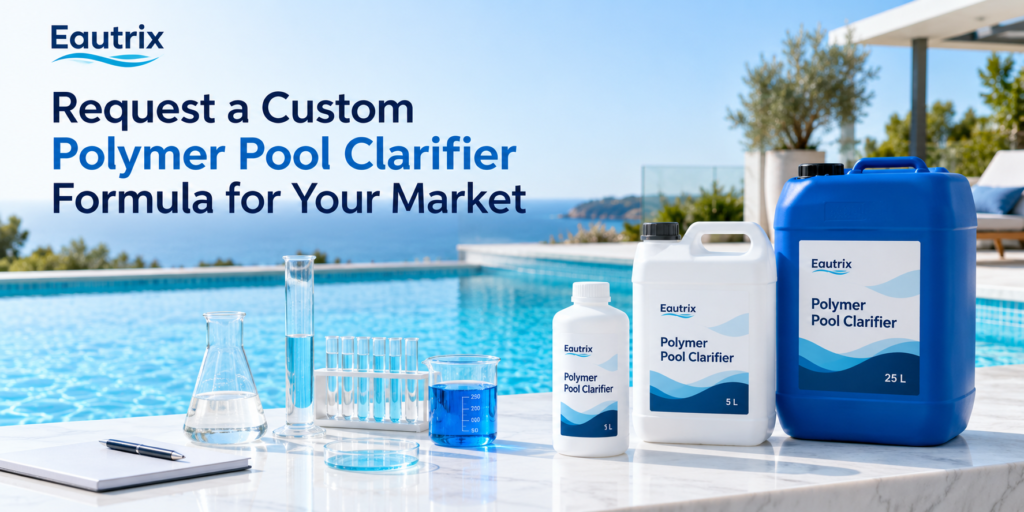
Request a Custom Polymer Pool Clarifier Formula for Your Market
A pool owner wants clear water. A service company wants a product that fits its daily routine. A distributor wants repeat orders, clear instructions, and fewer complaints.
They may all buy pool clarifier, but they don’t buy it for quite the same reason.
That’s why a custom polymer pool clarifier formula should start with your market. The right product needs to suit the people who use it, the filters they run, the water they treat, and the price they expect to pay.
A blue liquid in a smart bottle may catch the eye. Yet lasting sales depend on what happens after the cap comes off.
If you’re developing a private label pool care range or adding a clarifier to an existing line, a clear formulation brief can save a great deal of back-and-forth. It helps your supplier propose a suitable starting point and gives your team a fair way to assess samples.
Here’s how to request a custom polymer pool clarifier formula with the details that matter.
Start With the Customer Who Will Pour It
Before you ask about concentration, think about the person holding the bottle.
Will a homeowner measure a small dose once a week? Will a pool technician treat several pools each day? Will a hotel maintenance team use a written treatment schedule?
Those details shape the product.
For a retail buyer, simple instructions and a practical measuring method may matter more than a high concentration. For a trained service team, a concentrated product may be useful if it reduces storage and handling.
A commercial operator may place more weight on consistent supply, batch records, and technical support.
Your first inquiry should explain:
- The destination country or region.
- The main customer group.
- Residential or commercial pool use.
- Routine maintenance or occasional cloudy-water treatment.
- The intended sales channel.
- The desired pack size and price position.
For example, “a private label clarifier for residential pool shops” gives a supplier a useful starting point.
“A 1L retail clarifier for homeowners using small outdoor pools, with clear dosing instructions and a blue appearance” gives them much more.
You don’t need a perfect technical brief at this stage. You need a clear picture of the job.
Define the Water Problem Before Choosing the Formula
“Cloudy pool water” sounds specific. In practice, it describes a result, rather than a single cause.
Fine suspended dirt, poor filtration, water balance issues, and biological contamination can all affect water clarity. A clarifier request should explain which problem the product is expected to address.
For a filtration aid, the development goal should focus on helping the filter remove fine suspended material.
Avoid building the brief around a promise that the product will fix every cloudy pool. That can lead to weak instructions and disappointed customers.
Ask yourself:
What will customers see before they use this product? What should they check first? What should they reasonably expect afterward?
A useful product brief might say:
We want a liquid polymer pool clarifier for fine suspended particles in otherwise properly maintained pool water. The product should support filtration and have clear instructions for checking water balance and filter condition before use.
That statement gives the project a practical boundary.
It also helps separate clarification from disinfection. Clear-looking water alone does not establish that a pool is ready for swimming.
Give the Supplier a Clear Starting Point
A custom formula does not always need to begin from scratch.
In many projects, it makes sense to evaluate an existing product first. Your test results can then show whether any changes are needed.
Eautrix lists a PolyDADMAC-based pool clarifier containing 10% active ingredient, with original or blue-dyed appearance. Its product page also lists concentration adjustment, custom formulations, and private label support. These provide starting points for a development discussion; the final specification still needs to be agreed for your project.
You can review the Polymer Pool Clarifier product details before preparing your request.
Starting with an existing formula has a simple benefit: you have something concrete to test.
Perhaps the standard product already meets your needs. Perhaps the liquid needs a different appearance, or the packaging needs a better measuring cap. Those are useful findings.
Customization should solve a problem. It does not have to add complexity.
Ask What “Concentration” Actually Means
A request for “10% clarifier” may seem clear. It can still leave room for misunderstanding.
Does the percentage describe active polymer by weight? Total solids? The amount of a supplied raw material added during blending?
Those figures are not automatically interchangeable.
Ask the supplier to state the concentration basis in writing and explain how it is checked. If two suppliers use different definitions, their prices and specifications may be hard to compare fairly.
Also ask whether the proposed polymer grade has been selected for the intended pool application. A shared chemical name or CAS number does not establish that two finished products will perform the same way.
Your request can include:
Please state the polymer identity, the basis used for active content, the proposed specification range, and the test method used to verify that range.
That is much more useful than asking for the strongest formula available.
A higher concentration may suit some customers. For others, it may make small doses harder to measure. The right balance depends on the product’s tested performance and the user’s routine.
Make the Dose Easy to Understand
A technically sound formula can still cause trouble if the label leaves customers guessing.
“Add a small amount” is too vague.
Even “dose at 1 ppm” can be unclear unless the label states whether that means finished product or active polymer.
For development work, ask the supplier to express dosing in practical units such as milliliters of finished product per cubic meter of pool water. Any other units used on your label should be checked carefully.
The proposed instructions should answer:
- How does the user estimate pool volume?
- What amount should be measured?
- Where should the product be added?
- Should circulation remain running?
- When should the user assess the result?
- What should they check before adding more?
The final directions must reflect testing of the actual formula.
Do not copy the dose from a different product because the bottles look alike or both labels mention polymers. Changes in concentration, polymer grade, and formulation can affect the suitable treatment level.
A good label helps customers act with confidence. It should also help them pause when another dose is not the right next step.
Tell the Supplier Which Filters Your Customers Use
Your market may rely mainly on sand filters. Another market may have a large share of cartridge systems. Some customers may use diatomaceous earth filters.
Include that information early.
Ask the supplier to identify which filter types have been assessed with the proposed formula and what operating limits apply.
A statement such as “suitable for all filters” deserves supporting evidence. It should not become a label claim simply because it sounds useful.
For a custom polymer pool clarifier, your test plan should consider both water clarity and filter operation.
Ask testers to record flow changes, pressure readings where available, and cleaning needs. Better-looking water is valuable, but a product that creates an awkward maintenance routine may be a poor fit for your customers.
Also clarify the intended treatment method. Do you want a product used during normal filtration, or a treatment designed around settling and vacuuming?
Those are different customer routines. The label needs to make the intended process clear.
Clear or Blue? Choose With a Purpose
Color is often one of the first customization requests.
Blue can fit naturally within a pool care range. An undyed appearance may suit a brand that prefers a simpler visual style.
Neither choice proves better clarification performance.
Treat appearance as its own part of the brief. State the shade you want and ask how the supplier will check it from batch to batch.
A useful color request should address:
- The approved shade or physical reference sample.
- Acceptable variation.
- Appearance in the actual bottle.
- Stability under expected storage conditions.
- Any color transfer or staining concerns that need testing.
Packaging matters here. A blue liquid viewed through a clear bottle can look quite different from the same liquid poured into a glass.
If color is central to your brand, approve it in the final container.
And resist the urge to make it darker just to suggest strength. A deep shade can change the visual impression without improving the treatment result.
Build the Formula Brief Around Local Conditions
You don’t need to send a full water survey with your first email. Still, basic market information helps a supplier design a useful test plan.
Share what you know about local pool conditions, including common water sources, typical water temperature, and recurring maintenance problems.
Where records are available, include the usual pH, hardness, and alkalinity ranges.
Describe seasonal use, too.
A market with a short summer opening period may need different customer instructions from one where outdoor pools run throughout the year. A hotel pool with steady daily use presents another set of operating demands.
Avoid broad assumptions such as “our country has hard water.” Conditions can vary between cities and even between sites.
If reliable data are missing, say so. Then select representative test pools and collect the information during trials.
Measured local results are more useful than a confident guess.
Decide Whether You Need a Finished Product or a Blending Input
This choice affects much more than the purchase price.
A finished private label clarifier needs a complete package: approved formula, container, closure, label, directions, and batch identification.
A product supplied for local dilution or blending needs a different technical discussion.
If you plan to blend locally, explain your water source, equipment, batch size, and quality checks. Ask the supplier to define the proposed procedure and any limits on ingredients or mixing conditions.
Do not assume that adding water to a concentrate will automatically produce a stable retail product with a suitable shelf life.
Local blending can introduce variation through measuring errors, water quality, and handling.
For some distributors, importing a finished product will be the more practical route. Others may have the equipment and staff to manage local production.
The right request should reflect what your business can control consistently.
Compare Cost Per Treatment Alongside Bottle Price
A low price per liter can look attractive on a quotation sheet.
It says little about the cost of treating a pool unless you also know the effective dose.
When reviewing samples, compare the proposed purchase price with the treatment level supported by your trials. Keep freight, packaging, and handling in the calculation.
For a hypothetical example, consider two products:
| Item | Formula A | Formula B |
|---|---|---|
| Purchase cost per liter | $2.00 | $3.00 |
| Validated dose for the same trial condition | 100 mL | 50 mL |
| Product cost per treatment | $0.20 | $0.15 |
These figures are illustrative. They are not recommended doses or Eautrix prices.
The example shows why bottle price alone can mislead. The more expensive liquid may have a lower product cost per treatment, provided the trials confirm comparable results.
Also consider measuring convenience. A very small dose may look economical but be awkward for an untrained user to measure.
Commercial value includes performance, ease of use, and reliable repeat supply.
Choose the Packaging Before Final Approval
Packaging should be part of product development from the start.
A 1L bottle may fit a retail shelf. A 5L container may suit a service team. A 25L jerrycan may be useful for larger users.
Yet capacity alone does not tell you whether the pack works well.
Ask for samples of the proposed bottle and closure. Check how the liquid pours, whether the label remains readable after handling, and how easily the user can measure a dose.
Confirm:
- Container material and dimensions.
- Closure and seal design.
- Whether a measuring aid is included.
- Net fill basis.
- Carton quantity and gross weight.
- Pallet arrangement.
- Batch coding position.
Be precise about mass and volume. A stated container capacity is not the same thing as an agreed net fill, and liters should not be treated as kilograms without the correct density information.
A practical pouring test can reveal issues that a packaging drawing will never show.
Agree on Sample Testing Before Samples Arrive
Without an agreed plan, sample testing can become a collection of impressions.
“One pool looked better” is encouraging. It is not enough to approve a new formula.
Start by defining the test conditions and success criteria. Where practical, compare treated water with an untreated control under the same conditions.
Record the water source, starting condition, dose, mixing method, and observation times. Keep sample identification clear.
If you have access to a turbidity meter, use it consistently. If you rely on photographs, keep lighting, background, and viewing conditions as similar as possible.
Bench tests can help narrow the choices. They do not reproduce every feature of a working pool, so follow promising results with suitable pool trials.
During those trials, record filter behavior and maintenance needs as well as visible clarity.
The goal is to understand how the product performs, where it works well, and which instructions users need.
Check Stability in the Product You Plan to Sell
A fresh sample may look excellent. Your customer may open the bottle months later.
Ask for stability evidence that relates to the proposed formula and packaging. Discuss expected warehouse temperatures and shipping conditions.
The assessment may need to cover changes in appearance, separation, precipitation, viscosity, odor, and packaging condition. The relevant checks should be agreed with the supplier.
If freezing is a realistic risk on your route, raise it before ordering.
Also ask what supports the proposed shelf life. A shelf-life statement should relate to evidence and defined storage conditions.
Changes to dye, concentration, additives, or packaging may require further assessment.
Keep a retained sample of the approved product. It provides a useful reference if a later delivery looks different or a customer reports a concern.
Set Written Acceptance Criteria for Repeat Orders
Sample approval should lead to an agreed specification.
Otherwise, “same as last time” can mean different things to different people.
Your finished-product specification may include appearance, active content on a defined basis, pH under a stated test condition, density, and viscosity where relevant.
Packaging checks should cover fill, closure integrity, labeling, and batch identification.
Performance requirements also need a defined method. “Works fast” is too open-ended to serve as a release criterion.
Ask how formula changes will be managed. If a raw material grade, dye, or production step changes, when must the supplier notify you?
Clear change control protects both parties. It reduces the chance that a small production adjustment becomes an unexpected market problem.
Send a Request That a Supplier Can Act On
You can use the following message as a starting point.
Subject: Custom Polymer Pool Clarifier Formula Inquiry for [Market]
Dear Eautrix Team,
We are developing a private label polymer pool clarifier for [country or region]. Our main customers are [pool shops, distributors, service companies, or commercial pool operators].
The intended application is [routine clarification or fine-particle cloudy-water treatment]. Our customers mainly use [filter types].
We would like to evaluate a suitable PolyDADMAC-based starting formula and discuss the following requirements:
- Concentration: [target, or request a recommendation].
- Appearance: [original or desired blue shade].
- Packaging: [1L, 5L, 25L, or bulk].
- Typical water conditions: [available information].
- Target price position: [economy, mid-range, or premium].
- Estimated first order and annual demand: [quantity].
Please provide the proposed specification, concentration basis, sample availability, suggested test procedure, dosing basis, stability information, minimum order quantity, lead time, and quotation.
Please also explain which filter compatibility and performance claims are supported for the proposed formula.
Kind regards,
[Name / Company]
If some details are unknown, leave them open for discussion. Honest gaps are easier to resolve than assumptions hidden inside a quotation.
Turn an Approved Sample Into a Repeatable Product
Before placing the first commercial order, bring the formula, packaging, and instructions together for one final review.
The approved sample should match the agreed product code and specification. The artwork should match the intended pack. The directions should use the correct dose units.
Check that the technical documents describe the finished product being supplied. Ask qualified local support to review destination-market requirements where needed.
Avoid adding claims that were never part of the testing.
Finally, agree on what you will receive with each batch and how any complaint will be investigated. Batch traceability and retained samples make that process far easier.
To begin your project, send your market brief through Contact Eautrix. A few clear details about your users, filters, packaging, and commercial goals can turn a broad request into a focused development discussion.
Frequently Asked Questions
1. Can I request a custom polymer pool clarifier without knowing the required concentration?
Yes. Describe your customers, intended use, filter types, and price position. Ask for a suitable starting formula, then use sample trials to assess its performance and dosing convenience.
2. Can a private label PolyDADMAC pool clarifier be made blue?
A blue appearance can be discussed as part of the formulation brief. Approve the shade in the final packaging and confirm that the proposed dye system has been assessed for stability and intended use.
3. What should I test before approving a custom pool clarifier formula?
Check clarification performance, dose response, filter operation, appearance, stability, and packaging. Use a written test plan, and follow bench testing with representative pool trials before making broad claims.
4. Is a higher-concentration polymer pool clarifier always more economical?
No. Compare the cost per effective treatment using validated doses. Include freight, packaging, measuring accuracy, and handling when deciding which concentration suits your market.
5. What information should I send to request a custom pool clarifier quotation?
Provide the destination market, customer type, intended application, filter types, appearance preference, pack size, and estimated quantity. Request a defined specification, sample plan, dosing basis, and commercial terms.