
GET IN TOUCH
Ask For Sample?
How to Compare Polymer Pool Clarifier Suppliers?
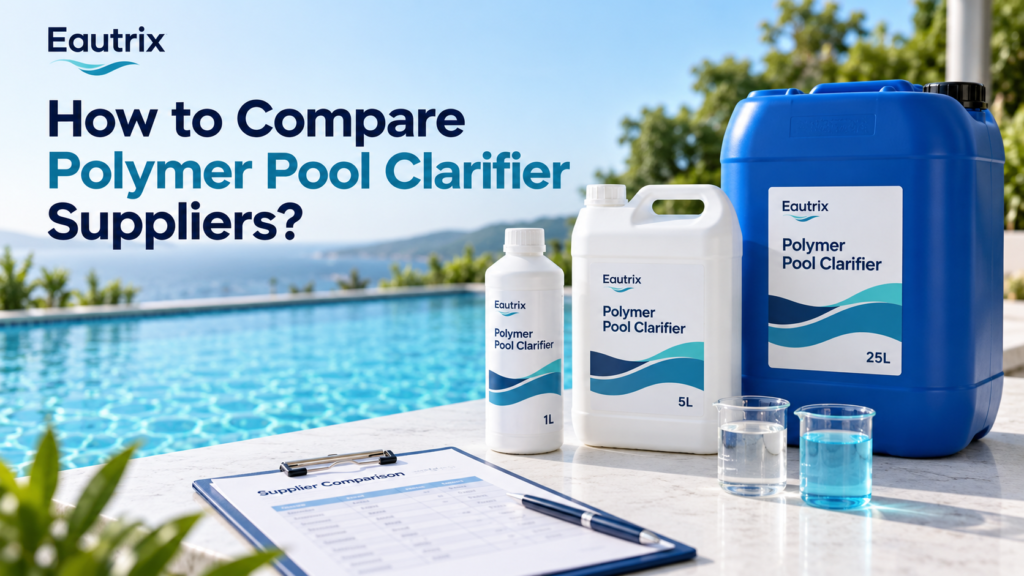
Two suppliers offer a blue liquid pool clarifier. Both promise clear water. Both can put your logo on the bottle. One quote comes in lower than the other.
So, which supplier deserves your order?
The price sheet alone won’t tell you. The real difference may sit in the polymer grade, batch control, packaging seal, or the care taken with your dosing instructions. Those details can be hard to see when you’re reviewing samples from a desk thousands of miles away.
For pool chemical distributors, private label brands, and professional service suppliers, the goal is straightforward: buy a product that performs as expected and can be supplied again with the same quality.
This guide explains how to compare polymer pool clarifier suppliers using evidence you can check—from the first technical document to the first repeat order.
Start With Your Market, Then Compare Suppliers
Before you send an inquiry, define what you need the product to do.
A supplier serving retail pool shops may need to provide small bottles, clear consumer instructions, and strong shelf appeal. A supplier serving pool service companies may need larger packs, reliable pouring, and practical technical support.
These are different buying briefs. Sending the same vague request—“Please quote your best pool clarifier”—leaves too much room for guesswork.
Prepare a short purchasing brief that covers:
- Target customers and destination market.
- Intended use: routine maintenance, occasional clarification, or another defined application.
- Required polymer chemistry, where specified.
- Target concentration and how that concentration should be measured.
- Clear or blue appearance.
- Packaging sizes and estimated order quantities.
- Private label requirements.
- Expected delivery schedule.
You don’t need to know every answer at this stage. Mark any open points as questions.
The purpose is to give each supplier the same starting line. Otherwise, you may spend days comparing offers for products that were never equivalent.
Make Sure You’re Comparing the Same Product
“Polymer pool clarifier” describes a product category. It does not identify one fixed formula.
Start by asking each supplier to state the chemical basis of the proposed product. For a PolyDADMAC-based clarifier, that means confirming the polymer identity, concentration, and relevant grade characteristics.
For example, Eautrix lists its Polymer Pool Clarifier as a PolyDADMAC-based formulation with 10% active ingredient, CAS No. 26062-79-3, available in original or dyed blue appearance. Those details provide a starting point for a product comparison.
However, matching the CAS number and stated percentage does not prove that two products will perform alike.
Ask what “10%” means. Is it polymer active content by weight? Is it total solids? Is the supplier referring to the amount of a purchased raw material added to the blend?
Those answers matter. Total solids and polymer active content are not automatically interchangeable.
A useful follow-up is:
“Please confirm the concentration basis, test method, and acceptance range for the finished product.”
A capable supplier should explain its terminology without turning the discussion into a guessing game.
Compare Specifications That Can Be Checked
A neat technical data sheet is helpful. A testable specification is more useful.
The difference is simple: a technical data sheet may describe typical properties, while an agreed specification sets the limits used to accept or reject a batch.
Ask suppliers to distinguish between the two.
| Item | What to compare | What to clarify |
|---|---|---|
| Polymer identity | Chemical name and CAS number | Does the proposed product match your brief? |
| Concentration | Defined active content or solids value | What does the percentage measure? |
| Appearance | Agreed clarity and color description | What variation is acceptable? |
| pH | Specified range | Is it measured neat or at a stated dilution? |
| Viscosity | Range and method | What temperature, instrument, and settings apply? |
| Density | Range and test temperature | How will mass and volume be reconciled? |
| Storage stability | Supported storage conditions and period | What evidence supports the claim? |
| Traceability | Batch identification | Can each shipment be linked to its records? |
Don’t assume that a higher viscosity means a better clarifier. It may reflect a different polymer grade, concentration, or measurement condition.
Likewise, a darker blue shade does not demonstrate stronger clarification.
The practical question is whether the supplier can define, measure, and repeat the properties you have approved.
Treat Color as a Branding Choice
Blue pool chemicals can look attractive on a retail shelf. Clear formulations may suit brands that prefer a simple, technical appearance.
Either choice should be evaluated on its own merits.
Compare suppliers on whether they can reproduce the approved shade, explain how color is controlled, and show that the finished formulation remains acceptable during storage.
Use the same lighting and sample container when reviewing color. A blue liquid can look quite different in a small glass vial, an opaque bottle, and a large translucent container.
If you approve a shade, retain a reference sample and describe the acceptance procedure. “Same blue as before” sounds clear until two people disagree about what they see.
Color belongs in your quality agreement. It should never replace a performance test.
Ask for Documents That Agree With Each Other
Request the technical data sheet, safety data sheet, a representative certificate of analysis, and proposed label information early.
Each serves a different purpose.
The technical data sheet describes the product and its intended application. The safety data sheet addresses hazards and handling. The certificate of analysis records selected results for a specific batch. The label tells the customer what the product is and how to use it.
Compare them as a set.
Does the product name match? Do the concentration descriptions agree? Are storage instructions consistent? Does the certificate identify a real batch?
A generic certificate with the same values repeated across every shipment deserves a closer look. Ask which properties are tested for each batch and which are controlled through production records or periodic checks.
Also, don’t mistake one document for proof of everything. A certificate of analysis does not establish pool performance, and a safety data sheet does not establish suitability for every destination market.
Where local documentation or label review is needed, identify who will handle it before printing thousands of labels.
Test Samples Under the Same Conditions
Samples are where attractive claims meet practical work.
Yet a sample test is only useful if you control the comparison. Testing one product in lightly cloudy water and another in heavily loaded water tells you very little about the suppliers.
Write a short protocol before the samples arrive.
Record the water source, starting conditions, sample volume, product dose, mixing procedure, observation times, and assessment method. Include an untreated control.
For a first screening, you might compare several doses within each supplier’s proposed application range. This helps show whether a product has a useful working range rather than one narrow point where it looks good.
Ask suppliers to explain their recommended testing procedure and its limits.
A static jar test can help screen products, but it does not fully reproduce a circulating pool with a working filter. A product that creates visible aggregates in a jar still needs application testing in the intended system.
The key is to use small tests to narrow the field, then confirm the result under realistic conditions.
Look Beyond the First Clear Sample
A dramatic before-and-after photograph is easy to remember. It is less useful than a complete test record.
When comparing polymer pool clarifier suppliers, review:
- How the product performs at the intended dose.
- Whether the result can be repeated.
- How it behaves across the planned dose range.
- What happens during filtration.
- Whether the water remains acceptably clear during the observation period.
- Whether the application instructions are practical for the intended user.
Record any changes in filter pressure, cleaning needs, or visible residue during controlled application trials.
Also ask what the product is not designed to solve. Cloudy water can have several causes, and a clarifier claim should not become a promise to correct every pool problem.
A supplier who explains application limits gives your sales team something valuable: a way to set realistic customer expectations.
That can be worth more than another bold sentence on a brochure.
Verify Filter Compatibility With Evidence
“All filter types” is a broad claim. Ask what supports it.
For your target market, identify whether customers mainly use sand, cartridge, or diatomaceous earth filtration. Then ask the supplier for instructions and evidence relevant to those systems.
Useful questions include:
- Which filter types were included in testing?
- What dosing and circulation conditions were used?
- Are there any application limits?
- What cleaning or backwashing guidance applies?
- Has the finished formulation been evaluated, including any dye or other additives?
Avoid treating the raw polymer’s general properties as proof for every finished product.
If your brand serves several filter types, test the important ones before making a broad label claim. A carefully supported claim is easier for distributors and service teams to use with confidence.
Check Whether the Supplier Can Repeat the Approved Sample
The first sample may be excellent. Your business still depends on the next batch—and the one after that.
Ask how the supplier connects the approved sample to commercial production.
Was it drawn from a normal production batch? Was it prepared separately? Can the supplier identify its formula version and batch number?
A separately prepared development sample can be useful, but its status should be clear.
Before a larger commitment, consider a second sample from another production batch. Where practical, arrange a pilot order using the intended production process and packaging.
Also ask about change control. The supplier should know when a change requires your review, such as a different polymer grade, dye, container, closure, or production site.
Write that requirement into the purchasing agreement. Memory is a poor quality system, especially when staff change.
Compare Packaging as Part of the Product
Packaging is easy to underestimate because it looks familiar.
A white bottle is a white bottle—until the cap leaks, the label wrinkles, or the carton fails in a warehouse stack.
For 1L retail packs, assess cap fit, seal design, label finish, pouring, and carton protection. For 5L packs, check the handle, grip, closure, and control during pouring. For 25L containers, assess handling, pallet arrangement, and the intended dispensing method.
The pack should also be suitable for the actual formulation and transport conditions.
Ask for a filled packaging sample where possible. An empty container cannot show every issue that may appear after filling and storage.
Confirm these details in writing:
- Nominal pack size and agreed net contents.
- Container and closure specification.
- Seal arrangement.
- Label material and artwork version.
- Units per carton.
- Pallet configuration.
- Batch marking location.
- Packaging inspection requirements.
Product illustrations help communicate the concept. Physical samples establish what you are buying.
Compare Private Label Support in Practical Terms
“Private label available” can mean anything from applying a sticker to managing a complete retail pack.
Ask each supplier to explain what is included in the quotation.
Who prepares the artwork? Who checks the technical text? Who approves the final label? Does a change to the bottle size affect the minimum order quantity?
Request a clear approval sequence: artwork proof, packaging sample where needed, final written approval, and production release.
Be precise about dosing instructions and measuring aids. If customers will measure small volumes, the closure or separate measure should suit the intended use.
Also confirm ownership and access. You should retain approved artwork files and know which version will be used for repeat orders.
A smooth private label process is less about endless design choices and more about preventing avoidable mistakes.
Work Out the Cost per Treatment
Price per kilogram matters. It is only one part of the comparison.
A lower-priced product may need a higher tested dose. A more concentrated product may cost more to ship per container but less per treatment. Packaging costs can also change the result.
Here is a simple illustration using invented figures:
| Comparison item | Supplier A | Supplier B |
|---|---|---|
| Delivered price per litre | $2.00 | $2.60 |
| Dose achieving the agreed trial result | 100 mL | 60 mL |
| Water volume treated in that trial | 10 m³ | 10 m³ |
| Product cost per trial treatment | $0.20 | $0.156 |
In this example, Supplier B has a higher price per litre but a lower product cost for the agreed treatment.
These figures are not dosing advice or market prices. They simply show why the purchase price and treatment cost should be reviewed together.
Use results from comparable tests. If offers are quoted per kilogram while dosing is expressed in millilitres, use the confirmed density to convert the units.
Then add packaging, freight, duties, inspection, and other applicable costs to build a landed comparison.
Make Commercial Offers Comparable
A quotation can look cheaper because it leaves out something another supplier included.
Send a common request for quotation and ask every supplier to use the same basis: quantity, formulation, pack, label, delivery term, and named location.
Separate product charges from artwork, printing, tooling, pallets, and other one-time costs.
Lead time also needs a definition. Does it start after payment, artwork approval, raw material confirmation, or all three?
For a new private label order, ask suppliers to break the schedule into approval, packaging procurement, blending, filling, inspection, and dispatch.
The aim is to find the point at which a delay could affect your selling season.
Payment terms belong in the comparison too. Review the full package of price, cash commitment, production evidence, and shipment controls. A single attractive term should not carry the whole decision.
Evaluate the People Behind the Offer
Communication provides useful evidence when you ask specific questions.
Send the same technical query to shortlisted suppliers. Ask them to explain the concentration basis, propose a sample test, or clarify a mismatch between documents.
Compare the substance of their replies.
Do they answer directly? Do they distinguish confirmed facts from items they need to check? Do revised documents arrive with the correction clearly made?
Fast replies are helpful. Accurate replies that resolve the issue are more helpful.
Also establish who handles quality concerns after delivery. Ask what records the supplier would need, how retained samples are used, and how an investigation would proceed.
A supplier relationship becomes much easier when there is a clear route from “we found a problem” to “here is the evidence and next action.”
Use a Scorecard, With a Few Firm Gates
A weighted scorecard helps keep a low quote from overshadowing weak evidence.
The following model is a suggested starting point, not an industry standard.
| Evaluation area | Suggested weight |
|---|---|
| Performance in agreed trials | 25% |
| Batch consistency and quality control | 20% |
| Packaging suitability and quality | 15% |
| Documents and traceability | 10% |
| Landed cost and commercial terms | 15% |
| Delivery capability | 10% |
| Technical communication | 5% |
| Total | 100% |
Score each area from one to five and record the evidence behind the number.
Keep missing information visible. “Not yet verified” is different from “poor,” but it is also different from “approved.”
Use a few mandatory gates before scoring the final shortlist. These might include confirmed product identity, acceptable application results, suitable documentation, and approved packaging.
A high total score should not excuse failure on a requirement your business cannot compromise.
Start With an Order That Teaches You Something
Once the comparison is complete, make the first order a controlled commercial trial.
It should be large enough to reveal how the supplier handles real production, filling, packing, and shipment, while keeping your exposure sensible.
Agree on acceptance criteria before production. Review the batch certificate, packaging photos, label version, and any planned inspection records before dispatch.
After delivery, check the shipment against the approved reference and record feedback from a limited market release.
Then assess the supplier again.
Did the product arrive as agreed? Were the documents consistent? Did the supplier handle questions well? Were there unexpected costs?
That first order provides evidence no sales presentation can supply.
For your next inquiry, prepare one clear brief and send it to every shortlisted supplier. You can use Eautrix’s contact page to discuss the required formulation, appearance, packaging, and quantity.
The strongest purchasing decision comes from a clear chain of proof: defined requirements, comparable samples, repeatable quality, and a shipment that matches the agreement.
Frequently Asked Questions
1. What should I check first when comparing polymer pool clarifier suppliers?
Confirm product identity, concentration basis, intended application, and packaging requirements. Without those basics, quotations may cover different products and cannot be compared fairly.
2. Can two 10% PolyDADMAC pool clarifiers perform differently?
Yes. The stated percentage does not describe every relevant property. Polymer grade, formulation, and application conditions can differ. Compare agreed specifications and run matched performance tests.
3. How can I compare private label pool clarifier prices fairly?
Request the same formulation, order quantity, packaging, label requirements, and delivery basis. Then compare landed cost and cost per treatment using verified trial results.
4. What is the best way to test pool clarifier supplier samples?
Use a written protocol with the same water, controlled doses, an untreated control, and fixed observation times. Follow initial screening with trials in the intended filtration system.
5. Should I choose a pool clarifier manufacturer or a trading company?
Choose the supplier that can demonstrate product control, traceability, dependable supply, and effective problem handling. Confirm who manufactures the product and who is responsible for quality and agreed changes.