
GET IN TOUCH
Ask For Sample?
How to Prepare an RFQ That Gets Accurate Pricing
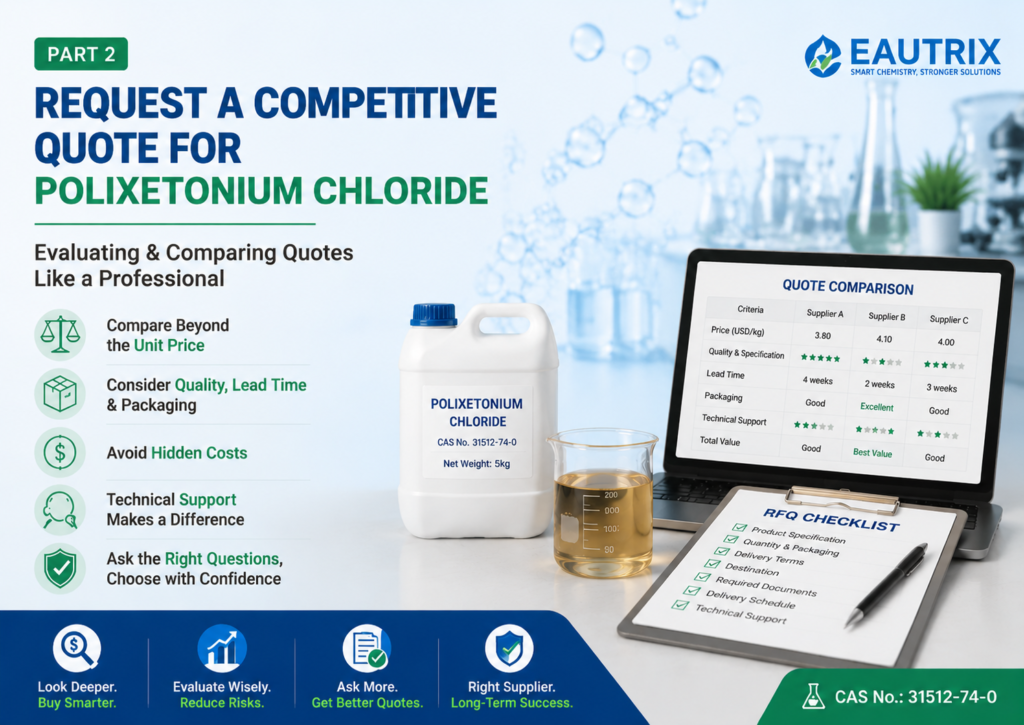
Have you ever sent an inquiry and then spent a week exchanging emails just to clarify basic details? It happens more often than you’d think.
A well-written RFQ (Request for Quotation) can dramatically shorten the quotation process and help suppliers provide pricing that’s both accurate and competitive.
Here’s a simple checklist of the information you should include:
- Product name: Polixetonium Chloride (CAS No. 31512-74-0)
- Required specification or active content
- Intended application
- Estimated order quantity
- Preferred packaging
- Delivery terms (FOB, CIF, etc.)
- Destination port or country
- Required documents (COA, SDS, TDS, third-party reports)
- Target delivery schedule
- Whether OEM or private labeling is needed
Providing these details up front reduces misunderstandings and allows suppliers to prepare quotations based on your actual purchasing requirements rather than assumptions.
Example of an Effective RFQ
Instead of writing:
Please quote your best price for Polixetonium Chloride.
Try something like this:
We are looking for Polixetonium Chloride (CAS No. 31512-74-0) for swimming pool algaecide production.
Initial order quantity: 1 metric ton.
Estimated annual demand: 20–30 metric tons.
Preferred packaging: 25 kg HDPE drums.
Delivery term: CIF Los Angeles.
Please include your COA, SDS, TDS, lead time, and sample availability.
Notice how much easier it becomes for a supplier to prepare an accurate quotation.
Even better, professional inquiries often receive faster responses because suppliers spend less time asking follow-up questions.
Comparing Quotes Beyond the Unit Price
One of the biggest purchasing mistakes is comparing quotations using only the price per kilogram.
Professional buyers evaluate the complete commercial package.
Product Quality
Ask yourself:
- Is the active content consistent?
- Does the supplier provide a detailed COA?
- Are production batches stable?
- Is third-party testing available?
A slightly higher price may reflect tighter quality control, which can reduce manufacturing problems later.
Lead Time
Production delays can be surprisingly expensive.
Ask suppliers:
- Is the product in stock?
- What is the normal production lead time?
- How quickly can repeat orders be shipped?
Reliable delivery often matters more than saving a few cents per kilogram.
Packaging Quality
Packaging affects transportation costs, warehouse handling, and even product safety.
Consider:
- Drum strength
- Leakage prevention
- Pallet configuration
- Container loading efficiency
- Export labeling
Better packaging can reduce freight damage and lower overall logistics costs.
Technical Support
What happens if you encounter formulation questions after receiving the product?
Reliable suppliers typically provide:
- Technical recommendations
- Application guidance
- Compatibility advice
- Sample testing support
- Fast communication
These services may not appear on the quotation, but they add significant value.
Supplier Experience
Suppliers with years of export experience usually understand:
- Customs documentation
- International shipping
- Dangerous goods regulations (when applicable)
- Import requirements
- Communication expectations
This experience often translates into smoother transactions.
Hidden Costs Buyers Often Overlook
A quotation doesn’t always tell the whole financial story.
Some costs appear only after production has started—or worse, after the shipment arrives.
Poor Product Consistency
If one batch performs differently from the previous one, you may need to:
- Adjust formulations
- Repeat production trials
- Delay customer deliveries
- Increase quality inspections
Those expenses quickly outweigh a small price difference.
Shipping Damage
Low-quality packaging may lead to:
- Leaking drums
- Broken pallets
- Damaged labels
- Product contamination
Replacing damaged cargo can become surprisingly expensive.
Documentation Problems
Missing paperwork may delay customs clearance.
Typical documents include:
- Commercial Invoice
- Packing List
- Bill of Lading
- Certificate of Origin
- SDS
- COA
An experienced exporter prepares these documents correctly the first time.
Communication Delays
Time is money.
Waiting several days for answers about production, shipping, or documentation can delay your own production schedule.
Many buyers eventually discover that responsive suppliers save more money than low-priced suppliers with slow communication.
Questions to Ask Before Accepting a Quote
Before making a purchasing decision, it’s worth asking a few additional questions.
These answers often reveal how reliable a supplier will be throughout the project.
Can Samples Be Provided?
Testing a sample before placing a bulk order reduces purchasing risk.
Ask:
- Is a laboratory sample available?
- What is the sample size?
- Is freight prepaid or collect?
A supplier willing to support evaluation usually demonstrates confidence in product quality.
How Stable Is Production?
You may also ask:
- Is production continuous?
- What is the normal monthly capacity?
- Can repeat orders maintain the same specification?
Consistency is especially important if you’re manufacturing branded products.
Are Third-Party Tests Available?
Besides routine factory testing, some suppliers also provide independent laboratory reports.
These may include:
- Molecular weight
- Active content verification
- Heavy metal analysis
- Microbiological testing
- Other customer-requested analyses
Independent verification can increase confidence, particularly for large purchasing projects.
Is Technical Support Available After Purchase?
Purchasing doesn’t end when the shipment leaves the factory.
Ask whether the supplier can assist with:
- Formulation questions
- Application recommendations
- Product compatibility
- Troubleshooting
- Technical documentation updates
Long-term technical support often becomes one of the most valuable parts of the supplier relationship.
Can the Supplier Support Future Growth?
Maybe today’s order is only one ton.
What if your demand grows to fifty tons next year?
It’s worth asking whether the supplier can scale production, maintain lead times, and continue offering competitive pricing as your business expands.
Building a long-term partnership is usually far more valuable than negotiating the absolute lowest price on a single shipment.
To be continued in Part 3: Conclusion, Why Eautrix, Common Mistakes, and 5 SEO FAQs.