
GET IN TOUCH
Ask For Sample?
Request a Competitive Quote for Polixetonium Chloride
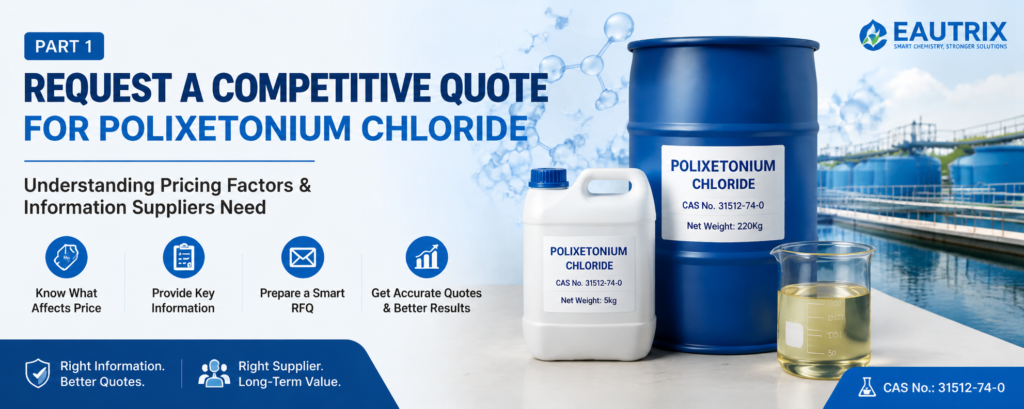
If you’ve ever sent an email that simply said “Please quote your best price for Polixetonium Chloride,” you’re not alone. Many buyers do exactly that—and then wonder why the quotations they receive vary so much or fail to meet their expectations.
The truth is that obtaining a competitive quotation isn’t just about asking for the lowest price. It’s about providing suppliers with enough information to prepare an accurate offer while giving yourself the ability to compare quotations fairly.
A well-prepared RFQ (Request for Quotation) saves time for both sides. Suppliers can recommend the right product and packaging, while buyers receive pricing that reflects their actual requirements instead of rough estimates.
In this guide, we’ll explain what determines the price of Polixetonium Chloride, what information suppliers need before quoting, and how to compare quotations like an experienced purchasing professional.
Why Pricing Alone Doesn’t Tell the Whole Story ?
Everyone wants the best price. That’s understandable.
However, the lowest quotation isn’t always the lowest total cost.
Imagine receiving two offers:
Supplier A quotes USD 4.80/kg
Supplier B quotes USD 5.10/kg
At first glance, Supplier A appears cheaper.
But after looking more closely, you discover:
- Supplier A only offers 200 kg drums.
- Ocean freight is higher because of inefficient pallet loading.
- Samples are charged separately.
- Delivery takes eight weeks.
- Technical documentation is incomplete.
Supplier B, on the other hand:
- Provides the preferred packaging.
- Includes complete technical documents.
- Ships within two weeks.
- Offers stable quality.
- Responds to technical questions within one business day.
Suddenly, the higher unit price may actually reduce your overall purchasing cost.
Experienced buyers evaluate quotations based on total value, not simply the number on the first page.
What Affects the Price of Polixetonium Chloride?
Many buyers are surprised when quotations differ by 10% or even 20% between suppliers. In reality, several factors influence pricing.
Product Specification
Not every Polixetonium Chloride product is exactly the same.
Pricing may vary depending on:
- Active content
- Polymer purity
- Viscosity
- Appearance
- Production consistency
- Testing standards
Products that consistently meet tighter quality specifications generally require stricter manufacturing control.
Order Quantity
Volume has a direct impact on pricing.
For example:
- Sample order
- Trial order
- One pallet
- Full container
- Annual purchasing contract
Larger purchase commitments usually allow suppliers to optimize production schedules and raw material purchasing.
If you expect repeat business, mentioning your estimated annual demand often results in a more competitive quotation.
Packaging Requirements
Packaging significantly affects cost.
Typical options include:
- 1 L plastic bottles
- 5 L plastic jerrycans
- 25 L stackable jerrycans
- 200 L plastic drums
- 1000 L IBC totes
Smaller retail packaging requires additional labor, labels, cartons, and palletizing.
Industrial bulk packaging generally offers the lowest cost per kilogram.
Destination Country
Shipping costs vary dramatically depending on destination.
Freight charges to Southeast Asia may differ considerably from shipments to Europe, North America, South America, or the Middle East.
Customs requirements, export documentation, and hazardous goods regulations may also influence the final quotation.
Delivery Terms
Always specify your preferred Incoterms.
Common choices include:
- EXW
- FOB
- CFR
- CIF
- DDP
Without clear delivery terms, comparing quotations becomes extremely difficult.
Information Suppliers Need Before Providing a Quote
Here’s something many buyers overlook:
Suppliers aren’t trying to ask unnecessary questions—they’re trying to avoid giving you an inaccurate quotation.
Providing complete information from the beginning helps everyone.
A professional RFQ should include the following information.
Product Name
Clearly specify the product.
For example:
Polixetonium Chloride
If applicable, also mention:
- CAS No. 31512-74-0
- Required active content
- Desired specification
Avoid using only trade names, as they may differ between suppliers.
Intended Application
How will the product be used?
Examples include:
- Swimming pool algaecides
- Cooling water treatment
- Industrial water treatment
- Metalworking fluids
- Oilfield chemicals
- Other industrial formulations
Knowing the application helps suppliers recommend the most suitable grade.
Required Quantity
Instead of saying:
“Please quote.”
Try saying:
- Initial trial: 25 kg
- Expected annual demand: 20 tons
- Monthly consumption: 2 tons
Long-term purchasing plans often lead to better commercial terms.
Packaging Preference
Specify your preferred packaging.
For example:
- 25 kg stacktable jerrycan
- 200 kg plastic drum
- IBC tote
- Private label bottles
- OEM packaging
If you’re flexible, mention that as well.
Suppliers may recommend a more economical option.
Destination Port
Always provide the destination.
For example:
- FOB Shanghai
- FOB Tianjin
- CIF Hamburg
- CIF Los Angeles
- CIF Dubai
Ocean freight changes frequently, so destination matters.
Required Documents
Many buyers forget this step.
If you require documentation such as:
- COA
- SDS/MSDS
- TDS
- Certificate of Origin
- Third-party testing reports
mention it in your initial inquiry.
Doing so avoids unnecessary follow-up emails and speeds up the quotation process.
Project Timeline
When do you need the material?
Examples:
- Immediate shipment
- Within two weeks
- Next quarter
- Annual procurement project
Knowing the timeline helps suppliers determine whether existing inventory or a new production batch is more appropriate.
To be continued in Part 2…