
GET IN TOUCH
Ask For Sample?
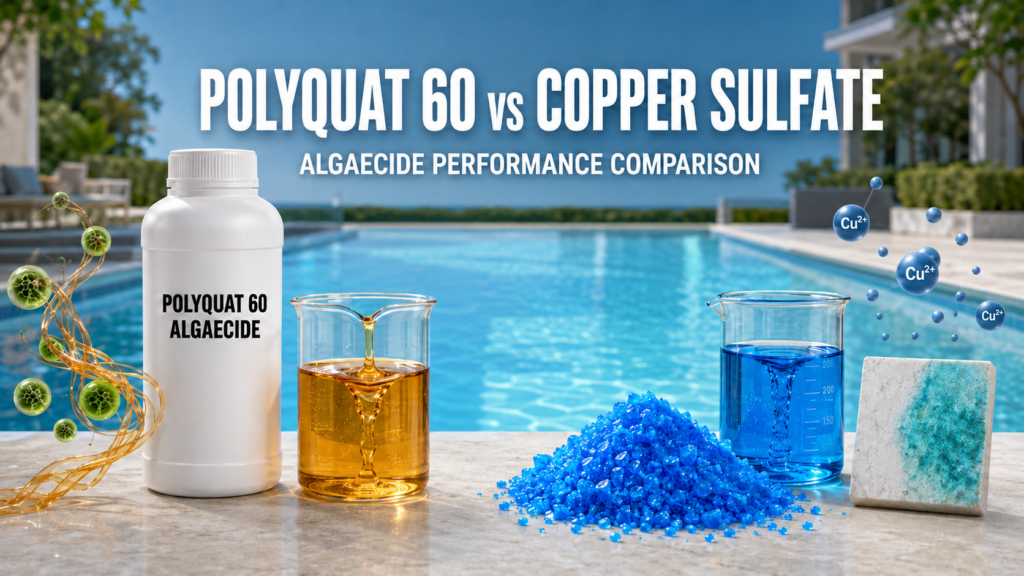
Polyquat 60 vs Copper Sulfate Algaecide: Performance Comparison
A swimming pool can turn green with surprising speed. One hot weekend, a missed chlorine check, a heavy rainstorm—and suddenly the walls feel slippery and the water looks dull.
At that point, many pool owners and service professionals face the same question: should they use Polyquat 60 or copper sulfate algaecide?
Both products can control algae, but they work in very different ways. Copper sulfate releases metal ions that are toxic to algae. Polyquat 60 uses a positively charged polymer to interact with algal cells and interfere with their normal functions.
That difference affects much more than algae-killing performance. It also influences staining risk, water chemistry, treatment consistency, filtration, seasonal maintenance, and the long-term appearance of the pool.
This article compares Polyquat 60 and copper sulfate algaecides under practical swimming pool conditions—not just on a chemical label.
First, What Are We Comparing?
“Polyquat 60” normally refers to a concentrated polymeric quaternary ammonium algaecide. One widely used active ingredient is polixetonium chloride, also known as Polyquaternium-42 or WSCP, with CAS No. 31512-74-0.
The number “60” generally refers to a formulation containing approximately 60% active polymer. It does not mean that the treatment produces 60 ppm of active material in pool water.
Polyquat 60 is:
- A non-oxidizing algaecide
- A cationic, or positively charged, polymer
- Water-soluble
- Non-metallic
- Generally non-foaming at normal application rates
- Commonly used with chlorine or bromine sanitation
Copper sulfate, usually supplied as copper sulfate pentahydrate, is an inorganic copper salt. It dissolves in water and releases copper ions, which interfere with several biological processes inside algae.
Copper sulfate is:
- A metal-based algaecide
- Blue in crystalline or concentrated solution form
- Effective at relatively low copper concentrations
- Influenced strongly by pool water chemistry
- Capable of accumulating in recirculating water
- Associated with surface staining when copper is not properly controlled
Both products are algaecides. Neither should automatically be treated as a complete substitute for a registered pool sanitizer.
How Does Polyquat 60 Control Algae?
Polyquat 60 carries multiple positive charges along its polymer chain. Algal cell surfaces, meanwhile, usually contain negatively charged components.
Opposite charges attract.
When Polyquat 60 disperses through the pool, its cationic chains are drawn toward the algae. The polymer can attach to the cell surface, disturb membrane functions, and interfere with the movement of substances into and out of the cell. The affected algae lose their ability to grow and survive normally.
The long polymer chain also helps bring very small suspended particles together. This can support filtration and may improve water clarity, although Polyquat 60 should not always be treated as a direct replacement for a dedicated clarifier.
The action is controlled rather than dramatic. You will not usually see the same rapid bleaching associated with a strong chlorine shock. That is why Polyquat 60 is often valued more for prevention, residual support, and routine maintenance than for rescuing a severely neglected green pool by itself.
Readers who want a closer look at the active chemistry can visit Polyquat 60 Algaecide.
How Does Copper Sulfate Control Algae?
Copper sulfate works after dissolving and releasing copper ions into the water.
These ions can bind to proteins and enzymes used by algae. They interfere with photosynthesis, cellular respiration, membrane integrity, and other essential processes. When enough biologically available copper reaches susceptible algae, growth stops and the cells die.
Copper has long been recognized as an effective algicidal material. The US Environmental Protection Agency notes that copper sulfate is used to control algae in swimming pools and other waters. Some registered pool product labels include claims for controlling green, mustard, and black algae.
There is a catch, though. The copper concentration measured in the water does not always equal the concentration that remains biologically available.
Copper ions may:
- Form complexes with other chemicals
- Bind to organic matter
- Precipitate at unsuitable pH levels
- React with carbonates
- Become trapped in deposits
- Remain in the pool after their useful treatment period
So, copper can be powerful—but its behavior is closely tied to the water around it.
Polyquat 60 vs Copper Sulfate: Quick Performance Comparison
| Performance factor | Polyquat 60 | Copper sulfate |
|---|---|---|
| Main active action | Cationic polymer interacts with algal cells | Copper ions interfere with algal metabolism |
| Preventive performance | Very good for routine maintenance | Good when soluble copper is maintained correctly |
| Severe bloom treatment | Usually works best with brushing, filtration, and shock treatment | Can control active algae, but should not replace cleaning and sanitation |
| Speed | Generally gradual | Can be relatively fast against susceptible algae |
| Residual behavior | Provides useful preventive support but is gradually consumed or removed | Copper remains in the water unless diluted, removed, or precipitated |
| Metal content | None | Adds copper |
| Staining risk | Does not cause copper staining | Can stain plaster, grout, vinyl, fiberglass, and fittings |
| Hair discoloration risk | Does not add copper | Elevated copper may contribute to greenish hair discoloration |
| Foaming | Normally non-foaming at proper dosage | Does not behave like a foaming surfactant |
| pH sensitivity | Generally performs across normal pool pH ranges | Copper solubility and activity are strongly affected by pH and alkalinity |
| Water chemistry workload | Relatively straightforward | Requires closer monitoring of copper and water balance |
| Seasonal use | Well suited to closing and preventive programs | Residual copper may remain through the season |
| Best general role | Metal-free prevention and ongoing control | Targeted metal-based algae control where copper is carefully managed |
Which Product Works Faster?
If the comparison is limited to visible speed against an established algae population, copper sulfate may sometimes appear faster. Soluble copper ions can attack susceptible algae once an effective concentration is present.
But “faster” is not the same as “better.”
Results depend on:
- The algae species
- The density of the bloom
- Water temperature
- pH and alkalinity
- Calcium hardness
- Organic contamination
- Circulation
- Brushing
- Filter condition
- Sanitizer level
- The actual concentration of available copper
Polyquat 60 tends to offer a steadier style of control. It is especially useful before algae become deeply established. In a clear pool with balanced chemistry, routine treatment can make it harder for new algae colonies to take hold.
For a dark green pool, neither product should be expected to do all the work alone. Physical cleaning, filtration, circulation, and an appropriate sanitizer treatment remain essential. Dead algae still need to be removed—killing them does not magically carry them out of the pool.
Green Algae Performance
Green algae are the most common pool algae and generally the easiest to control.
Both Polyquat 60 and copper sulfate can perform well against them. The practical difference appears in how the products fit into the maintenance program.
Polyquat 60 is particularly suitable when the pool is already reasonably clean and the goal is to prevent green algae from returning. Its non-metallic character makes repeated maintenance dosing easier to manage.
Copper sulfate can also suppress green algae effectively. However, repeated additions without copper testing may allow the metal concentration to rise. The pool may look clear for a while, yet a staining problem could be developing quietly.
That is the awkward part: the algae may be gone, but the copper is still there.
Mustard Algae Performance
Mustard algae, sometimes called yellow algae, often appear as yellow-brown dust on shaded walls, steps, or the pool floor. They can be brushed away easily but tend to return.
Their persistence is partly caused by reinfection. Spores may remain on ladders, toys, brushes, swimwear, or equipment.
Copper sulfate has activity against many mustard algae problems when a suitable soluble copper level is maintained. Polyquat 60 can also support control and help prevent regrowth.
In either case, chemical treatment should be combined with:
- Thorough brushing
- Cleaning of ladders and fittings
- Treatment of pool accessories
- Filter cleaning or backwashing
- Correct sanitizer levels
- Improved circulation in shaded areas
Choosing a stronger algaecide while ignoring a contaminated pool brush is a bit like locking the front door while leaving a window open.
Black Algae Performance
Black algae are among the most difficult pool contaminants to remove. They attach firmly to porous surfaces and develop protective layers that reduce chemical penetration.
Copper-based products are often selected for stubborn black algae because copper ions can provide strong algicidal activity. Yet chemical contact remains the challenge. The protective growth must usually be disrupted by firm brushing before treatment can reach the underlying cells.
Polyquat 60 can also help control black algae and reduce recurrence. A 60% polyquat supplier describes the chemistry as effective against both free-floating green algae and wall-attached black algae. Still, a badly established infestation normally requires more than one product application.
For black algae, performance is shaped by the whole treatment procedure:
- Identify the growth correctly.
- Brush the affected surfaces thoroughly.
- Maintain proper sanitizer conditions.
- Apply a registered algaecide according to its label.
- Keep the filter operating.
- Repeat brushing as needed.
- Correct areas of weak circulation.
In short, black algae reward persistence. There is no honest “pour once and forget it” answer.
Preventive Performance: This Is Where Polyquat 60 Shines
Polyquat 60 is commonly chosen for preventive pool maintenance because it combines residual algae control with a low risk of metal-related side effects.
It is especially useful:
- During hot weather
- Before a period of heavy pool use
- After heavy rain
- During pool closing
- When chlorine may temporarily decline
- In pools with expensive decorative finishes
- In systems where metal accumulation is undesirable
Routine application allows the product to interact with algae before a visible colony becomes established. This is often more efficient than waiting for green water and then reaching for an aggressive corrective treatment.
Polyquat 60 is not permanent, however. Chlorine exposure, algae, suspended solids, filtration, dilution, and other pool conditions gradually reduce the active amount. Maintenance doses must therefore follow the finished product label.
For more guidance on application frequency and concentration, see the Polyquat 60 Dosage Guide for Swimming Pool Applications.
Copper Stays Longer—but That Can Be a Mixed Blessing
Copper does not disappear simply because the algae have died.
Unlike an organic treatment that may gradually degrade or be consumed, copper is an element. It can remain dissolved, bind to pool materials, precipitate, become captured in the filter, or leave when water is drained.
This persistence can provide continuing algae suppression. That sounds convenient—and sometimes it is. But residual copper also makes repeated dosing less forgiving.
If an operator adds copper sulfate whenever algae appear without measuring existing copper, the concentration may build over time. Once conditions change, dissolved copper can oxidize or precipitate and produce:
- Blue-green stains
- Gray or dark marks
- Discolored grout
- Deposits around fittings
- Greenish hair discoloration
- Tinted or cloudy water
CDC pool guidance warns that heavy metals such as copper, iron, and manganese may cause staining and water discoloration. This does not mean every copper treatment will stain a pool. It means copper requires proper concentration control.
How pH and Alkalinity Change Copper Performance
Copper sulfate performance cannot be separated from water chemistry.
At lower pH, copper tends to remain more soluble. At higher pH—especially when alkalinity is also high—copper is more likely to form less-soluble compounds and precipitate.
That creates two possible problems.
First, less soluble copper may mean less predictable algicidal activity. The total copper test might show that copper exists in the water, while a smaller fraction remains available to act on algae.
Second, precipitated or oxidized copper may attach to pool surfaces and produce stains.
Source-water chemistry, carbonate concentration, hardness, temperature, organic matter, and sequestering agents can all influence the outcome. Even EPA technical material notes that copper sulfate dosage and behavior depend on variables such as pH, alkalinity, temperature, and the algae involved.
Polyquat 60 is generally less sensitive to normal swimming pool pH variation. Water balance still matters for swimmer comfort, sanitizer efficiency, and equipment protection, but the product does not face the same metal precipitation issue.
What Happens When Chlorine Is Present?
Polyquat 60 and chlorine perform different jobs.
Chlorine is an oxidizing sanitizer. It controls harmful microorganisms and oxidizes many organic contaminants. Polyquat 60 is a non-oxidizing algaecide that gives extra support against algae.
They can be used in the same maintenance program when applied according to their registered product labels. However, very high chlorine levels may gradually consume or reduce the polymer. This is particularly relevant during strong shock treatment.
A practical sequence may involve:
- Balancing the water
- Brushing and vacuuming
- Applying shock treatment when required
- Allowing chlorine to return to the label-specified range
- Adding Polyquat 60 for follow-up protection
The exact order and waiting period must follow the finished formulation’s instructions. Concentrated raw material should never be dosed directly based only on a generic blog formula.
Copper sulfate can also be used in chlorinated systems, but the combination requires more attention. Oxidizing conditions and changes in pH can influence copper color, solubility, and stain formation.
Which One Is Safer for Pool Surfaces?
For pools where surface appearance is a priority, Polyquat 60 usually provides the more forgiving option.
Because it contains no copper, it does not increase the pool’s dissolved-metal load and cannot create copper-based stains. This is useful for:
- White plaster pools
- Light-colored grout
- Fiberglass pools
- Vinyl liners
- Decorative tile
- Water features
- Hotel and resort pools
- Newly renovated pools
Copper sulfate can be used successfully, but dosage discipline is critical. Pools with high pH, existing metal contamination, or previous staining require extra caution.
It is also worth noting that removing a metal stain may require lowering the metal concentration, using a suitable stain treatment, applying a sequestering agent, or partially replacing the water. The cost of correcting stains can quickly exceed the savings from buying a less expensive algaecide.
Does Either Algaecide Cause Foam?
Copper sulfate is not a surfactant-type quat, so it does not normally cause the classic foam associated with some conventional quaternary ammonium algaecides.
Polyquat 60 is also widely described as non-foaming. Its polymeric structure behaves differently from smaller-chain quats that can stabilize bubbles.
This makes Polyquat 60 useful in pools with:
- Return jets
- Waterfalls
- Fountains
- Counter-current systems
- Heavy swimmer activity
“Non-foaming” should still be interpreted sensibly. An overdosed pool containing body oils, detergents, cosmetics, or other surfactants may develop bubbles. Not every patch of foam comes from the algaecide.
Which Product Produces Clearer Water?
Both can lead to clearer water when they successfully stop algae growth. Yet they reach that result in different ways.
Copper sulfate kills algae through copper toxicity. After treatment, the dead cells remain suspended or settle on surfaces. They must be filtered, vacuumed, or otherwise removed.
Polyquat 60 can also affect suspended material through cationic charge interactions and polymer bridging. Under suitable conditions, small particles may form larger aggregates that the filter captures more easily.
This secondary clarification effect can be useful, but it varies with dosage, formulation, particle load, and filter performance. A purpose-formulated Algae Control 60 product may combine algae control with water-clarification goals more deliberately.
Too much cationic polymer can also produce poor results. More chemical is not automatically more effective.
Cost per Treatment vs Total Maintenance Cost
Copper sulfate may appear less expensive when cost is calculated only by raw material weight. It is widely available, concentrated, and effective at low copper levels.
Polyquat 60 often has a higher purchase price per kilogram or per treatment. But raw material price tells only part of the story.
A realistic cost comparison should include:
- Copper testing
- Sequestering chemicals
- Stain prevention
- Possible stain removal
- Additional water replacement
- Labor for correcting discoloration
- Customer complaints
- Damage to premium pool finishes
- Product storage and handling
- Frequency of preventive dosing
- Treatment consistency across different water conditions
For a commercial pool operator, one staining complaint can cost more than months of routine Polyquat 60 treatment.
Copper sulfate may still be economical in a carefully monitored system. Polyquat 60 often becomes more attractive when predictable maintenance, surface protection, and simple operation carry more value than the lowest chemical price.
When Does Copper Sulfate Make Sense?
Copper sulfate may be suitable when:
- A metal-based treatment is specifically desired
- The pool operator can measure and control copper
- Water chemistry is stable and well understood
- Surface staining risk has been evaluated
- The product is registered for the intended use
- The treatment label is followed precisely
- Discharge into natural water is properly controlled
The last point deserves attention. Copper is toxic to many aquatic organisms. EPA guidance for direct water applications includes environmental warnings because copper-containing water can affect fish, aquatic invertebrates, and plants.
Pool water treated with copper should not be discharged carelessly into ponds, streams, or sensitive landscaped areas.
When Is Polyquat 60 the Better Choice?
Polyquat 60 is often the stronger practical choice when:
- The goal is routine algae prevention
- The pool has light-colored or premium finishes
- Metal staining must be avoided
- The water already contains copper or iron
- The pool uses chlorine or bromine sanitation
- Non-foaming performance is important
- The pool is being prepared for winter
- A private-label brand wants a metal-free algaecide
- Operators need consistent results across different pool types
- Long-term appearance matters as much as immediate algae control
It is particularly attractive for service companies managing many pools. These businesses may encounter different source-water conditions at every property. A non-metallic formulation removes one major variable from the maintenance program.
So, Which Algaecide Performs Better?
There is no honest winner under every possible condition.
Copper sulfate can produce strong algicidal action and may act quickly against susceptible algae. It can be a useful treatment when the copper concentration and pool chemistry are carefully managed.
Polyquat 60 offers a more balanced performance profile. It controls and prevents algae without adding metals, avoids copper-related staining, works across normal pool pH conditions, and fits easily into chlorine-based maintenance programs.
The practical verdict is:
- For rapid metal-based algae control under closely monitored conditions, copper sulfate can perform well.
- For routine maintenance, seasonal protection, premium surfaces, and lower staining risk, Polyquat 60 is usually the more forgiving choice.
- For a severe algae bloom, neither one should replace proper sanitation, brushing, circulation, and filtration.
That final point matters. Algaecide is one member of the maintenance team—not the entire team.
What Should Pool Chemical Brands Consider?
For distributors, formulators, and private-label pool chemical brands, product selection should go beyond the active ingredient name.
A useful evaluation should cover:
- Active ingredient concentration
- Chemical identity and CAS number
- Appearance and viscosity
- pH
- Density
- Dilution stability
- Packaging compatibility
- Cold-storage behavior
- Foam performance
- Label claims permitted in the target market
- Regulatory registration
- Finished-product dosage
- Raw material consistency between batches
Polyquat 60 is commonly supplied as a concentrated, transparent amber liquid. Its viscosity can affect pumping, mixing, filling, and cold-weather handling, so a representative sample should be tested in the intended formulation.
Copper sulfate requires its own controls, including dissolution, copper concentration, precipitation risk, packaging selection, and environmental labeling.
Performance should always be assessed in the finished formula—not assumed from the raw material name alone.
Frequently Asked Questions
1. Is Polyquat 60 more effective than copper sulfate for green pool algae?
Both can control green algae. Copper sulfate may show faster visible action in some active blooms, while Polyquat 60 is often better suited to regular prevention and regrowth control without adding metals.
2. Can copper sulfate algaecide stain a swimming pool?
Yes. Excess copper or changes in pH and oxidation conditions may cause blue-green, gray, or dark stains on pool surfaces. Correct dosage, copper testing, and balanced water reduce the risk but cannot be ignored.
3. Does Polyquat 60 replace chlorine in a swimming pool?
No. Polyquat 60 is a non-oxidizing algaecide, not a complete pool sanitizer. It should support a properly maintained chlorine or bromine program rather than replace it.
4. Which algaecide is better for a fiberglass or vinyl pool?
Polyquat 60 is often preferred because it does not add copper and therefore avoids copper-based staining. Always check the finished product label for surface compatibility and dosage instructions.
5. Can Polyquat 60 and copper sulfate be used together?
They may appear in some formulated treatment programs, but casual mixing is not recommended. Cationic polymers, copper ions, sequestering agents, pH, and other ingredients can interact. Compatibility and performance should be verified through formulation testing and the registered product label.