GET IN TOUCH
Ask For Sample?
Industry Trends for Polixetonium Chloride: What’s Shaping the Market in 2026 and Beyond
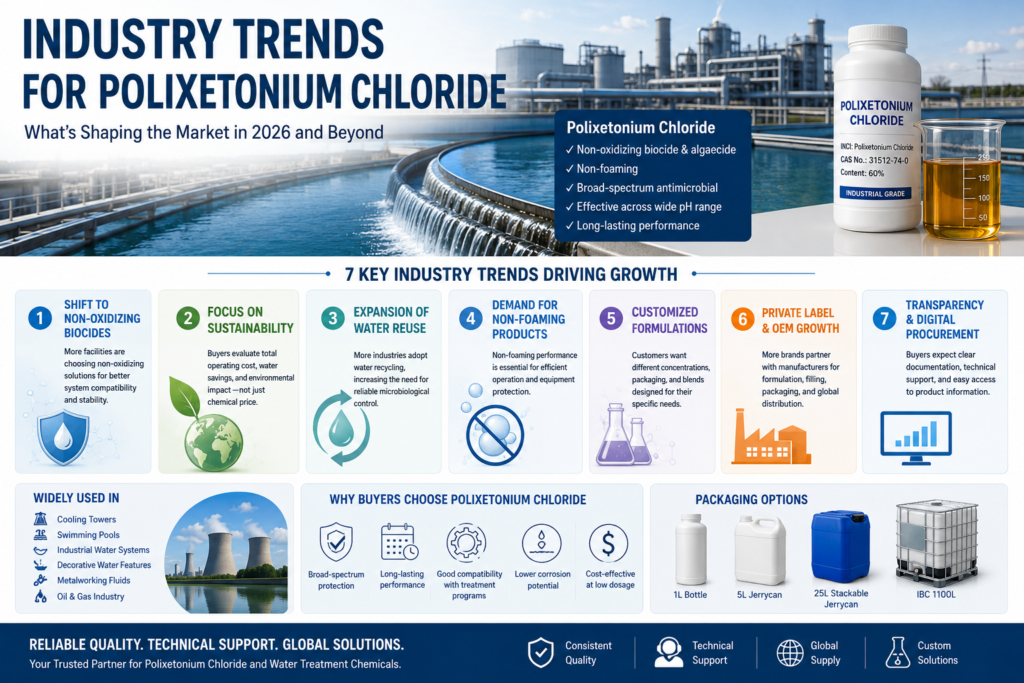
Industrial water treatment isn’t standing still. Rising water costs, stricter environmental regulations, and higher expectations for system reliability are changing how companies select biocides. One product that continues to attract attention is Polixetonium Chloride.
Once known mainly within swimming pool maintenance, Polixetonium Chloride has gradually found wider acceptance in industrial cooling systems, decorative water features, metalworking fluids, and other water-based processes. Buyers aren’t simply searching for a product anymore—they’re searching for longer-lasting protection, fewer operational headaches, and suppliers who can provide technical support alongside stable quality.
So, where is the market heading? Let’s look at the biggest industry trends influencing Polixetonium Chloride.
What Is Polixetonium Chloride?
Polixetonium Chloride is a polymeric quaternary ammonium compound widely used as a non-oxidizing biocide and algaecide. Unlike chlorine or bromine, it controls microorganisms without relying on oxidation.
Its main advantages include:
- Non-foaming performance
- Long-lasting antimicrobial activity
- Broad compatibility with many water treatment programs
- Effective algae control
- Good stability across a wide pH range
- Lower corrosion potential than many oxidizing treatments
Because it is polymeric, it remains active longer than many small-molecule disinfectants, making it particularly attractive for systems that require continuous microbial control.
Why Demand Is Growing Across Industries
Several global changes are pushing demand upward.
Water has become more expensive. Industrial systems are operating with higher cycles of concentration. Cooling towers are running under greater stress, while environmental agencies continue tightening discharge standards.
That means operators need products that work efficiently without creating additional operational problems.
Polixetonium Chloride fits this trend because it combines algae control with broad antimicrobial activity while producing virtually no foam during normal use.
Trend #1 — More Facilities Are Switching to Non-Oxidizing Biocides
Traditional oxidizing biocides still play an important role, but many facilities now use non-oxidizing products as part of an integrated treatment program.
Why?
Because oxidizing products can sometimes:
- Lose effectiveness rapidly
- Increase corrosion risks
- React with organic contaminants
- Require tighter dosage control
Polixetonium Chloride offers a complementary solution that remains effective over longer treatment intervals.
Many operators now alternate oxidizing and non-oxidizing biocides to reduce microbial resistance and improve overall performance.
Trend #2 — Sustainability Is Becoming a Purchasing Factor
A few years ago, purchasing decisions focused almost entirely on price.
That’s changing.
Many industrial buyers now evaluate:
- Chemical consumption
- Equipment life
- Water savings
- Maintenance costs
- Total operating cost
Rather than purchasing the cheapest chemical, companies increasingly calculate the overall economic value.
Because Polixetonium Chloride is effective at relatively low treatment concentrations and has good persistence, it can help reduce treatment frequency in suitable applications.
Trend #3 — Water Reuse Is Expanding Worldwide
Industrial water recycling continues to grow across sectors including:
- Manufacturing
- Power generation
- Mining
- Food processing
- Chemical production
Recycled water often contains higher microbial loads, making biological control more challenging.
This creates opportunities for high-performance non-oxidizing biocides capable of controlling:
- Gram-positive bacteria
- Gram-negative bacteria
- Slime-forming microorganisms
- Many common algae found in industrial water systems
As water reuse becomes more common, reliable microbiological control becomes even more valuable.
Trend #4 — Non-Foaming Products Are Becoming More Important
Nobody enjoys dealing with excessive foam.
Foaming can interfere with:
- Pumps
- Filters
- Sensors
- Water circulation
- Visual inspection
That’s one reason buyers increasingly specify non-foaming performance when evaluating water treatment chemicals.
Polixetonium Chloride naturally aligns with this requirement, making it particularly suitable for recirculating systems where foam would be undesirable.
Trend #5 — Customized Formulations Are Replacing One-Size-Fits-All Products
Not every customer wants exactly the same product.
Today, manufacturers increasingly offer:
- Different active concentrations
- Customized packaging
- Private labeling
- Colored formulations for consumer products
- Application-specific blends
This flexibility allows distributors and brand owners to serve different market segments without developing entirely new chemistries.
OEM manufacturing has become a significant growth area, especially for pool chemical brands.
Trend #6 — Private Label Manufacturing Continues to Grow
Many regional distributors no longer manufacture chemicals themselves.
Instead, they partner with experienced manufacturers that provide:
- Product formulation
- Filling
- Packaging
- Label design
- Regulatory documentation
- Export logistics
Private labeling reduces investment while allowing distributors to build their own brands.
For manufacturers, this has shifted competition away from simply offering low prices toward providing complete solutions.
Trend #7 — Buyers Expect Greater Transparency
Industrial procurement has changed dramatically.
Today’s buyers often request:
- COA
- SDS
- Product specifications
- Batch consistency data
- Manufacturing capability
- Quality management documentation
- Technical support
A supplier’s website is now often the first technical evaluation tool.
Companies that publish detailed product information, educational articles, and application guidance tend to build credibility more quickly than those offering only basic product listings.
Regional Market Trends
North America
Demand remains steady, particularly for swimming pool chemicals, cooling water treatment, and private-label products. Buyers generally emphasize consistent quality, regulatory compliance, and dependable supply.
Europe
European customers increasingly focus on sustainability, product documentation, and long-term supplier partnerships. Stable product performance and transparent quality systems are often key purchasing criteria.
Middle East
Rapid infrastructure development and the widespread use of cooling systems continue to support demand for effective water treatment chemicals capable of performing under challenging operating conditions.
Southeast Asia
Industrial growth, expanding manufacturing capacity, and increasing investment in water management continue to create opportunities for high-performance biocides.
Challenges Facing the Industry
The market also faces several challenges.
Raw material price fluctuations
Chemical feedstock costs continue to vary, affecting production expenses and pricing stability.
Increasing regulatory expectations
Different countries maintain different chemical regulations, requiring manufacturers to prepare appropriate documentation for export markets.
Growing competition
More suppliers have entered the market, making product quality, technical support, and service increasingly important differentiators.
Customer education
Many end users still compare products based solely on price rather than total performance, creating a need for better technical communication.
What Buyers Should Look for in a Polixetonium Chloride Supplier
Choosing the right supplier involves more than comparing prices.
Consider these factors:
- Stable active ingredient consistency
- Reliable manufacturing capacity
- Batch-to-batch quality control
- Technical documentation
- Export experience
- Responsive technical support
- Flexible packaging options
- OEM and private-label capabilities
- Consistent delivery schedules
A dependable supplier helps reduce risk throughout the supply chain.
Future Outlook
The long-term outlook for Polixetonium Chloride appears positive.
Several factors support continued growth:
- Increasing industrial water reuse
- Greater investment in infrastructure
- Rising demand for non-oxidizing antimicrobial technologies
- Expansion of private-label pool chemical brands
- Stronger focus on equipment protection
- Digital procurement and supplier transparency
Rather than replacing every existing biocide, Polixetonium Chloride is likely to remain an important component of integrated water treatment programs where long-lasting microbial control and non-foaming performance are valued.
Conclusion
The Polixetonium Chloride market is evolving alongside broader changes in industrial water treatment. Buyers are placing greater emphasis on reliability, sustainability, operational efficiency, and supplier expertise—not simply on the lowest purchase price.
Manufacturers that combine consistent product quality with strong technical support, flexible packaging, and transparent documentation are well positioned to meet these changing expectations. As industries continue investing in water conservation and more efficient treatment programs, demand for dependable non-oxidizing biocides such as Polixetonium Chloride is expected to remain resilient.
Frequently Asked Questions
1. Why is Polixetonium Chloride becoming more popular?
Its non-foaming performance, long-lasting antimicrobial activity, and compatibility with many industrial water systems make it attractive for both industrial and pool water treatment applications.
2. Is Polixetonium Chloride replacing oxidizing biocides?
Not entirely. Many facilities use it alongside oxidizing biocides as part of an integrated microbial control program, with each product serving a different role.
3. Which industries are driving demand for Polixetonium Chloride?
Major users include industrial water treatment, cooling towers, swimming pool chemicals, decorative water systems, metalworking fluids, and OEM chemical manufacturers.
4. What trends are influencing the Polixetonium Chloride market?
Key trends include water reuse, sustainable treatment programs, increased demand for non-foaming products, private-label manufacturing, and higher expectations for supplier transparency.
5. What should buyers consider when choosing a Polixetonium Chloride manufacturer?
Look for consistent product quality, comprehensive technical documentation, reliable production capacity, export experience, flexible packaging options, and responsive customer support.