
GET IN TOUCH
Ask For Sample?
Why Demand for Polixetonium Chloride Is Growing
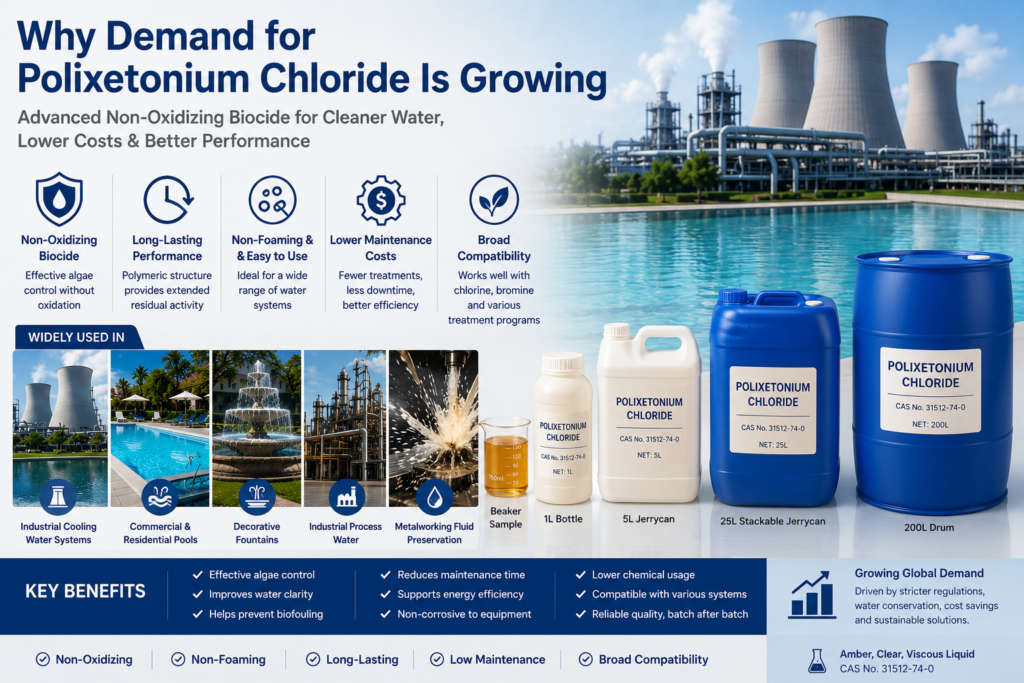
Water treatment has changed a lot over the past decade. Companies aren’t just looking for chemicals that kill algae anymore—they want products that work longer, create fewer operational problems, and help reduce maintenance costs.
That’s exactly why Polixetonium Chloride has been attracting increasing attention around the world.
Whether it’s a commercial swimming pool, an industrial cooling system, or a water reuse facility, many operators are moving away from traditional treatment programs and looking for polymeric alternatives that offer stable, long-lasting performance.
So, what’s driving this growing demand? Let’s take a closer look.
What Is Polixetonium Chloride?
Polixetonium Chloride is a polymeric quaternary ammonium compound widely used as a non-oxidizing biocide and algaecide.
Chemical Name
Poly[oxyethylene(dimethyliminio)ethylene(dimethyliminio)ethylene dichloride]
CAS No.: 31512-74-0
Unlike oxidizing biocides such as chlorine or bromine, Polixetonium Chloride controls algae through a different mechanism. Its positively charged polymer chains attach to negatively charged algal cell surfaces, disrupting cell membrane integrity and ultimately preventing normal cellular activity.
Because it is a polymer rather than a small reactive molecule, it generally remains active in water longer than many conventional oxidizing treatments under normal operating conditions. This longer residual activity is one reason it is widely used in systems that require continuous algae control.
Typical applications include:
- Commercial swimming pools
- Industrial cooling water
- Decorative fountains
- Industrial process water
- Metalworking fluid preservation
- Water storage systems
Why Global Demand Is Increasing
Several market trends are pushing demand upward simultaneously.
1. Stricter Water Quality Regulations
Across many countries, water quality standards continue to become more demanding.
Industrial facilities are expected to reduce biological fouling, improve water efficiency, and maintain stable operating conditions. Poor microbial control can increase energy consumption, reduce heat transfer efficiency, and shorten equipment life.
As operators seek more reliable treatment programs, polymeric biocides have become increasingly attractive.
2. Growing Industrial Water Recycling
Fresh water is becoming more valuable every year.
Many factories now recycle cooling water rather than discharging and replacing it. Recycling saves water, but it also creates ideal conditions for algae growth if biological control isn’t effective.
Polixetonium Chloride helps maintain cleaner recirculating water systems while fitting well into many long-term treatment programs.
3. Expansion of Commercial Swimming Pools
The global pool industry continues to grow.
Hotels, resorts, residential communities, water parks, and sports facilities all require dependable algae control.
Pool operators increasingly prefer products that are:
- Non-foaming
- Compatible with chlorine programs
- Easy to dose
- Long-lasting
- Less likely to contribute metal staining than copper-based algaecides
These characteristics have made Polixetonium Chloride a popular ingredient in premium polymeric algaecide formulations.
4. Preference for Non-Oxidizing Biocides
Many industrial systems cannot rely solely on oxidizing chemicals.
Oxidizing biocides can be consumed rapidly in waters with high organic loads and may require more frequent dosing to maintain effectiveness. In contrast, non-oxidizing biocides provide a different mode of action and are often incorporated into broader microbial control programs.
Rather than replacing every other treatment, Polixetonium Chloride is frequently used alongside compatible water treatment strategies to improve overall biological control.
5. Rising Demand for Long-Lasting Algae Control
Nobody wants to add chemicals every day if they don’t have to.
Maintenance teams appreciate products that continue working between treatment cycles.
Because Polixetonium Chloride acts through adsorption of its polymer chains onto algal cells rather than rapid oxidation, it can provide extended algae control when used correctly.
That translates into:
- Fewer algae outbreaks
- Reduced maintenance
- Cleaner water appearance
- Improved operating efficiency
Industries Driving Market Growth
Demand isn’t coming from just one market. Several industries are contributing.
Swimming Pool Industry
This remains one of the largest markets.
Premium polymeric algaecides based on Polixetonium Chloride help prevent common algae while remaining non-foaming and compatible with routine sanitizer programs.
Industrial Cooling Water
Cooling towers constantly face biological contamination.
Unchecked algae can reduce heat transfer, clog equipment, and increase maintenance costs.
Polixetonium Chloride helps control biological growth, supporting cleaner system operation.
Decorative Fountains
Public fountains often operate continuously under sunlight, making algae growth a persistent challenge.
A long-lasting algaecide helps maintain water clarity while minimizing maintenance frequency.
Industrial Process Water
Many manufacturing processes depend on stable water quality.
Biological fouling can interfere with equipment performance and process consistency.
Using an effective polymeric biocide supports more reliable operation.
Metalworking Fluid Preservation
Although less well known, Polixetonium Chloride has also been used to preserve certain water-based metalworking fluids, particularly formulations based on soluble oils or synthetic fluids that do not contain incompatible anionic surfactants.
By suppressing bacterial growth, it helps extend fluid service life and reduce odor formation. Product compatibility should always be confirmed with the specific formulation before use.
Why More Buyers Are Switching from Traditional Biocides
Every treatment chemical has strengths and limitations.
Here’s how Polixetonium Chloride compares in several common situations.
| Treatment | Main Advantages | Typical Limitations |
|---|---|---|
| Chlorine | Fast disinfection | Short residual, affected by organics |
| Bromine | Effective sanitizer | Higher operating cost in some systems |
| Copper algaecides | Good algae control | May contribute to staining under certain water conditions |
| Polixetonium Chloride | Non-foaming, long-lasting algae control, compatible with many treatment programs | Primarily intended for algae control rather than rapid broad-spectrum disinfection |
Instead of replacing every existing chemical, many facilities use Polixetonium Chloride as part of an integrated water treatment program.
Market Trends Shaping the Future
The market continues to evolve.
Several trends are expected to support demand over the coming years.
Sustainability
Reducing chemical consumption and extending treatment intervals are becoming increasingly important.
Products with longer residual activity align well with these goals.
Lower Operating Costs
Labor is expensive.
Products requiring fewer treatment cycles can help reduce maintenance time and operating costs.
Private Label Opportunities
Many distributors now offer their own branded pool chemicals.
Polixetonium Chloride is widely used as an active ingredient in private-label polymeric algaecide products sold through regional distributors and retailers.
Customized Formulations
Customers increasingly request formulations tailored to their own markets.
Manufacturers that provide flexible packaging, concentration adjustments, and private labeling are well positioned to meet these needs.
How to Choose the Right Supplier
Not all products are manufactured to the same standard.
When evaluating suppliers, pay attention to more than price.
Consider:
- Consistent active ingredient content
- Stable production quality
- Batch-to-batch consistency
- Reliable technical documentation (COA, SDS, TDS)
- Third-party testing when required
- Flexible packaging options (1 L, 5 L, 25 L, 200 L, and 1000 L IBC)
- Technical support for application and formulation
A dependable supplier helps reduce quality risks and supports smoother long-term cooperation.
Conclusion
Demand for Polixetonium Chloride is growing because water treatment priorities are changing.
Industrial operators want dependable biological control with fewer maintenance interruptions. Pool professionals want effective algae prevention without foaming or metal-related staining concerns. Manufacturers and distributors are looking for products that combine reliable performance with flexible formulation and branding options.
Polixetonium Chloride addresses many of these needs, which explains why it continues to gain attention across industrial water treatment and commercial pool markets.
As water conservation, equipment efficiency, and long-term operating costs become even more important, polymeric algaecides like Polixetonium Chloride are likely to remain an important part of modern water treatment programs.
Frequently Asked Questions
1. What is Polixetonium Chloride mainly used for?
Polixetonium Chloride is primarily used as a non-oxidizing polymeric algaecide for swimming pools, cooling water systems, decorative fountains, industrial process water, and certain water-based metalworking fluids.
2. Is Polixetonium Chloride compatible with chlorine?
Yes. It is generally compatible with chlorine and bromine treatment programs and is often used alongside these sanitizers to provide longer-lasting algae control.
3. Does Polixetonium Chloride cause foaming?
No. One of its key advantages is its non-foaming performance, making it suitable for circulating water systems where foam can interfere with operation.
4. Why are more buyers choosing polymeric algaecides?
Many buyers value polymeric algaecides because they provide extended algae control, are easy to apply, work well in routine maintenance programs, and can help reduce the frequency of algae-related problems compared with relying on oxidizing treatments alone.
5. What should I look for when purchasing Polixetonium Chloride?
Look for a supplier that offers consistent active ingredient content, reliable quality control, complete technical documentation, flexible packaging, and knowledgeable technical support. These factors are just as important as price when selecting a long-term supply partner.