
GET IN TOUCH
Ask For Sample?
Why Is Poly(2-hydroxypropyldimethylammonium chloride) Important?
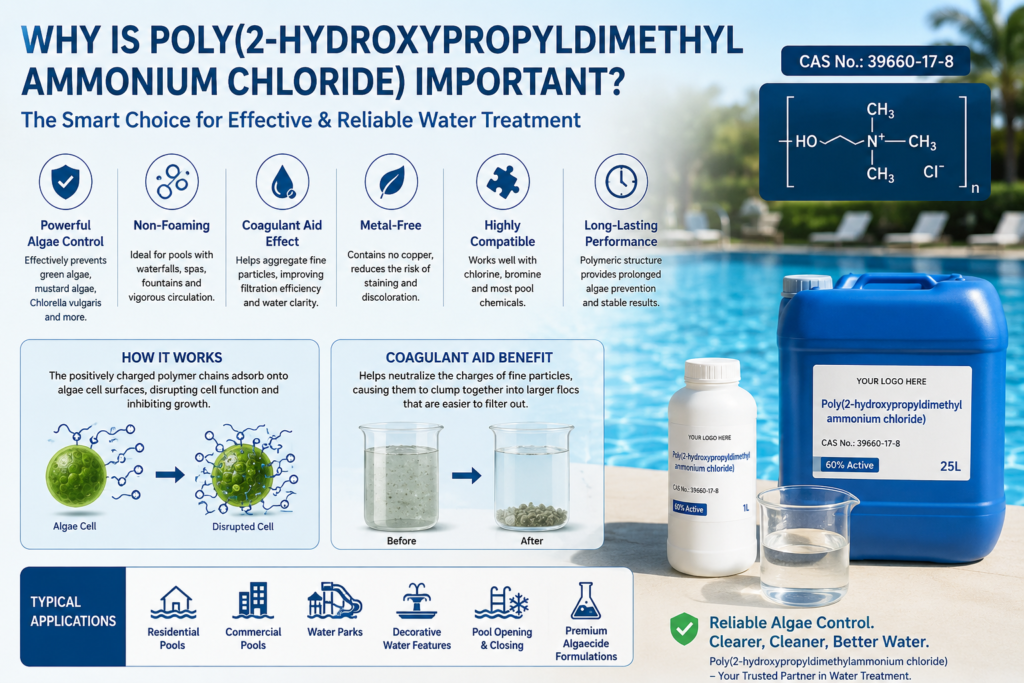
Water treatment has changed dramatically over the past few decades. Today’s systems aren’t just expected to keep water clean—they’re expected to do it efficiently, safely, and with fewer side effects.
That’s exactly where Poly(2-hydroxypropyldimethylammonium chloride) comes in.
Known in the pool industry as one of the most effective polymeric algaecides, this cationic polymer helps control algae without many of the limitations associated with traditional chemicals. Beyond algae prevention, it also provides a valuable coagulant aid effect, helping suspended particles aggregate more easily so filtration systems can remove them more efficiently.
Whether you’re maintaining a residential swimming pool or formulating professional water treatment products, understanding why this polymer matters can help you make better decisions.
What Is Poly(2-hydroxypropyldimethylammonium chloride)?
Poly(2-hydroxypropyldimethylammonium chloride) is a water-soluble cationic polymer produced by polymerizing quaternary ammonium monomers.
Its positively charged polymer chains naturally interact with negatively charged microorganisms and suspended particles in water.
Unlike oxidizing chemicals that destroy microorganisms through chemical oxidation, this polymer works through surface interaction. It adsorbs onto algal cell surfaces, disrupts normal membrane functions, and inhibits further growth.
Because it is already permanently quaternized, its performance remains relatively stable over the normal pH range encountered in swimming pools.
Why Has It Become So Important?
The answer is simple.
Pool owners and water treatment professionals increasingly want products that are:
- Effective
- Easy to use
- Compatible with existing sanitizer programs
- Less likely to cause unwanted side effects
Poly(2-hydroxypropyldimethylammonium chloride) meets all of these expectations.
Instead of replacing chlorine or bromine, it complements them by providing long-lasting algae prevention while helping maintain water clarity.
That combination has made it one of the preferred active ingredients in many premium polymeric algaecide formulations.
1. Excellent Algae Prevention Without Foaming
One of its biggest strengths is reliable algae control.
It performs well against many common swimming pool algae, including:
- Green algae
- Mustard algae
- Chlorella vulgaris
- Scenedesmus subspicatus (a freshwater green microalga commonly used in laboratory testing)
Unlike some surfactant-based products, properly formulated Poly(2-hydroxypropyldimethylammonium chloride) is non-foaming, even in pools with waterfalls, spas, fountains, or vigorous circulation.
That makes it particularly attractive for premium pool maintenance products.
2. Works Together with Chlorine Instead of Replacing It
A common misconception is that polymeric algaecides replace chlorine.
They don’t.
Instead, they provide an additional protective layer.
Chlorine remains the primary sanitizer responsible for disinfecting bacteria and viruses.
Poly(2-hydroxypropyldimethylammonium chloride) focuses mainly on preventing algae from becoming established, allowing chlorine to work more efficiently under normal operating conditions.
This complementary approach often results in more stable pool water and reduced algae outbreaks
3. Helps Improve Water Clarity Through a Coagulant Aid Effect
Here’s something many people overlook.
Although its primary function is algae control, Poly(2-hydroxypropyldimethylammonium chloride) also provides a useful coagulant aid effect.
Its cationic polymer chains can help neutralize the surface charges of fine suspended particles. As these tiny particles begin to aggregate into larger flocs, they become easier for the pool’s filtration system to capture.
This means the product:
- Supports clearer water
- Improves filtration efficiency
- Helps remove fine suspended matter
It’s important to note that this does not make it a dedicated pool clarifier. Instead, the clarification benefit is a valuable secondary advantage that accompanies its primary role as a polymeric algaecide.
4. Metal-Free Algae Control
Many traditional algaecides rely on copper compounds.
Copper can be highly effective, but excessive metal concentrations may increase the risk of staining or discoloration under certain pool conditions.
Poly(2-hydroxypropyldimethylammonium chloride) contains no copper, making it an attractive option for pool owners seeking effective algae prevention without introducing additional metal ions into the water.
5. Compatible with Routine Pool Maintenance
Another reason this polymer has become so popular is its compatibility.
It generally works well alongside:
- Chlorine programs
- Bromine systems
- Most routine pool maintenance chemicals
When used according to the manufacturer’s recommendations, it integrates easily into regular maintenance schedules without requiring major changes to existing water treatment practices.
6. Suitable for Both Residential and Commercial Pools
Its versatility is another key advantage.
You’ll commonly find it in products intended for:
- Residential swimming pools
- Hotels
- Resorts
- Apartment pools
- Community pools
- School pools
- Commercial aquatic facilities
Manufacturers also appreciate its compatibility with private-label formulations, making it a popular active ingredient in premium pool chemical product lines.
7. Supports More Consistent Water Quality
Clear water isn’t achieved by one chemical alone.
It depends on maintaining the right balance between sanitization, filtration, circulation, and preventive maintenance.
Poly(2-hydroxypropyldimethylammonium chloride) contributes by helping prevent algae before it becomes visible while also assisting the filtration process through its coagulant aid effect.
The result is water that is easier to keep clean over time, especially when used as part of a well-managed maintenance program.
Typical Applications
The most common uses include:
- Residential swimming pools
- Commercial swimming pools
- Pool opening after winter
- Seasonal preventive maintenance
- Premium polymeric algaecide formulations
- Private-label pool chemicals
Because it is supplied as a concentrated liquid, manufacturers can formulate products with different active concentrations to suit various market requirements.
How to Choose a High-Quality Product
Not every product performs the same.
When comparing suppliers, pay attention to:
Active ingredient content
Some manufacturers specify active ingredient content, while others refer to total solids. These are not the same measurement, and confusing the two can lead to inaccurate product comparisons.
Appearance
A high-quality product is typically a clear, colorless to light-yellow liquid without visible impurities.
Viscosity
Viscosity often reflects the polymer’s molecular weight. Consistent viscosity from batch to batch usually indicates good manufacturing control and helps deliver stable performance.
Compatibility
The product should remain stable when incorporated into common swimming pool formulations.
Manufacturing quality
Reliable suppliers provide consistent production, documented quality control, and complete technical documentation such as COA, SDS, and technical data sheets.
Final Thoughts
Poly(2-hydroxypropyldimethylammonium chloride) has become an important ingredient in modern swimming pool water treatment because it offers a combination that is difficult to match.
Its primary strength is dependable, non-foaming algae prevention. At the same time, its cationic polymer structure provides a useful coagulant aid effect, helping filtration systems remove fine suspended particles more efficiently.
Add its metal-free composition, compatibility with standard sanitizer programs, and suitability for a wide range of pool applications, and it’s easy to see why manufacturers around the world continue to rely on this polymer in premium algaecide formulations.
For pool professionals, distributors, and private-label brands, it remains one of the most practical and well-established polymeric algaecide technologies available.
Frequently Asked Questions
1. What is the primary function of Poly(2-hydroxypropyldimethylammonium chloride)?
Its primary function is to act as a polymeric algaecide, helping prevent algae growth in swimming pools while remaining non-foaming and compatible with common sanitizer programs.
2. Is Poly(2-hydroxypropyldimethylammonium chloride a pool clarifier?
Not primarily. Its main role is algae control. However, because it is a cationic polymer, it also acts as a coagulant aid, which can improve filtration efficiency and contribute to clearer water.
3. Does it contain copper?
No. Poly(2-hydroxypropyldimethylammonium chloride is a metal-free polymeric algaecide and does not introduce copper ions into pool water.
4. Can it replace chlorine?
No. It is designed to complement chlorine or bromine, not replace them. Chlorine remains the primary disinfectant, while the polymer helps prevent algae growth.
5. Why is viscosity important when selecting Poly(2-hydroxypropyldimethylammonium chloride?
Viscosity is often related to the polymer’s molecular weight. Consistent viscosity between production batches is a good indicator of stable manufacturing quality and consistent application performance.