
GET IN TOUCH
Ask For Sample?
Understanding Polixetonium Chloride Technology: The Science Behind a Powerful Non-Oxidizing Biocide
Water systems rarely fail overnight.
More often, the trouble starts quietly. A thin layer of slime appears inside a cooling tower. Algae begin growing around the edges of a swimming pool. Bacteria settle onto pipe walls, creating biofilms that become harder and harder to remove.
Once that happens, water quality drops, equipment efficiency declines, and maintenance costs begin climbing.
That’s exactly why Polixetonium Chloride has become an important technology across industrial water treatment and specialty pool chemicals. Unlike oxidizing disinfectants that work through aggressive chemical reactions, this polymeric biocide controls microorganisms through a completely different mechanism.
So, what makes it different?
Let’s explain the science in plain English.
What Is Polixetonium Chloride?
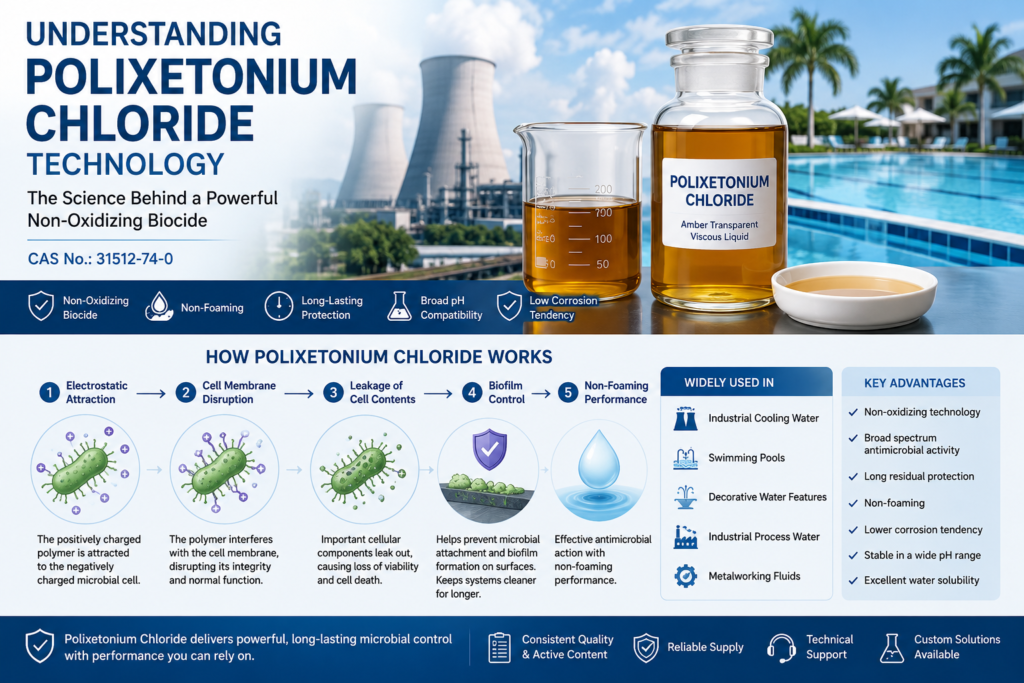
Polixetonium Chloride is a polymeric quaternary ammonium compound (polyquat) used primarily as a non-oxidizing biocide and algaecide.
Typical properties include:
- CAS No.: 31512-74-0
- Amber transparent viscous liquid
- Water soluble
- Non-foaming
- Broad pH compatibility
- Long-lasting antimicrobial activity
Because it is polymeric rather than a small-molecule disinfectant, it behaves very differently from chlorine, bromine, ozone, or peroxide-based products.
Instead of rapidly oxidizing contaminants, it attaches directly to microbial cells and disrupts their normal functions.
That difference may sound subtle—but it changes everything.
Why Was This Technology Developed?
Traditional oxidizing biocides are highly effective, but they also have limitations.
They can:
- Break down quickly
- Lose effectiveness in high organic loads
- Increase corrosion risks
- Produce unwanted reaction by-products
- Require frequent dosing
Industrial water systems often need something more stable.
Polixetonium Chloride was developed to provide:
- Longer residual activity
- Better material compatibility
- Lower foaming
- Reduced equipment stress
- Continuous microbial control
Rather than replacing oxidizing biocides entirely, it is often used as part of a complete water treatment program.
The Chemistry Behind Polixetonium Chloride
Without getting too deep into polymer chemistry, here’s the basic idea.
Polixetonium Chloride is made up of repeating positively charged quaternary ammonium units connected into long polymer chains.
That positive charge is the key.
Most microorganisms—including bacteria, algae, and many fungi—carry negatively charged cell surfaces.
Opposite charges attract.
When Polixetonium Chloride enters the water, the polymer naturally moves toward microbial cells.
This attraction is the first step in its antimicrobial action.
Think of it like a magnet finding metal.
How Does Polixetonium Chloride Work?
The technology works through several complementary mechanisms.
1. Electrostatic Attraction
The positively charged polymer is attracted to negatively charged microbial membranes.
This concentrates the active ingredient exactly where it’s needed.
Instead of reacting randomly throughout the water, much of the activity occurs directly on microbial surfaces.
2. Cell Membrane Disruption
After attachment, the polymer interferes with the integrity of the cell membrane.
The membrane begins losing its ability to regulate:
- Water transport
- Nutrient movement
- Waste removal
Eventually, the cell can no longer maintain normal biological functions.
3. Leakage of Cellular Contents
As membrane damage increases, important intracellular components begin leaking out.
Without proper membrane control, microorganisms lose viability and eventually die.
This process is effective against many:
- Gram-positive bacteria
- Gram-negative bacteria
- Slime-forming microorganisms
- Algae
- Certain fungi
The exact susceptibility depends on the organism and treatment conditions.
4. Biofilm Control
One of the biggest challenges in industrial water systems is biofilm.
Biofilms protect microorganisms from many disinfectants.
Polixetonium Chloride helps limit biofilm development by preventing microbial populations from establishing stable colonies on surfaces.
Less biofilm means:
- Better heat transfer
- Cleaner pipes
- Lower maintenance costs
- Improved water circulation
Why Doesn’t It Foam?
Many surfactant-based chemicals create excessive foam.
Polixetonium Chloride is different.
Its polymer design allows excellent antimicrobial performance while remaining non-foaming, making it suitable for systems where foam would interfere with operation.
This characteristic is particularly valuable in:
- Cooling towers
- Industrial circulation systems
- Water treatment equipment
- Swimming pool applications
Advantages Over Traditional Biocides
Every biocide has strengths and limitations.
Polixetonium Chloride stands out in several important ways.
| Feature | Polixetonium Chloride |
|---|---|
| Technology | Polymeric quaternary ammonium |
| Oxidizing? | No |
| Foaming | Non-foaming |
| Residual activity | Long-lasting |
| Corrosion tendency | Generally lower than strong oxidizers |
| Water solubility | Excellent |
| Broad pH performance | Yes |
Its stability often allows longer intervals between treatments compared with rapidly consumed oxidizing products.
Common Applications
One of the reasons this technology remains popular is its versatility.
Industrial Cooling Water
Cooling towers provide ideal conditions for microbial growth.
Polixetonium Chloride helps control:
- Slime
- Bacteria
- Algae
- Biofilm formation
Swimming Pools
Professional pool maintenance programs often use polymeric algaecides because they:
- Help prevent algae growth
- Produce little or no foam
- Work alongside chlorine-based sanitizers
- Remain active for extended periods
Decorative Water Features
Fountains and ornamental ponds benefit from improved algae control while maintaining water clarity.
Industrial Process Water
Many manufacturing facilities use Polixetonium Chloride to reduce microbial contamination that could affect production efficiency or equipment cleanliness.
Metalworking Fluids
Microbial contamination can shorten fluid life and create unpleasant odors.
Adding an appropriate biocide program helps extend service life and improve fluid stability.
Factors That Affect Performance
Even excellent chemistry depends on proper application.
Performance may vary based on:
Water Temperature
Higher temperatures generally increase microbial activity, which may influence treatment frequency.
Organic Load
Heavy contamination can consume active ingredients more quickly.
Pre-cleaning heavily contaminated systems often improves results.
Water Chemistry
Hardness, suspended solids, and other treatment chemicals can influence overall system performance.
Compatibility testing is always recommended.
Dosage
Too little product may not provide adequate microbial control.
Too much increases treatment cost without necessarily improving performance.
Following supplier recommendations is important.
Is Polixetonium Chloride Compatible with Other Water Treatment Chemicals?
In many systems, yes.
It is commonly incorporated into treatment programs that may also include:
- Scale inhibitors
- Corrosion inhibitors
- Flocculants
- Dispersants
Compatibility should always be verified before mixing concentrated products directly.
A complete treatment program should be designed around the specific water chemistry and operating conditions.
Storage and Handling
Polixetonium Chloride is typically supplied as an amber transparent viscous liquid.
Good storage practices include:
- Keep containers tightly closed.
- Store in original containers.
- Follow local chemical handling regulations.
- Wear appropriate personal protective equipment during handling.
Always consult the product’s Safety Data Sheet (SDS) before use.
How to Choose a Quality Supplier
Not all products are manufactured to the same standards.
When evaluating suppliers, consider:
- Consistent active content
- Stable viscosity
- Reliable quality control
- Batch-to-batch consistency
- Complete technical documentation
- COA and SDS availability
- Private label capability if required
- Responsive technical support
For industrial buyers, supply consistency is often just as important as price.·
Final Thoughts
Polixetonium Chloride technology offers a smart alternative to conventional oxidizing biocides by combining polymer chemistry with long-lasting antimicrobial performance.
Its positively charged polymer structure enables targeted interaction with microorganisms, helping control bacteria, algae, and biofilm while remaining non-foaming and broadly compatible with many water treatment programs.
Whether used in industrial cooling systems, process water, decorative fountains, or swimming pools, the technology has earned its place because it balances effectiveness, operational stability, and ease of use.
As water treatment systems become more demanding, polymeric biocides like Polixetonium Chloride continue to provide practical solutions for maintaining cleaner, more reliable water systems.
Frequently Asked Questions
1. What is Polixetonium Chloride used for?
Polixetonium Chloride is primarily used as a non-oxidizing biocide for controlling algae, bacteria, slime, and biofilm in industrial water systems, cooling towers, swimming pools, and other water treatment applications.
2. Is Polixetonium Chloride an oxidizing biocide?
No. It is a non-oxidizing polymeric quaternary ammonium biocide that controls microorganisms by interacting with their cell membranes rather than through oxidation.
3. Why is Polixetonium Chloride considered non-foaming?
Its polymeric molecular structure provides effective antimicrobial activity without generating significant foam, making it well suited for recirculating water systems.
4. Can Polixetonium Chloride be used with chlorine?
Yes. It is commonly used alongside chlorine-based pool sanitation or industrial water treatment programs. The exact treatment strategy should be determined based on system requirements and compatibility testing.
5. What should buyers look for when purchasing Polixetonium Chloride?
Key factors include active ingredient consistency, product stability, technical documentation, manufacturing quality, reliable supply, and technical support. Choosing an experienced manufacturer helps ensure consistent performance across batches.