
GET IN TOUCH
Ask For Sample?
Top 5 Advantages of Poly(2-hydroxypropyldimethylammonium Chloride)
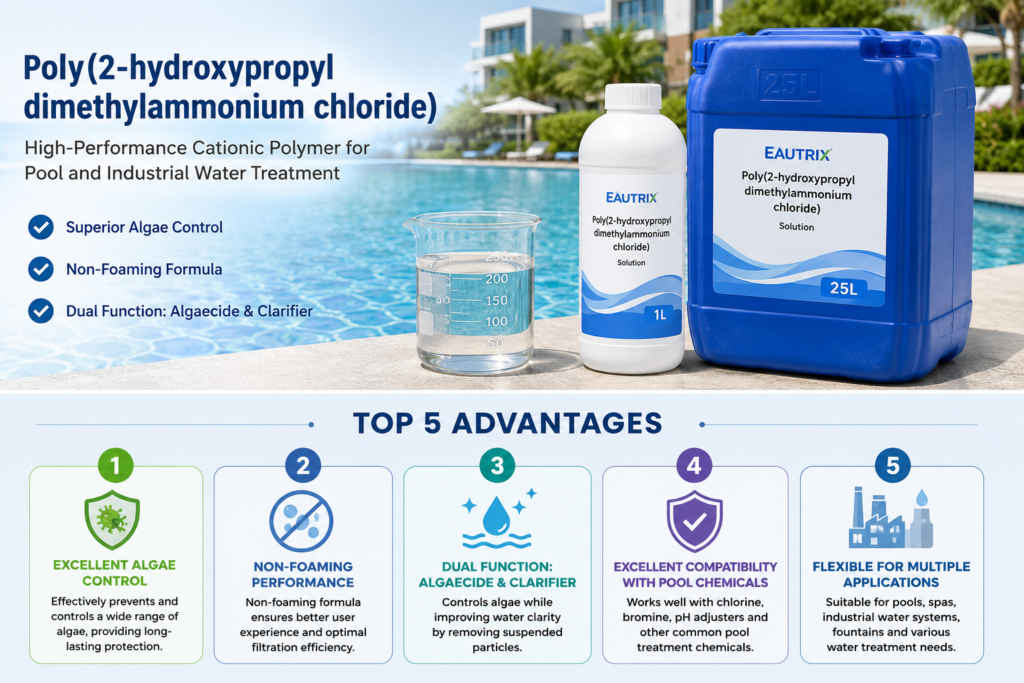
When it comes to modern water treatment chemicals, not every product manages to balance effectiveness, safety, and ease of use. Poly(2-hydroxypropyldimethylammonium chloride) is one of the few that does exactly that.
Whether you’re manufacturing specialty pool chemicals, developing water treatment formulations, or searching for a reliable non-metallic algaecide ingredient, this cationic polymer has earned its reputation for good reason.
Unlike traditional oxidizing biocides, it provides long-lasting algae prevention without adding metals to the water or creating excessive foam. Even better, many formulations can improve water clarity at the same time.
So, what makes this polymer stand out from other water treatment chemicals?
Let’s look at its five biggest advantages.
What Is Poly(2-hydroxypropyldimethylammonium Chloride)?
Poly(2-hydroxypropyldimethylammonium chloride), a kind of Polyquat, is a water-soluble cationic polymer widely used in swimming pools, spas, industrial water systems, and specialty water treatment products.
Its positively charged polymer chains interact with negatively charged algae cells, disrupting their cell membranes and preventing further growth. Because it works through physical interaction rather than oxidation, it remains effective over a relatively long period.
Depending on the application, manufacturers typically supply it as aqueous solutions with different active concentrations, such as 10%, 30%, 50% or 60%.
Why This Polymer Has Become So Popular
Water treatment professionals are constantly looking for products that work well without creating additional maintenance problems.
That’s exactly where Poly(2-hydroxypropyldimethylammonium chloride) shines.
Instead of relying on harsh oxidation, it offers stable algae prevention while remaining compatible with most common water treatment programs.
Even better? It often reduces the amount of additional chemicals needed to maintain clear water.
Top 5 Advantages of Poly(2-hydroxypropyldimethylammonium Chloride)
1. Excellent Long-Lasting Algae Control
Its primary advantage is highly effective algae prevention.
The positively charged polymer adsorbs onto algae cells, damaging their protective membranes and stopping reproduction before algae blooms become visible.
This provides protection against many common algae species, including:
- Green algae
- Mustard algae
- Black algae (preventive control)
- Suspended microscopic algae
Because the polymer remains in the water for an extended period, protection lasts significantly longer than many fast-acting oxidizing treatments.
For pool owners, that means fewer algae outbreaks and more consistent water quality.
2. Non-Foaming Performance
Nobody wants a swimming pool filled with foam.
Fortunately, Poly(2-hydroxypropyldimethylammonium chloride) is well known for its non-foaming characteristics.
This makes it particularly suitable for:
- Residential swimming pools
- Commercial pools
- Hotel pools
- Water parks
- Decorative fountains
- Spa systems
Low foam improves both user experience and filtration efficiency, especially in high-circulation systems.
3. Dual Function: Algaecide and Water Clarifier
Here’s something many users don’t realize.
Besides controlling algae, this polymer also contributes to clearer water.
As a cationic polymer, it neutralizes negatively charged fine particles suspended in water.
Those tiny particles begin forming larger flocs, making them easier for filters to remove.
The result?
- Improved water clarity
- Lower turbidity
- Better filter performance
- Reduced cloudiness
That’s why many premium pool formulations combine algae prevention with enhanced water polishing using the same active ingredient.
4. Excellent Compatibility with Other Pool Chemicals
One major concern when selecting specialty chemicals is compatibility.
Poly(2-hydroxypropyldimethylammonium chloride) performs well alongside many common pool treatment products, including:
- Chlorine sanitizers
- Bromine systems
- pH adjusters
- Pool clarifiers
- Scale inhibitors
- Water balancing chemicals
This compatibility allows distributors and formulators to integrate it into existing maintenance programs without redesigning the entire treatment process.
For private-label manufacturers, that’s a huge advantage.
5. Flexible for Multiple Water Treatment Applications
Although it’s widely recognized as a pool algaecide ingredient, its usefulness goes well beyond swimming pools.
Its stability, water solubility, and cationic charge make it valuable across many industries.
Common applications include:
- Swimming pool chemicals
- Industrial cooling water
- Decorative fountains
- Aquatic facilities
- Water recycling systems
- Industrial process water
- Specialty water treatment formulations
Its versatility also makes it attractive for OEM and private-label chemical manufacturers developing customized formulations.
Typical Industries That Benefit from This Polymer
Because of its versatility, Poly(2-hydroxypropyldimethylammonium chloride) serves customers across several industries.
These include:
- Swimming pool chemical manufacturers
- Private-label pool chemical brands
- Water treatment chemical suppliers
- Industrial water treatment companies
- Commercial pool service providers
- Resort and hotel maintenance companies
- Water park operators
- Chemical distributors
Many manufacturers also formulate seasonal maintenance products, including winter algaecides and long-lasting preventative treatments, using this polymer.
How to Choose a Reliable Supplier
Not all products offer the same level of consistency.
When selecting a supplier, consider several important factors.
Consistent Active Content
Reliable manufacturers maintain stable polymer concentration with minimal batch-to-batch variation.
High Product Clarity
A clear, homogeneous solution usually reflects better production control and filtration.
Stable Viscosity
Consistent viscosity improves filling, blending, transportation, and end-user dosing.
Technical Documentation
Professional suppliers should provide:
- Certificate of Analysis (COA)
- Safety Data Sheet (SDS/MSDS)
- Technical Data Sheet (TDS)
- Recommended application guidelines
Flexible Packaging
Look for suppliers offering multiple packaging options, including:
- 1 L bottles
- 5 L containers
- 25 L drums
- 200 L drums
- 1000 L IBC totes
Private labeling and custom packaging are also valuable if you’re building your own brand.
Conclusion
Poly(2-hydroxypropyldimethylammonium chloride) continues to gain popularity because it combines several important benefits in a single ingredient.
It delivers reliable algae control, remains non-foaming, improves water clarity, works well with existing treatment programs, and adapts to a wide variety of industrial and recreational water systems.
For manufacturers, distributors, and water treatment professionals, those advantages translate into simpler formulations, improved customer satisfaction, and dependable long-term performance.
If you’re searching for a versatile cationic polymer for pool chemicals or industrial water treatment, Poly(2-hydroxypropyldimethylammonium chloride) is certainly worth considering.
Frequently Asked Questions
1. What is Poly(2-hydroxypropyldimethylammonium chloride) mainly used for?
It is primarily used as a polymeric algaecide and water treatment chemical for swimming pools, spas, industrial cooling systems, decorative fountains, and specialty water treatment formulations.
2. Is Poly(2-hydroxypropyldimethylammonium chloride safe for swimming pools?
When used according to the manufacturer’s recommended dosage, it is widely used in pool maintenance because it provides effective algae prevention without introducing metal ions or excessive foam.
3. Can Poly(2-hydroxypropyldimethylammonium chloride replace chlorine?
No. It is an algaecide rather than a primary sanitizer. It is typically used alongside chlorine or bromine to improve algae prevention and extend overall water quality.
4. Why is Poly(2-hydroxypropyldimethylammonium chloride considered a dual-function polymer?
Besides inhibiting algae growth, its cationic polymer structure helps aggregate fine suspended particles, improving filtration efficiency and enhancing water clarity.
5. What should buyers look for when sourcing Poly(2-hydroxypropyldimethylammonium chloride?
Choose a supplier that offers consistent active content, stable viscosity, clear appearance, comprehensive technical documentation (COA, SDS, and TDS), quality control, and flexible packaging or private-label manufacturing options.