GET IN TOUCH
Ask For Sample?
Why Is Polixetonium Chloride Used in So Many Industries?
When people hear the name Polixetonium Chloride, they often think of swimming pool chemicals. That’s understandable—it’s one of the most recognized non-oxidizing algaecides available.
But here’s the interesting part: its value extends far beyond pools.
Because it combines broad-spectrum antimicrobial activity with excellent material compatibility and low foaming characteristics, Polixetonium Chloride has become a preferred solution for controlling algae, bacteria, and biofilm in many industrial water systems.
Whether you’re maintaining a cooling tower, protecting metalworking fluids, or treating decorative fountains, chances are this polymer can help.
Let’s look at where it’s most commonly used—and why.
What Is Polixetonium Chloride?
Polixetonium Chloride is a polymeric quaternary ammonium compound that functions as a non-oxidizing biocide. Unlike chlorine or bromine, it destroys microorganisms without relying on oxidation.
Typical characteristics include:
- Broad-spectrum antimicrobial activity
- Effective algae prevention
- Non-foaming
- Non-staining
- Compatible with chlorine programs
- Stable over a wide pH range
- Long residual activity
These properties make it attractive wherever continuous microbial control is needed.
Why Industries Prefer Polixetonium Chloride
Every water system has one common enemy: biofilm.
Once microorganisms attach to surfaces, they create protective layers that reduce heat transfer, clog filters, increase corrosion, and shorten equipment life.
Polixetonium Chloride helps by:
- Preventing algae growth
- Disrupting bacterial cell membranes
- Limiting biofilm formation
- Remaining active longer than many conventional disinfectants
The result?
Cleaner systems, lower maintenance costs, and more stable operation.
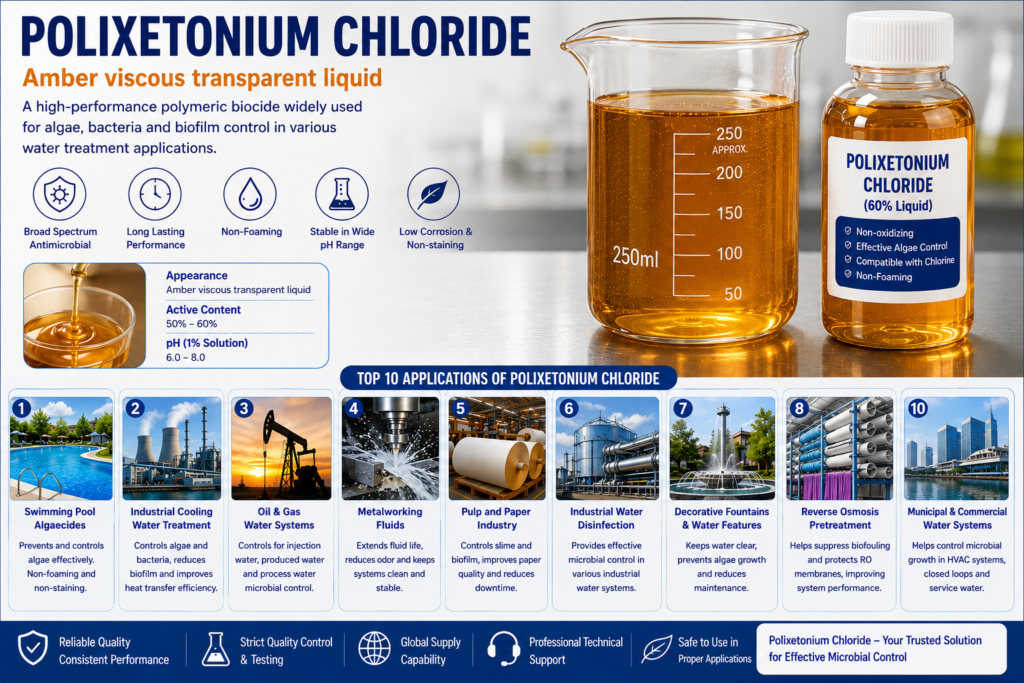
Top 10 Applications of Polixetonium Chloride
1. Swimming Pool Algaecides
This is by far the most familiar application.
Professional pool operators appreciate Polixetonium Chloride because it:
- Prevents green algae
- Controls black algae
- Suppresses mustard algae
- Produces little or no foam
- Does not contain copper
- Won’t stain plaster or vinyl surfaces
Unlike copper-based algaecides, it also avoids metal staining.
For commercial pools, residential pools, and water parks, it is often used as a maintenance algaecide throughout the swimming season.
2. Industrial Cooling Water Treatment
Cooling towers provide perfect conditions for microorganisms:
- Warm temperatures
- Constant moisture
- Plenty of nutrients
Without proper treatment, algae and bacteria quickly develop into biofilms.
Polixetonium Chloride helps:
- Reduce microbial fouling
- Improve heat transfer efficiency
- Lower maintenance frequency
- Extend equipment life
It is frequently incorporated into industrial cooling water treatment programs alongside oxidizing biocides.
3. Oil & Gas Water Systems
Produced water and injection water often contain significant microbial contamination.
Unchecked microbial growth can lead to:
- Pipeline fouling
- Biofilm accumulation
- Reduced production efficiency
- Increased maintenance costs
Polixetonium Chloride is suitable for:
- Injection water
- Produced water
- Storage tanks
- Process water systems
Its polymeric structure provides sustained antimicrobial performance under demanding operating conditions.
4. Metalworking Fluids
Metalworking fluids are particularly vulnerable to bacterial contamination.
When microbes multiply, operators notice:
- Unpleasant odors
- Reduced coolant life
- Lower machining performance
- Worker discomfort
Adding Polixetonium Chloride helps:
- Extend fluid service life
- Reduce odor formation
- Maintain microbial balance
- Improve system cleanliness
Many formulators include polymeric biocides as part of comprehensive coolant preservation programs.
5. Pulp and Paper Industry
Paper mills continuously recycle large volumes of process water.
Unfortunately, recycled water encourages:
- Slime formation
- Biofilm growth
- Production interruptions
- Product quality defects
Polixetonium Chloride assists by controlling microbial populations throughout the wet end of the papermaking process.
Benefits include:
- Cleaner machinery
- Fewer shutdowns
- Improved paper quality
- Better operational stability
6. Industrial Water Disinfection
Many manufacturing plants require ongoing microbial control in process water.
Examples include:
- Chemical manufacturing
- Food equipment cleaning systems
- Industrial washing systems
- Utility water circuits
Because Polixetonium Chloride remains effective over a broad pH range, it fits many industrial treatment programs.
Its low corrosiveness is another significant advantage compared with highly oxidizing chemicals.
7. Decorative Fountains and Water Features
Anyone who manages decorative fountains knows how quickly algae can appear.
Green water doesn’t just look unpleasant—it can clog pumps and filters as well.
Polixetonium Chloride helps maintain:
- Clear water
- Cleaner surfaces
- Better water circulation
- Reduced maintenance
It’s commonly used in:
- Hotel fountains
- Commercial landscapes
- Public parks
- Artificial lakes
- Water displays
8. Reverse Osmosis (RO) Pretreatment
Reverse osmosis membranes are extremely sensitive to biological fouling.
Even thin biofilms can reduce:
- Water flux
- Membrane efficiency
- Operating lifespan
In certain pretreatment programs, Polixetonium Chloride can help suppress microbial growth upstream of membrane systems, reducing biofouling pressure and improving overall system performance. Compatibility with specific membrane materials and operating conditions should always be verified before use.
9. Textile Processing Water
Textile plants consume enormous volumes of water during:
- Dyeing
- Washing
- Finishing
- Cooling
Microbial contamination may lead to:
- Odor problems
- Equipment fouling
- Product quality issues
Polixetonium Chloride supports cleaner water circulation while helping maintain stable production conditions.
10. Municipal and Commercial Water Systems
Commercial buildings often operate closed-loop water systems where microbial growth gradually becomes a concern.
Examples include:
- HVAC water systems
- Closed circulation loops
- Service water tanks
- Auxiliary water storage
Within appropriate treatment programs and where local regulations permit, Polixetonium Chloride can contribute to microbial control and help reduce biofilm formation, supporting cleaner system operation and lower maintenance requirements.
How to Choose the Right Grade of Polixetonium Chloride
Not every application requires the same formulation.
Manufacturers typically offer:
| Application | Recommended Concentration |
|---|---|
| Pool algaecides | 60% concentrate |
| Industrial water treatment | 50–60% |
| Custom formulations | 10–60% |
| Private label products | Customized |
When selecting a supplier, consider:
- Active content
- Molecular weight consistency
- Regulatory compliance for your target market
- Packaging options
- Technical support
- Private-label capabilities
Working with an experienced manufacturer can simplify product selection and formulation.
Final Thoughts
One reason Polixetonium Chloride has remained popular for decades is its versatility. Rather than serving a single niche, it performs reliably across a wide range of water treatment applications—from keeping swimming pools clear to helping industrial facilities manage biofouling.
That said, no single biocide is ideal for every situation. Factors such as water chemistry, target microorganisms, system design, and local regulations all influence product selection. Evaluating these variables carefully—and consulting experienced technical support when needed—can help ensure effective and compliant treatment.
As industries continue to seek efficient, long-lasting, and low-foaming microbial control solutions, Polixetonium Chloride is likely to remain an important option in many water treatment programs.
Frequently Asked Questions
1. What is Polixetonium Chloride mainly used for?
Its primary applications include swimming pool algaecides, industrial cooling water treatment, metalworking fluids, decorative fountains, and various industrial water systems where algae, bacteria, and biofilm control are required.
2. Is Polixetonium Chloride the same as chlorine?
No. Polixetonium Chloride is a non-oxidizing polymeric biocide, while chlorine is an oxidizing disinfectant. They work through different mechanisms and are often used together in complementary treatment programs.
3. Can Polixetonium Chloride prevent biofilm?
Yes. It helps suppress microbial growth and reduce biofilm formation, making it valuable in cooling towers, process water systems, and other industrial applications. Complete biofilm control typically requires a comprehensive water treatment program.
4. Is Polixetonium Chloride suitable for private-label pool chemicals?
Yes. Many manufacturers supply it as a concentrated raw material for formulating and packaging private-label pool algaecides under customers’ own brands.
5. What concentration of Polixetonium Chloride is commonly sold?
Commercial products are often available as 50% or 60% aqueous solutions, although lower concentrations (such as 10%) may also be supplied for ready-to-use formulations or customized applications.
2 comments on “Top 10 Applications of Polixetonium Chloride”
Comments are closed.