
GET IN TOUCH
Ask For Sample?
How Does Polixetonium Chloride Work?
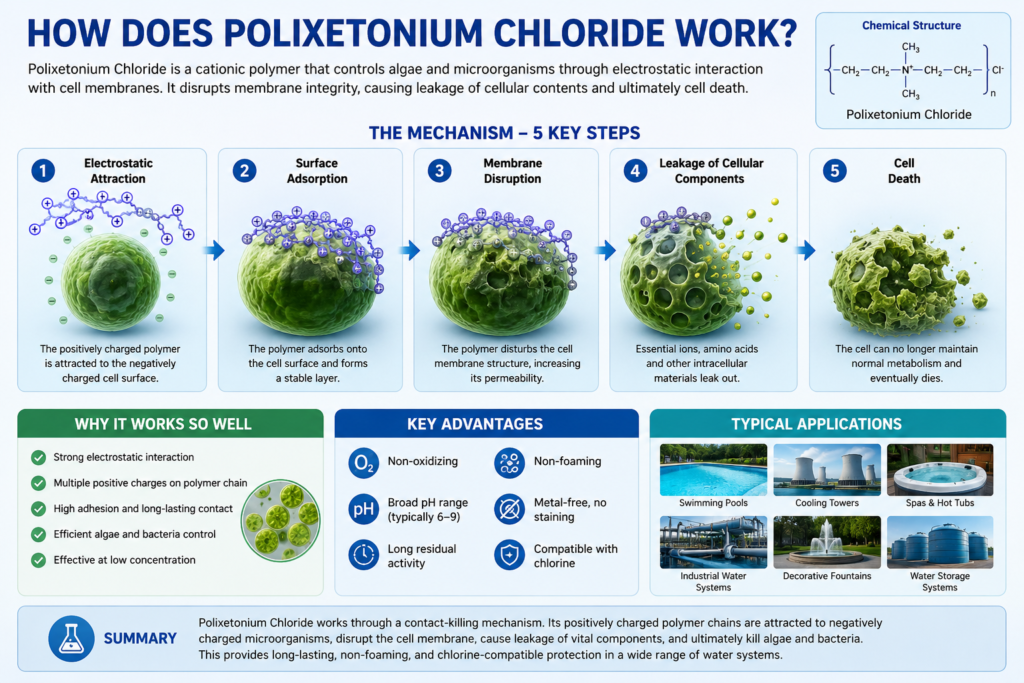
Polixetonium Chloride is a polymeric quaternary ammonium compound (polyquat) that controls algae and microorganisms through electrostatic interaction with cell membranes. Unlike oxidizing biocides such as chlorine or bromine, it does not kill by oxidation. Instead, it disrupts the integrity of microbial cell membranes, causing leakage of cellular contents and ultimately cell death.
This unique mechanism makes it one of the most popular non-foaming, non-metallic algaecides for swimming pools and an effective industrial biocide in water treatment systems.
The Basic Principle
Polixetonium Chloride is a cationic (positively charged) polymer.
Most microorganisms—including algae, bacteria, and fungi—have negatively charged cell surfaces due to phospholipids, proteins, and other biological molecules.
When Polixetonium Chloride is added to water:
- The positively charged polymer is attracted to negatively charged microbial cells.
- It adsorbs strongly onto the cell surface.
- The polymer disturbs the cell membrane structure.
- Membrane permeability increases.
- Essential ions and intracellular materials leak out.
- The microorganism can no longer maintain normal metabolism and eventually dies.
Unlike many small-molecule disinfectants, the polymer chains can interact with multiple sites on a single microorganism, making the disruption highly effective.
Step-by-Step Mechanism
Step 1: Electrostatic Attraction
The polymer contains numerous quaternary ammonium groups, each carrying a permanent positive charge.
These positive charges naturally seek out negatively charged microorganisms.
Positive polymer (+ + + + +)
          ↓
Negative algae cell (− − − −)
This attraction occurs almost immediately after the product disperses in water.
Step 2: Surface Adsorption
After reaching the microorganism, the polymer forms a stable layer on the cell surface.
Unlike chlorine, which diffuses through water as an oxidizer, Polixetonium Chloride works primarily by surface contact.
The long polymer chains wrap around portions of the cell membrane.
Step 3: Membrane Disruption
The cell membrane functions as a selective barrier.
Polixetonium Chloride disrupts this barrier by:
- disturbing membrane proteins
- damaging phospholipid organization
- increasing membrane permeability
The membrane gradually loses its ability to regulate transport.
Step 4: Leakage of Cellular Components
As membrane integrity decreases:
- potassium ions escape
- amino acids leak out
- enzymes become inactive
- ATP production declines
- water balance is lost
Eventually the cell collapses.
Step 5: Cell Death
Without an intact membrane, algae and bacteria cannot:
- generate energy
- regulate osmotic pressure
- transport nutrients
- reproduce
The microorganism dies, preventing further growth.
Why It Works Well Against Algae
Algae cells possess negatively charged outer surfaces.
Because Polixetonium Chloride has many positive charges along each polymer chain, a single molecule can attach to multiple locations on an algal cell.
This provides:
- strong adhesion
- prolonged contact
- efficient cell disruption
- long-lasting algae prevention
It is particularly effective as a preventive algaecide, stopping algae before blooms become severe.
Why It Does Not Foam
Many surfactants create foam because they reduce surface tension dramatically.
Polixetonium Chloride is a high-molecular-weight polymer, not a conventional detergent.
Its structure minimizes foam formation, making it suitable for:
- swimming pools
- fountains
- cooling towers
- decorative water systems
- industrial recirculating water
Why It Is Compatible with Chlorine
A major advantage is that Polixetonium Chloride works by physical membrane disruption, while chlorine works by chemical oxidation.
These two mechanisms complement one another.
| Chlorine | Polixetonium Chloride |
|---|---|
| Oxidizes proteins | Disrupts cell membranes |
| Fast sanitizer | Long-lasting algaecide |
| Consumed quickly | More persistent |
| Excellent against pathogens | Excellent against algae |
Many pool maintenance programs combine both products for broader protection.
Industrial Water Treatment Mechanism
In industrial cooling systems, microorganisms often form biofilms.
A biofilm protects bacteria from disinfectants and reduces heat-transfer efficiency.
Polixetonium Chloride helps by:
- attacking microorganisms attached to surfaces
- preventing early biofilm formation
- slowing slime accumulation
- improving system cleanliness
Because it is non-oxidizing, it can also be alternated with oxidizing biocides to reduce the chance of microbial resistance.
Factors Affecting Performance
Its effectiveness depends on several operating conditions.
Water pH
Polixetonium Chloride remains effective across a broad pH range, typically 6–9, making it suitable for most pool and industrial systems.
Dosage
Higher microbial loads require higher treatment dosages.
Preventive maintenance generally uses much lower concentrations than shock treatments.
Contact Time
Longer contact time improves microbial control.
Because the polymer is relatively stable in water, it provides residual protection longer than many oxidizing disinfectants.
Organic Matter
Heavy contamination can reduce efficiency because organic materials compete for adsorption sites.
Advantages of Its Working Mechanism
Compared with many conventional algaecides, Polixetonium Chloride offers several benefits:
- Non-oxidizing
- Non-foaming
- Metal-free
- Long residual activity
- Broad-spectrum antimicrobial performance
- Compatible with chlorine programs
- Less corrosive than many oxidizing biocides
- Low risk of staining pool surfaces
Typical Applications
Because of this mechanism, Polixetonium Chloride is widely used in:
- Swimming pools
- Spas
- Cooling towers
- Industrial circulating water
- Decorative fountains
- Water storage systems
- Process water treatment
- Some industrial formulations requiring microbial control
Summary
Polixetonium Chloride works through a contact-killing mechanism rather than oxidation. Its positively charged polymer chains are attracted to negatively charged microorganisms, where they adsorb onto the cell surface, disrupt membrane integrity, cause leakage of essential cellular components, and ultimately kill algae and bacteria.
This mechanism explains why Polixetonium Chloride is valued as a long-lasting, non-foaming, chlorine-compatible algaecide and non-oxidizing biocide. By combining effective microbial control with broad pH stability and low corrosiveness, it has become an important ingredient in both swimming pool maintenance and industrial water treatment.
Frequently Asked Questions
Does Polixetonium Chloride kill algae immediately?
It begins interacting with algae shortly after application, but complete control depends on dosage, algae density, water temperature, and circulation. Heavy algae blooms may require supplemental treatment.
Why is Polixetonium Chloride considered non-oxidizing?
Unlike chlorine or bromine, it does not destroy microorganisms through oxidation. Instead, it physically disrupts cell membranes through electrostatic interactions.
Can Polixetonium Chloride be used together with chlorine?
Yes. It is commonly used alongside chlorine because the two products work through different mechanisms and can complement each other in water treatment programs.
Does Polixetonium Chloride prevent biofilm formation?
Yes. By inhibiting microbial attachment and growth, it helps reduce the development of biofilms in industrial water systems and cooling towers.
Is Polixetonium Chloride safe for swimming pools?
When used according to the manufacturer’s recommended dosage, it is widely used as a non-foaming swimming pool algaecide that provides effective algae prevention without introducing metals that may stain pool surfaces.