
Outline
- What is Polixetonium Chloride?
- Why has it become so widely used?
- Chemical properties explained in simple terms
- How does it work?
- Main applications across different industries
- Advantages and limitations
- Safety and handling
- Frequently asked questions
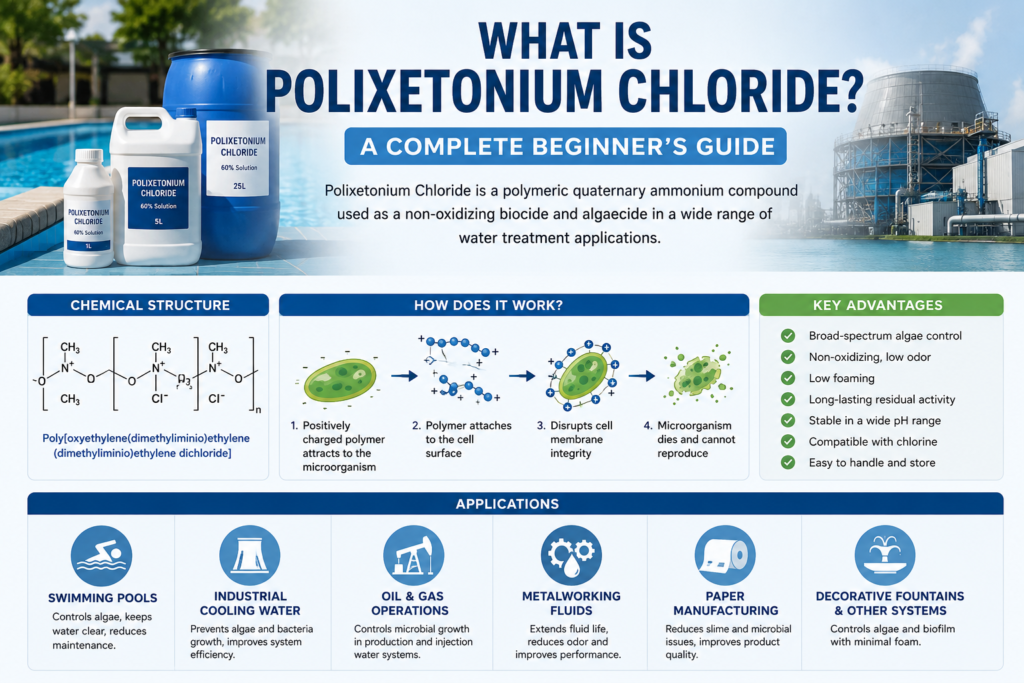
What Is Polixetonium Chloride? A Complete Beginner’s Guide
If you’ve been searching for information about Polixetonium Chloride, you’ve probably noticed something interesting—there isn’t much beginner-friendly information available. Most articles are filled with chemistry jargon that makes the subject seem far more complicated than it really is.
The good news? It doesn’t have to be that way.
Whether you’re sourcing industrial biocides, manufacturing pool chemicals, treating cooling water, or simply trying to understand what this polymer actually does, this guide explains everything in plain English.
Let’s start with the basics.
What Is Polixetonium Chloride?
Polixetonium Chloride is a polymeric quaternary ammonium compound, often called a polyquat. Unlike traditional disinfectants such as chlorine or bromine, it belongs to a family of non-oxidizing biocides that control microorganisms without relying on oxidation.
In simple terms, think of it as a long positively charged polymer chain that naturally attracts negatively charged microorganisms such as algae, bacteria, and fungi.
Once contact occurs, it disrupts the microorganisms’ cell membranes, causing them to lose their normal function and eventually die.
Because of this unique mechanism, Polixetonium Chloride is widely used in:
- Swimming pool algaecides
- Industrial cooling water treatment
- Oilfield water systems
- Metalworking fluids
- Paper mills
- Decorative fountains
- Industrial process water
One of its biggest advantages is that it controls biological growth without creating foam or significantly affecting water chemistry.
What’s Another Name for Polixetonium Chloride?
You may encounter several names for the same chemistry.
Common names include:
- Polixetonium Chloride
- Polyquat biocide
- Polymeric quaternary ammonium compound
- Polyquaternium biocide (in certain applications)
The exact chemical identity is:
Poly[oxyethylene(dimethyliminio)ethylene(dimethyliminio)ethylene dichloride]
Don’t worry if that sounds intimidating. Most buyers simply refer to it as Polixetonium Chloride or Polyquat.
Why Is It Different from Chlorine?
This is probably the question beginners ask most.
The key difference lies in how they kill microorganisms.
Chlorine
Chlorine works by oxidation.
It reacts chemically with organic matter, breaking apart cells through powerful oxidation reactions.
This makes chlorine highly effective—but also relatively unstable.
It can:
- Be consumed quickly
- Produce chloramine odors
- Fade swimsuits
- Irritate skin and eyes
- Lose efficiency under sunlight
Polixetonium Chloride
Polixetonium Chloride works differently.
Instead of oxidizing microorganisms, it binds to their cell surfaces through electrostatic attraction.
Its positive charges attach to negatively charged cell membranes, disrupting their integrity.
The result is long-lasting biological control without aggressive oxidation.
That’s why it’s often described as a non-oxidizing algaecide and biocide.
How Does Polixetonium Chloride Work?
Here’s an easy analogy.
Imagine algae cells are tiny balloons.
Their outer surfaces carry a negative electrical charge.
Polixetonium Chloride behaves like thousands of tiny positively charged magnets.
As soon as they meet:
- The polymer attaches to the cell surface.
- The membrane becomes unstable.
- Water balance inside the cell is disrupted.
- Essential biological processes stop.
- The microorganism dies.
Since one polymer chain contains many active sites, each molecule can interact with multiple cells.
This contributes to its long-lasting performance.
What Makes It So Popular?
You know what? Many water treatment professionals choose polymeric biocides because they solve problems that traditional oxidizing chemicals sometimes create.
Some key advantages include:
Excellent algae control
It effectively controls:
- Green algae
- Black algae
- Mustard algae
- Slime-forming microorganisms
Non-foaming
Unlike some surfactant-based biocides, properly formulated Polixetonium Chloride produces no foam.
This is particularly valuable in:
- Cooling towers
- Decorative fountains
- Industrial circulation systems
- Swimming pools
Long residual activity
Because the polymer remains active for an extended period, treatments generally last longer than many fast-reacting oxidizers.
This often means:
- Less frequent dosing
- Lower maintenance effort
- More consistent microbial control
Stable over a broad pH range
Many water systems experience changing pH values.
Polixetonium Chloride maintains good performance across a relatively wide operating range.
Compatible with chlorine programs
Rather than replacing chlorine completely, it is often used alongside chlorine.
The combination can improve algae prevention while allowing chlorine to focus on sanitation.
Where Is Polixetonium Chloride Used?
Its versatility is one reason it has become an important specialty chemical.
Swimming pools
Probably the best-known application.
It helps:
- Prevent algae blooms
- Keep water clearer
- Reduce maintenance
- Lower the frequency of shock treatments
- Minimize staining associated with some metal-based algaecides
Pool professionals often use it as part of a regular maintenance program.
Industrial cooling water
Cooling towers provide an ideal environment for microbial growth.
Unchecked algae and bacteria can:
- Reduce heat transfer
- Increase corrosion risks
- Promote slime formation
- Raise maintenance costs
Polixetonium Chloride helps keep systems cleaner while supporting overall water treatment performance.
Oil and gas operations
Produced water and injection water frequently contain microorganisms.
These microbes can:
- Form biofilms
- Block pipelines
- Reduce production efficiency
Polymeric biocides help control biological contamination without excessive foaming.
Metalworking fluids
Microbial contamination shortens coolant life.
Adding suitable non-oxidizing biocides helps:
- Reduce unpleasant odors
- Extend fluid service life
- Improve machining stability
Paper manufacturing
Paper mills use large volumes of circulating water.
Microbial slime can affect:
- Product quality
- Equipment efficiency
- Production uptime
Polixetonium Chloride helps minimize these biological issues.
What Are the Main Advantages?
Let’s summarize the biggest benefits.
- Broad-spectrum algae control
- Non-oxidizing mode of action
- Low foaming characteristics
- Long-lasting effectiveness
- Good compatibility with many treatment programs
- Stable storage performance
- Easy liquid handling
- Suitable for many industrial water systems
Are There Any Limitations?
No chemical is perfect.
Polixetonium Chloride also has some practical considerations.
It should not be viewed as a complete replacement for disinfectants where rapid pathogen reduction is required. In many systems, it works best as part of a broader treatment program.
Performance can also depend on factors such as:
Proper dosing practices
Selecting the right concentration and treatment schedule is important for achieving reliable results.
Organic contamination levels
Water temperature
Existing microbial populations
Overall treatment chemistry
Is Polixetonium Chloride Safe?
When handled according to the product’s Safety Data Sheet (SDS) and local regulations, Polixetonium Chloride is widely used in industrial and commercial water treatment applications.
General handling recommendations include:
- Wear appropriate protective gloves and eye protection.
- Avoid direct contact with skin and eyes.
- Store the product in a cool, dry, well-ventilated area.
- Keep containers tightly closed when not in use.
- Do not mix with incompatible chemicals unless recommended by the supplier.
Always follow the manufacturer’s instructions for safe handling, storage, and disposal.
How Is It Supplied?
Commercial products are typically available as aqueous liquid formulations in various active concentrations to meet different application needs.
Common packaging options include:
- 1 L bottles for laboratory or evaluation use
- 5 L containers
- 25 L drums
- 200 L drums
- 1,000 L IBC totes
- Bulk tanker deliveries for large industrial users
Suppliers may also offer custom packaging and private-label solutions for distributors.
How Do You Choose a Reliable Supplier?
Not every supplier offers the same level of quality or technical support.
When evaluating a manufacturer, consider:
- Consistent product specifications
- Reliable quality control
- Complete documentation (COA, SDS, TDS)
- Stable production capacity
- Export experience
- Responsive technical support
- Flexible packaging options
- Ability to provide samples for evaluation
A dependable supplier can help ensure consistent performance and smoother procurement.
Final Thoughts
Polixetonium Chloride may have a complicated name, but its role is straightforward.
It is a polymeric, non-oxidizing biocide designed to control algae and microbial growth across a wide range of water treatment applications. Its combination of long-lasting activity, low foaming behavior, broad compatibility, and operational flexibility has made it a trusted choice in swimming pools and industrial water systems alike.
For buyers, engineers, and distributors, understanding how this chemistry works makes it much easier to select the right treatment program and evaluate potential suppliers.
As water treatment systems continue to prioritize efficiency, reliability, and cost-effective maintenance, Polixetonium Chloride is likely to remain an important part of modern microbial control strategies.
Frequently Asked Questions
- Is Polixetonium Chloride the same as chlorine?
No. Chlorine is an oxidizing disinfectant, while Polixetonium Chloride is a non-oxidizing polymeric biocide that controls algae and microorganisms through a different mechanism. - Can Polixetonium Chloride replace chlorine in swimming pools?
Generally, no. It is commonly used alongside chlorine to improve algae control and support overall water treatment rather than replacing primary sanitizers. - Is Polixetonium Chloride effective against algae?
Yes. It is widely used to control green algae, black algae, mustard algae, and other nuisance microorganisms in swimming pools and industrial water systems. - Does Polixetonium Chloride create foam?
Properly formulated products are known for their low-foaming characteristics, making them suitable for applications where foam control is important. - What industries commonly use Polixetonium Chloride?
Common applications include swimming pool maintenance, industrial cooling water treatment, oil and gas operations, metalworking fluids, paper manufacturing, and other industrial water treatment systems.
13 comments on “What Is Polixetonium Chloride ? A Complete Beginner’s Guide”
Comments are closed.