
GET IN TOUCH
Ask For Sample?
Why Pool Professionals Consider Polyquat Algaecide for Routine Maintenance?
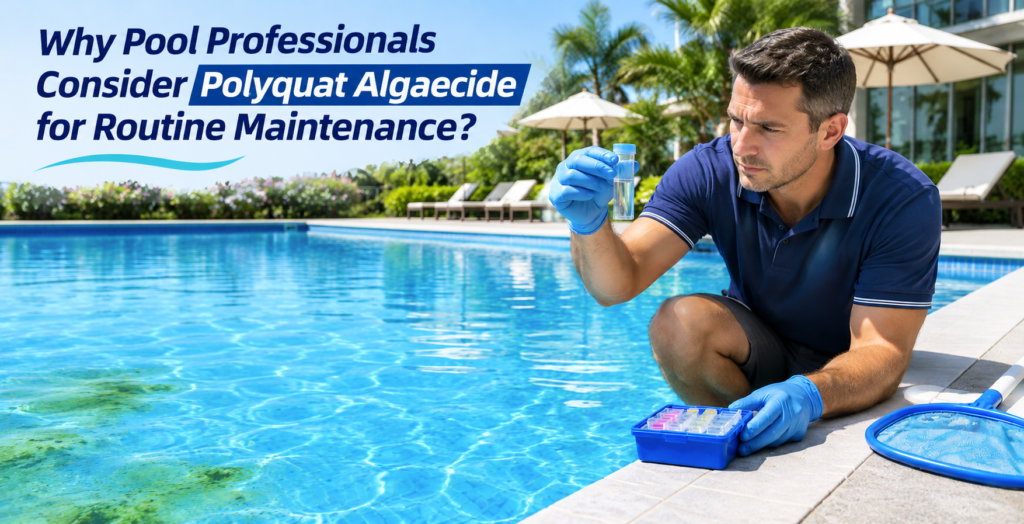
A swimming pool can look perfect on Monday and show signs of algae by Friday. For pool service professionals, that’s more than a water quality issue. It can mean extra cleaning, unhappy customers, and an unexpected return visit.
Keeping pool water clear takes more than adding chlorine. It calls for regular testing, proper filtration, good water circulation, and a sound plan for algae prevention.
That’s why many pool professionals consider Polyquat Algaecide as part of their routine pool maintenance programs.
Unlike some traditional algaecides, Polyquat 60 is a non-foaming, metal-free polymer-based treatment. It helps control algae without adding copper to pool water, making it useful for residential pools, commercial facilities, and pools with water features.
But what makes this type of algaecide attractive to professionals? And when does it make sense to include it in a regular maintenance schedule?
Let’s look at the chemistry, practical benefits, and factors that matter when maintaining pools week after week.
What Is Polyquat Algaecide, and Why Does It Matter?
Polyquat Algaecide is a type of polymeric quaternary ammonium compound used to control algae growth in swimming pools and other water systems.
One widely used active ingredient is Polixetonium Chloride (CAS No. 31512-74-0), also known in the industry as Polyquat 60 or Polyquaternium-42.
The term “polyquat” refers to its polymer structure, which contains positively charged quaternary ammonium groups.
That sounds technical, but the basic idea is simple.
Algae cells generally carry negatively charged surface groups. The positively charged polymer can interact with these surfaces and interfere with cell membrane function, helping control algae growth.
Polyquat 60 is commonly supplied as a concentrated liquid containing approximately 60% active ingredient. The raw material is typically a transparent amber-colored, viscous liquid.
It has several properties that make it useful in pool maintenance:
- Non-oxidizing algae control
- Low-foaming or non-foaming performance at recommended doses
- Metal-free formulation
- Compatibility with properly maintained chlorine-treated pools
- Effectiveness across a relatively broad pH range
- Suitability for preventive maintenance when used according to the registered product label
These features explain why polymeric algaecides have found a place in professional pool care.
Still, one distinction matters: Polyquat Algaecide supports pool sanitation. It does not replace chlorine or another approved primary sanitizer.
1. Prevention Is Easier Than Fighting an Algae Bloom
Imagine arriving at a customer’s pool and finding green patches along the walls.
The water may still look clear from a distance. Yet algae have already started growing in areas with weak circulation, along steps, or behind ladders.
Now the job becomes more involved.
The technician may need to brush the pool, check sanitizer levels, correct water balance, clean the filter, and carry out an algae treatment. A follow-up visit may also be necessary.
That’s why prevention matters.
Polyquat Algaecide can provide an extra layer of algae control when used as part of a regular maintenance program.
Rather than waiting for visible algae, professionals may apply an approved maintenance dose to help suppress new growth.
This approach can be useful for pools exposed to conditions such as:
- Warm water and strong sunlight
- Heavy swimmer activity
- Organic debris from nearby trees
- Periods of reduced circulation
- Seasonal changes in water temperature
- Recurring algae problems
Of course, Polyquat won’t correct poor circulation or inadequate sanitizer levels. Those problems still need attention.
But as an added preventive measure, it can help pool professionals manage algae risks before they become more difficult to handle.
2. Non-Foaming Performance Makes Pool Care Simpler
Foam is rarely something a pool owner wants to see.
Picture a beautiful backyard pool with a waterfall, spa jets, and a bubbling return system. Everything looks great—until foam begins collecting on the surface.
Some conventional quaternary ammonium algaecides can produce noticeable foam, particularly in water with strong agitation.
Polyquat 60 is valued for its low-foaming characteristics.
That makes it particularly attractive for pools with:
- Attached spas
- Waterfalls
- Decorative fountains
- High-flow return jets
- Other water features that create turbulence
For professional pool service companies, this can reduce the risk of customer complaints related to unwanted foam.
There’s another practical advantage.
Technicians don’t want to solve one maintenance problem only to create another. A non-foaming algaecide can fit more comfortably into a regular service routine without changing the pool’s visual appearance.
Published pool product labels and technical literature recognize non-foaming performance as a key characteristic of polymeric algaecides. www3.epa.gov+1
3. Metal-Free Algae Control Helps Avoid Copper-Related Staining
Copper-based algaecides can be effective in certain applications. However, copper introduces another water chemistry factor that professionals must manage.
When dissolved copper accumulates or precipitates under certain water conditions, it may contribute to staining on pool surfaces.
Discoloration can be particularly frustrating in pools with light-colored plaster, fiberglass, or decorative finishes.
Polyquat 60 offers a different approach.
Because a standard Polyquat 60 formulation does not rely on copper or other metal-based active ingredients, it does not introduce copper as part of the algae treatment.
This can be attractive for pool professionals responsible for:
- Premium residential swimming pools
- Light-colored pool finishes
- Fiberglass pools
- Commercial pools with decorative surfaces
- Facilities where appearance is a major concern
Does that mean Polyquat prevents every type of stain? No.
Iron, manganese, existing copper contamination, scale, and other water chemistry issues can still cause discoloration.
However, choosing a metal-free algaecide removes one potential source of added metal from the maintenance program.
For pool owners who care about a spotless finish, that’s a meaningful benefit.
4. It Works Alongside Regular Chlorine Maintenance
Chlorine remains one of the most widely used swimming pool sanitizers.
It helps control harmful microorganisms and oxidizes contaminants introduced by swimmers and the environment.
So why would a professional use Polyquat Algaecide if the pool already contains chlorine?
Because the two products serve different, though partly overlapping, roles.
Chlorine is the primary sanitizer in a chlorine-treated pool. Polyquat is a supplemental algaecide that helps manage algae growth.
A properly selected Polyquat product can be used in chlorine-treated water, subject to its label directions.
This makes it possible to include Polyquat in an established maintenance program without replacing the core sanitation system.
However, compatibility in pool water does not mean concentrated chemicals can be mixed together.
Polyquat should never be directly mixed with concentrated chlorine, pool shock, or other chemicals in the same container.
Each product must be added separately according to its label.
Some registered Polyquat labels also indicate that regular use may reduce the amount of chlorine normally required under certain conditions. That should not be interpreted as permission to maintain sanitizer levels below applicable requirements. www3.epa.gov+1
The professional goal is not simply to use less chlorine.
It’s to maintain safe, balanced water while controlling algae with as few complications as possible.
5. Routine Maintenance Can Become More Predictable
For a pool service business, consistency is everything.
A technician may manage dozens of pools each week. Each one has its own water chemistry, filtration system, swimmer load, and environmental conditions.
Unexpected algae growth can disrupt that schedule.
A pool that normally takes a short service visit may suddenly require extensive brushing, cleaning, and chemical treatment.
That’s where a preventive algae control program may offer operational value.
When Polyquat Algaecide is used appropriately, it can become part of a planned maintenance routine rather than an emergency response.
For example, a professional might combine:
- Water chemistry testing and adjustment
- Pool surface brushing and debris removal
- Filtration and circulation checks
- Routine sanitizer management
- Supplemental Polyquat Algaecide treatment when justified
This structured approach can help reduce uncertainty.
It also makes it easier to explain maintenance procedures to customers.
Instead of waiting for problems, the service company can show that it follows a planned water care program.
That’s good for service quality—and potentially good for customer confidence.
6. Concentrated Polyquat 60 Can Be Practical for Professional Use
Professional pool technicians often prefer products that are easy to measure, transport, and store.
Polyquat 60 is commonly supplied as a concentrated liquid containing about 60% active ingredient.
Compared with a more dilute formulation, a concentrated product may require a smaller liquid volume to deliver the same quantity of active ingredient.
This can have several practical benefits.
First, technicians may need to carry less liquid for a given treatment requirement.
Second, distributors can consider the amount of active ingredient delivered per package when comparing product costs.
Third, concentrated products may reduce packaging volume relative to equivalent quantities of more dilute formulations.
But concentration alone doesn’t determine value.
A 60% product isn’t automatically more economical than every 30% or 10% formulation.
The purchase price, recommended dosage, shipping costs, packaging, and local regulations all affect the final cost.
Professionals should compare cost per correctly treated pool volume, not just the price per bottle.
This is especially important for commercial pool operators and service companies managing many pools.
7. How Much Polyquat Algaecide Should Professionals Use?
Correct dosing is one of the most important parts of professional algae control.
Too little product may fail to provide the intended protection. Too much can increase costs and may cause unwanted water quality effects.
The right dose depends on the registered formulation, pool volume, water condition, and label instructions.
For reference, one U.S. EPA-registered Polyquat product label provides the following directions for a 60% formulation. www3.epa.gov+1
| Treatment purpose | Example dosage per 10,000 US gallons |
|---|---|
| Initial treatment of a clean pool | 6–11 fl oz (177–325 mL) |
| Routine maintenance | 2–4 fl oz (59–118 mL) every 5–7 days |
| Treatment when light algae growth is visible | 11–17 fl oz (325–503 mL) |
These are examples from a specific registered product label, not universal instructions. Always follow the exact label approved for the product and market.
A pool professional should also consider the following factors before treatment.
Pool volume: Accurate volume calculations help avoid underdosing or overdosing.
Existing algae: A pool with visible algae may require a different treatment approach from a clean pool receiving preventive maintenance.
Water circulation: Good circulation helps distribute the product throughout the pool.
Sanitizer and pH levels: Proper water balance remains essential, even when an algaecide is used.
Application timing: Follow the product label for any separation required between chemical treatments and for swimming restrictions.
For a pool service company, accurate dosing records can be just as important as the treatment itself. They make it easier to evaluate results and identify recurring water quality problems.
8. Does Polyquat Algaecide Work in Different Pool Conditions?
Not every pool operates under ideal conditions.
Outdoor pools face rain, wind, leaves, and changing temperatures. Indoor pools may have different circulation patterns and bather loads.
Commercial pools often experience heavy use, while private pools may remain unused for days.
Polyquat Algaecide is attractive partly because it can function across a relatively broad range of pool water conditions.
Its polymeric structure allows it to provide algae control without relying on an oxidation reaction like chlorine.
However, this doesn’t mean water chemistry can be ignored.
Pool professionals still need to monitor pH, sanitizer residuals, total alkalinity, and other parameters required by the facility’s maintenance plan.
In particular, poor circulation can leave areas where algae continue to grow despite chemical treatment.
The lesson is straightforward: Polyquat works best as one part of a complete pool maintenance program.
9. What About Pool Water Clarity?
Clear water is often the first thing customers notice.
They may not understand free chlorine, total alkalinity, or filtration rates. But they can see whether the pool looks inviting.
Polyquat Algaecide is primarily designed for algae control, yet some polymeric formulations may also contribute to improved water appearance.
This is partly related to the cationic nature of the polymer.
Positively charged polymers can interact with certain negatively charged suspended particles. Under suitable conditions, these interactions may encourage particle aggregation and removal through filtration.
However, the degree of clarification depends on the formulation, water conditions, and filtration system.
A Polyquat Algaecide should not automatically be treated as a dedicated pool clarifier.
For pools where fine suspended particles are the main concern, a specialized clarifier may be more appropriate.
For example, Eautrix offers a separate Polymer Pool Clarifier based on PolyDADMAC for water clarification applications.
Understanding this difference helps professionals select the right treatment for the actual problem.
10. Can Polyquat Help Reduce Maintenance Costs?
Pool professionals often evaluate chemicals by looking beyond the purchase price.
A cheaper product may not always deliver the lowest overall maintenance cost.
Consider the potential expenses associated with recurring algae problems: extra technician visits, additional brushing, filter cleaning, chemical treatments, and customer complaints.
A preventive Polyquat program may help reduce some of these costs when it successfully limits algae growth.
Still, the savings are not guaranteed.
They depend on the pool’s condition, the effectiveness of the maintenance program, product pricing, and how often algae problems would otherwise occur.
For a fair evaluation, service companies can compare:
- Product cost per treatment
- Number of algae-related service visits
- Labor time spent on corrective cleaning
- Additional chemical consumption
- Customer complaints related to algae
Over several months, these records can help show whether routine Polyquat treatment provides a worthwhile return.
The most economical maintenance program isn’t necessarily the one that uses the fewest chemicals. It’s the one that keeps water safe and clean without unnecessary treatments or repeat work.
11. Why Commercial Pool Operators May Find Polyquat Useful
Commercial swimming pools present a different maintenance challenge from private backyard pools.
Hotels, resorts, fitness centers, and community facilities often need to maintain consistent water quality while serving many swimmers.
An algae problem can affect both the appearance of the facility and its operations.
For these environments, preventive maintenance is particularly important.
Polyquat Algaecide may be considered for commercial pool programs because of its non-foaming performance, metal-free composition, and compatibility with common pool sanitation systems.
For example, a resort pool with decorative waterfalls may benefit from a non-foaming algaecide. A premium hotel pool with light-colored finishes may place greater value on avoiding copper-based additives.
However, commercial operators must follow local public health regulations, facility operating procedures, and the product’s approved use directions.
Some facilities may not need routine supplemental algaecide at all when their sanitation, circulation, and filtration systems are working well.
That makes professional judgment essential.
12. What Should Professionals Check Before Choosing a Polyquat Supplier?
For pool service companies and chemical distributors, product quality matters just as much as the chemistry.
Two products sold under similar names may differ in active concentration, formulation additives, viscosity, and quality control.
Before purchasing Polyquat Algaecide in bulk, buyers should review several technical and commercial factors.
| Evaluation factor | Why it matters |
|---|---|
| Active ingredient identity | Confirms the intended Polyquat chemistry |
| Active concentration | Helps compare formulations and treatment costs |
| Appearance and viscosity | Supports consistency checks between batches |
| pH and density | Useful for quality control and handling |
| Certificate of Analysis (COA) | Provides batch-specific test results |
| Safety Data Sheet (SDS) | Supports safe storage, transport, and handling |
| Regulatory status | Determines whether the product can legally be marketed and used as an algaecide |
| Packaging | Affects handling, distribution, and storage |
| Batch consistency | Helps maintain predictable product performance |
For distributors developing private label products, packaging flexibility can also be important.
Eautrix supplies Polyquat 60 raw material and offers formulation and packaging support for professional pool chemical markets, including 1L bottles, 5L containers, 25L drums, and larger industrial packages.
The product can be developed for different distribution channels, subject to formulation validation and applicable regulatory requirements.
Buyers interested in product specifications can explore Eautrix Polyquat 60 Algaecide for more information about the company’s pool chemical portfolio.
One point deserves special attention: technical supply capability and pesticide registration are not the same thing. Importers and brand owners must verify the relevant product registration, label approval, and authorization requirements before selling an algaecide in their target market.
13. Common Mistakes When Using Polyquat Algaecide
Even a well-formulated algaecide can disappoint when it is used incorrectly.
One common mistake is treating Polyquat as a replacement for proper sanitation.
It isn’t.
A pool still needs an approved sanitizer at the required residual level.
Another mistake is applying an algaecide without checking the actual water condition.
If algae are already well established, a routine maintenance dose may not be sufficient. The pool may need a more complete corrective treatment.
Other problems include inaccurate pool volume estimates, poor circulation during application, excessive dosing, and failure to clean contaminated filters or pool surfaces.
Directly mixing concentrated chemicals is particularly dangerous and must be avoided.
Professional pool maintenance is about understanding how each treatment fits into the overall system.
Chemicals work together in the pool only when they are selected, measured, and applied correctly.
14. Is Polyquat Algaecide Always Necessary?
Not necessarily.
A well-maintained pool with proper sanitizer levels, balanced water chemistry, effective filtration, and good circulation may remain algae-free without routine supplemental algaecide.
In such cases, adding another chemical may offer limited value.
However, some pools face recurring algae pressure because of environmental conditions, heavy use, or other operating challenges.
For those pools, an approved Polyquat Algaecide may provide useful additional protection.
The decision should be based on the pool’s history, maintenance requirements, product label, and local regulations.
Professionals should avoid treating every pool with the same chemical schedule simply because it’s convenient.
A more thoughtful approach is to identify which pools benefit from supplemental algae control and adjust the maintenance plan accordingly.
15. Why Polyquat Algaecide Remains Relevant to Professional Pool Care
Pool maintenance isn’t just about fixing problems.
It’s about keeping water safe, clean, and attractive through changing weather, swimmer activity, and operating conditions.
Polyquat Algaecide offers several practical advantages that explain its continued interest among professional pool technicians and chemical distributors.
Its non-foaming nature makes it suitable for many pools with water features. Its metal-free chemistry avoids adding copper. Its compatibility with properly maintained chlorine systems allows it to serve as a supplemental algae control product.
And when used correctly, it can support a preventive approach to pool care.
For service companies, that may mean fewer algae-related interruptions. For pool owners, it may mean more consistent water appearance. For distributors, it offers a recognized product category within a professional pool maintenance range.
The key is to use it where it adds real value.
Polyquat Algaecide is not a substitute for good pool maintenance. It is a tool that can make a well-managed maintenance program more effective.
For buyers developing a professional pool chemical range, Eautrix provides Polyquat 60 material supply, concentration customization, and private label packaging support.
Visit Eautrix or contact info@eautrix.com to discuss your Polyquat Algaecide requirements.
Frequently Asked Questions (FAQ)
1. Can Polyquat 60 Algaecide be used every week for pool maintenance?
Yes. Certain registered Polyquat 60 products have weekly or 5–7-day maintenance directions. The correct dosage and frequency depend on the specific product label, pool volume, and water conditions. Routine use should supplement, not replace, proper sanitation.
2. Is Polyquat Algaecide suitable for saltwater swimming pools?
Many Polyquat 60 formulations are suitable for pools equipped with salt chlorine generators. They can provide supplemental algae control while the generator maintains the required chlorine residual. Always verify compatibility and approved use on the product label.
3. Will Polyquat Algaecide cause foam or metal stains in swimming pools?
Standard Polyquat 60 formulations are non-foaming at recommended doses and contain no copper-based active ingredient. This makes them attractive for pools with spas, waterfalls, and decorative finishes. Existing metals or other water chemistry problems can still cause staining.
4. What is the difference between Polyquat 60 Algaecide and chlorine?
Chlorine is a primary pool sanitizer that disinfects water and oxidizes contaminants. Polyquat 60 is a non-oxidizing polymeric algaecide used to control algae growth. The two products can serve complementary roles, but Polyquat does not replace chlorine or another approved sanitizer.
5. How can pool chemical distributors source private label Polyquat 60 Algaecide?
Distributors should first verify the active ingredient, concentration, batch quality, documentation, and regulatory requirements in their target market. They can then discuss packaging sizes, label design, and formulation requirements with a qualified supplier such as Eautrix. Commercial supply should proceed only after the relevant approvals and product requirements are satisfied.