
GET IN TOUCH
Ask For Sample?
Bulk Purchasing Guide for Polymer Pool Clarifier
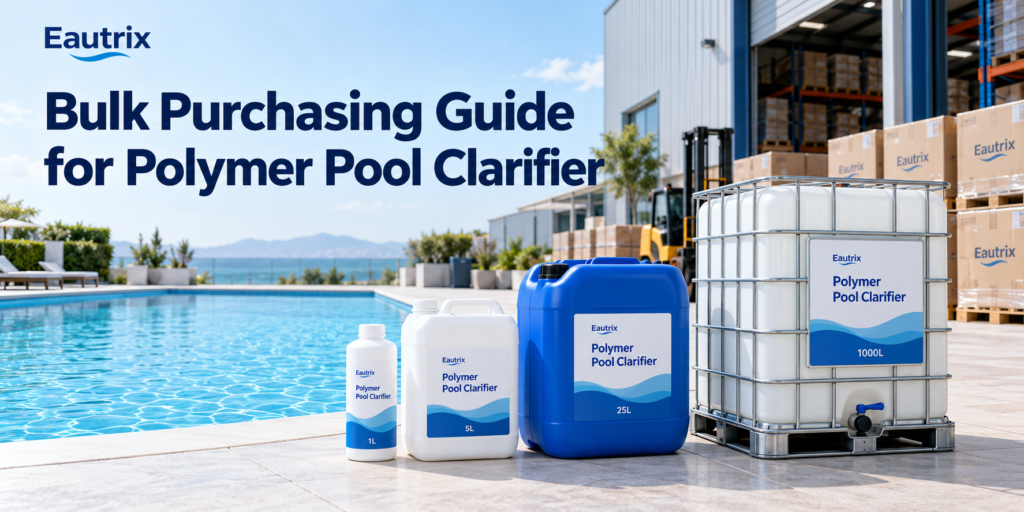
Buying polymer pool clarifier in bulk can help distributors, pool brands, and service companies control costs and keep products in stock. Yet a good purchase involves far more than finding a low price per kilogram.
Will the product perform in your customers’ pools? Does the quoted concentration mean what you think it means? Will the bottles arrive ready for sale? And can you sell the stock while enough shelf life remains?
These questions matter because a small mistake grows with the order. An unclear dosing instruction on one sample bottle is easy to fix. The same mistake printed on several thousand bottles becomes a costly headache.
This bulk purchasing guide for polymer pool clarifier explains how to define your requirements, assess samples, compare quotations, and prepare a clear purchase agreement. The goal is simple: buy a product you can sell, support, and reorder with confidence.
Start With Your Customers, Then Choose the Product
Before asking suppliers for prices, decide who will use the clarifier and how they will buy it.
A pool shop may want a compact bottle with clear instructions. A service company may prefer a larger container that is easy to pour. A local chemical packer may need bulk liquid for filling under its own brand.
Each buyer needs a different supply arrangement.
For example, a retail brand buying finished 1L bottles must assess bottle strength, label quality, carton design, and shelf appeal. A distributor buying IBCs needs to think about transfer equipment, filling controls, storage space, and traceability after repacking.
Start with a short product brief:
- Target market and customer type.
- Intended use, such as routine pool water clarification.
- Preferred formulation and concentration.
- Required pack sizes.
- Expected first order and annual demand.
- Private label requirements.
- Delivery destination and target arrival date.
You don’t need a perfect sales forecast. You do need enough detail to prevent suppliers from quoting different products against the same vague request.
“Please quote pool clarifier” leaves too much room for guesswork.
Know What “Polymer Pool Clarifier” Means in the Quote
Polymer pool clarifier is a product category, rather than one fixed formula. Two products with similar names may use different polymers, concentrations, or supporting ingredients.
This guide focuses on PolyDADMAC-based liquid pool clarifier. Eautrix’s published product listing identifies its standard product as a 10% PolyDADMAC formulation, CAS No. 26062-79-3, with original or blue-dyed appearance available. Buyers can review the Polymer Pool Clarifier product page as a starting point for a detailed specification.
When reviewing any supplier’s offer, ask for the full product identity. A trade name alone won’t tell you whether two quotations cover comparable materials.
Also distinguish a finished pool product from a polymer raw material. A raw material offered for further formulation should not be assumed to have the same application instructions, packaging, or supporting validation as a finished clarifier.
That distinction shapes the entire purchase.
Put the Specification in Writing
A sample shows what one container looks like. A written specification defines what future deliveries must meet.
Without one, “same quality as before” can mean different things to the buyer and supplier.
Your specification should cover the properties that affect use, handling, and consistency. Avoid adding tests simply because they appear on another supplier’s sheet. Each requirement should serve a purpose.
| Specification item | What the buyer should clarify |
|---|---|
| Product identity | Polymer type, CAS number, and formulation reference |
| Polymer content | Target, tolerance, reporting basis, and test method |
| Total solids | Whether reported separately from polymer content |
| Appearance | Accepted color, clarity, and visible condition |
| pH | Test concentration, temperature, and accepted range |
| Viscosity | Method, temperature, instrument settings, and range |
| Density | Test temperature and accepted range |
| Shelf life | Duration, storage conditions, and date basis |
| Packaging | Container, closure, seal, net fill, and label |
| Traceability | Batch coding and corresponding records |
Not every supplier will use the same test methods. Resolve those differences before comparing figures.
A viscosity result, for instance, is hard to interpret without the test conditions. The number needs context.
Don’t Let “10%” Do All the Talking
Concentration is one of the easiest details to misunderstand.
When a supplier offers “10% polymer pool clarifier,” ask what the percentage represents. Is it polymer content by mass? Total nonvolatile solids? Or the amount of a purchased polymer solution added during blending?
Those descriptions are not interchangeable.
Consider a hypothetical blend made by adding 10 kg of a 40% polymer solution to 90 kg of water. The final 100 kg mixture contains 4 kg of polymer. Its polymer content is therefore 4% by mass, even though the original polymer solution makes up 10% of the blend.
A clear purchase specification should state the concentration basis and how it is verified.
The same care applies to total solids. Depending on the formulation, a solids result may include material other than the functional polymer. Ask the supplier to explain what the test measures.
This may feel like a small technical detail. In a bulk order, it can change the whole price comparison.
Approve Performance Before Committing to Volume
A clear or attractive blue liquid can look excellent in a sample bottle. Appearance alone does not establish how it will work.
Ask for a representative sample and record its batch number. If the sample is a development blend, confirm that fact and arrange approval of material made through the intended production process.
Build the evaluation around the conditions your customers are likely to face.
A sensible trial should document:
- Starting water condition.
- Pool volume or test volume.
- Relevant water chemistry.
- Filter type and operating condition.
- Exact product dose.
- Mixing, circulation, and observation times.
- Results and any extra maintenance needed.
Use a comparison where practical. Treating similar water samples under the same conditions gives more useful evidence than comparing photographs taken on different days.
A bench test can help screen products, but it does not reproduce a full pool system. Follow promising results with a controlled application trial using the intended filtration setup and supplier instructions.
Agree on success before the trial begins. “Looks better” is a weak acceptance standard. Recorded observations, consistent photographs, and suitable measurements give both parties something firmer to discuss.
Check the Instructions as Carefully as the Liquid
Your customers buy an outcome. The label tells them how to pursue it.
That makes dosing instructions part of product quality.
Ask whether a stated dose refers to the supplied formulation or to active polymer. If the supplier uses “ppm,” request a plain explanation of the basis. A technical instruction must translate into a practical amount that the user can measure.
Avoid adopting a dose from another product just because both labels say “polymer clarifier.”
Your review should also cover:
- How to measure and add the product.
- Whether dilution is required or permitted.
- When to circulate and filter.
- When to reassess water clarity.
- How to decide whether another application is needed.
- What filter care may follow treatment.
Seek formulation-specific support for filter compatibility claims. Broad statements such as “suitable for every filter” need evidence.
The aim is to give a pool operator a clear next step, without leaving them to guess.
Choose Packaging That Fits the Sales Channel
The cheapest container to fill may not be the easiest container to sell.
Packaging affects freight, shelf appeal, handling, and the amount a customer must buy at once. Choose it around real demand.
| Packaging format | Possible buyer fit | Main checks |
|---|---|---|
| 1L bottle | Retail shops and consumer brands | Measuring ease, closure seal, label space |
| 5L jerrycan | Pool service firms and repeat users | Handle strength, pouring control, carton strength |
| 25L jerrycan | Commercial supply and distributors | Handling equipment, closure security, pallet layout |
| IBC | Local packers and bulk users | Transfer system, valve protection, filling capability |
These are starting points, not fixed rules. A distributor may sell several formats through different channels.
Ask for packaging samples where appearance or handling matters. Check how the container feels when full, whether the label sits well, and whether the closure can be opened and resealed as intended.
Also confirm the actual fill. A container’s nominal capacity does not establish its net contents. Liters and kilograms must be stated clearly, with density considered when converting between them.
Buying Bulk Liquid? Plan the Filling Operation First
An IBC quotation can look attractive beside finished bottles. But the lower purchase price comes with more work on the buyer’s side.
Before choosing bulk liquid, map the route from incoming IBC to saleable package.
Who will receive and inspect the liquid? What equipment will transfer it? How will staff control fill quantities? How will each finished bottle link back to the original batch?
Include the costs of bottles, closures, labels, labor, cleaning, quality checks, losses, and waste handling in the comparison.
If further dilution is planned, agree on a validated blending procedure. Water quality, equipment cleanliness, ingredient compatibility, and storage stability need attention.
A laboratory dilution that looks fine on day one is not enough to set a commercial shelf life.
Bulk purchasing works best when the receiving operation is ready for it. Otherwise, inexpensive liquid can become expensive inventory.
Compare Landed Cost, Then Compare Treatment Cost
The quoted product price is only one part of the buying decision.
Build a landed cost estimate using the costs that apply to your shipment and destination:
Landed cost per saleable unit = total applicable purchasing and delivery costs ÷ saleable units received
Your worksheet may include product, packaging, inland transport, freight, insurance, destination handling, clearance, duties, local delivery, and inspection.
Treat recoverable taxes separately where relevant to your accounting. Avoid counting the same freight charge twice when comparing offers with different delivery terms.
Then assess cost per treatment.
Here is a hypothetical example:
| Item | Product A | Product B |
|---|---|---|
| Landed cost per kg | $1.20 | $1.60 |
| Product used per comparable treatment | 0.20 kg | 0.10 kg |
| Product cost per treatment | $0.24 | $0.16 |
Product B costs more per kilogram but less per treatment in this example.
The comparison is meaningful only if trials support comparable results under the defined conditions. Don’t assume a more concentrated product will always use proportionally less liquid. Formulation and application performance still need testing.
Size the First Order Around Sell-Through
A large order may reduce unit cost. It also puts more cash and storage space into one product.
For a new market, the smallest available unit price is not always the most useful target. A first order should be large enough to test demand and serve customers, while remaining manageable if sales develop slowly.
Estimate demand using likely customers and repeat purchases. Separate confirmed orders from hopeful interest.
Then work backward from shelf life. Allow time for production, shipping, clearance, your own storage, and the customer’s use.
Ask for a minimum remaining shelf life at dispatch, or another clearly defined point in the transaction. Confirm how production and expiry dates appear on the package.
A full warehouse can feel reassuring before the season. It feels different when the season ends and stock is still sitting there.
Separate the Different Minimum Order Quantities
There may be more than one minimum order quantity, or MOQ.
A supplier might accept a modest liquid order while requiring a larger quantity for custom bottles, printed cartons, or a special color.
Ask for each minimum separately:
- Minimum production batch.
- Minimum per formulation or concentration.
- Minimum per color.
- Minimum per packaging size.
- Minimum for each label or carton design.
- Minimum repeat order.
Also ask who owns and stores unused packaging.
For example, a supplier may purchase a large run of printed labels for a smaller first shipment. Clarify whether you pay for the entire run, how the balance is stored, and what happens if the artwork changes.
These details rarely appear in a headline price. They still affect your commitment.
Review the Supplier’s Process, Not Just Its Presentation
A polished website can help you discover a supplier. Your purchasing decision needs more evidence.
Ask who formulates the product, who fills it, who releases the batch, and who handles a complaint. These responsibilities may sit within one business or across several partners.
What matters is that the supplier can explain and control the arrangement.
Useful evidence includes a sample COA, a clear specification, traceable batch coding, production or packing records appropriate to the order, and a defined process for changes.
Ask a direct question: what happens if a raw material, formulation, container, or production location changes?
For an established private label product, changes that could affect performance, appearance, packaging, or documentation should be communicated through an agreed process.
A reliable supply relationship depends on repeatability. The second order matters as much as the first.
Make the Documents Match the Actual Shipment
Documents should describe the product being supplied, rather than a loosely related grade.
Request a technical data sheet, current safety data sheet, and batch-specific certificate of analysis. Review them for consistent product identity, formulation references, and supplier details.
The COA should report the agreed batch checks and make acceptance clear. The SDS serves a different purpose and should not be treated as a performance certificate.
For international orders, have the relevant parties confirm shipment-specific customs and transport requirements before booking. Requirements can depend on the actual formulation, route, destination, and claims made for the product.
Avoid copying classifications or declarations from another chemical merely because its trade name sounds similar.
Private labeling should also preserve the required traceability and product information. Your brand can lead the presentation while the supporting records remain accurate.
Give Private Label Artwork a Proper Approval Stage
Artwork errors are cheap to correct before printing.
Review the label on the actual container shape, at its intended size. Text that looks clear on a large screen may be hard to read on a curved bottle.
Check product name, net contents, directions, warnings, batch-code space, business details, and language requirements for the destination.
Then check the carton. The warehouse team needs to identify the product and pack count without opening every box.
Agree on the exact file revision approved for production. If you supply a barcode, confirm who checks its print quality and readability.
For dyed products, approve the color with a physical reference and an agreed tolerance where practical. A photograph viewed on two screens is a poor color standard.
Color can support brand recognition. It should never serve as the test for polymer content or treatment performance.
Confirm the Shipment Plan Before Paying the Balance
Bulk liquid is heavy. Packaging and loading plans deserve a final review.
Request the proposed carton count, pallet layout, net and gross weights, and overall shipment dimensions. Have the freight provider confirm the load plan against the intended equipment and route.
Ask how containers, valves, caps, and labels will be protected during handling.
Before dispatch, review the agreed evidence. Depending on the order, this may include batch results, package photographs, fill checks, label checks, and an independent inspection.
Define what happens if something falls outside the specification. A useful agreement states the inspection period, evidence required, contact person, and route to resolution.
Payment stages should be clear too. Link them to agreed commercial milestones so both parties know what is due and when.
Turn the Purchase Order Into a Shared Reference
A good purchase order ties the product, packaging, and commercial details together.
Include the approved formulation reference, specification revision, quantity, net fill, packaging design, artwork version, delivery terms, and document requirements.
Record sample approval separately and connect it to the order. The written specification should remain the main acceptance reference; a retained sample can support comparisons.
For repeat orders, maintain a short product record with approved documents and change history. This saves both parties from rebuilding the same discussion each season.
Once stock arrives, collect feedback from the people who use it. Were the directions clear? Did the container pour cleanly? Did the product meet the agreed trial expectations?
That feedback makes the next purchase more precise.
Build Your Bulk Inquiry Around Clear Requirements
A strong inquiry helps a supplier provide a useful answer quickly.
Instead of asking only for the “best price,” send a brief that identifies your market, formulation needs, packaging, quantity, and delivery point. State whether you need finished retail goods or bulk liquid for local filling.
Ask for sample availability, the proposed specification, lead time, packaging minimums, and a quotation with clearly stated inclusions.
For Eautrix supply discussions, you can request a bulk polymer pool clarifier quotation with those details.
The strongest bulk purchase is one you can explain in plain terms: this is the product, this is how we verified it, this is what it costs to sell and use, and this is how the next batch will be controlled.
That clarity is worth building before the first pallet leaves.
Frequently Asked Questions
1. What should I check before buying polymer pool clarifier in bulk?
Confirm product identity, polymer content, test methods, sample performance, packaging, shelf life, and landed cost. Put the approved specification and artwork references into the purchase agreement.
2. Is a 10% PolyDADMAC pool clarifier always the same between suppliers?
No. Ask how the percentage is defined and measured. Polymer grade, supporting ingredients, and production controls may also differ, so compare specifications and trial results.
3. Should I buy private label pool clarifier in bottles or IBCs?
Finished bottles suit buyers who want goods ready for sale. IBCs may suit businesses with suitable filling equipment, quality controls, and enough demand to justify local packing.
4. How can I compare bulk pool clarifier prices fairly?
Compare the same concentration basis, packaging, quantity, and delivery terms. Then calculate landed cost and assess treatment cost using doses supported by comparable application trials.
5. Can I order custom blue polymer pool clarifier for my brand?
Discuss a blue formulation with the supplier and approve a representative sample. Confirm the color target, stability expectations, specification, and label before authorizing bulk production.