
GET IN TOUCH
Ask For Sample?
Custom Concentration Options for Polymer Pool Clarifier
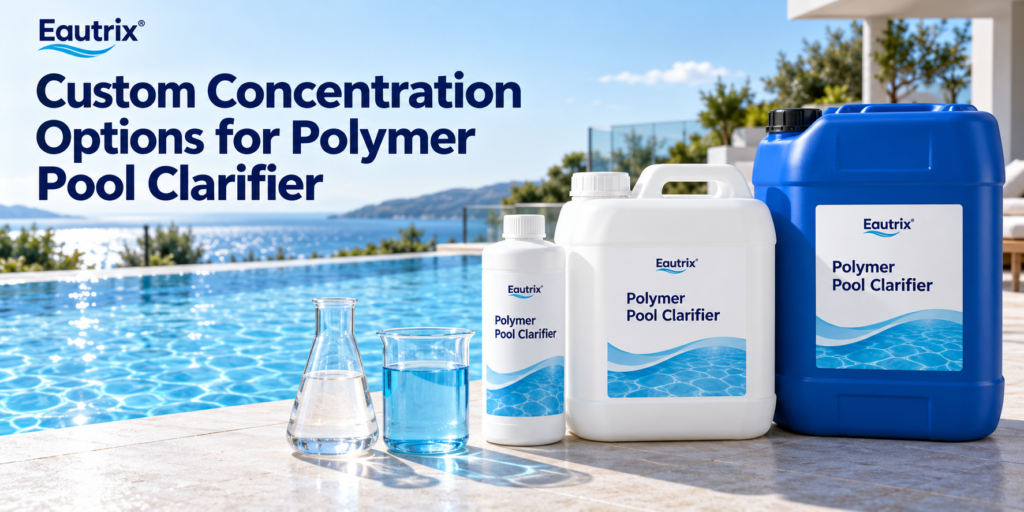
A pool chemical distributor may want a liquid clarifier that homeowners can measure with ease. A service company may prefer a concentrated product that takes up less room in the van. A private label brand may need a formula that fits an existing bottle, price point, and set of dosing instructions.
Each buyer wants clear pool water. Yet the right concentration may differ.
That’s why custom concentration deserves a closer look when developing a polymer pool clarifier. It affects much more than the percentage printed on a specification sheet. It shapes how the product is used, packed, shipped, priced, and understood.
A stronger formula can offer practical benefits. So can a more dilute one. The useful question is: Which concentration helps your customers get reliable results with the least confusion?
For distributors, pool brands, and professional suppliers, that question is a sound place to start.
What Does Pool Clarifier Concentration Actually Mean?
Concentration describes how much of a defined ingredient is present in the finished product.
For a PolyDADMAC-based pool clarifier, the figure might refer to active polymer content by weight. But buyers should confirm that definition before comparing offers. “10% polymer,” “10% solids,” and “10% added polymer solution” do not necessarily describe the same composition.
Here’s a simple example.
Suppose a manufacturer adds 10 kilograms of a raw material containing 20% active polymer to a finished batch weighing 100 kilograms. That raw material contributes 2 kilograms of active polymer. The finished batch therefore contains 2% active polymer by weight, assuming no other source of polymer.
It does not contain 10% active polymer.
That distinction can change a buying decision quite quickly.
A useful specification should identify:
- The polymer chemistry.
- The concentration and its measurement basis.
- Whether the stated value means active polymer or total solids.
- The agreed test method or calculation method.
- The acceptable production range.
A clear definition makes price comparisons, sample trials, and quality checks much easier.
Start With the Customer’s Pool, Then Choose the Percentage
It’s tempting to begin a sourcing discussion with one short request: “Please quote your strongest clarifier.”
A better starting point is the intended use.
Will the product sit on a retail shelf beside small residential pool supplies? Will technicians carry it between large outdoor pools? Will a distributor buy bulk material and prepare a finished product locally?
These uses place different demands on the same basic chemistry.
A homeowner may need a dose large enough to read clearly on a measuring cup. A trained technician may be comfortable measuring a smaller amount. A local blender may need a concentrate with detailed dilution and quality-control instructions.
Pool size matters, too. A dose that is easy to measure for a large commercial pool may be awkward for a small above-ground pool.
Before choosing a concentration, define the customer, the typical pool volume, the measuring tool, and the treatment purpose. The percentage should support those decisions.
Why Concentration Alone Cannot Predict Performance
Two products can have the same stated polymer content and still perform differently.
Polymer grade matters. So do molecular characteristics, the rest of the formulation, and the conditions in the pool. A percentage tells you how much polymer is present; it does not describe every feature that affects clarification.
This is a little like comparing two filters by their size alone. Size is useful information, but it cannot tell the whole story.
When evaluating samples, keep several factors in view:
- The nature and amount of suspended matter.
- Water balance and treatment history.
- The polymer grade used.
- Product dispersion during application.
- Circulation and filtration conditions.
- The dose applied.
The aim is to find a suitable working dose for the finished product under defined conditions. A concentration figure helps with that work, but it cannot replace it.
Buyers who want more background can read How Cationic Polymers Help Remove Suspended Particles from Pool Water.
Lower Concentration Can Make Sense for Retail Products
A more dilute formula can be a practical choice when ease of measurement is a priority.
Picture a pool owner trying to measure a very small dose with a broad bottle cap. The instructions may be correct, yet the tool makes accurate use difficult. A modest extra splash could represent a large dosing error.
A lower concentration may allow a larger, easier-to-read dose for the same amount of active polymer.
That can suit products intended for smaller pools, occasional users, or retail channels where customers receive limited technical advice. It may also help a brand build clear directions around familiar measuring equipment.
There are tradeoffs, of course. More finished liquid must be stored, packed, and transported to deliver the same polymer mass. A larger dose can also mean a bottle lasts for fewer treatments.
Neither point makes the formula a poor choice. It means the brand should judge the whole customer experience.
A product that people can measure correctly may offer more practical value than one that looks impressive on paper but causes repeated mistakes.
Where a 10% PolyDADMAC Clarifier Fits
Eautrix’s published Polymer Pool Clarifier uses PolyDADMAC, CAS No. 26062-79-3, with a stated active ingredient content of 10%. The product page also lists concentration adjustment, color customization, and private label support.
That gives buyers a defined starting point for discussion.
A 10% formulation can be evaluated against the target market’s pool sizes, dosing tools, packaging, and expected use. It should not be treated as a universal answer for every pool care brand.
For one buyer, it may provide a useful balance between dose size and pack size. Another may need a more dilute finished product. A professional supplier may want to explore a higher concentration, subject to formulation feasibility and testing.
The key is to compare actual use.
Can the customer measure the dose comfortably? Does the bottle pour cleanly? Are the directions easy to follow? Does the product perform consistently in the intended treatment program?
These questions give the percentage a practical meaning.
Higher Concentration Needs Better Dosing Control
A higher concentration can reduce the product mass required to supply a given amount of active polymer, provided the chemistry is otherwise comparable.
That may interest professional service companies and bulk buyers. Less finished liquid can mean fewer containers to handle and less storage space for the same active polymer quantity.
But a smaller dose requires suitable control.
If the recommended treatment calls for only a few milliliters, a rough capful is not a good measuring system. The product may need a graduated dispenser, a suitable measuring device, or a properly selected dosing pump.
Handling deserves attention as well. Changes in concentration can affect viscosity, pouring behavior, and pump performance. These effects depend on the polymer grade and formulation; they should be measured rather than assumed.
A concentrated product therefore needs more than a revised label. It needs a package and dosing method that help the user apply it accurately.
Any percentage above an established grade should be discussed as a development request until the manufacturer confirms feasibility, specifications, and validated directions.
Compare Concentration Routes Without Turning Them Into a Ranking
The following table shows useful development routes. It does not represent a confirmed catalog of available concentrations.
| Development route | Possible use | Main point to verify |
|---|---|---|
| Lower concentration than the reference formula | Retail products and smaller pools | Dose is easy to measure with the supplied tool |
| Established 10% formulation | Evaluation for distributor and private label programs | Performance and handling suit the intended market |
| Higher concentration than the reference formula | Professional use and bulk supply | Accurate dosing, viscosity, and packaging are suitable |
| Bulk concentrate for local blending | Buyers with controlled formulation facilities | Dilution process and finished-product quality are validated |
The table is a decision aid, not a strength chart.
A retail formula and a professional concentrate can each be well designed. Their success depends on how well they fit the work customers need to do.
A Simple Calculation Makes Comparisons Clearer
Concentration comparisons become easier when they use active polymer mass.
Consider two hypothetical products:
- Product A contains 5% active polymer by weight.
- Product B contains 10% active polymer by weight.
A 100-gram quantity of Product A contains 5 grams of active polymer. A 50-gram quantity of Product B also contains 5 grams.
On that basis, Product B supplies the same active polymer mass in half the product mass.
This is a calculation example, not a pool dosing recommendation. Equal polymer mass also does not prove equal performance if the products use different polymer grades or formulations.
Now consider a comparison made in milliliters. Density enters the picture.
Active polymer mass = product volume × product density × active polymer mass fraction
The units must be consistent. If volume is in milliliters and density is in grams per milliliter, the result is in grams.
This is why a buyer should avoid assuming that 100 milliliters of every clarifier weighs exactly 100 grams.
Keep “Product Dose” and “Active Dose” Separate
Dosing errors often start with a small ambiguity.
A technical note may say “apply 1 ppm” without explaining whether it means 1 ppm of finished product or 1 ppm of active polymer. Those are different quantities.
For a formula containing 10% active polymer by weight, a finished-product dose expressed on a mass basis delivers one-tenth that amount as active polymer.
The solution is straightforward: state the basis every time.
Consumer directions are usually easier to follow when they give a measurable finished-product quantity for a defined pool volume. Technical documents can include active polymer information where useful.
Also check the water-volume units. Liters, cubic meters, US gallons, and imperial gallons should never be left to guesswork.
A good label should make the next action obvious: how much product to measure, what volume of pool water it treats, and how to apply it.
More Polymer Does Not Always Mean Clearer Water
Polymer treatment has a useful dose range. Adding extra product can move the treatment outside that range.
Depending on the chemistry and conditions, excessive polymer can interfere with particle aggregation, contribute to renewed haze, or increase the load placed on the filter. Eautrix’s technical explanation discusses how excessive dosing can allow treated particles to become stable again.
This matters when developing a concentrated product.
The question is not just whether the formula works at its intended dose. It is also whether the measuring system helps customers stay near that dose.
During development, examine a range of treatment levels under controlled conditions. Record where useful performance begins, how results change, and what happens above the intended dose.
Then translate those findings into clear directions.
Avoid vague advice such as “add more until clear.” Persistent haze should prompt a check of the water, treatment history, and filtration system before another addition.
Blue Color and Polymer Concentration Are Separate Choices
A blue clarifier can look familiar and appealing on a pool chemical shelf. A clear formula can suit brands that prefer a simple, technical appearance.
Neither appearance establishes the polymer concentration.
A darker blue sample does not prove that it contains more active polymer. Dye level and polymer content are separate formulation variables.
For a private label project, specify them separately:
- The active polymer concentration.
- The desired liquid appearance.
- The dye shade and acceptable color range.
- The finished-product performance requirements.
Color should also be checked in the actual package. A sample that looks pale in a small glass vial may look much darker through a large container.
When comparing trial batches, use the same vessel, fill depth, lighting, and background. That small bit of discipline can prevent long email chains about whether the latest sample is “slightly too blue.”
Packaging Should Help the User Get the Dose Right
Concentration and packaging belong in the same conversation.
A bottle is part of the application system. Its neck, cap, grip, and pouring behavior all affect how easily someone can measure the product.
A smaller retail pack may suit a graduated cap or separate measuring cup. A larger professional container may need a controlled dispensing arrangement. A bulk supply program may need transfer equipment and a written handling procedure.
Before approving the package, try it with the actual formula.
Check whether the liquid pours smoothly, leaves residue around the neck, or becomes difficult to handle at the lower end of the intended storage range. Confirm that the closure seals well and that the label remains readable after normal handling.
Also distinguish nominal container capacity from net contents. A container described by its liter capacity does not automatically contain the same numerical mass in kilograms.
Clear fill specifications protect both the buyer and the supplier.
Can Buyers Dilute a Concentrate Locally?
Local dilution may suit a buyer that already has suitable equipment, trained staff, and a controlled blending process.
It can also create extra work.
Dilution changes the finished formulation. Water quality, mixing accuracy, equipment cleanliness, storage conditions, and any preservation system must be considered. A concentrate’s shelf-life claim should not automatically be applied to a diluted product.
For a simple mass-balance example, 50 kilograms of a 20% active polymer solution contains 10 kilograms of active polymer. Adding 50 kilograms of suitable water produces 100 kilograms at a theoretical active polymer content of 10%.
That calculation is only the starting point.
It does not prove that the blend meets requirements for appearance, stability, microbial quality, handling, or pool performance. The finished product still needs an approved specification and suitable checks.
For a buyer without blending facilities, importing the finished concentration may be the more manageable route.
Ask for Tests That Reflect Real Use
A sample should be tested against a written plan.
Begin by defining the water conditions and the result being assessed. Then compare doses in a controlled way. Keep records of the product batch, concentration basis, treatment quantity, mixing conditions, and observation times.
Laboratory screening can help narrow the choices, but it should be followed by trials that reflect the intended application.
Where a filter is part of the treatment, a clear-looking beaker alone cannot show how the product will behave through that filter.
Useful trial observations may include:
- Changes in measured turbidity.
- Visible haze over time.
- Filter pressure and cleaning needs.
- Ease of measuring and applying the dose.
- Any unwanted appearance or residue.
Do not promise compatibility with every sand, cartridge, or diatomaceous earth filter based on polymer identity alone. Check the finished product’s directions and the relevant equipment instructions.
Compare Cost per Treatment, Not Just Price per Drum
The lowest price per kilogram may not produce the lowest cost in use.
For the same polymer chemistry and comparable quality, cost per kilogram of active polymer is a useful first comparison. Divide the product price per kilogram by its active polymer mass fraction.
For example, a hypothetical product priced at $1.00 per kilogram with 10% active polymer has a raw product cost of $10.00 per kilogram of active polymer.
That still leaves freight, packaging, handling, and other costs.
A fuller comparison uses the validated finished-product dose for a defined pool volume. Add the costs that belong to the buyer’s supply model, including local blending or repacking where relevant.
Concentrates may reduce some transport and container needs. Finished retail products may reduce local processing work.
The right choice depends on the complete cost of getting a reliable treatment into the customer’s hands.
Build a Clear Customization Brief Before Requesting a Quote
A detailed inquiry helps the supplier propose a useful formula and reduces avoidable revisions.
Include the target customer, typical pool sizes, preferred packaging, sales market, expected order quantity, and intended application method. State whether the requested percentage means active polymer by weight.
If you already sell a clarifier, share the relevant performance requirements and dosing format. A reference sample can support comparison, but appearance alone cannot define its composition.
Ask the supplier to identify which requirements are established and which need development.
For the approved formula, agree on specifications such as polymer content, appearance, pH, density, and viscosity where relevant. Request documentation that describes the supplied formulation, including a technical data sheet, safety data sheet, and batch certificate of analysis as appropriate.
Eautrix’s Polymer Pool Clarifier page provides a starting point for discussing concentration, color, packaging, and private label requirements.
Choose the Concentration Your Customers Can Use With Confidence
A successful custom clarifier brings several decisions together: suitable chemistry, a validated dose, practical packaging, clear instructions, and consistent supply.
The concentration supports all of them.
For a retail brand, the strongest feature may be a dose that customers can measure easily. For a professional supplier, it may be a compact product with a dependable dispensing method. For a bulk buyer, it may be a concentrate backed by a controlled local blending process.
Start with the customer’s task. Test the proposed formula. Then choose the concentration that makes reliable use straightforward.
That is how a percentage becomes a product people trust.
Frequently Asked Questions
1. What is the best concentration for a private label polymer pool clarifier?
There is no single best concentration. The choice depends on pool size, customer experience, measuring equipment, packaging, and validated performance. Define the intended use before selecting the percentage.
2. Can a 10% PolyDADMAC pool clarifier be customized to a different concentration?
Concentration adjustment can be discussed with the manufacturer. The proposed formula needs confirmation of feasibility, specifications, stability, and dosing directions before commercial supply.
3. Does a concentrated polymer pool clarifier always work faster?
No. Clearing time depends on the finished formulation, dose, suspended matter, circulation, and filtration. A higher concentration supplies more polymer per unit of product, but does not by itself prove faster results.
4. Can a distributor dilute bulk polymer pool clarifier before bottling?
Potentially, with a manufacturer-approved process and suitable quality controls. The diluted product needs its own verified specification, storage guidance, and supported shelf life.
5. Is dark blue pool clarifier stronger than clear pool clarifier?
Color does not establish active polymer content. Compare the stated concentration basis, polymer grade, batch quality, and application performance rather than the shade of the liquid.