
GET IN TOUCH
Ask For Sample?
Custom Blue Polymer Pool Clarifier Manufacturing: What Buyers Should Know
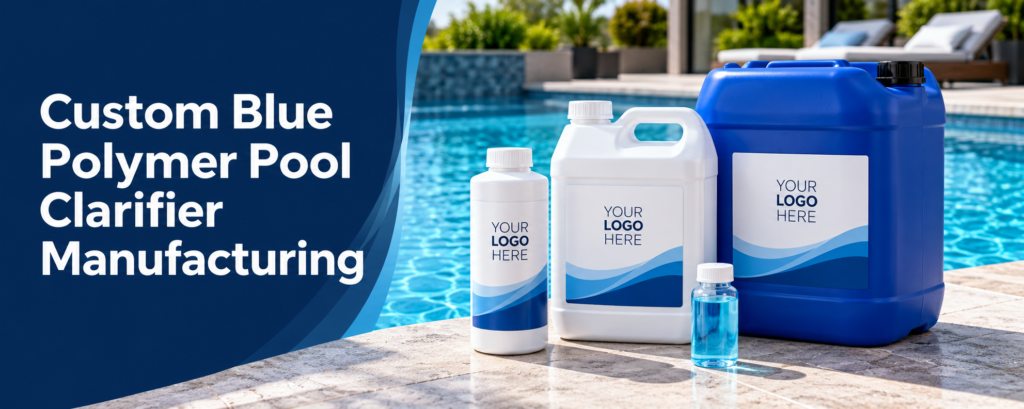
A pool clarifier needs to do two jobs well. It should help improve water clarity, and it should give customers confidence in the product they’re using.
For a pool chemical brand, appearance can play a part in that first impression. A clear, light blue liquid looks at home in a swimming pool care range. It can also help distinguish a clarifier from other products on the shelf.
But color is only one part of the buying decision.
The polymer, concentration, packaging, stability, instructions, and quality controls all affect whether the finished product is suitable for your market. A beautiful blue liquid won’t make up for unclear dosing directions or inconsistent batches.
So, what should you discuss with a manufacturer before placing an order? Let’s take a closer look.
What Is a Custom Blue Polymer Pool Clarifier?
A custom blue polymer pool clarifier is a liquid pool care product that contains a polymer selected to help improve water clarity. The manufacturer adds a suitable blue colorant to give the finished product the appearance requested by the brand or distributor.
The word custom can cover several things:
- The shade and intensity of the blue liquid
- Polymer type and concentration
- Bottle or container size
- Label design and brand name
- Packaging and shipping arrangements
- Product documentation and agreed specifications
The exact choices depend on the manufacturer’s capabilities and the buyer’s target market.
For example, a retail brand may want a light blue clarifier in a 1 L bottle with a colorful label. A pool service distributor may prefer the same general product concept in a 5 L or 25 L container with practical dosing information.
Both buyers want clear water. Their packaging and commercial needs, though, can be quite different.
Eautrix offers a Polymer Pool Clarifier based on PolyDADMAC technology, with original or blue appearance and private-label support available for discussion.
How Does a Polymer Pool Clarifier Work?
Pool water can look cloudy when small particles remain suspended in it. These particles may come from dust, pollen, body oils, organic material, or other sources.
Some particles are so fine that a pool filter may struggle to capture them efficiently. A polymer clarifier helps these small particles come together into larger groups, making them easier for a suitable filtration system to remove.
Think of it like collecting flour from a countertop. Fine powder is difficult to pick up one speck at a time. Once it gathers into larger clumps, it becomes easier to collect.
That comparison is simple, of course. Actual results depend on the polymer, the particles in the water, the dose, water conditions, circulation, and filter performance.
A clarifier supports filtration. It doesn’t replace filtration, balanced water, or an appropriate sanitizer. The U.S. Centers for Disease Control and Prevention discusses coagulation as one way to enhance filtration performance in pool systems.
For more background on the chemistry, see How Cationic Polymers Help Remove Suspended Particles from Pool Water.
Why Do Buyers Choose a Blue Pool Clarifier?
Blue is a familiar color in the pool care market. It reminds customers of clean water, and it can make a product range look coordinated.
For a private-label brand, that visual connection can be useful. A blue clarifier may stand out from a clear product when displayed in transparent packaging or shown in marketing images. It may also fit the color scheme used across labels, cartons, and sales materials.
There’s another practical point: when a service company handles several liquids, a distinct appearance can support product recognition. Even so, staff must always identify a product by its label. Color alone is never a reliable substitute.
A blue appearance can help a brand tell its story, but it shouldn’t be presented as proof of stronger performance.
Does a darker blue mean a stronger clarifier?
No. The color intensity does not tell you how much active polymer the product contains or how well it will clarify water.
A pale blue clarifier can contain more polymer than a darker product. Likewise, two liquids with a similar blue shade can have different formulations and application rates.
When comparing products, ask for the technical specification and recommended use rate. Those details tell you much more than the color.
Start With the Polymer, Not the Color
Before deciding on a shade, ask what type of polymer the manufacturer uses and why it suits your intended application.
One polymer used in pool clarification is PolyDADMAC, short for polydiallyldimethylammonium chloride. It is a cationic polymer, which means it carries a positive charge in water. That charge helps it interact with certain suspended particles.
PolyDADMAC products are not all identical. Differences in concentration and other polymer properties can affect how a formulation behaves. A finished pool clarifier may also contain other components selected for its intended use.
When discussing the formulation, ask the supplier:
- What is the main polymer in the finished product?
- What is its target concentration, and how is that concentration expressed?
- Which properties are controlled for each batch?
- Is the product designed for routine maintenance, cloudy water treatment, or both?
- What testing supports the proposed use instructions?
- Can the supplier provide a technical data sheet and safety data sheet for the finished formulation?
A meaningful conversation about those questions is often more useful than asking for “the strongest product.”
A concentrated formula may reduce the amount needed per treatment, but the actual dose depends on the product and the condition of the water. Higher concentration also makes accurate dosing more important.
You can learn more about the ingredient in Why PolyDADMAC Is Suitable for Swimming Pool Water Clarification.
What Does “10% Polymer” Actually Mean?
A buyer may request a 10% polymer pool clarifier, but that description needs a little care.
Does “10%” refer to the active polymer content in the finished product? Or does it mean that 10% of a polymer solution was added during production?
Those are different statements.
For example, adding a polymer solution that contains 40% active matter to a formulation at a 10% addition rate would contribute approximately 4% polymer active matter to the final product, assuming the values are expressed on the same weight basis.
The distinction can affect price comparisons, product claims, and dosing.
Before approving a specification, agree on:
- The substance being measured: polymer active matter or the amount of supplied polymer solution.
- The basis of the percentage: by weight or another stated basis.
- The target value and acceptable range.
- The test method or calculation used.
- How the result will appear on the certificate of analysis, if applicable.
This is one of those small details that can prevent a large misunderstanding later.
If a supplier proposes a 10% PolyDADMAC-based finished clarifier, ask for the exact definition in writing. Don’t assume that every supplier uses the same wording.
Choosing the Right Shade of Blue
“Blue” covers a surprisingly wide range—from a faint tint to a deep, vivid color.
A buyer may prefer:
- Light blue: A subtle, clean appearance that can suit a premium retail product.
- Medium blue: A more visible color for product identification and display.
- Deep blue: A bold appearance that may appeal to certain markets or packaging designs.
The right shade depends on how the product will be sold and used.
A transparent bottle shows the color directly. An opaque white bottle does not, so the customer may only see the liquid when opening or pouring the product. A blue 25 L container can look attractive, but it also hides the color of the contents.
Before choosing a shade, consider the full customer experience. Will your buyer see the liquid on a shelf, in a sample bottle, or only during use?
How can you make the color consistent?
Start with an approved physical sample. Photos are useful for the first discussion, but screen settings and lighting can change how a color looks.
A practical approval process may include:
- The buyer provides a target sample or reference.
- The manufacturer prepares one or more laboratory samples.
- Both parties review the samples in a suitable container and under agreed lighting.
- The chosen sample becomes the reference for future production.
- The supplier and buyer agree on an acceptable variation range.
If precise matching matters, discuss whether the manufacturer can use an instrumental color measurement and specify the method. Otherwise, a retained reference sample and agreed visual inspection conditions can help reduce disagreements.
Remember that the container matters. The same liquid can look different in a narrow sample bottle and a large container.
Is the Blue Colorant Compatible With the Formula?
A colorant should do more than produce an attractive shade. It must also remain suitable in the complete formulation throughout the intended storage period.
Ask the manufacturer how the proposed colorant is selected and tested. Relevant questions include:
- Is it compatible with the polymer solution?
- Does the liquid remain clear and uniform?
- Does the color change during storage?
- Is the colorant suitable for the intended product and destination market?
- Is there any evidence of staining at the recommended dose?
- Does the colorant affect packaging compatibility or the product’s test results?
The answer should come from testing the finished formula, not simply from the colorant’s appearance when first added.
A blue liquid that looks perfect on production day may change after exposure to heat, cold, or light. The polymer solution, water quality, colorant, and packaging can all influence the final result.
That’s why a buyer should review a representative sample in the proposed packaging whenever practical.
What Should Be Included in a Finished Product Specification?
A specification gives both parties a shared description of what is being purchased. It doesn’t need to be complicated, but it should be clear enough to support production and inspection.
For a custom blue polymer pool clarifier, the specification may cover:
| Item | What to agree on |
|---|---|
| Appearance | Clear, translucent, or other agreed appearance; presence or absence of visible particles |
| Color | Approved blue reference and acceptable variation |
| Polymer content | Target, range, basis, and method of determination |
| pH | Test conditions and acceptable range |
| Density | Test temperature and acceptable range, if relevant |
| Viscosity | Test temperature, method, and range, if relevant |
| Packaging | Container material, nominal size, closure, and label |
| Batch identification | Format and location of batch number |
| Shelf life | Proposed period and storage conditions, supported by available data |
| Documents | Agreed technical, safety, quality, and shipping documents |
Not every property needs a numerical limit for every product. The right list depends on the formula, production method, and buyer’s requirements.
What matters is that the values and methods are agreed upon before commercial production—not after the goods are packed.
Ask About Water Quality and Manufacturing Controls
A pool clarifier may look simple in the bottle, but consistency depends on the details behind it.
The water used for dilution, the quality of raw materials, the sequence of addition, and mixing conditions can all influence the finished liquid. Even a small variation in a colorant addition may be visible in a lightly tinted product.
A buyer doesn’t need to know every part of a supplier’s confidential process. But it is reasonable to ask how the manufacturer controls the result.
Useful questions include:
- How are incoming raw materials identified and checked?
- What type of water is used in the formulation?
- How is the product mixed to achieve a uniform batch?
- How are color, appearance, and other agreed properties checked?
- Are samples retained from each batch?
- How can a batch be traced if a customer raises a complaint?
- What happens if a batch falls outside the agreed specification?
A certificate of analysis is helpful, but it is most useful when it reports the properties and methods that were actually agreed upon.
And one more thing: a certificate by itself does not prove that every performance claim has been tested. Ask for the evidence behind any specific claim that matters to your market.
How Should Buyers Evaluate Performance?
A good-looking sample is a starting point. It is not the whole evaluation.
Clarifier performance can vary with pool water conditions, the nature of the suspended material, circulation, and the filtration system. A product that performs well in one test may behave differently in another pool.
For a more useful comparison, ask the manufacturer about testing with:
- A defined water sample or reproducible test water
- A known or described source of cloudiness
- Measured doses
- A consistent mixing procedure
- A stated settling or filtration period
- A way to observe or measure changes in water clarity
- A comparison with an untreated control
A laboratory jar test can help screen formulations, but it cannot reproduce every condition in an operating pool. If the product is intended for a particular market or professional application, consider a controlled field trial as well.
Record the starting conditions and the results. If the water clears, you’ll want to understand what was done—not simply remember that the sample “worked.”
For more detail on the process, see Understanding Polymer-Based Pool Water Clarification.
Does the Clarifier Work With Every Pool Filter?
Don’t assume that every clarifier works with every filter in every situation.
Pool filtration systems differ. Sand, cartridge, and diatomaceous earth filters have different operating needs, and the condition of the filter matters too.
Ask the supplier which filter types the finished product is intended for and what evidence supports those instructions. If your customers use a particular type of system, make that clear during product development.
The label should also explain any relevant steps for filtration and filter maintenance. If a product is overdosed, excess polymer or accumulated material may cause operating problems, depending on the formulation and system.
A practical label helps users avoid the familiar mistake of thinking, “If a little works, more must work faster.”
Why Stability and Packaging Tests Matter
A shipment may travel through warm ports, cool warehouses, and long distribution routes before it reaches the final customer. Your product should be evaluated with that journey in mind.
Ask what stability information is available for the finished formulation and the proposed container. Depending on the product and market, the manufacturer may assess:
- Appearance and color over time
- pH and other agreed properties
- Separation, sediment, or visible particles
- Changes under elevated or low temperatures
- Effects of light exposure
- Container deformation, leakage, or closure performance
- Label adhesion and readability
Accelerated testing can help identify possible issues sooner, but it does not automatically establish a real-time shelf life. Ask what data support the shelf-life statement and storage conditions.
Packaging compatibility deserves its own discussion. A container that looks suitable may still need checking for leakage, closure integrity, and suitability with the actual formulation.
If your market experiences very hot summers or cold winters, share that information early. A sample approved in a comfortable office tells you only part of the story.
Which Packaging Size Fits Your Market?
Packaging affects more than appearance. It changes how customers carry, store, dose, and reorder the product.
Eautrix offers pool clarifier packaging in 1 L, 5 L, and 25 L formats, with customization available for discussion. eautrix.com
| Pack size | Potential users | Buying considerations |
|---|---|---|
| 1 L | Retail shops, residential pool owners, online sellers | Shelf appeal, easy handling, clear directions, label space |
| 5 L | Pool service companies, installers, smaller commercial users | Balance between carrying convenience and purchase volume |
| 25 L | Distributors, professional service teams, commercial buyers | Storage, lifting and pouring, closure strength, unit cost |
These are general starting points. The right size depends on the recommended dose, customer demand, local preferences, and distribution model.
A retail customer may appreciate a compact bottle that fits on a shelf. A service company may care more about how easily its staff can pour from a container at several sites in one day.
For some markets, bulk supply followed by local filling may also be worth discussing. Before choosing that route, check the suitability of local handling facilities, legal responsibilities, quality controls, and packaging arrangements.
What Should Go on a Private-Label Clarifier?
A strong label combines brand identity with instructions that a customer can actually follow.
Depending on the destination market and finished formulation, label information may include:
- Product and brand name
- Intended function
- Net contents
- Directions for use and dosing
- Handling and storage information
- Relevant hazard and precautionary statements
- Batch number and other required identifiers
- Manufacturer, importer, or responsible business details
- Any locally required language or regulatory information
The exact requirements vary by market and product. Have the final artwork reviewed against the finished formula, current safety data sheet, and applicable local rules before printing.
Be especially careful with claims.
“Helps improve water clarity” describes a clarification function. Claims about killing algae, bacteria, or other organisms can trigger different regulatory requirements. In the United States, for example, EPA advises users to use an EPA-registered product for control of microorganisms or algae in pool and spa water.
If you plan to sell in several countries, review the proposed wording for each destination. A label that works in one market may need changes elsewhere.
Which Documents Should a Buyer Request?
Before placing a commercial order, agree on the documents required for your product and destination.
A typical request may include:
Technical data sheet (TDS). This describes the product’s intended use and relevant technical information.
Safety data sheet (SDS). This provides information on hazards, handling, storage, transport, and emergency measures for the finished product. It should reflect the actual formulation and be suitable for the relevant market.
Certificate of analysis (COA). This reports agreed quality results for the batch or shipment, according to the supplier’s testing process and the purchase agreement.
Commercial and shipping documents. These may include a commercial invoice, packing list, and other documents required for the transaction.
Supporting information for claims or compliance. The exact documents depend on the market, formulation, intended use, and claims.
Don’t leave document questions until the shipment is ready. If a distributor needs a particular product name, language, or format, discuss it before production.
Also, make sure the trade name used on commercial documents remains consistent with the actual goods and any applicable disclosure requirements. Private labeling changes the brand presented to customers; it does not remove legal responsibilities for product identification or safety information.
How Are Minimum Order Quantities and Prices Set?
Buyers often want one quick answer: “What is your MOQ?”
It’s a fair question, but the answer can depend on several choices:
- Whether the formulation is standard or customized
- The amount of product ordered
- Container size and availability
- Custom label printing requirements
- Carton design and printing quantity
- The number of different pack sizes
- Testing and documentation requests
- Delivery terms and destination
A custom color may be relatively straightforward for one supplier and require additional setup or testing for another. A fully printed bottle or custom carton may also have its own minimum quantity.
When comparing quotations, ask what is included. A lower price per kilogram may not include the same packaging, artwork, tests, or shipping terms.
It helps to compare the cost per treatment, too. If two products have different concentrations and recommended doses, the cheapest container is not necessarily the least expensive product for the end user.
Use the supplier’s supported dose for the intended application, then calculate:
Product cost per treatment = amount used per treatment × product cost per unit
This comparison is only useful when the products are assessed for a similar purpose and under comparable conditions.
A Practical Path From Inquiry to Production
A custom clarifier project is easier when both sides know what they are trying to achieve.
Here is a simple process that buyers can use.
1. Describe your target customer
Are you selling to homeowners, pool stores, service companies, hotels, or distributors?
Tell the manufacturer about the pool types, filter systems, climate, and market where the product will be sold. The more relevant the brief, the easier it is to propose a suitable product.
2. Define the product concept
Discuss the polymer type, desired concentration, appearance, pack size, and expected product position.
You do not need to arrive with every technical answer. But you should be clear about your intended use and any requirements that are non-negotiable.
3. Request and evaluate samples
Review the color and appearance, then assess performance using a suitable test plan. If possible, include the proposed packaging in the evaluation.
Keep a record of the sample version and test conditions. Small changes can otherwise be hard to track.
4. Agree on the specification
Confirm the properties, ranges, methods, reference sample, packaging, and documents in writing.
This step protects both the buyer and the manufacturer. It also gives the production team a clear target.
5. Approve artwork and commercial terms
Check the label text, languages, product name, container details, order quantity, pricing, delivery terms, and lead time.
Ask who is responsible for final regulatory review in the destination market. That responsibility should be clear.
6. Review the first commercial batch
Request the agreed quality documents and check the packed product against the approved sample and artwork.
If you plan to reorder, record any feedback from distributors or end users. A useful first order can teach you what needs improvement before the next one.
Common Buying Mistakes to Avoid
A few issues come up often when buyers focus too heavily on the appearance or price of a product.
Mistake 1: Comparing products by color.
Blue shade does not reveal polymer content or effectiveness. Compare specifications, test results, and recommended doses instead.
Mistake 2: Leaving “10%” undefined.
Confirm whether the number refers to active polymer in the finished product or the addition rate of a polymer solution.
Mistake 3: Approving a photo instead of a sample.
A photo can start the conversation, but an agreed physical reference is more useful for color approval.
Mistake 4: Skipping packaging checks.
The liquid and container need to work together through storage and transport.
Mistake 5: Using broad claims without support.
Keep label claims consistent with the product’s evidence and the rules in the destination market.
Mistake 6: Ignoring customer instructions.
Even a well-made clarifier can disappoint users if the directions are confusing or incomplete.
The best time to resolve these points is before labels are printed and containers are filled.
Can Eautrix Help With a Custom Blue Clarifier?
If you are building or expanding a pool care range, Eautrix can discuss a PolyDADMAC-based polymer pool clarifier for distributor and private-label projects.
Available options for discussion include a blue appearance, 1 L, 5 L, or 25 L packaging, and branded labels. Specific formulation, packaging, documentation, order quantity, and lead-time requirements should be confirmed for each project.
To make an inquiry more useful, share:
- Your destination market
- Your target customers and intended application
- Preferred polymer concentration or product specification
- Desired blue shade or a reference sample
- Preferred container size and estimated order quantity
- Required labels and documents
- Any planned performance claims
You can start with the Eautrix Polymer Pool Clarifier product page and request further details for your project.
A successful blue clarifier is more than an attractive liquid. It is a product whose appearance, performance, instructions, packaging, and documentation work together—and whose quality can be repeated from one order to the next.
Frequently Asked Questions
1. Does a blue polymer pool clarifier work better than a clear clarifier?
Not because it is blue. The color is mainly an appearance choice. Performance depends on the polymer formulation, dose, water conditions, circulation, and filtration.
2. Can I customize the blue color of a private-label pool clarifier?
Color customization may be available, subject to formulation compatibility and an agreed reference sample. Ask the manufacturer about shade matching, stability testing, and acceptable variation between batches.
3. What is the difference between 10% polymer content and a 10% polymer solution addition?
A 10% polymer content describes the amount of polymer in the finished product when clearly defined on a stated basis. A 10% addition of a polymer solution describes how much solution was added; its actual polymer contribution depends on the concentration of that solution.
4. Which packaging is suitable for a private-label blue pool clarifier?
The choice depends on your customers. A 1 L bottle may suit retail buyers, while 5 L and 25 L containers may be more practical for service companies and distributors. Confirm container compatibility and closure performance for the finished formula.
5. Can a polymer pool clarifier replace chlorine or an algaecide?
No. A clarifier is intended to help improve water clarity through particle removal. Use appropriate sanitizers and, where needed, algae-control products according to their labels and local requirements.