
GET IN TOUCH
Ask For Sample?
How to Develop Your Own Private Label Pool Clarifier?
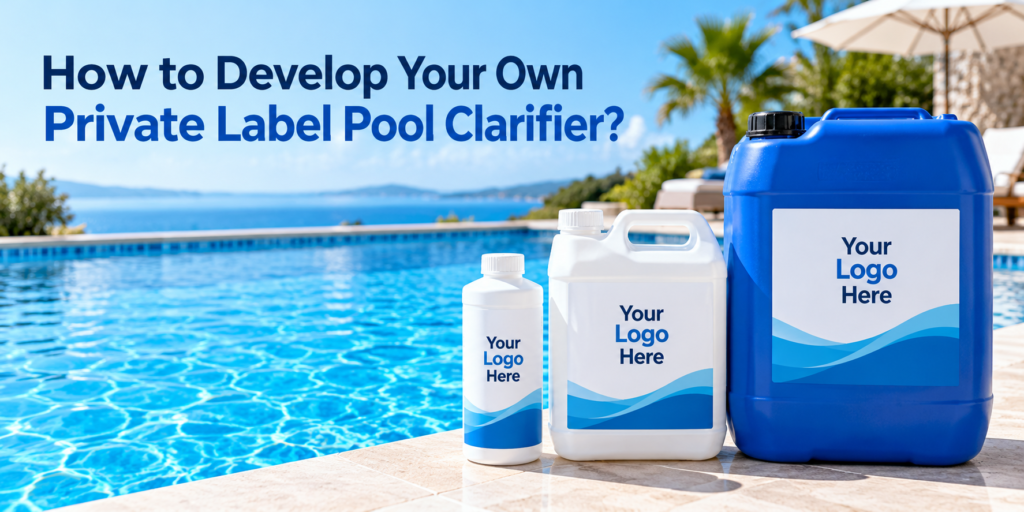
A private label pool clarifier can be a useful addition to a pool care range. It addresses a problem many pool owners know well: water that looks dull or cloudy even though the pump is running and the pool is being maintained.
For a distributor or pool chemical brand, the opportunity is straightforward. Customers want clear water, and they want a product that is easy to understand and use. A well-developed clarifier can help meet that need while carrying your brand name.
But putting your label on a bottle is only one part of the job.
You also need to decide who will use the product, what kind of performance they expect, which package suits them, and how you will confirm quality before placing an order. The formula, label, and sales claims all need to work together.
So, where should you begin?
Let’s walk through the process, from the first product idea to a private label pool clarifier that is ready for your market.
What Is a Private Label Pool Clarifier?
A private label pool clarifier is a water clarification product made or supplied by one company and sold under another company’s brand.
For example, a pool chemical distributor may work with a manufacturer to supply a liquid polymer clarifier. The distributor sells the product under its own brand, using its preferred label design and selected packaging.
The level of customization can vary. One buyer may use an existing formula and add its own label. Another may request changes to concentration, color, package size, or other product features.
Some suppliers use the term OEM, or original equipment manufacturing, for these services. In pool chemicals, the practical question is less about the name and more about which parts of the product can be customized and who is responsible for each step.
Eautrix offers a polymer pool clarifier with OEM and private label support for buyers developing pool care products.
First, Decide Who Your Clarifier Is For
Before discussing colors or bottle designs, think about the person who will use the product.
A homeowner shopping for a small bottle has different needs from a pool service company treating several pools every day. A distributor supplying hotels may have another set of requirements altogether.
Ask yourself:
- Will the product be sold to homeowners or professionals?
- Is it for residential pools, commercial pools, or both?
- Will customers buy it in retail stores, online, or through a distributor?
- Do they prefer a ready-to-use product or a more concentrated formulation?
- What package size can they handle and store comfortably?
- What directions and language will they expect on the label?
These answers shape almost every later decision.
For a retail product, a compact bottle, clear directions, and an easy-to-read dosage chart may matter most. For a professional product, buyers may focus on cost per treatment, larger containers, reliable supply, and documentation.
You don’t need to serve every customer with one bottle. In fact, starting with one clear audience often makes development much easier.
Understand What a Pool Clarifier Can—and Cannot—Do
A clarifier helps improve water clarity by helping fine suspended particles come together. Once those particles form larger groups, the filtration system may capture them more easily.
Think of it as helping a filter catch what it might otherwise miss. The clarifier and the filter do different jobs, but they need each other.
Pool water can become cloudy for many reasons, including fine debris, heavy use, poor filtration, or water chemistry problems. A clarifier may help with suspended particles, but it does not fix every cause of cloudy water.
For example, it does not replace:
- Routine filtration and filter cleaning
- Proper water balance
- An appropriate sanitizer
- Treatment for an active algae problem
- Repair of faulty circulation equipment
This distinction matters when you write your label. A customer who understands what the product does is more likely to use it correctly—and less likely to expect it to solve a problem outside its intended purpose.
For a broader introduction, see Pool Clarifier Explained: A Beginner’s Guide to Clearer Pool Water.
Choose the Right Clarifier Technology
There is more than one way to formulate a pool clarifier. The right choice depends on the desired performance, target market, filter systems, price point, and the supplier’s technical capabilities.
One option is a cationic polymer clarifier. “Cationic” means the polymer carries positive charges. Those charges can help bring together some negatively charged particles suspended in water.
A common polymer used in this type of formulation is PolyDADMAC, also known as poly(diallyldimethylammonium chloride).
That name is a mouthful, but the buying decision can be kept practical: you need to know how the finished product performs, how it should be used, and whether the supplier can provide consistent batches.
A polymer’s identity alone does not tell you everything about a finished clarifier. Products based on the same general polymer can differ in concentration, viscosity, performance, and recommended dosage. Ask for the specification of the finished product, rather than relying on the ingredient name alone.
You can read more in How PolyDADMAC Is Used in Polymer Pool Clarifier Formulations.
Decide Whether to Use an Existing Formula or Request Changes
Most private label projects start with one of two approaches.
Use an existing formulation
Here, the manufacturer supplies an established product with your branding and agreed packaging.
This can be a practical starting point if you want to enter the market without a lengthy formulation project. You can evaluate a sample, review its documentation, and focus on the label and package.
An existing formula may also suit brands that want to test demand before committing to a larger product range.
However, an existing product is not automatically right for every market. You should still confirm performance, compatibility, legal requirements, and the product claims you plan to make.
Request a customized formulation
A custom project may involve changes to one or more features, such as:
- Polymer concentration
- Product color
- Viscosity
- Appearance
- Packaging format
- Product specifications
The supplier should confirm which changes are feasible and how they may affect performance, stability, cost, and minimum order quantity.
A change that looks small on paper can affect the rest of the product. For instance, adding a colorant may require further stability checks. Increasing concentration may change viscosity or how easily the product can be poured.
The lesson? Agree on the purpose of each change before asking for it. A distinctive product is useful only if it also works well.
What Concentration Should Your Pool Clarifier Have?
Concentration influences the amount of product needed for treatment, but it is only one part of the performance picture.
For example, a supplier may offer a polymer pool clarifier containing approximately 10% PolyDADMAC. That can be a starting point for discussion, provided the supplier confirms the specification and recommends directions for the actual finished formula.
A higher concentration may reduce the volume needed per treatment. It may also affect viscosity, handling, packaging, and cost. A lower concentration may be easier for some customers to measure, although they may need a larger dose.
Ask the manufacturer:
- How is the polymer concentration defined and tested?
- What dosage range is recommended for this specific product?
- What water conditions and filter systems were used to develop that guidance?
- How does the product behave if too much is added?
- What is the estimated cost per treatment?
The last question is especially useful. A cheaper price per liter does not always mean a lower cost for the user.
For example, if one product costs more per bottle but treats more water at its recommended dose, the cost per treatment may be similar—or lower. Compare products using the same pool volume and the supplier’s documented directions.
Clear or Blue: Which Appearance Fits Your Brand?
Many pool clarifiers are clear or lightly colored. Some brands prefer a blue product because the color fits the visual language of pool care.
Both approaches can work.
A clear product may suit a simple, professional look. A light blue product may be easier to connect with a broader pool care range. The choice depends on how you want the product to appear on the shelf and how it fits with your other packaging.
That said, color is not proof of clarification performance. A blue clarifier is not automatically stronger or faster than a clear one.
If you request a custom color, discuss:
- The desired shade and appearance
- Whether the color remains stable during storage
- Whether light or temperature may affect the appearance
- Compatibility with the bottle and label
- Any applicable local requirements for the colorant
Ask to approve a physical sample whenever possible. Colors can look quite different in a digital image, inside a bottle, or under store lighting.
Select Packaging That Matches How Customers Buy
Packaging affects more than shelf appeal. It affects shipping, storage, handling, and how easily customers use the product.
Eautrix offers pool clarifier packaging in 1 L, 5 L, and 25 L formats, with private label options available for discussion.
| Package size | Potential customer | Main consideration |
|---|---|---|
| 1 L | Retail buyers and homeowners | Convenient handling and shelf display |
| 5 L | Pool service companies and frequent users | Balance between capacity and portability |
| 25 L | Distributors and commercial users | Larger volume for regular professional use |
These are starting points, not strict rules. A retail buyer might prefer a larger container, while a professional may want smaller packs for specific jobs.
Also check the details behind the container:
- Bottle or container material
- Closure and seal design
- Leak resistance
- Handle strength
- Label surface and dimensions
- Carton configuration
- Pallet arrangement
- Compatibility with the formulation
- Requirements for transport and the destination market
A package that looks attractive in a catalog still needs to survive filling, storage, loading, and delivery.
Build a Label That Helps Customers Use the Product
A good label does more than display your logo. It helps the buyer understand what is inside, what the product does, and how to use it safely.
Depending on the destination market and product classification, label content may include:
- Product name and intended use
- Net contents
- Directions and dosage
- Relevant safety statements
- Storage guidance
- First-aid information
- Batch or lot identification
- Supplier or responsible-company details
- Required hazard information and pictograms
- Language required in the destination market
The final label should be checked against the rules that apply to the specific product and market. Do this early, before printing thousands of labels.
Your marketing claims deserve the same care. If the product is intended only to help clarify water, describe that function clearly. Avoid adding claims about killing algae, bacteria, or other organisms unless the product is authorized for those claims in the relevant market.
For example, in the United States, claims to control algae or microorganisms can make a pool product subject to pesticide requirements. The EPA also advises businesses to seek guidance when they are unsure whether a product requires registration.
A pool clarifier may be one item in a complete maintenance line, but the claims for each item must match its legal status.
Request Samples Before You Approve the Product
A sample gives you a chance to look beyond a product description and see how the clarifier behaves.
Before requesting one, tell the supplier what you want to evaluate. A useful sample request might include:
“We are developing a private label polymer pool clarifier for residential pools. Please provide a sample, product specification, recommended dosage, safety data sheet, and available packaging details.”
When the sample arrives, record its appearance and compare it with the supplier’s description. Check whether it pours as expected and whether the package closes properly after use.
For performance testing, agree on a simple plan with the supplier or a qualified laboratory. Consider:
- A comparison with an untreated water sample
- The types of particles creating turbidity
- Water temperature and relevant water chemistry
- Product dose and mixing procedure
- Time allowed for treatment
- The filter or filtration method used
- How clarity will be measured and recorded
A jar test can be useful for comparing formulations or doses under controlled conditions. It does not, by itself, prove performance in every pool. If possible, follow laboratory comparisons with trials in representative pool systems.
Keep notes. Photographs can help, but measurements and documented conditions make results easier to compare.
Test Stability and Packaging Compatibility
A product that performs well when freshly made still needs to remain acceptable during storage and distribution.
Ask your supplier about available stability data for the finished formulation. The questions should relate to the conditions your product may face: a hot warehouse, a long sea shipment, or seasonal storage before the pool season begins.
Useful checks may include:
- Changes in color or appearance
- Separation or sediment
- Changes in pH or viscosity
- Closure integrity and leakage
- Changes in the container or label
- Product performance after storage
The testing plan and acceptance criteria should be agreed upon for the actual formulation and packaging. Accelerated tests may provide useful early information, but they do not automatically replace real-time shelf-life data.
Be cautious about assigning a shelf life simply because another product uses it. Ask what evidence supports the period stated on your label.
Agree on Product Specifications Before Production
A specification turns broad expectations into details both sides can review.
Rather than asking for “a good-quality blue pool clarifier,” agree on measurable or clearly described requirements. Depending on the product, these may include:
- Appearance and color
- Polymer content or another agreed measure of concentration
- pH and the method or dilution used to measure it
- Viscosity, where relevant
- Density, where relevant
- Packaging type and net fill
- Label version
- Batch identification
- Agreed performance or quality checks
The manufacturer should also explain which tests are performed for each batch and which tests are carried out during product development.
A certificate of analysis, often called a COA, can report agreed batch test results. A safety data sheet, or SDS, provides safety information for handling, storage, and transport. These documents serve different purposes, so ask for both when relevant.
Consistency is especially important for private label products. Your customers see your brand on the bottle, so they expect one batch to behave much like the last.
Calculate the Full Cost, Not Just the Product Price
A private label project has several costs beyond the liquid inside the bottle.
When requesting a quotation, ask what is included:
- Formulation and filling
- Bottle, cap, and seal
- Label printing and application
- Outer cartons
- Samples and testing
- Artwork preparation or changes
- Documentation
- Freight and insurance
- Import duties, taxes, and local handling
- Any market-specific compliance work
Also clarify the quoted trade term, such as FOB or CIF, and the place named in the quotation. Different terms place different transport responsibilities on the buyer and seller.
Then consider your own costs: local warehousing, distributor margins, marketing, and returns. A product with an attractive factory price can become expensive if it needs special packaging or costly adjustments after arrival.
Ask about minimum order quantities as well. The minimum for the liquid, the bottle, and a custom printed label may differ. A supplier may have an existing bottle available in a smaller quantity while a custom container requires a larger order.
Choose a Manufacturer You Can Communicate With
Price matters, of course. But a private label relationship often lasts longer than a single purchase order.
A useful supplier should be able to answer questions about the finished product, its specifications, packaging, and documents. They should also be clear about what they can customize and what needs further evaluation.
Here are some questions to ask:
- Is the product based on an existing formulation?
- Which specifications are checked for each batch?
- Can you provide samples and technical documents?
- Which package sizes and label services are available?
- What changes require a new stability or compatibility assessment?
- What is the minimum order quantity for each packaging format?
- How are complaints and batch traceability handled?
- What is the expected production lead time after artwork approval?
- Which documents will be supplied with the shipment?
- Who is responsible for confirming compliance in the destination market?
A good conversation at this stage can prevent a lot of trouble later. If an answer is unclear, ask for it in writing before you approve the order.
Plan the First Order Around Your Sales Channel
It can be tempting to launch several package sizes at once. Sometimes that makes sense, especially if you already serve retail and professional buyers. But each new size adds artwork, inventory, and forecasting decisions.
For a first order, look at where demand is most likely to come from.
A retail brand may begin with a 1 L bottle and simple consumer directions. A pool service distributor may prefer 5 L or 25 L containers and more detailed technical information. A company with both channels may choose two sizes of the same approved formulation.
Before production begins, confirm the final version of:
- The product specification
- The approved sample
- Packaging and closure
- Label artwork and language
- Carton markings
- Order quantity
- Required documents
- Price and trade term
- Delivery schedule
- Payment terms
It is also sensible to agree on how changes will be handled. If a bottle, raw material, label, or formulation needs to change later, who must approve it? That small question can protect the consistency of your brand.
Make Your Product Easy to Sell
A strong clarifier needs a clear message. Customers should understand its purpose within a few seconds.
For a homeowner, that might mean explaining that the product helps the filter remove fine particles that make water look cloudy. For a professional buyer, information about concentration, recommended use, pack size, and batch documentation may be more useful.
Your sales materials can answer common questions:
- When should a clarifier be used?
- How does it work with the filter?
- What should users check if the water remains cloudy?
- How should the product be measured and added?
- What other pool maintenance steps are still needed?
Keep instructions consistent across the label, website, product sheet, and sales team. If the label says one thing and the online listing says another, customers may lose confidence quickly.
And remember: the clearest claim is often the most useful one. You do not need to promise instant results in every pool. Explain what the product is designed to do, provide realistic instructions, and support your claims with suitable evidence.
Develop Your Private Label Pool Clarifier with Eautrix
If you are planning a new pool care product, it helps to start with a clear brief.
Tell your supplier about your target market, customer type, preferred package size, expected order volume, and the product features that matter to you. From there, you can discuss an existing polymer clarifier or explore suitable customization.
Eautrix supplies a PolyDADMAC-based polymer pool clarifier and offers OEM and private label support. Available options can be discussed according to your project, including appearance, packaging, and labeling.
Whether you are adding one product to an established range or preparing your first pool care line, the goal is the same: a clarifier your customers can understand, use with confidence, and purchase again.
Contact Eautrix to discuss your requirements and request product information or a sample.
Frequently Asked Questions
1. Can I sell a pool clarifier under my own brand name?
Yes. With a private label pool clarifier, a supplier provides the product and you sell it under your own brand. Confirm the formulation, packaging, label requirements, and responsibilities with the supplier before ordering.
2. Can I customize the color of a private label pool clarifier?
A supplier may offer clear or colored versions, such as light blue. Confirm the available options and ask for a sample and relevant stability information before approving the final appearance.
3. What packaging is available for a private label polymer pool clarifier?
Eautrix offers 1 L, 5 L, and 25 L packaging formats. The right size depends on whether you sell to homeowners, pool service companies, distributors, or commercial operators.
4. Does a polymer pool clarifier replace chlorine or algaecide?
No. A clarifier helps address suspended particles that affect water clarity. It does not replace a sanitizer or an appropriate treatment for an algae problem.
5. What documents should I request from a pool clarifier manufacturer?
Start with the finished product specification, SDS, recommended directions, and a sample COA. Depending on your market and order, you may also need additional safety, transport, labeling, or regulatory documentation.