
GET IN TOUCH
Ask For Sample?
Why Do Global Pool Chemical Distributors Source Private Label Clarifiers from China?
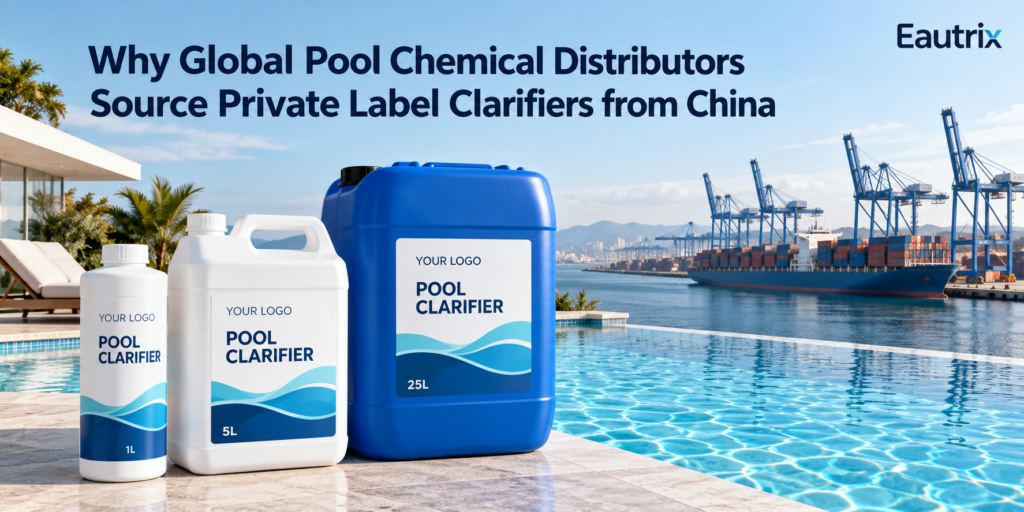
A pool chemical distributor puts more than a bottle on a shelf. It puts its name behind the product.
When that product works well, customers remember the brand. When the cap leaks, the label peels, or the instructions leave a pool owner confused, they remember the brand then, too.
That’s why sourcing a private label pool clarifier involves much more than finding a low price. The formula matters. So do the packaging, technical documents, delivery plan, and supplier’s ability to repeat an approved batch.
For distributors evaluating China, the appeal is the chance to bring those elements together through one manufacturing partner. A suitable supplier may provide polymer formulation, filling, branded labels, and export packaging as part of the same project.
The business case can be strong—but it depends on the supplier and the order. China is a sourcing location, not a quality guarantee.
So, why does this route make sense for some pool chemical distributors? And what should buyers check before putting their own name on the bottle?
A Private Label Clarifier Gives Distributors Something They Own
Selling established products can help a distributor build sales. Yet when several sellers carry the same item, customers can compare prices in seconds.
A private label product gives the distributor more control over how it competes.
The brand owner can shape the packaging, product positioning, sales material, and customer experience. It can develop a clarifier that fits its existing pool care range rather than squeeze another supplier’s branding into the catalog.
Imagine a distributor that already sells chlorine, pH adjustment products, and an algaecide. Customers may still buy their water clarifier elsewhere. Adding a suitable own-brand clarifier gives those customers another reason to place a more complete order.
That doesn’t guarantee loyalty. The product still has to earn its place.
But it creates an opportunity to build value around the distributor’s name—through reliable supply, useful advice, and a consistent product.
For a business with strong local relationships, that can be a practical next step.
The Attraction Starts With Cost—but It Shouldn’t End There
Purchase price matters. Distributors need room for dealer discounts, warehousing, sales support, and profit.
A Chinese private label supplier may offer an attractive production price, particularly when its formulation and packaging capabilities suit the buyer’s order. However, a low factory quotation doesn’t prove that the finished project will cost less.
The useful comparison is landed cost per saleable unit.
That means looking beyond the liquid and including:
- Bottles, caps, seals, labels, and cartons.
- Artwork setup and any packaging tooling.
- Inland transport and international freight.
- Insurance, clearance, and applicable import charges.
- Inspection, storage, and local handling.
- Damage, leakage, and unsold inventory.
Two quotations can look similar while covering very different things. One may include printed cartons and pallet protection; another may leave them out.
Ask for the details before comparing totals.
There’s also the cost of treatment. A lower-priced bottle may require a different dose or serve a different application. Buyers should compare validated use instructions and performance, not assume that every liter delivers the same result.
A good sourcing decision protects margin after the product reaches the warehouse—and after the customer starts using it.
One Partner Can Bring Several Production Steps Together
Launching a private label chemical can become a juggling act.
One company supplies the polymer. Another blends it. A third fills the bottles. Then there are labels, cartons, and shipping arrangements.
That model can work, especially when the distributor already has local production resources. But each handoff creates another point that needs coordination.
A Chinese supplier with suitable capabilities may bring several steps under one project:
- Formulation or dilution to an agreed specification.
- Appearance and color adjustment.
- Filling and closure application.
- Label and carton preparation.
- Batch identification and release checks.
- Preparation for export shipment.
The benefit is simpler coordination, provided the supplier controls the work well.
Still, “we handle everything” needs a closer look. Does the supplier make the polymer, blend purchased material, or arrange production through another facility? Which packaging steps are subcontracted?
These are normal buying questions. Clear answers help the distributor understand who is responsible when something needs attention.
A trading company can provide good service, and a manufacturer can provide poor service. What matters is transparent responsibility and evidence that the agreed process is controlled.
Packaging Can Follow the Customer, Rather Than the Other Way Around
A homeowner, a pool service technician, and a commercial operator don’t buy in the same way.
The homeowner may want a bottle that’s easy to store and measure. A technician may value a handle that pours cleanly between service calls. A commercial buyer may care more about larger packs, storage space, and purchasing frequency.
Private label sourcing allows the distributor to plan around those differences.
| Packaging format | Potential customer fit | Main points to review |
|---|---|---|
| 1L bottle | Retail and residential pool care | Readable directions, handling, shelf presentation |
| 5L jerrycan | Pool service businesses | Pouring control, closure quality, transport convenience |
| 25L jerrycan | Higher-use professional accounts | Safe handling, storage, dispensing arrangements |
| Bulk container | Buyers with suitable filling or blending facilities | Transfer equipment, quality controls, local production costs |
These are starting points, not fixed rules. The right size depends on the product’s dose, the customer’s consumption, and local buying habits.
Eautrix’s product page lists a PolyDADMAC-based pool clarifier with original or blue appearance, formulation adjustment, private labeling, and packaging that includes 1L, 5L, 25L, and bulk formats. Those listed services provide a basis for discussing a specific project; final specifications and commercial terms still need agreement.
A distributor can review the Polymer Pool Clarifier page before preparing a sourcing brief.
Your Brand Needs More Than a Different Sticker
A logo matters. But branding doesn’t stop at the front label.
The whole pack tells the customer what kind of company stands behind it. Is the text easy to read? Does the bottle feel suitable for the job? Can the user find the dose without turning the container three times?
Those small details shape trust.
A retail clarifier may need simple measuring guidance and a clear explanation of when to use it. A professional pack may need especially clear dilution or dosing instructions, batch details, and storage information.
Color can support recognition, too. A blue liquid may suit a pool care range, while an undyed appearance may fit another brand’s design. Neither appearance proves better performance.
The useful question is whether the chosen appearance remains acceptable through the intended shelf life and storage conditions.
Ask for samples in the proposed final container. A liquid can look different through opaque plastic than it does in a clear sample bottle. Likewise, a label that looks sharp on a screen may be hard to read on a curved pack.
Private label development works best when the distributor reviews the whole product as the customer will receive it.
Formula Choice Gives Buyers Room to Position the Product
“Pool clarifier” describes a purpose. It doesn’t identify one universal formula.
Products can differ in polymer type, concentration, viscosity, appearance, recommended dose, and intended use. That gives distributors room to develop different offers—but it also makes quotation comparisons harder.
Before asking for a price, describe the application.
Will the product support routine residential maintenance? Will service companies use it across many pools? Is the buyer seeking a ready-to-sell liquid or material for further processing?
Then agree on what the product needs to do.
A stronger concentration isn’t automatically the better commercial choice. It may reduce the volume needed for a validated treatment, but it can also change measuring needs, handling, and the risk of user error.
For some customers, a straightforward product with clear instructions offers more value than a highly concentrated product they struggle to dose.
The same care applies to filter claims. Suitability for a particular filtration system should be supported for the actual formulation and use conditions.
Write the intended use first. Choose the formula second.
Repeatable Quality Is Where the Real Value Appears
The first sample can win an order. Repeat batches determine whether the relationship lasts.
A distributor needs confidence that the approved product will arrive again with the same agreed characteristics. Unexpected changes can lead to questions from dealers and service teams—even when the supplier considers the change minor.
A useful specification may cover:
- Polymer identity and agreed concentration.
- Appearance and acceptable color range.
- pH, density, or viscosity where relevant.
- Test methods and acceptance limits.
- Net fill quantity.
- Container and closure requirements.
- Batch coding and storage conditions.
Be precise about concentration terminology. Total solids and active polymer content aren’t automatically interchangeable. Both parties should understand what is being measured and how.
A certificate of analysis, or COA, should report the agreed release tests. It becomes far more useful when those tests match the purchase specification.
Retained samples help as well. Keeping an approved reference and samples from supplied batches gives both sides something concrete to examine if a question arises.
Quality is easier to manage when expectations are written down before production.
Packaging Quality Protects More Than the Liquid
A clarifier can meet its chemical specification and still become a costly delivery.
A loose closure, weak carton, or poorly bonded label can create extra work throughout the distribution chain. Someone must inspect stock, clean containers, replace labels, or handle returns.
That’s why packaging deserves its own approval process.
Review the container, cap, sealing system, label material, and transport pack as a complete unit. Ask how the supplier checks closures and fill quantities. Discuss suitable compatibility, leakage, and transport testing for the proposed package and route.
Labels need attention in particular. Pool chemicals may be handled with damp hands or stored in humid areas. The chosen label and adhesive should suit the container surface and expected conditions.
Pre-shipment photographs can confirm visible details such as label placement, batch codes, and pallet arrangement. They don’t replace testing or inspection, but they can catch avoidable errors before dispatch.
A sound bottle is part of the product. So is the carton that gets it to the customer.
Finished Packs or Bulk Supply? Run Both Numbers
Some distributors want finished, labeled stock they can place straight into their sales channel. Others have local facilities and prefer bulk material.
Both routes deserve a fair calculation.
Finished packs can reduce the need for local filling equipment, packaging purchases, and production scheduling. They may suit a distributor that wants to focus on sales and customer service.
Bulk supply may suit a buyer with suitable facilities, trained staff, and enough demand to support local processing.
But bulk isn’t automatically cheaper once every cost is included.
Local filling requires containers, closures, labels, labor, equipment, cleaning, quality checks, and stock control. Further dilution or blending adds more process requirements. Any proposed savings should account for those responsibilities.
Compare cost per finished saleable unit, using realistic volumes for each route.
Sometimes the simpler route is also the stronger business choice. A distributor doesn’t need to own a filling line to own a respected brand.
A Sensible Minimum Order Helps Protect Cash Flow
A new product needs time to prove itself.
The distributor may be confident about demand, yet still lack reliable sales data for the first season. Ordering too much can tie up money that would be better spent on sales visits, dealer support, or other stock.
Ask how the minimum order quantity is built.
There may be separate minimums for blending, filling, printed labels, custom bottles, or cartons. A supplier may be able to produce the liquid at a modest volume while a packaging vendor requires a much larger print run.
That distinction can reveal practical alternatives.
A standard container with a custom label may suit a first order better than a unique bottle. One well-chosen pack size may be easier to launch than four sizes at once.
A useful starting range is often a tested formula, one main pack, and a clear target customer.
More choices can follow once actual sales show where demand sits.
Seasonal Planning Makes Overseas Sourcing More Useful
Pool care has a calendar, even when the calendar varies by market.
Some distributors build stock before summer opening. Others serve pools that operate through much of the year. Hotels and service companies may follow their own purchasing cycles.
Overseas supply needs to fit that pattern.
Work backward from the date stock must be available for sale. Allow time for sample approval, artwork, packaging procurement, production, inspection, transport, clearance, and warehouse receipt.
The supplier’s production lead time is only one part of that schedule.
There’s a balance to strike. Ordering late can leave the distributor short during strong demand. Ordering far too early can increase storage costs and reduce the remaining saleable shelf life.
Ask when shelf life begins and what evidence supports the stated storage period. Then plan quantities around likely turnover.
The goal is stock that arrives while customers need it, with enough useful life remaining to sell and use it responsibly.
Clear Communication Reduces Expensive Guesswork
A good supplier relationship often looks quite ordinary: clear questions, written answers, and no mystery about which version was approved.
That’s a strength.
The distributor should know which formula, label, bottle, and carton belong to the order. The supplier should know that substitutions require review.
Useful habits include approved artwork files, revision dates, signed specifications, and a clear process for production changes.
For example, changing a bottle may affect label fit or pallet quantity. Changing a dye may affect appearance or stability. Neither should happen casually because the original material is unavailable.
Also discuss how complaints will be investigated. Who receives the report? What batch information is needed? Are retained samples available?
Fast replies are helpful. Accurate replies are what make them valuable.
How to Compare Chinese Private Label Clarifier Suppliers?
Start by sending each candidate the same brief. Otherwise, each may quote a different interpretation of the project.
Include the target market, intended users, estimated volume, pack sizes, desired appearance, technical needs, and delivery terms.
Then compare the offers across several areas:
| Review area | What the distributor should establish |
|---|---|
| Product | Does the sample meet the intended application? |
| Quality | Are the specification and release checks clear? |
| Packaging | Has the complete pack been reviewed and approved? |
| Commercial terms | Are costs, minimums, and payment terms understood? |
| Supply | Can the proposed schedule support expected demand? |
| Support | Is there a clear route for technical questions and complaints? |
A trial order can test the working relationship as well as the product.
Check what arrives against what was approved. Record any differences while the project is still small enough to correct easily.
Price remains part of the decision. It simply sits beside the other things that determine whether the product earns money.
The Strongest Reason Is a Better Fit for Your Business
Global pool chemical distributors may source private label clarifiers from China because the right partner can combine formulation, packaging, and supply support around their brand.
The value comes from that fit.
For one distributor, it may mean a retail-ready bottle that completes a pool care range. For another, it may mean a professional pack with consistent quality and dependable replenishment. A buyer with local facilities may find value in bulk supply.
None of these benefits follows from location alone.
They come from choosing carefully, testing the product, agreeing on specifications, and keeping control of changes.
Your customer sees your label. Build the sourcing relationship with that responsibility in mind.
Frequently Asked Questions
1. Why do distributors buy private label pool clarifiers from China?
Distributors may choose Chinese suppliers for a combination of production pricing, formulation support, branded packaging, and export supply services. The business case depends on verified quality, landed cost, order volume, and delivery needs.
2. Can a Chinese manufacturer supply custom-label pool clarifier in several pack sizes?
Some suppliers offer several sizes, including retail bottles and larger professional containers. Confirm availability, packaging compatibility, minimum quantities, and labeling costs for each size before placing an order.
3. How can buyers check private label pool clarifier quality before importing?
Approve a representative sample, agree on written specifications and test methods, review batch documents, and test the complete packaging. A trial shipment can also help assess consistency and delivery performance.
4. Is bulk pool clarifier cheaper than finished private label bottles?
It may be, but the comparison must include local filling, packaging, labor, equipment, testing, and inventory costs. Calculate the cost per finished saleable unit for both supply routes.
5. What information should distributors send with a private label clarifier inquiry?
Provide the destination market, intended application, expected volume, preferred pack sizes, appearance requirements, technical specifications, and delivery terms. Ask the supplier to identify any assumptions or exclusions in its quotation.