
GET IN TOUCH
Ask For Sample?
Clear or Blue? Choosing the Right Appearance for Your Private Label Pool Clarifier
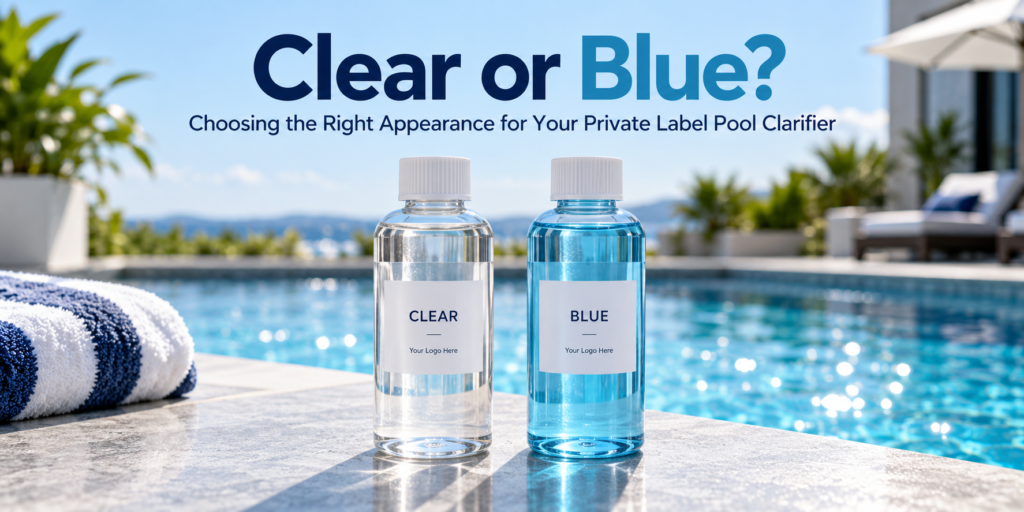
Two bottles sit on the sample table. One holds a clear, colorless liquid. The other contains a transparent blue liquid.
Both look suitable for a pool care range. Yet they send slightly different signals.
The clear version may suit a simple, technical product line. The blue version may work well with a brand built around bright water and summer pool care. For a private label buyer, that small visual choice can lead to bigger questions.
Will customers think blue works better? Does a clear formula look too plain? Could the color fade in storage? And does adding dye change how the clarifier performs?
The key is to separate appearance from treatment performance, then bring them together in a product that makes sense for your market.
A blue pool clarifier is not stronger simply because it is blue. A clear pool clarifier is not weaker simply because it has no added color. Performance needs to be assessed through the formula, dose, application conditions, and test results.
Appearance still matters. It helps shape the first impression, supports product identity, and affects how the finished package looks on a shelf or screen.
Here’s how to make that choice with more confidence.
First, “Clear” and “Colorless” Aren’t Quite the Same
Before comparing samples, it helps to agree on the words.
In everyday conversation, buyers often use “clear” to mean “without color.” In a product specification, however, clarity and color describe different things.
A liquid can be blue and clear at the same time. You can see through it, even though it has a visible tint.
A liquid can also be colorless but hazy.
For a private label pool clarifier, these descriptions are more useful:
- Colorless and transparent: No visible color under agreed inspection conditions.
- Pale yellow and transparent: A slight yellow tone, without visible haze.
- Blue and transparent: A blue tint, without visible haze.
- Hazy or cloudy: Reduced transparency that needs to be assessed against the product specification.
That distinction can prevent a surprising number of purchasing disputes.
If your purchase order says only “clear liquid,” one person may expect a water-white sample while another understands it to mean a transparent liquid with a slight natural tint.
Use a written description and an approved reference sample. Both sides should know what an acceptable batch looks like.
What Actually Does the Clarifying Work?
A polymer pool clarifier helps the filtration process deal with fine suspended particles that contribute to cloudy water.
In a PolyDADMAC-based formula, the cationic polymer provides the treatment function. “Cationic” means positively charged. This charge can help destabilize certain fine particles, making them easier to collect and remove under suitable treatment and filtration conditions.
Eautrix’s product page lists its polymer pool clarifier as a 10% PolyDADMAC formulation, available in an original appearance or dyed blue. It also lists color customization and private label support.
The important point for buyers is straightforward: the blue appearance is a separate formulation feature.
It does not, by itself, establish:
- The amount of active polymer.
- The polymer’s suitability for a particular application.
- The correct treatment dose.
- The speed of clarification.
- Compatibility with a specific filter.
- Performance in a customer’s pool.
Think of appearance as part of the product’s presentation. The treatment evidence still has to come from testing.
Two versions made from the same base formula may deliver comparable results when the dye is suitable and the finished formulations have been verified. But “same base” should start the comparison, not end it.
Why a Clear Formula May Fit Your Brand?
A colorless or lightly tinted original formula can suit a brand that favors a clean, restrained look.
Picture a white bottle with a simple label: product name, clear directions, and a strong focus on function. The liquid does not need to carry the visual message. The package does that work.
For some professional buyers, this approach may feel right. They want a product they can assess through its specification, consistency, and results.
That does not mean every pool service company prefers a clear liquid. It means a clear formula gives you a practical starting point when added color has no defined role.
There is also one fewer added ingredient to assess if the formula contains no dye. That can simplify part of the development discussion.
Still, don’t turn that point into a claim that the product is automatically safer, purer, or more effective. Those are separate claims that need their own support.
A clear formula can be a strong choice when your brand message is simple: a dependable clarifier, clear instructions, and consistent supply.
Why Blue May Work Well for Your Product Range?
Blue has an obvious visual connection with pool water.
A blue liquid in a transparent bottle can support a pool-focused design. It may help the product stand out in a catalog photograph or fit the look of an existing maintenance range.
For a private label brand, that can be useful. Customers often meet the package before they read the technical sheet.
But the benefit should be treated as a branding hypothesis, not a guaranteed sales result.
Would your customers prefer a pale blue liquid or a deeper shade? Would they notice the difference in your chosen bottle? Would a blue label on a white bottle work just as well?
A few real packaging samples can answer more than a long debate over a screen.
Blue can also help staff distinguish products within a range. Yet color should remain a secondary cue. The product name, label, and handling instructions must do the main work.
Two blue liquids may have completely different uses. No one should identify a pool chemical by color alone.
A Darker Blue Does Not Mean a Stronger Clarifier
This deserves a direct answer because it is an easy assumption to make.
A dark blue liquid can look concentrated. A pale liquid can look diluted. Neither impression tells you the active polymer content.
The depth of color depends on the colorant, its amount, the sample container, lighting, and the distance light travels through the liquid.
A large container can make the same formula look much darker than a small sample bottle.
That is why a photograph of a blue IBC is a poor reference for approving the shade of a one-liter retail pack.
If you sell more than one concentration, avoid using color depth as the main way to distinguish them. State the concentration or product grade clearly, supported by directions written for that formulation.
Otherwise, customers may conclude that the darker bottle needs a smaller dose, even when your label says something else.
Good presentation should make correct use easier.
Your Bottle May Make the Decision for You
Before paying for a custom shade, look at the final container.
In a clear bottle, liquid color becomes a major part of the design. In an opaque white bottle, customers may see it only when they pour the product.
That changes the commercial value of coloring the liquid.
| Packaging format | How much the liquid appearance matters | Main point to check |
|---|---|---|
| Transparent bottle | High | Shade, clarity, label coverage, and light exposure |
| Translucent container | Moderate | How the container changes the visible color |
| Opaque white bottle | Limited before opening | Whether added color serves a useful customer need |
| Large professional pack | Depends on the container | Pouring, identification, storage, and consistency |
| Bulk supply | More relevant to handling and downstream filling | Agreed inspection method and finished-pack appearance |
Try the sample in the actual bottle, with the proposed label attached.
A bright blue liquid behind a large white label may look quite different from the same liquid in a bare sample bottle. Bottle tint and wall thickness can change the result too.
Packaging is part of the appearance decision, not a final detail to add later.
Test the Dye in the Finished Formula
Choosing a blue shade is also a formulation decision.
A dye that dissolves in water is not automatically suitable for every polymer system. Its behavior needs to be checked in the complete product.
Because PolyDADMAC is cationic, the formulator should assess whether the selected colorant interacts with the polymer. Some colorants may create unwanted changes, depending on their chemistry and the formulation conditions.
The right approach is to ask the supplier for a suitable colorant and supporting test work.
Useful checks include:
- Whether the liquid remains transparent.
- Whether sediment, particles, or a surface ring develops.
- Whether the color changes during storage.
- Whether viscosity or pH changes beyond the agreed range.
- Whether the finished product still performs as intended.
- Whether the container or closure shows discoloration.
These are checks to carry out, not problems to assume.
A well-developed blue formula may remain attractive and perform well throughout its supported shelf life. The point is to establish that through evidence before placing a large order.
Look Beyond the Fresh Sample
A fresh sample can be lovely. Your customer may open the bottle months later.
Between those two moments, the product may pass through transport, warehouse storage, a distributor’s stockroom, and a pool shop.
Appearance approval should account for that journey.
Ask how the finished formula behaves under its intended storage conditions. If your market involves heat, light exposure, or cold weather, discuss a suitable test plan with the supplier.
Accelerated storage tests can help identify potential issues, while real-time storage supports the longer-term picture. Neither should be interpreted without considering the test conditions.
For blue products, watch for fading, shade changes, and loss of transparency.
For undyed products, watch for changes in natural tint, haze, and visible particles.
Both versions need quality control. Choosing a clear formula does not remove the need for stability work.
Also, a color change does not prove that the polymer has stopped working. It does show that the product needs investigation against its agreed appearance and performance requirements.
Will Blue Clarifier Make the Pool Water Blue?
The appearance of the concentrated product does not tell you how the treated pool will look.
Once added at the label dose, the colorant is diluted along with the rest of the formulation. Whether any visible tint remains depends on the dye, its level, the application rate, and the pool conditions.
A pool clarifier should be assessed for its intended clarification function. Buyers should not assume that a blue clarifier is designed to color the whole pool.
Test the finished product at the proposed use rate.
Check the water’s appearance and assess contact with representative surfaces where appropriate. Avoid making an absolute “will never stain” claim without adequate support.
The same care applies to marketing photos. A vivid blue pool image can look appealing, but the copy should not imply that the liquid dye creates clean or properly treated water.
Blue water is a visual impression. Water clarity and sanitary condition require their own checks.
That distinction helps keep expectations realistic.
Compare Clear and Blue Samples Fairly
If you want to know whether adding blue color affects performance, keep the comparison focused.
Start with the same base clarifier. Confirm that the versions have equivalent active content and otherwise comparable composition.
Then compare them using the same water, dose, mixing conditions, and filtration setup.
A useful development trial may include an untreated control and several treatment levels around the proposed application rate. Record starting conditions and measure results with a consistent method.
Turbidity measurements can help quantify changes in cloudiness. Visual checks are useful too, but a tinted sample can affect how people judge the result. Where color could influence an instrument reading, use a suitable measurement method.
The test question should be specific:
Does the colored version retain the required clarification performance and acceptable appearance under the intended use conditions?
That is more useful than asking which bottle looks “more powerful.”
Small laboratory trials can help screen formulations. Representative system trials can then show how the product behaves with the intended filtration process.
Write an Appearance Specification People Can Use
“Nice blue” is not a purchasing specification.
Neither is “same as the photo.”
A useful specification gives the supplier and buyer a shared way to assess each batch. It can remain simple, provided the method is clear.
Consider agreeing on:
- The color description and permitted variation.
- A retained reference sample or suitable color standard.
- The sample container and viewing conditions.
- Requirements for transparency.
- Limits for visible sediment or foreign matter.
- Relevant pH and viscosity ranges.
- The method used to confirm polymer concentration.
- Storage conditions and supported shelf life.
For blue products, record the approved shade in the finished packaging as well as in a standard inspection container.
For original-color products, define whether a slight natural tint is acceptable.
Ask what the certificate of analysis will report. “Appearance: passes” is meaningful only when both sides understand the acceptance criteria behind it.
This small amount of work can prevent rejected shipments and awkward conversations later.
Consider the Full Cost of a Second Appearance
Adding a blue version may seem like a small change. Managing two finished products can be a larger one.
Even when the packaging looks similar, clear and blue versions may require separate sample approvals, stock records, photographs, and quality references.
Ask the supplier whether the color choice changes:
- Minimum order quantity.
- Production scheduling.
- Testing requirements.
- Unit price.
- Packaging availability.
- Lead time.
There is no universal answer. The effect depends on the supplier’s process and the order.
For a new private label range, one well-defined appearance may make purchasing and stock control easier. A second version can follow when customers have a clear reason to buy it.
If you already serve distinct retail and professional channels, two appearances may make sense from the start. Just be sure each has a purpose.
More choice helps when it answers a customer need. Otherwise, it can leave you holding two slow-moving stocks instead of one healthy product line.
Keep the Label Focused on What Customers Need
The appearance should support the product story. It should not become the whole story.
Your customer still needs to know what the clarifier does, how much to use, which systems it suits, and what to expect after treatment.
Avoid unsupported statements such as “extra strength blue” or “colorless means chemical-free.”
Likewise, do not describe a colored formula as dye-free. Simple wording builds trust.
Where supported by the product’s evidence, a label can explain that the clarifier helps filtration remove fine suspended particles. Directions should match the exact formula being sold.
Keep application limits and filter compatibility clear. A new color does not establish suitability for every pool or filter.
For technical details, buyers can review the Eautrix Polymer Pool Clarifier page, then request documentation and samples for the specific private label version under consideration.
So, Which Appearance Should You Choose?
Choose the version that fits your customers, package, and evidence.
A clear or original-color formula may suit a restrained technical range, especially when the liquid is hidden by opaque packaging.
A blue formula may suit a visible retail pack or an established visual identity, provided the colorant and finished product pass the required checks.
Neither choice needs a grand claim.
Imagine a new distributor launching one clarifier in white bottles for pool service firms. If customers care most about clear dosing directions and dependable results, a custom blue shade may add little value.
Now imagine a retail brand using transparent bottles across its maintenance range. A stable, carefully chosen blue could contribute more to the finished presentation.
These are different commercial needs. Both are valid.
Before approving production, place the samples in the final packaging, review the test results, agree on the appearance standard, and confirm the supply terms.
Eautrix lists original and blue-dyed appearances, color customization, private labeling, and several packaging formats for its polymer pool clarifier. These provide a starting point for discussing a specific product brief.
The most useful brief goes beyond “clear or blue.” Tell the supplier who will buy the product, how it will be packed, where it will be stored, and which performance requirements it must meet.
Then the appearance becomes a deliberate part of the product—and a much easier decision to defend.
Frequently Asked Questions
1. Does blue pool clarifier work better than clear pool clarifier?
Blue color alone does not show better performance. Compare the active polymer, concentration, recommended dose, and finished-product test results. Equivalent base formulas may perform similarly, but the colored version should still be verified.
2. Can I order a private label pool clarifier without added dye?
Ask the supplier for an undyed version and confirm its normal appearance range. An original formula may be colorless or have a slight natural tint, so approve a written specification and reference sample.
3. What should I test before buying blue private label pool clarifier?
Assess color consistency, transparency, storage stability, packaging compatibility, and clarification performance. Test the finished formula at its proposed use rate rather than approving it from bottle appearance alone.
4. Is clear or blue pool clarifier better for opaque white bottles?
Either may suit the product. Since customers cannot easily see the liquid before opening, label design may have more influence on presentation. Add color when it serves a defined need and passes formulation checks.
5. Can clear and blue clarifiers use the same dosage instructions?
They may, if the active content, base formula, and validated treatment performance support the same directions. Never assume that color is the only difference between two products; confirm the exact formulations with the supplier.