
GET IN TOUCH
Ask For Sample?
Why Pool Distributors Need a Reliable Water Clarifier Product?
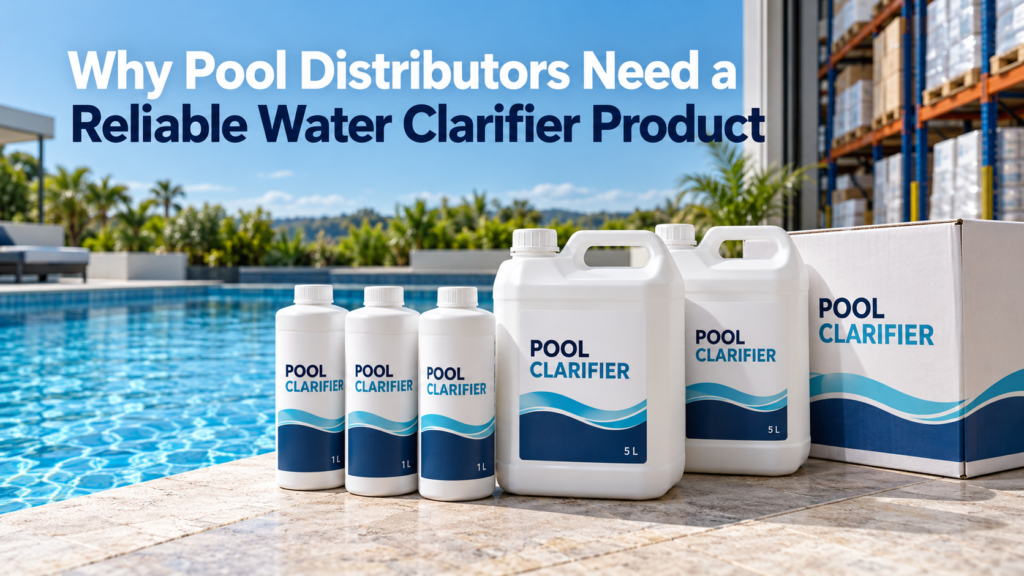
A pool dealer calls on a busy Friday afternoon. A customer’s water looks dull, the weekend is close, and the usual checks haven’t solved the problem. The dealer needs a product they can explain, supply, and stand behind.
For a pool distributor, that moment matters.
A reliable water clarifier gives dealers another tool for managing fine suspended particles. But its value goes beyond the water. Consistent quality, clear instructions, sound packaging, and dependable supply can help a distributor earn trust across its sales network.
The word reliable does a lot of work here. A clarifier must do more than look good in a bottle or perform well in one sample test. It needs to arrive in good condition, match the agreed specification, and give users a clear route from diagnosis to treatment.
That’s why choosing a pool water clarifier deserves the same care as choosing the supplier behind it.
Cloudy Water Creates Questions Dealers Need to Answer
Pool owners tend to judge water with their eyes first.
They may not know the filter’s flow rate or the water’s calcium level. They do notice when the deep end looks hazy. For a hotel or leisure facility, poor clarity can also affect how guests view the whole pool area.
Yet cloudy water is a symptom with several possible causes. Fine dust, poor circulation, filter faults, algae, and water chemistry problems can all play a part.
A dealer who treats every cloudy pool the same way is likely to face disappointed customers.
This is where a well-supported clarifier earns its place. It gives the dealer a treatment for suitable particle-related problems, alongside guidance on when to investigate something else.
Clarity also has safety implications. CDC guidance advises swimmers to avoid unusually cloudy water. A distributor’s product training should therefore make one point clear: improving appearance does not prove that water is properly disinfected or ready for swimming. CDC
Good advice protects the customer. It also protects the dealer’s credibility.
What Does a Polymer Pool Clarifier Actually Do?
A polymer pool clarifier helps fine suspended particles become easier for a suitable filtration system to remove.
Many small particles remain dispersed in water. Some are difficult for a filter to capture under normal operating conditions. A suitable polymer can help destabilize those particles and bring them together into more filterable groups.
Think of loose paper scattered across a desk. Collecting each scrap takes time. Gathering the scraps into a few piles makes the job easier.
The chemistry is more complex, of course. Polymer type, dose, particle characteristics, water conditions, and filtration all affect the result.
For a distributor, the useful message is straightforward:
A clarifier supports particle removal as part of a working pool treatment system.
It does not repair a damaged filter. It does not replace sanitizer. And a product sold for clarification should not be presented as an algae treatment unless it has the appropriate formulation, evidence, and permitted claims.
When dealers understand that role, they can make more accurate recommendations.
Reliability Starts With Consistent Batches
Imagine a service company buys the same clarifier each month.
Its technicians learn the directions. They know how to measure the dose and what to check afterward. Then a new batch arrives with a different concentration, but the label and instructions stay the same.
Confusion follows.
A distributor needs confidence that repeat orders will match the agreed product specification. Depending on the formulation, relevant controls may include polymer content, pH, viscosity, density, appearance, and other agreed quality measures.
Not every specification needs to appear on the retail label. The supplier and distributor should still know what is being controlled and how it is measured.
A written specification gives both parties a shared reference. Batch identification and a certificate of analysis, or COA, help connect that reference to the goods received.
There’s a practical benefit here: when a complaint arrives, the discussion can begin with facts.
Which batch was used? Was it within specification? How was it stored? What dose was applied?
That is far more useful than guessing from the color of a bottle.
Clear Instructions Can Prevent Avoidable Complaints
A good formulation can still disappoint when the directions leave too much room for interpretation.
“Add a small amount” sounds simple. It is also vague.
A homeowner may use a capful without knowing its volume. A technician may mistake a dose stated for the finished product for one based on active polymer. Another user may add more before the first treatment has had time to work.
Distributors should look for directions that clearly explain:
- The volume of pool water being treated
- The amount of finished product to add
- Any difference between initial and maintenance treatment
- The required circulation and filtration procedure
- When to inspect or clean the filter
- What to check before repeating treatment
Units deserve special care. A dose in parts per million means little unless the basis is clear. Is it measured as supplied product or active ingredient? Is the product being measured by mass or volume?
These details belong in the approved product instructions.
Overdosing is another training point. Depending on the formulation and pool conditions, too much polymer can reduce treatment efficiency or contribute to filter loading and water clarity problems.
More product is not a sound troubleshooting method. Better diagnosis is.
Dealers Sell With More Confidence When They Know the Limits
A reliable product comes with a clear explanation of where it fits.
Can it be used with the customer’s filter? Does the equipment manufacturer allow that treatment? Is it intended for routine water polishing, occasional corrective use, or both?
Those questions should have specific answers.
Broad claims such as “works with every filter” may sound convenient, but they can create trouble if the formulation or equipment has limits. Sand, cartridge, and diatomaceous earth systems differ, and a treatment suitable for one setup should not be assumed suitable for all others.
The same care applies to chemical compatibility.
Compatibility at normal pool concentrations does not mean concentrated products can be mixed in a bucket or storage container. Dealers need to explain separate application and handling instructions.
A supplier that answers these questions clearly gives the distributor useful sales support. It also helps staff avoid promises that the product cannot reasonably keep.
Confidence grows from knowing what to recommend—and knowing when to pause and ask another question.
Reliable Performance Can Support Repeat Business
The first sale often depends on price, presentation, and availability.
The next sale depends on experience.
If a dealer can explain a clarifier clearly, supply it on time, and help customers use it correctly, there is a sound basis for repeat orders. The outcome still depends on the pool, the treatment, and the service provided. No product can guarantee customer loyalty.
But consistency removes one source of doubt.
For service companies, a familiar product may also make training easier. Staff can work from the same instructions rather than relearning a different formulation each time the purchasing team changes suppliers.
For retailers, clear positioning helps staff answer common questions at the counter.
For distributors, these small gains can strengthen relationships across a dealer network.
The goal is not to encourage unnecessary dosing. It is to become a dependable source of products and advice when a suitable need arises. That kind of trust is harder to replace than a temporary discount.
Look Beyond the Price Per Bottle
A low purchase price is easy to compare. The full cost of supplying a product takes more work.
Freight, storage, damaged stock, technical support, returns, and packaging all affect the result. So does the amount of product required for a labeled treatment.
Consider two hypothetical clarifiers.
Product A costs less per liter. Product B costs more per liter but requires a lower validated dose for the intended application. Product B may cost less per treatment—but that conclusion needs dose and performance evidence.
A useful starting calculation is:
Product cost per treatment = price per liter × liters required per treatment
The comparison should use equivalent pool volumes and suitable treatment conditions. It should also include the costs that matter to the distributor’s business.
Concentration alone cannot settle the question. Two formulations with similar polymer content may perform differently because polymer characteristics and formulation design also matter.
A more useful purchasing question is:
What does it cost to deliver a suitable treatment, with dependable quality and support?
That shifts the conversation toward value the dealer can understand.
Packaging Is Part of Product Quality
A clarifier can meet its chemical specification and still cause problems if its packaging fails.
A leaking cap can damage a carton. A weak handle can make a large container awkward to move. A label that peels away in a damp storeroom can leave staff unable to identify the product properly.
These are product issues from the buyer’s point of view, even when the liquid itself is fine.
Distributors should review packaging as a complete system: container, closure, seal, label, carton, and pallet arrangement.
Pack sizes should also match the customer.
A small bottle may suit a homeowner who needs easy handling and modest stock. A larger jerrycan may suit a service company. Bulk supply may make sense for an established blending or filling operation with suitable facilities and controls.
Bigger is not always better. A pack that takes too long to sell can tie up cash and approach its shelf-life limit.
The most useful range is the one that fits how customers buy, store, and use the product.
Supply Reliability Matters Most When Demand Rises
Outdoor pool markets can have sharp seasonal peaks.
A distributor may hold stock for months, then receive several large dealer orders within a short period. If the next shipment is late, the consequences spread through the network.
Dealers have empty shelves. Service companies look for replacements. Sales staff spend time explaining delays.
A reliable supplier helps the distributor plan before that pressure builds.
The discussion should cover normal lead times, seasonal capacity, packaging availability, order quantities, and the time needed for custom labels. Importers also need room for transport and clearance.
Forecasts will never be perfect. Even so, a shared forecast is more useful than a last-minute request during the busiest month.
Shelf life belongs in this conversation too. Excess stock creates its own risk, especially if storage conditions are poorly controlled.
Good supply planning balances availability with sensible inventory. It gives dealers a reason to keep ordering through the distributor they already trust.
A Clarifier Can Strengthen a Product Range—If It Has a Clear Job
Distributors do not need a new product simply to make a catalog longer.
They need a product that fills a real gap.
A dedicated pool clarifier may be useful where dealers serve customers with fine-particle haze and need a filtration aid suited to those conditions. It can sit alongside sanitizers, algaecides, water balance products, and cleaning equipment, each with a distinct role.
That distinction helps sales conversations.
A sanitizer addresses disinfection. An algaecide has an algae-control role according to its approved directions. A clarifier supports the removal of suitable suspended particles. Filter maintenance helps keep the removal system working.
These roles can connect within a maintenance program, but they should not be blurred.
Routine clarifier use also deserves judgment. A pool that stays clear with proper chemistry, circulation, and filtration may not need an extra treatment.
Dealers who acknowledge that can earn more trust than those who recommend another bottle for every visit.
Private Label Works Better With a Stable Product Behind It
For some distributors, private labeling offers a way to build recognition around their own product range.
The opportunity is real, but a new label does not create product reliability.
Before approving artwork, the distributor should settle the formulation, specification, pack size, directions, claims, and documentation. Those decisions shape what the label can accurately say.
A useful private label plan answers a few basic questions:
Who will buy the product? What problem is it meant to address? Which filter systems and applications have been assessed? What evidence supports the dose and performance claims?
The distributor should also agree how changes will be handled. A supplier should not quietly change a key raw material, concentration, or package component without the review required by the supply agreement.
For a new launch, a controlled trial order can reveal issues before a large stock commitment.
That is a reasonable place to test dealer feedback, label clarity, packaging performance, and reorder interest.
Check the Supplier Before Committing to the Product
A sample is a starting point. It is not the whole supplier review.
Ask for the current technical data sheet, safety data sheet, product specification, sample COA, storage guidance, and shelf-life information. Check that the product names and identifying details agree across the documents.
Then ask how the supplier handles batch traceability and complaints.
Can a retained sample be checked? What information will the technical team need? Who will respond if a dealer reports a problem during peak season?
These questions reveal how the relationship may work after payment.
For imported products, the distributor should also verify the local requirements for classification, labeling, sale, and any claims made. Requirements depend on the destination and the exact product; another market’s label should not be copied without review.
A reliable supplier does not need to have an instant answer to every question. It does need a clear process for finding and documenting the answer.
Trial the Clarifier Under Relevant Conditions
A good-looking sample bottle tells you very little about field performance.
Start with a defined evaluation.
Choose pools or test conditions that reflect the intended customer base. Record water conditions, filter type, dose, circulation, clarity observations, and filter maintenance. Where practical, compare treated and untreated samples during screening.
Small-scale tests can help identify promising conditions, but they cannot reproduce every feature of a working pool. Field evaluation remains useful before making broad claims.
Try to learn more than whether the water looks clearer.
Was the product easy to measure? Did the directions make sense to the technician? Was filter cleaning manageable? Did the container pour cleanly?
Agree on success criteria before the trial begins. Otherwise, it is too easy to judge results by enthusiasm rather than evidence.
The aim is to build a recommendation that dealers can repeat with a clear understanding of its limits.
Give Dealers a Simple Way to Handle Questions
A distributor does not need to turn every salesperson into a polymer chemist.
It does need to give staff a short, practical troubleshooting route.
When a customer reports cloudy water, staff can ask about sanitizer readings, water balance, filter condition, circulation, recent treatments, and the amount of clarifier already used. Those answers help determine whether the issue fits the product’s intended role.
If treatment has failed, the next step should be investigation before another dose.
A complaint record should capture the product batch, pool volume, dose, filter type, timing, and relevant water test results. Photos can help, though they do not replace measurements.
This approach makes support more consistent. It also gives the supplier useful information when technical review is needed.
Good support is part of the product customers remember.
Building a Dependable Clarifier Offering With Eautrix
For distributors reviewing a polymer-based option, Eautrix’s Polymer Pool Clarifier provides a starting point for discussion.
The published product page identifies a 10% PolyDADMAC formulation, clear or blue color choices, and packaging that includes 1 L bottles, 5 L jerrycans, and 25 L containers. It also lists formulation adjustment and private label services. Buyers should confirm the final specification, directions, packaging, and commercial terms for their intended market.
The right inquiry begins with the distributor’s needs: customer type, local pool systems, preferred pack sizes, expected volume, and the role the product will play in the range.
A reliable water clarifier earns its place through consistent supply and well-supported use. For distributors, that creates something more valuable than another item on the price list: a product dealers can recommend with confidence.
Frequently Asked Questions
1. What should distributors look for in a reliable pool water clarifier?
Look for an agreed specification, consistent batches, clear finished-product dosing instructions, suitable packaging, and dependable supply. Technical support and batch traceability are also valuable when investigating customer complaints.
2. Is a concentrated pool clarifier always better for wholesale distribution?
No. A concentrate may reduce packaging or freight per treatment, but the distributor must assess validated dose, ease of measurement, formulation performance, and customer needs. Compare cost per suitable treatment rather than concentration alone.
3. Can pool distributors sell polymer clarifier under their own brand?
Yes, where the supplier offers private label services and the product meets the destination market’s requirements. Confirm formulation, claims, directions, documentation, and packaging before approving the label.
4. Should dealers recommend pool clarifier for every cloudy pool?
No. Cloudiness can result from water chemistry, algae, filter faults, poor circulation, or suspended particles. Dealers should identify the likely cause before recommending a clarifier and follow the product and equipment instructions.
5. How can a distributor compare pool clarifier suppliers before placing a bulk order?
Review specifications, documents, samples, packaging, lead times, and complaint support. Then run a defined trial under relevant conditions. Evaluate repeatability and practical use as well as the initial improvement in clarity.