
GET IN TOUCH
Ask For Sample?
Why Pool Chemical Brands Add Polymer Clarifier to Their Product Lines?
A pool owner walks into a store with a familiar complaint: “The chlorine level looks fine, but the water still isn’t clear.”
For a pool chemical brand, that question reveals a gap. Sanitizers serve an essential role. Algaecides address specific algae problems. Water balance products help manage pH, alkalinity, and other conditions. Yet none of those functions fully describes the removal of fine suspended particles.
That’s where a polymer pool clarifier can earn its place.
Pool chemical brands add polymer clarifier to their product lines because it addresses a distinct water care need, complements existing products, and creates opportunities for both corrective treatment and suitable maintenance use. It can also support private-label development and give distributors another useful product to offer.
But adding a bottle to the catalog is the easy part.
The real value comes from choosing a suitable formula, proving its performance, and explaining when customers should use it. A well-designed clarifier range gives buyers a clear answer to a specific problem. A poorly explained one becomes just another bottle on a crowded shelf.
Clear Water Is a Result Customers Can See
Many parts of pool care are hard to judge by sight.
A pool owner can’t look at the water and measure free chlorine. They can’t see total alkalinity or know whether a test result falls within the right range. Those checks need proper tools.
Water clarity feels different.
People notice when the steps look sharp, the floor is easy to see, and sunlight moves through the water without a dull haze. They also notice when that clear view fades.
This makes clarity a strong point of contact between a brand and its customers. It is a visible concern that can start a useful conversation about filtration, water balance, and chemical care.
There is an important limit, though: clear water does not prove that a pool is properly disinfected. CDC guidance stresses testing and maintaining disinfectant and pH levels as part of pool water care. Clarification should support that work, never replace it.
For brands, the lesson is simple. Sell the value of clearer water while keeping the role of the product precise.
“Helps the filter remove fine suspended particles” is a much more useful promise than a vague claim that one bottle fixes everything.
Polymer Clarifier Fills a Different Gap in the Range
A strong product line gives each item a clear job.
When products appear to do the same thing, customers struggle to choose. Retail staff may struggle too. A clarifier becomes easier to sell when its role sits neatly beside the other parts of pool care.
| Product category | Main role | What customers should understand |
|---|---|---|
| Sanitizer | Maintains disinfection when used correctly | Clear water still needs proper sanitizer control |
| Water balance products | Adjust specific water chemistry conditions | Some haze may require a chemistry correction |
| Algaecide | Helps prevent or control algae, according to its label | Algae treatment and particle removal are different tasks |
| Polymer clarifier | Helps fine suspended particles become easier to remove through filtration | The filter and circulation system must work |
| Settling flocculant | Encourages particles to settle for removal under its directions | Treatment may require a different removal process |
The distinction between clarifier and settling flocculant deserves special care. Product names are not always used consistently across markets. Brands should explain the intended process rather than rely on the word “flocculant” alone.
Does the product work with normal filtration? Does it call for settling and vacuuming to waste? Which filters can use it?
Those answers shape the customer’s experience far more than a bold front label.
For a brand that already sells sanitizers, algaecides, and balance products, a filtration-support clarifier can close a practical gap in the range.
The Chemistry Has a Useful, Plain-English Story
Technical products sell more easily when people understand what they do.
Many cationic polymer clarifiers use positively charged polymers to help destabilize fine particles in water. Some suspended particles carry a negative surface charge, which helps them remain dispersed.
A suitable polymer can reduce that stability and encourage particles to come together. Depending on the polymer and conditions, charge neutralization, particle aggregation, and bridging may contribute to the process.
The plain-English version?
The clarifier helps tiny bits become easier for the filter to catch.
That explanation works well on a product page or during a store conversation. It links the chemical to the equipment the customer already owns.
Still, the chemistry needs a few boundaries. Not all particles behave alike. Not all polymers perform the same way. Dose, water conditions, mixing, and filter performance all affect the outcome.
PolyDADMAC—poly(diallyldimethylammonium chloride), CAS 26062-79-3—is one polymer used in pool clarifier formulations. Eautrix’s current clarifier is based on this chemistry. That does not mean every polymer clarifier contains PolyDADMAC, or that every PolyDADMAC grade is suitable for the same finished product.
For a brand, the chemistry provides the foundation. Testing shows whether the finished formula delivers the promised result.
It Gives Dealers Another Useful Answer
Imagine a dealer whose shelves already hold chlorine, pH products, and algaecides.
A customer brings in a water sample and describes a light haze. After checking the water and asking about the filter, the dealer concludes that fine suspended material may be part of the problem.
Without a clarifier in the brand’s range, the dealer may need to recommend a product from another supplier.
With a suitable clarifier available, the dealer can offer another tool within the same range.
That creates a potential commercial benefit: the brand can serve more of the customer’s pool care needs. It may also make ordering easier for dealers who prefer to buy related products from fewer suppliers.
These are business opportunities, not guaranteed sales outcomes. Stock availability, dealer confidence, price, and product results still matter.
The strongest support a brand can give its dealer is a short, useful decision guide:
- Check sanitizer and water balance.
- Inspect circulation and filter condition.
- Consider whether fine suspended particles remain.
- Use clarifier only when appropriate and permitted by the product and equipment instructions.
- Follow the labeled dose and filter care directions.
That sequence helps dealers recommend the product with confidence.
Repeat Sales Can Follow a Real Need
Cloudy water is not always a one-time event.
Pools receive fresh material from swimmers, wind, rain, nearby soil, and other sources. Conditions change through the season. A pool that stays clear during quiet weeks may look dull after heavy use or a storm.
This gives clarifier a possible place in repeat purchasing.
Some formulas carry maintenance directions as well as corrective treatment instructions. Where those uses are supported, brands can explain both clearly.
The crucial word is supported.
Every pool does not need clarifier on a fixed weekly schedule. A well-run pool may stay clear through sound filtration and normal chemical care. Encouraging needless treatment can waste money and lead to dosing mistakes.
A better approach is to build repeat business around suitable use:
“Use as directed when fine-particle haze persists after normal pool care checks.”
Customers tend to remember brands that help them solve a problem without making the process harder. A sensible maintenance message can strengthen that trust.
Repeat sales then come from a product earning its place in the routine.
It Can Help a Brand Sell on More Than Price
Pool chemical buyers often compare prices quickly. Two containers may look similar, carry similar names, and sit side by side on a shelf.
A clarifier gives brands several ways to explain value beyond the container price.
Those may include clear dosing, convenient packaging, supported filter compatibility, reliable batch quality, and useful technical guidance.
The cost per treatment matters too.
A lower-priced bottle may treat less water at its labeled dose. A more concentrated product may cost more per bottle but less per suitable treatment. Yet concentration alone does not prove better performance.
The fair comparison uses the finished formula, supported dose, and treatment result.
Brands should also avoid assuming that clarifier always produces a high margin. Packaging, freight, dealer discounts, local stock, testing, and customer support can take a large share of the selling price.
A practical calculation starts with the net selling price and subtracts the full delivered and selling costs. It should include enough room for returns, damaged packs, and support work.
The opportunity is real only when the numbers and the product both hold up.
Private Label Makes Product Development More Accessible
A pool chemical brand does not always need its own blending plant to add clarifier.
Private-label supply allows a business to source a finished product and present it under its own brand. Depending on the supplier, the service may cover labels, filling, containers, cartons, and formulation adjustments.
That can make a clarifier launch more accessible for a distributor or a smaller brand.
But private label is more than a label swap.
The brand still needs to understand the formula, confirm its intended uses, review the instructions, and check the requirements in its sales market. The name on the bottle creates a customer expectation, regardless of who filled it.
A sensible starting brief answers five questions:
- Who will buy the product?
- What water problem will it address?
- Which filter systems will the instructions cover?
- What pack size will suit the sales channel?
- What evidence will support the main claims?
A clear brief helps the supplier propose a suitable product. It also prevents late changes that affect labels, cartons, and launch costs.
Different Customers Need Different Packs
A homeowner, pool service company, and distributor may want the same basic function in very different formats.
A small bottle can suit occasional home use. A service business may prefer a larger pack that reduces frequent reordering. A local blender may want bulk supply.
The right pack therefore begins with the buyer’s workflow.
A container should be easy to store, carry, and dose from. The cap and neck should support controlled pouring. The label needs room for instructions people can read.
A large container with a low purchase price can become awkward if users cannot measure small doses accurately. A small bottle can feel convenient but create too much packaging cost for a busy service team.
Brands should test the pack as part of the product, including leakage, label durability, and transport handling.
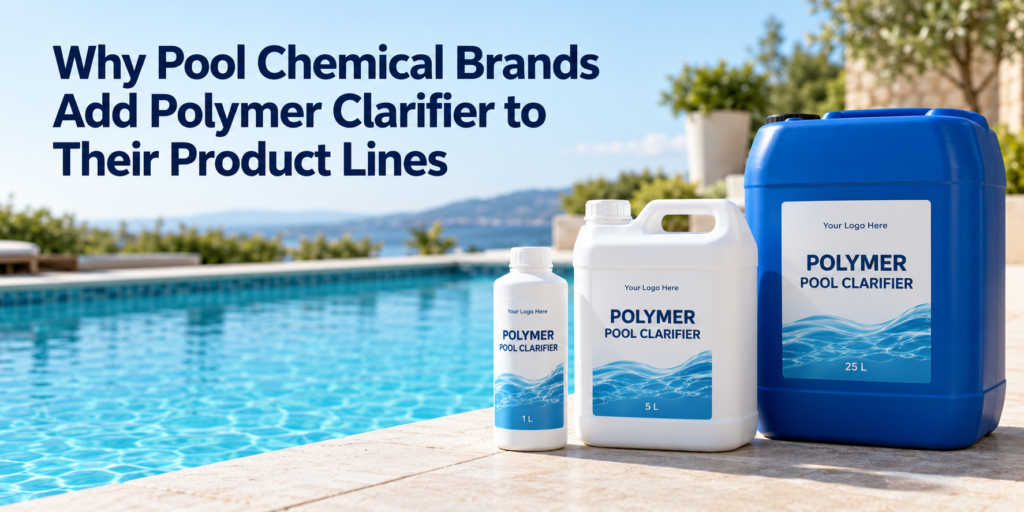
Eautrix lists 1 L, 5 L, and 25 L packs, along with bulk supply and private-label options, on its Polymer Pool Clarifier page. Buyers can use these formats as a starting point for discussions about their own sales channels.
Color Helps Presentation, but Performance Needs Proof
Blue clarifier looks at home in a pool care range. It can also help a brand create a consistent shelf appearance.
An undyed formula may suit another brand just as well.
Neither choice proves that the product works better.
Brands should keep appearance and function separate in their product development. If dye is added, the finished formula needs checks for stability, packaging compatibility, and unwanted effects at the intended dose.
The same care applies to concentration claims.
A “high strength” message needs a defined basis. Is it a higher active content? A lower supported dose? A comparison with a specific earlier formula?
Without that detail, the phrase can confuse buyers.
Often, a plain statement of treatment coverage and clear directions gives customers more useful information than a dramatic product name.
A good label should help someone make a sound choice while standing in a shop—not require them to decode a chemistry puzzle.
Instructions Are Part of the Product
A clarifier may perform well in testing and still disappoint customers if the label is unclear.
Dose errors are one obvious risk. Instructions that simply say “add a small amount” invite guesses. Directions written only for one pool size force users to do calculations they may not understand.
A useful label states how much finished product to add per defined volume of pool water.
It should also distinguish between product concentration and dose. “Percent active” describes what is in the container. “Milliliters per pool volume” tells the customer how much to use.
Any reference to parts per million needs a clear basis: finished product or active polymer.
The application directions should explain circulation, filter care, any relevant restrictions, and what to do if the water does not improve.
More is not always better. Excess polymer can affect clarification and filter loading; depending on the system, it may contribute to persistent haze or poor results.
Brands protect their reputation when they make correct use easy. Good instructions reduce guesswork, which can also reduce avoidable complaints.
Compatibility Claims Need Careful Boundaries
“Works with all filters” sounds convenient. It is also a broad claim that needs strong support.
Sand, cartridge, and diatomaceous earth filters differ in how they capture and release material. Equipment makers may place limits on the use of clarifiers or other additives.
A responsible brand confirms compatibility for its finished formula and respects those equipment instructions.
Chemical compatibility needs the same precision.
A product may be suitable for use in a pool treatment program alongside chlorine without being suitable for direct mixing with concentrated chlorine products.
That distinction belongs in user guidance.
Brands should avoid claims such as “compatible with all pool chemicals” unless the scope is clearly defined and supported. Practical instructions about separate application are often more valuable.
Technical restraint can be a selling point. It tells professional buyers that the supplier understands the difference between a useful claim and an oversized promise.
Supplier Quality Shapes Brand Quality
A customer sees the brand on the bottle. They rarely see the supply chain behind it.
That makes supplier selection central to the launch.
A low quote is only one part of the decision. Brands also need batch consistency, clear specifications, traceability, and a process for handling changes.
A useful supplier review covers:
- Polymer identity and suitable grade selection.
- Defined finished-product specifications.
- Batch certificates of analysis.
- Current safety and technical data sheets.
- Shelf-life evidence for the finished formula and pack.
- Storage guidance and transport suitability.
- Notification before material or formulation changes.
Samples are useful, but one good sample does not establish long-term consistency.
Performance trials should also reflect intended use. A simple jar test can help compare doses and particle response, but it cannot fully represent circulation and filter capture in a working pool.
Where practical, brands should pair controlled screening with relevant system trials. Record the starting conditions, dose, filter setup, and results.
That evidence helps the brand write better claims and answer harder customer questions.
A Focused Launch Is Easier to Manage
There is a temptation to launch several versions at once: standard, premium, blue, clear, concentrated, and commercial.
Each version adds work.
It needs a stock position, label, specification, price, and reason to exist. Too much choice can confuse dealers and tie up cash.
For many brands, one clearly positioned formula in a small number of useful packs is a more manageable starting point.
The first launch should answer a specific need. For example, a product intended to help remove fine-particle haze through suitable filtration, with clear directions for the supported applications.
Then watch what happens.
Which customers reorder? Which pack moves steadily? What questions reach the sales team? Do complaints point to dosing, filter condition, or a gap in the instructions?
Those findings can guide the next version.
Seasonal promotions can help introduce the product, but the message should fit its role. After heavy pool use or during seasonal opening, brands can explain when clarifier may help and which checks come first.
Educational content works well here because the customer’s question is practical: “What should I do next?”
The Best Addition Has a Clear Reason to Exist
Pool chemical brands add polymer clarifier because it can solve a problem their core products do not fully address.
It gives dealers another useful recommendation, helps brands serve more of the pool care routine, and offers room for private-label packaging and targeted product development.
Yet its value depends on discipline.
The formula must suit the application. Claims need evidence. Instructions must be easy to follow. The supplier must deliver the same product consistently.
For brands assessing a new range, Eautrix’s pool chemical and cationic polymer portfolio provides a starting point for discussing clarification products alongside other pool care categories.
Start the conversation with the target customer, filter systems, desired pack sizes, and intended claims. Those details create a much stronger product brief than a request for the cheapest bottle.
A clarifier earns its place when buyers know what it does, use it correctly, and find that it helps. That is the basis of a product worth keeping in the range.
Frequently Asked Questions
1. Why do pool chemical brands sell polymer clarifier alongside algaecide?
The products serve different roles. Algaecide addresses algae according to its label, while polymer clarifier helps fine suspended particles become easier to remove through filtration. Offering both lets a brand address more distinct pool care needs.
2. Can a distributor launch a private-label polymer pool clarifier without a blending factory?
Yes. A distributor can work with a supplier that offers finished-product filling and private labeling. The distributor still needs to review the formula, instructions, claims, documentation, and requirements in its target market.
3. Is concentrated pool clarifier always more profitable for a brand?
No. Profit depends on the selling price, supported treatment dose, packaging, freight, channel costs, and customer support. Higher concentration alone does not guarantee better performance or a better margin.
4. What should brands check before claiming pool clarifier compatibility with cartridge filters?
They should confirm that the finished formula is suitable at its labeled dose and review relevant filter manufacturer instructions. Filter loading, cleaning needs, and overdosing effects should be considered before making the claim.
5. Should a pool chemical brand launch blue clarifier or clear clarifier first?
Choose based on customer preferences and product positioning, then verify the finished formula’s stability and performance. Blue color can support shelf presentation, but it does not show that a clarifier is stronger or more effective.