
GET IN TOUCH
Ask For Sample?
How to Use Polymer Pool Clarifier with a Cartridge Filter?
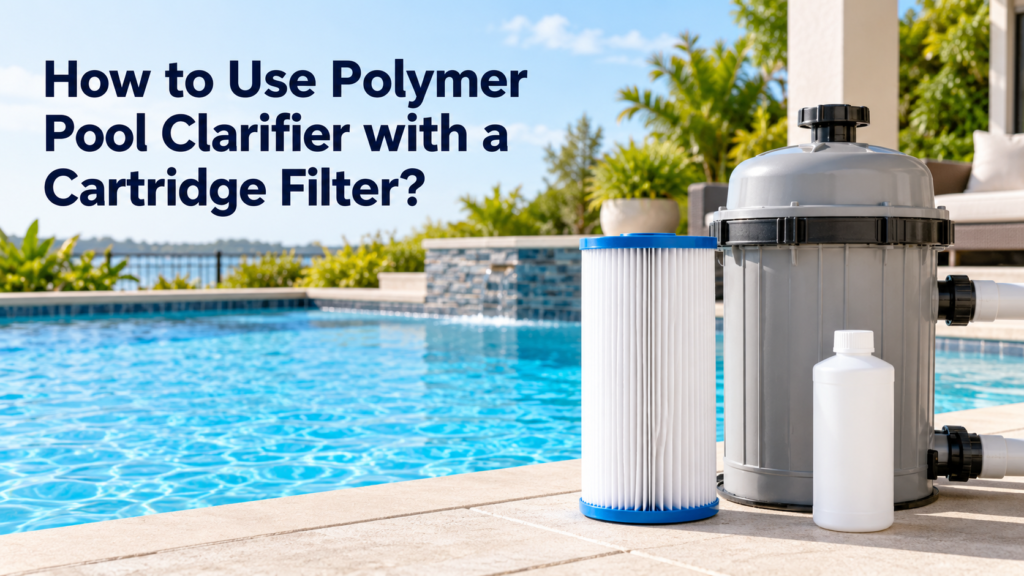
Your pool looks slightly hazy. The pump is running, the cartridge filter is in place, and the water tests seem reasonable. Yet the pool still lacks that crisp, clear look.
Should you add a polymer pool clarifier?
Yes—a polymer pool clarifier can be used with a cartridge filter when the product label confirms compatibility. The key is to start with a sound filtration system, measure the correct dose, keep water moving as directed, and clean the cartridge when its condition calls for it.
That last point matters. Clarifier helps your filter collect fine particles, but those particles still need to leave the pool. With a cartridge system, you usually remove them by taking out and cleaning the filter element.
Think of clarifier as a helping hand for filtration. It brings small bits of suspended matter together so the filter has a better chance of catching them. It does not repair weak circulation, replace sanitizer, or wash a dirty cartridge for you.
Let’s walk through the process, from the first water test to the final rinse.
Can a Cartridge Filter Really Benefit from Clarifier?
Cartridge filters use pleated filter media to collect suspended debris. Those folds create a large surface area inside a fairly compact housing.
They can already remove a great deal of fine material. So why might the water still look dull?
Some particles remain difficult to capture under actual pool conditions. Their size, surface charge, and behavior in water can affect how readily they collect on the filter media.
A suitable polymer clarifier helps bring dispersed particles together. Instead of remaining as scattered specks, they form aggregates that may be easier to retain during filtration.
The process is a bit like gathering loose crumbs before sweeping them up. The broom still does the removal; gathering the crumbs makes the job easier.
However, you may not need clarifier at all. If the pool is clear, circulation is good, and the cartridge is working well, extra treatment may offer little benefit. Use it to address a known need or follow a supported maintenance program.
First, Make Sure You Have the Right Product
“Pool clarifier” is a broad description. It does not tell you everything about the formula or how it should be used.
Before adding anything, check the current label for:
- Compatibility with cartridge filters.
- Compatibility with your sanitizer system.
- The dose for your pool volume and water condition.
- Application and circulation instructions.
- Any restrictions involving other pool chemicals.
- The permitted interval between treatments.
A product described as suitable for all filter types should still have clear directions. If the wording leaves you guessing, ask the supplier to confirm its use with your equipment.
The distinction between a clarifier and a settling flocculant also deserves attention.
Some flocculant treatments are designed to gather debris into material that settles on the pool floor. Their instructions may require vacuuming that material to waste. Many cartridge installations lack a dedicated vacuum-to-waste route.
Do not assume a settling treatment can simply pass through your cartridge. Follow its stated procedure and confirm that your plumbing can support it.
For a cartridge pool, look for a clarifier intended to support normal filtration.
Check the Cause of Cloudiness Before Treating It
A hazy pool does not always have a fine-particle problem.
Cloudiness can come from poor circulation, algae, mineral precipitation, chemical imbalance, or a damaged filter. More than one cause may be present.
Start with water testing. Check sanitizer and pH, then review total alkalinity, calcium hardness, and other readings relevant to your pool system. For an outdoor chlorine pool, cyanuric acid also affects how you interpret the sanitizer reading.
Compare the results with the requirements for your pool, sanitizer, and local operating rules.
Next, look at the pool itself.
Are the walls slippery? Is there a green tint? Does dust collect in quiet corners? Has the water turned cloudy soon after a chemical addition?
Those clues help you choose the next step.
If algae are growing, address that problem with an appropriate treatment program. A clarifier may help collect suspended residue afterward, but it is not a substitute for algae control or disinfection.
If cloudiness appears after a major pH change, investigate water balance and possible precipitation. Adding more polymer without checking the cause can turn a simple issue into a drawn-out guessing game.
And if you cannot clearly see the pool bottom, keep swimmers out until visibility and water quality meet the applicable safety requirements.
Give the Cartridge a Fair Chance
Before dosing, check that the filter can do its job.
Empty the skimmer and pump baskets as needed. Make sure the pool water level supports proper skimming and that the return flow appears normal.
Then inspect the filter’s operating condition.
A cartridge that is already packed with dirt has little spare capacity. Adding clarifier may help collect more particles, but a heavily loaded element can quickly restrict flow.
Clean the cartridge first if it has reached the cleaning point specified in the equipment manual or if flow has fallen significantly. Inspect it for torn pleats, cracked end caps, and poor seating.
A damaged element may allow debris to pass through. Clarifier cannot close a tear or correct a misplaced seal.
You do not need to dismantle a clean, well-performing filter before every clarifier dose. The aim is to begin with enough filter capacity and healthy circulation.
That is a useful distinction: prepare the filter according to its condition, rather than following a cleaning ritual that adds work without a clear reason.
Record the Starting Pressure
The pressure gauge gives you a practical way to track filter loading.
After cleaning and restarting the system correctly, note the normal pressure. If you have a variable-speed pump, record the pump speed as well.
Compare later readings at the same speed and with the same valve settings. A change in pump speed can change pressure even when the cartridge has collected no extra dirt.
Some cartridge filter manuals specify cleaning at about 10 psi above the clean starting pressure, or when flow drops significantly. Use your own model’s cleaning threshold, since one figure does not apply to every filter.
Avoid relying on an absolute pressure such as “20 psi means dirty.” One pool may operate normally at that reading, while another may have a much lower clean pressure.
Your baseline is what makes the gauge useful.
Measure the Dose—Don’t Guess from the Bottle Size
Pool clarifiers vary in concentration and formulation. The same volume of two different products may deliver very different amounts of active polymer.
Use the dose on the label of the product you actually have.
If the label gives a range, follow its guidance for the current water condition. Do not assume the highest dose will produce the fastest result.
You also need a reliable estimate of pool volume. A dose based on an oversized volume estimate can lead to unnecessary treatment.
For a label written in milliliters per cubic meter:
Required product volume = pool volume × label dose
Here is a calculation example using an illustrative rate, not a treatment recommendation:
| Item | Example |
|---|---|
| Pool volume | 40 m³ |
| Illustrative label rate | 3 mL/m³ |
| Calculated product volume | 120 mL |
The arithmetic is straightforward: 40 × 3 = 120.
For a label written in fluid ounces per number of gallons, use the same principle. Keep the units consistent and distinguish US gallons from imperial gallons.
A marked measuring container is much better than “a small splash.” With concentrated products, that splash may be larger than you think.
Be Careful with Dosage Written in ppm
Professional buyers may receive guidance in parts per million, or ppm. This needs more care than a simple volume-based label rate.
Ask what the figure refers to:
- Active polymer.
- Finished product.
- A dose by mass.
- A dose converted to liquid volume.
These are different bases.
For dilute water treatment calculations, 1 ppm by mass is approximately 1 mg/L. But you still need to know whether that mass represents active ingredient or the supplied formulation.
Converting a product mass into milliliters also requires its density.
For example, a formulation containing 10% active polymer is not equivalent, gram for gram, to pure active material. Confusing the two can create a large dosing error.
If a technical sheet gives ppm without stating the basis, ask for clarification before calculating the dose. A clear instruction in mL per m³ can make field application much easier.
Add the Clarifier Where the Label Says
Once the water and filter are ready, apply the measured dose according to the product directions.
Many liquid clarifiers are added to pool water while the circulation system runs. However, the application point and any dilution instructions depend on the formula. One manufacturer’s directions, for example, call for direct addition to the pool with circulation running; that should not be treated as a universal instruction for every clarifier.
If your label directs addition around the pool or near return jets, follow that method. Good distribution helps the product contact suspended particles throughout the water.
Do not pour concentrated clarifier straight into the cartridge housing.
Likewise, do not use the skimmer as a dosing point unless the product instructions specifically permit it. A concentrated slug entering the filter may behave differently from a dose dispersed through the pool.
Only dilute the product when the supplier directs you to do so. Use clean equipment and the stated method.
Never mix concentrated clarifier with chlorine, acid, algaecide, or another treatment in the same container. Chemical compatibility in pool water does not establish compatibility between concentrates.
Keep Water Moving Through the Filter
Once the clarifier is dispersed, filtration needs time to collect the conditioned particles.
This is where patience pays off.
Follow the circulation period stated on the label. Do not switch the pump off after a few minutes and expect a filtration aid to finish the job while the water sits still.
At the same time, avoid assuming that maximum pump speed is always better. Operate within the equipment’s permitted flow range and maintain circulation that suits the pool.
A filter only treats the water that reaches it. Leaves in a skimmer basket, a restricted suction line, or poor circulation around the pool can slow progress.
Look for dead zones where debris keeps collecting. Brushing and suitable return-jet adjustment may help move suspended material toward the filtration system.
Continue routine maintenance during treatment. Clarifier works as part of that routine, not as a reason to pause it.
How Long Should You Wait for Clearer Water?
There is no single clearing time that applies to every pool.
Some product directions describe improvement within hours, while other situations take longer. The result depends on the amount and type of debris, filter condition, circulation, pool size, and correct dosing.
For example, a light haze after a busy swimming day is a different task from a pool full of suspended residue after algae treatment.
Use the product’s stated evaluation period as your guide. Then check for a trend.
Can you see the steps more clearly? Does the deep end look less milky? Is the view of the floor improving?
Photos taken from the same position under similar light can help. Bright sun, shadows, and reflections can make the same water appear quite different.
Do not add a second dose simply because the first has not produced a dramatic change by lunchtime. Give the treatment its specified time, then reassess the whole system.
Watch Pressure and Flow Together
As the cartridge captures material, its resistance to water flow may increase.
A pressure rise can therefore be consistent with dirt collection. But pressure alone does not prove the clarifier is working.
Use several signs together:
| Observation | What to check |
|---|---|
| Water becomes clearer and pressure rises gradually | Filter loading; clean when the manual requires it |
| Return flow weakens noticeably | Cartridge condition and other circulation restrictions |
| Pressure rises sharply soon after dosing | Dose accuracy, prior filter loading, and circulation |
| Water stays cloudy with little change | Water chemistry, particle source, filter integrity, and run time |
| Pressure remains high after cleaning | Remaining deposits, equipment condition, and system restrictions |
A rapid pressure increase deserves prompt attention. Do not keep adding clarifier while the system struggles to move water.
Conversely, a low reading is not proof that everything is fine. Pump or suction problems can reduce pressure and flow at the same time.
The gauge is a clue. Pair it with what you see at the return jets and in the pool.
Clean the Cartridge to Remove the Collected Dirt
Clarification is not complete until the captured material leaves the system.
For most cartridge filters, that means removing and cleaning the element rather than performing the routine backwash used with other filter designs.
Follow the equipment manual for shutdown, pressure release, opening, cleaning, and restart. Before servicing, isolate power and prevent an automatic start. Release pressure using the specified procedure and confirm the system is depressurized. Never loosen a pressurized housing.
During cleaning, pay attention to the spaces between the pleats. A quick spray across the outside can leave a surprising amount of dirt behind.
Use the rinsing method permitted by the cartridge manufacturer. Avoid pressure washers or harsh handling that could damage the media.
If oils or stubborn deposits remain, use an approved cartridge cleaner as directed. Rinse it thoroughly before reinstalling the element. Chemical cleaning methods should match the deposit and the manufacturer’s guidance; an acid soak is not a universal answer.
After reassembly, follow the prescribed startup and air-release procedure. Check for leaks, confirm normal flow, and compare pressure with the clean baseline.
What If You Add Too Much Clarifier?
More clarifier does not always mean clearer water.
An excessive dose may increase filter loading, leave polymer-related deposits, or interfere with the intended particle aggregation. The effect depends on the formula and the water.
Possible clues include haze that worsens after treatment, unusually fast pressure buildup, or sticky material on the cartridge.
None of those signs proves an overdose by itself. Oils, algae residue, and heavy debris can produce similar symptoms. Check the treatment record before deciding what happened.
If you suspect excess dosing:
- Stop adding clarifier.
- Check the calculated pool volume and measured amount.
- Test the water and inspect circulation.
- Clean the cartridge when required.
- Ask the supplier for product-specific recovery advice.
Avoid trying to cancel one chemical with another. That can make diagnosis harder and create additional problems.
Any water replacement should follow suitable professional advice, particularly where draining creates structural or groundwater risks.
Still Cloudy? Trace the Problem Before Dosing Again
If the pool remains hazy after the stated treatment period, work through the likely causes.
First, check filtration time and flow. A pump may be running while moving too little water for useful treatment. Inspect baskets, water level, and obvious restrictions.
Next, revisit water chemistry. Sanitizer demand can change after heavy use or a storm. A reading taken before treatment may no longer describe current conditions.
Then inspect the cartridge and its installation. Torn media, damaged components, or incorrect seating can allow water and debris to bypass the intended filtration path.
Also consider what keeps entering the pool.
Nearby building work, windblown dust, pollen, and heavy swimmer use can create a continuing particle load. The filter may be removing material while fresh contamination arrives.
Finally, review every recent chemical addition. Cloudiness that begins after a treatment may call for a different investigation from haze caused by dust.
A useful question is: Are we failing to remove particles, or are we still creating them?
That distinction helps prevent a cycle of repeated dosing without lasting improvement.
Make Routine Clarification a Measured Decision
Should you use polymer clarifier every week?
Only if the product directions and the pool’s needs support that schedule.
A pool with steady water quality and clear water may not benefit from frequent additions. Another pool, exposed to regular fine debris, may fit a labeled maintenance program.
Seasonal conditions can change the need. Spring pollen, summer crowds, or autumn storms may increase the particle load without changing the basic treatment process.
Keep a simple log:
- Water test results.
- Clarifier product and dose.
- Treatment date and circulation period.
- Pressure at a recorded pump speed.
- Cartridge cleaning date.
- Changes in clarity.
For pool service teams, these notes also help the next technician understand what has already been done. That reduces accidental repeat treatment.
The goal is clear water with a sensible dose and sound maintenance—not a calendar full of chemical additions.
What Professional Buyers Should Ask Their Supplier?
For distributors, private-label brands, and commercial pool operators, buying a polymer clarifier involves more than choosing a color or bottle.
Ask for the active ingredient, concentration, cartridge compatibility, dose basis, application directions, and restrictions involving other treatments.
Request a technical data sheet and safety data sheet. The final label should turn the technical guidance into clear instructions that pool users can follow.
Eautrix’s Polymer Pool Clarifier is listed as a liquid formulation based on 10% PolyDADMAC, with original or blue-dyed appearance options. Buyers should confirm cartridge-specific directions and the meaning of any ppm guidance for the formulation supplied.
For private-label projects, confirm that the label matches the actual concentration. A change in formulation should trigger a review of the directions, rather than a simple copy of the previous bottle’s dose.
Clear instructions help both the customer and the service team use the product consistently.
Bring the Process Together
Using polymer pool clarifier with a cartridge filter is a partnership between chemical treatment and physical removal.
Choose a compatible product. Check the water and equipment. Measure the label dose. Apply it as directed, maintain circulation, and watch the filter’s condition.
Then remove the collected dirt when cleaning is due.
You may find that a small, well-measured treatment is enough to restore the view of the pool floor. Or you may discover that the real issue was a loaded cartridge or weak circulation.
Either way, careful observation gives you a better result than another unmeasured splash.
Frequently Asked Questions
1. Can I use polymer pool clarifier with a small above-ground cartridge filter?
Yes, if the clarifier label permits cartridge use and covers your pool type. Calculate the dose carefully for the smaller water volume, and check filter loading often. A compact cartridge may need cleaning sooner under a heavy debris load.
2. Should I clean my cartridge filter before or after adding pool clarifier?
Clean it before treatment if it is already restricted or has reached the manual’s cleaning threshold. After treatment, clean when pressure, flow, or the manufacturer’s guidance calls for it. You do not need to remove a clean cartridge simply because you plan to dose.
3. Can I pour polymer pool clarifier into the skimmer of a cartridge-filter pool?
Only when the product label specifically allows that application point. Otherwise, use the stated pool-water dosing method. Avoid sending an unapproved concentrated dose directly toward the filter.
4. Why does cartridge filter pressure rise after adding clarifier?
The cartridge may be collecting more suspended material, increasing resistance to flow. A sharp rise can also indicate heavy prior loading, excessive dosing, or another restriction. Compare readings at the same pump speed and follow your filter’s cleaning threshold.
5. Can I swim after using polymer pool clarifier with a cartridge filter?
Follow the product’s re-entry directions and applicable pool rules. Swimming also requires suitable sanitizer, water balance, and visibility. The presence of clarifier—or water that looks clearer—does not by itself establish that the pool is safe to use.