
GET IN TOUCH
Ask For Sample?
Can Polymer Pool Clarifier Be Used with DE Filters?
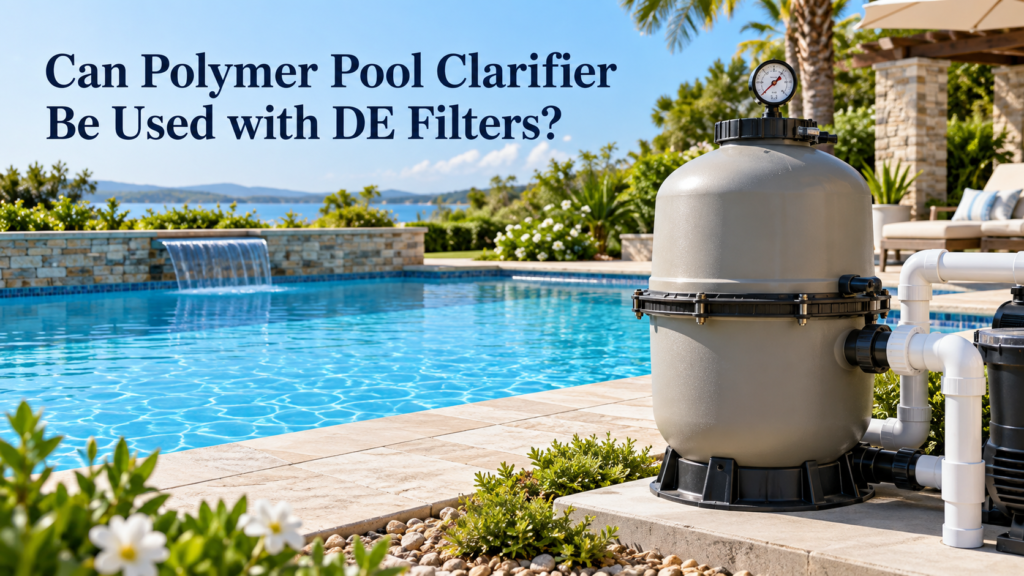
Yes, some polymer pool clarifiers can be used with diatomaceous earth (DE) filters—but only when the finished product’s directions confirm that use. Other clarifiers specifically exclude DE systems. The word “polymer” alone does not tell you whether a product is suitable.
That distinction matters. You may have a good filter, balanced water, and a pool that still looks a little dull. Adding a clarifier seems like the obvious next step. Yet the wrong formula can create more filter work instead of solving the haze.
DE filters already provide fine filtration. They may clear mild cloudiness without any extra clarification chemical. When a suitable clarifier is needed, careful dosing and close attention to filter pressure help keep the treatment on track.
So, how do you decide? Start with the product label, check your filter instructions, and find out what is making the water cloudy. Those three steps are far more useful than a blanket “yes” or “no.”
Why Do You Hear Different Answers About DE Compatibility?
Search for advice on pool clarifiers and DE filters, and you’ll soon find conflicting views.
Some instructions allow clarifier use across several filter types. Others state that the product should not be used with DE. Both positions can be valid for the specific products involved. Published product directions include clarifiers whose manufacturers confirm DE compatibility, as well as formulations whose suppliers expressly exclude it. lowes.com
The trouble starts when a rule for one bottle becomes a rule for the whole category.
“Pool clarifier” describes a purpose. It does not describe one fixed chemical formula. Products may differ in their active ingredient, concentration, polymer properties, and other components. Their application instructions can differ, too.
Think of it like choosing a cleaner for a delicate surface. Two bottles may both say “cleaner,” but you still check what each one is designed to clean.
For a DE system, the useful question is:
Does this exact clarifier have clear directions for use with my filter type?
If the label excludes DE filters, follow that restriction. If it mentions only sand and cartridge filters, ask the supplier before using it. Silence on the label should not be treated as confirmation.
What Makes a DE Filter Different?
A DE filter uses a coating of diatomaceous earth on supporting filter elements. Depending on the design, those elements may be grids, fingers, or cartridge-style assemblies.
The DE coating forms the working filtration layer. Water passes through it while suspended debris is retained. Equipment manuals describe applying DE as a precoat and specify how the filter must be operated and serviced.
That fine filtration is a major reason pool owners choose DE systems.
It also changes how you should approach cloudy water. A pool with a functioning DE filter may need time, good circulation, and proper maintenance before it needs another chemical.
There is a catch, though: captured material stays in the filter until it is removed through the appropriate service procedure. A filter that collects debris well still has a limited capacity to hold it.
Imagine a fine kitchen sieve. It catches small bits well, but a thick layer of material slows the water passing through. Pool filtration is more complex, yet the basic idea is familiar.
A clarifier can change how suspended particles collect. With a DE system, that change needs to support filtration without causing an excessive restriction.
How Does a Polymer Pool Clarifier Help?
Fine particles can remain scattered through pool water. Dust, small organic fragments, and other suspended debris may create a haze that is hard to remove quickly.
A cationic polymer clarifier carries positive charges. In suitable water conditions, it can interact with negatively charged particles and help them gather into larger groups. Depending on the polymer and the particles involved, charge neutralization and polymer bridging may contribute to the process.
In plain language, the clarifier helps small bits come together.
The filter then has to capture them.
That last step is easy to overlook. Clarifier does not make dirt vanish. It changes the condition of the suspended material so filtration can remove it more effectively.
For more background, see How Pool Clarifiers Help Restore Crystal-Clear Water.
A useful treatment therefore depends on two things working together: the chemical must suit the water and equipment, and the filter must have enough flow and capacity to collect the treated particles.
Does a DE Pool Need Clarifier in the First Place?
Not always.
If the pool has a slight haze after a windy day or a busy weekend, normal filtration may be enough. Before adding anything, check that the pump is circulating water as expected and the filter is ready for service.
Also test the water. Cloudiness has more than one cause.
A high pH, mineral precipitation, poor sanitation, or an algae problem requires its own correction. Clarifier may help collect some residual particles, but it cannot replace the treatment that addresses the source.
A practical starting check includes:
- Sanitizer level and pH.
- Filter pressure and return flow.
- Pump and skimmer baskets.
- Recent filter cleaning and DE charging.
- Visible debris, algae, or signs of poor circulation.
- Chemicals added during the past few days.
Why add a particle treatment if the real issue is a damaged filter element or weak circulation?
Once water chemistry and equipment condition have been checked, a DE-compatible clarifier may be worth considering for persistent fine haze. The need should come from the pool’s condition, not simply from the date on a maintenance calendar.
Why Can the Wrong Clarifier Cause Trouble?
Some clarifier formulas are unsuitable for DE filtration because they can interfere with the DE layer and create a restrictive deposit. A published supplier explanation for one excluded formulation specifically describes coagulation of DE particles and a gumming effect on the supporting elements.
That does not mean every polymer behaves this way. It explains why product-specific restrictions deserve attention.
Even with a suitable product, a large amount of collected debris can load the filter quickly. Excess dosing adds another possible problem.
Warning signs may include:
- A rapid pressure increase.
- Weaker flow at the return jets.
- Very short periods between filter servicing.
- Little improvement in clarity despite ongoing filtration.
These signs need investigation. They do not prove that the clarifier alone caused the problem.
A heavily contaminated pool, incorrect DE charge, dirty elements, or other equipment issues may also be involved. Look at the full system before deciding what went wrong.
Most of all, resist the urge to add another dose just because the first one has not produced clear water yet. If flow is falling, more chemical may make progress slower.
Read the Label Like It Matters—Because It Does
Before treating a DE pool, look for clear compatibility wording.
A product may name DE filters directly or state that it is suitable for all pool filter types. Read the full instructions, including restrictions and any separate technical guidance. A broad marketing phrase should not override a specific warning.
Check the following details:
| What to check | Why it matters |
|---|---|
| DE filter compatibility | Confirms whether the finished formula is intended for this use |
| Dose per pool volume | Prevents guesswork and concentration errors |
| Application method | Determines where and how the product should be added |
| Filtration instructions | Explains the required operating conditions |
| Repeat-treatment interval | Helps prevent doses from building up |
| Chemical restrictions | Identifies combinations or treatment sequences to avoid |
Also distinguish sanitizer compatibility from filter compatibility.
A product described as suitable for chlorine or saltwater pools has answered a question about the treatment program. That statement alone does not confirm suitability for a DE filter.
If the directions are unclear, ask the supplier for written guidance for the exact product. This is especially useful for bulk buyers, pool service firms, and private-label businesses.
How to Use a Confirmed DE-Compatible Polymer Clarifier?
Once compatibility is confirmed, use a measured process.
First, address the cause of the haze. Remove large debris and correct water conditions that fall outside the pool’s operating targets. If algae are present, deal with that problem through the appropriate treatment program.
Next, check the filter. If it is already due for servicing, follow the equipment manual before starting the clarification treatment. Do not add a new particle load to a filter that already has poor flow.
Record the clean operating pressure under normal conditions. Note the pump speed if the system uses a variable-speed pump.
Then calculate the dose from the product label. Use the pool’s actual water volume rather than a rough visual estimate. Measure with suitable equipment.
Add the product by the specified route. Some instructions call for distribution around the pool; others may use a different method. Do not assume that pouring it into the skimmer is acceptable.
If dilution is directed, use the stated procedure. Keep concentrated chemicals separate and never make an improvised mixture of clarifier, sanitizer, acid, or other pool treatments.
Finally, run the system as directed and observe the result. Check clarity, pressure, and return flow during treatment. Give the product the stated assessment period before considering another dose.
The aim is steady removal of suspended matter—not the largest possible chemical addition.
There Is No Universal Dose for a DE Filter
A dosage copied from another clarifier bottle may be wrong for yours.
Two liquid products can have different active concentrations and different directions. A small amount of one may deliver as much active material as a much larger amount of another.
Even “ppm” needs care.
Does the supplier mean parts per million of the finished product, or parts per million of active polymer? Those are different quantities. For a product containing 10% active material by mass, confusing the two bases can create a tenfold dosing error.
For professional buyers, clear units are essential. Ask whether the guidance refers to:
- Finished product or active ingredient.
- Mass or liquid volume.
- An initial treatment or maintenance addition.
- A general application range or a confirmed DE-specific procedure.
Do not invent a DE dose by cutting a sand-filter dose in half. A reduced quantity does not make an excluded formulation suitable.
The safest useful direction is also the simplest: use the exact product’s confirmed DE instructions.
Watch Pressure and Flow Together
Filter pressure is helpful, but one number does not tell the whole story.
Compare the current reading with the clean starting pressure under comparable operating conditions. A change in pump speed or valve position can affect the reading.
Some DE equipment guidance calls for servicing when pressure rises approximately 10 psi above the original starting pressure, or when flow drops significantly. Your own filter manual should determine the trigger for your system.
For example, a clean reading of 12 psi and a later reading of 22 psi represent a 10 psi rise. A reading of 22 psi on its own tells you much less.
Do not wait for a particular number if the system is showing a serious loss of flow. Conversely, avoid unnecessary servicing solely because the gauge moved slightly.
During clarification, a pressure rise may reflect captured particles. It can also reflect an undesirable restriction. Review the speed of the change, the condition of the water, and the strength of the return flow together.
A simple service log helps. Record the dose, time, pressure, pump setting, and visible result. That record is far more useful than trying to remember whether the pool looked “a bit better” yesterday.
Backwashing and DE Recharging Need the Right Procedure
DE filter care should follow the model’s manual.
Some systems use backwashing. Others provide different cleaning arrangements. The procedure, valve sequence, and required amount of fresh DE can vary.
Equipment instructions for a DE system may require adding the specified DE charge after backwashing. Do not assume the amount is identical after every type of service.
Too little or too much DE can affect operation. Clarifier is not a substitute for the required filter medium.
Before opening a filter, shut down and isolate the equipment as instructed, release pressure, and follow the manufacturer’s safety procedure. A pressurized filter is not something to open for a quick look.
When handling dry DE, follow the product’s dust precautions. Use the filter-grade material required by the equipment instructions.
For commercial pools, plan the treatment around staffing and maintenance access. If a cloudy pool is likely to load the filter quickly, someone should be available to check it. Good timing makes the treatment easier to manage.
Clarifier and Flocculant Are Not Interchangeable
The names can sound similar, but the intended removal process matters.
A filter-aid clarifier generally supports capture through the pool’s filtration system. A settling flocculant is used to gather material that settles for removal, commonly by vacuuming to waste according to its directions.
A settling treatment should not be sent through a DE filter unless the product and equipment instructions allow that process.
Before using a flocculant, confirm that the pool has a suitable waste-removal route. Some systems cannot perform that task easily.
Also avoid relying on names alone. Pool products do not always use terms in exactly the same way. Read what the treatment requires you to do with the particles afterward.
For a fuller explanation, see Pool Clarifier Explained: A Beginner’s Guide to Clearer Pool Water.
The right choice is the one that fits both the problem and the available removal method.
What If the Water Stays Cloudy?
Pause before repeating the treatment.
Start by checking whether the filter is actually collecting and retaining material. Damaged elements, seals, or internal components can allow bypass. Adding clarifier cannot repair those faults.
Then review the water test results and recent chemical additions. An unresolved algae problem or continuing mineral precipitation may keep producing particles while the filter removes others.
Next, consider circulation. Water needs to reach the filter. Dead zones, weak flow, and interrupted pump operation can delay improvement.
Finally, review the dose and product compatibility. If pressure rose sharply soon after treatment, service and inspect the system as directed rather than adding more clarifier.
There is no honest clearing-time promise that fits every pool. Starting conditions, debris load, flow, filter condition, and the finished formulation all affect the result.
If there is little progress after the product’s stated assessment period, seek a diagnosis. Repeated dosing without one is guesswork.
And keep swimming safety separate from appearance. Clear-looking water does not prove adequate sanitation. A pool that lacks required visibility or fails its operating criteria should remain closed until those conditions are corrected.
What Should Pool Professionals and Buyers Ask Suppliers?
For a service company, distributor, or private-label buyer, “compatible with DE” should come with usable directions.
Ask what supports the statement. Useful information includes the finished formula tested, the filter arrangement, the treatment range, and observations of pressure, flow, and cleaning needs.
One successful water sample does not establish suitability for every operating condition. Clear limits are more useful than sweeping claims.
PolyDADMAC, for example, is a cationic polymer used in pool clarification products. Eautrix lists a pool clarifier based on 10% PolyDADMAC, CAS 26062-79-3. That ingredient listing identifies the product’s chemical basis; it does not by itself establish DE compatibility or a DE-specific dose.
Buyers can review the Eautrix Polymer Pool Clarifier information and request written guidance for their intended filtration system.
The practical rule is straightforward: confirm the finished product, use the stated dose, and watch the filter. A suitable clarifier can be a useful aid. A healthy DE system and a sound diagnosis remain the foundation of clear water.
Frequently Asked Questions
1. Can PolyDADMAC pool clarifier be used with DE filters?
Only when the finished formulation has confirmed DE-use instructions. The ingredient name and CAS number alone do not establish compatibility. Check the label or obtain written guidance from the supplier.
2. Will polymer pool clarifier clog a diatomaceous earth filter?
An unsuitable formula or excessive dose can contribute to filter restriction. A suitable product can also increase loading as debris is captured. Monitor pressure and flow, and service the filter according to its manual.
3. Should I backwash my DE filter immediately after adding clarifier?
Follow the product directions and filter-service criteria. Immediate backwashing may remove treatment material before useful filtration occurs, but you should not delay necessary servicing when pressure or flow indicates a problem.
4. Can a DE filter clear cloudy pool water without clarifier?
Yes. A properly operating DE filter may remove the suspended material without chemical assistance. Check water chemistry, circulation, filter condition, and the cause of cloudiness before deciding that clarifier is needed.
5. Can I use a smaller dose of a clarifier marked “not for DE filters”?
No. A smaller dose does not cancel the restriction. Choose a product with confirmed DE compatibility, or continue with appropriate water correction and filtration while seeking suitable treatment guidance.