
GET IN TOUCH
Ask For Sample?
How Positive Charges Help Pool Clarifiers Capture Fine Particles?
A swimming pool can have the right chlorine level, a sensible pH, and a working circulation system—and still look slightly cloudy.
That seems odd at first. If the water chemistry is under control, shouldn’t the water look perfectly clear?
Not always.
The problem may be a large population of extremely small suspended particles. Each particle is too small for the pool filter to catch efficiently. Instead of sinking or joining other particles, it remains dispersed in the water. Under sunlight or underwater lighting, these particles scatter light and create a dull, hazy appearance.
A cationic polymer pool clarifier addresses this problem through a simple but powerful feature: positive electrical charge.
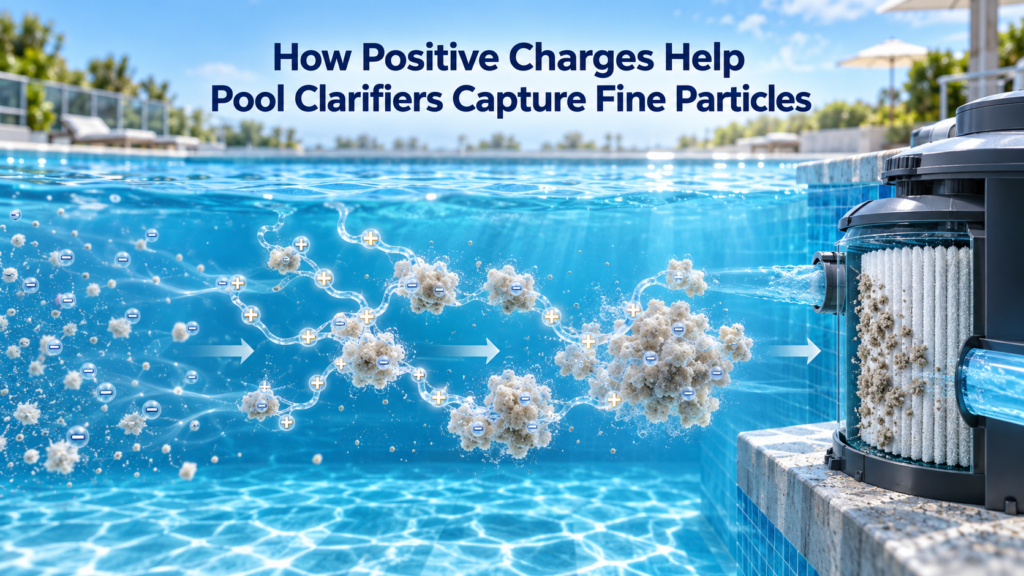
The positive charges attract many of the negatively charged particles found in pool water. At the same time, long polymer chains can connect several particles together. The separate microscopic particles become larger clusters that the filtration system can remove more easily.
It sounds like a tiny detail from a chemistry lesson. In practice, it can make the difference between water that merely passes a chemical test and water that looks genuinely clean.
Why Do Fine Particles Stay Suspended in Pool Water?
Cloudy water is rarely caused by one single substance. It is usually a mixture of many tiny contaminants, including:
- Dust carried by wind
- Pollen and plant material
- Skin cells
- Body oils and cosmetic residues
- Fine soil particles
- Dead algae
- Organic debris
- Insoluble mineral particles
- Residues produced after oxidation
- Contaminants introduced during heavy swimming periods
Some debris is large enough to settle or be trapped during normal filtration. Very fine particles behave differently.
They are so small that gravity has little immediate effect on them. Water movement keeps them suspended, while their surface chemistry helps them remain separated from one another.
Here is the important part: many suspended particles in water carry a negative surface charge.
Particles with similar charges repel each other. Picture several magnets placed with matching poles facing one another. They resist contact. In pool water, this repulsive force can prevent fine particles from joining together, even when they repeatedly collide.
As a result, the particles remain stable and dispersed. A filter may capture some of them, but many can pass through the media and return to the pool.
The water keeps circulating. The haze keeps coming back.
A Particle Is More Than a Tiny Piece of Dirt
It is tempting to think of suspended debris as nothing more than very small dirt. Chemically, however, each particle has a surface that interacts with the surrounding water.
That surface may gain a negative charge through ionization, adsorption, or contact with dissolved substances. A surrounding layer of oppositely charged ions then develops in the water. Together, these layers form what water-treatment professionals often call the electrical double layer.
This charged environment influences how closely two particles can approach each other.
When the repulsive force is strong, particles remain apart. They may bump into each other due to circulation or molecular motion, but they do not stay together. It is a bit like trying to push two spring-loaded objects into contact. The closer they get, the harder they resist.
This condition is known as colloidal stability.
A stable suspension may contain particles that are difficult to see individually. Yet when millions of them scatter light, the entire pool can appear milky, flat, or slightly gray.
The filter is not necessarily broken. It may simply be facing particles that are still too small and too stable to capture well.
So, What Does “Cationic” Actually Mean?
“Cationic” means positively charged.
A cationic polymer is a long-chain molecule containing positive charge sites along its structure. Depending on the chemistry, those charges may be permanent or influenced by the water conditions.
PolyDADMAC is one example of a cationic polymer used in water clarification. Its full chemical name is polydiallyldimethylammonium chloride, and its commonly referenced CAS number is 26062-79-3.
The name is a mouthful. The basic idea is easier: it is a water-soluble polymer with positively charged groups distributed along its chain.
When a correctly formulated cationic clarifier is added to pool water, those positive sites can interact with negatively charged suspended matter. This weakens the electrical forces that keep the particles apart.
EPA water-treatment literature describes two relevant actions of cationic polymers: reducing particle surface charge and forming bridges between particles.
That combination is the heart of polymer clarification.
First Step: Positive Charges Reduce Particle Repulsion
Imagine a group of negatively charged particles floating near one another. Because their charges are similar, they repel each other and remain dispersed.
Now introduce a controlled amount of cationic polymer.
The polymer’s positive charge sites attach to negative areas on the particle surfaces. This reduces the effective negative charge and weakens the repulsive barrier between particles.
The particles do not necessarily become fully neutral. Complete charge neutralization is not always required for good coagulation. In fact, treatment can work well while particles still retain some negative charge.
That distinction matters.
Pool clarification is not a simple equation in which every negative charge must meet one positive charge. Real pool water contains particles of different sizes, compositions, and surface properties. The aim is to destabilize the suspension enough for particles to approach and remain associated.
Once repulsion is reduced, normal water movement brings the particles into closer contact. Collisions that previously achieved nothing can now contribute to particle growth.
The invisible haze begins to organize itself into something the filter can handle.
Second Step: Polymer Chains Build Bridges
Charge reduction is only part of the story.
A polymer molecule is much longer than a simple dissolved ion. One part of the chain may attach to one particle, while another section remains extended into the surrounding water. That free section can then attach to a second particle.
The polymer has created a bridge.
Additional particles can become attached to the same chain or to nearby chains. Gradually, the individual particles form larger, loose clusters. These clusters are often called microflocs or flocs, depending on their size and structure.
The sequence looks like this:
- Fine particles remain suspended and repel one another.
- Cationic polymer chains enter the water.
- Positive sites adsorb onto negative particle surfaces.
- Electrostatic repulsion becomes weaker.
- Polymer segments connect nearby particles.
- Small clusters grow into filterable aggregates.
- The circulation system carries those aggregates to the filter.
The clarifier has not made the particles disappear. It has changed their physical behavior.
That is an important difference. A clarifier prepares contaminants for removal; the filter performs the removal.
Why Larger Clusters Are Easier to Filter?
Every pool filter has practical limits.
Sand, cartridge, and diatomaceous earth filters use different mechanisms and can remove particles across different size ranges. Their real-world performance also depends on flow rate, media condition, loading, maintenance, and system design.
Very fine colloidal particles may travel through openings in the filter media. Once they have been gathered into larger clusters, they are more likely to become trapped:
- Between grains of sand
- Within the depth of a filter bed
- On cartridge fibers
- Inside an existing filter cake
- Against previously captured material
The improvement does not always come from producing huge, visible flakes. A routine pool clarifier usually aims to create aggregates large enough for filtration while keeping them manageable within normal circulation.
This is one reason a clarifier differs from a strong flocculant treatment. A clarifier generally supports filtration over time. A flocculant may create heavier material intended to settle so it can be vacuumed to waste.
Same broad family of ideas, different operating goals.
Does the Clarifier “Pull” Particles Out of the Water?
Not by itself.
Words such as “capture,” “bind,” and “attract” are useful, but they can make the clarifier sound more independent than it really is.
The product does not act like a net that sweeps through the whole pool. Several processes must work together:
- The clarifier must disperse through the water.
- Polymer chains must contact suspended particles.
- The charge conditions must allow adsorption.
- Water movement must bring destabilized particles together.
- Clusters must reach the filter.
- The filter must retain them.
- The accumulated material must eventually be removed by cleaning or backwashing.
Good circulation is therefore essential. A well-formulated polymer cannot help much if large areas of the pool receive weak circulation or if the filter is bypassing water.
Clarification is a team effort. Chemistry makes the particles easier to collect; hydraulics move them; filtration finishes the job.
Why More Positive Charge Is Not Always Better?
If positive charge helps, why not add a large dose and finish the job faster?
Because polymer treatment has an effective dose range.
With too little clarifier, there may not be enough polymer to destabilize and connect the available particles. The improvement may be slow or barely visible.
With too much, particle surfaces can become heavily coated. Excess positive charge or excess polymer can cause the particles to repel one another again. This effect is often called restabilization.
The EPA’s research literature notes that particle restabilization can begin before complete charge reversal occurs.
Overdosing can therefore produce several frustrating results:
- Persistent haze
- Sticky deposits on surfaces or filter media
- Rapid pressure increase across the filter
- Shortened filter runs
- More frequent backwashing or cartridge cleaning
- Poorer clarification despite adding more product
It is one of those cases where a little discipline beats enthusiasm.
The proper dose depends on the active polymer level, charge density, molecular characteristics, pool volume, contaminant load, circulation pattern, and filter type. A concentrated raw material and a ready-to-use pool clarifier cannot be dosed as if they were the same product.
Commercial buyers should compare products by active content and recommended use concentration—not by liquid volume alone.
Charge Density and Molecular Structure Both Matter
Two cationic polymers can have a similar appearance yet behave differently in pool water.
Charge density describes the number of charged sites carried by the polymer relative to its molecular structure. A higher cationic charge may increase attraction to negatively charged particles, but it does not automatically make a product better for every pool.
Molecular weight and chain length also influence performance.
A longer chain may provide more opportunities for polymer bridging. However, viscosity, dispersion, mixing behavior, and the risk of filter loading must also be considered. A very high molecular weight material may be suitable for one water-treatment process but awkward in a consumer pool product.
The practical formulation must balance several properties:
- Sufficient positive charge for particle adsorption
- Suitable chain length for bridging
- Good water solubility
- Easy dispersion
- Manageable viscosity
- Compatibility with the intended pool system
- Stable performance during storage
- A useful margin between underdosing and overdosing
This is why polymer selection should not be based only on the words “cationic clarifier” or on a CAS number. The actual grade, concentration, formulation, and intended application matter.
What Role Does pH Play?
Pool pH influences nearly every part of water treatment.
Its effect on a cationic polymer depends partly on the polymer chemistry. Some polymers contain charge groups whose ionization changes with pH. Quaternary ammonium polymers, including PolyDADMAC, generally retain their positive charge across the normal swimming-pool pH range.
That does not mean pH becomes irrelevant.
An unsuitable pH can still cause cloudiness through calcium carbonate precipitation, poor sanitizer performance, or changes in the surface properties of suspended matter. It may also affect other ingredients in a blended clarifier.
A pool operator should correct the underlying water balance rather than asking the clarifier to hide it.
If the haze is caused by high calcium saturation and mineral precipitation, the particles may respond to clarification, but the chemical cause remains. More solids may continue to form.
Clear water begins with balanced water. The clarifier provides support when fine suspended material remains.
Clarification Is Not the Same as Sanitization
This distinction deserves a clear statement: a pool clarifier is not a substitute for an approved sanitizer.
Clarifiers help remove suspended particles. Chlorine, bromine, or another approved disinfection system controls microorganisms according to the pool’s operating requirements.
Some microbes may become associated with particles, and filtration can contribute to overall water treatment. Still, a standard clarifier should not be presented as a disinfectant unless the finished product has the required composition, testing, claims, and regulatory authorization for that purpose.
A clear pool is not automatically a sanitary pool.
The opposite is also true. Water may contain an acceptable sanitizer residual while remaining cloudy because of fine debris, filtration limits, mineral precipitation, or a high bather load.
Visual clarity and microbiological control are connected, but they are not interchangeable.
Why Water Clarity Is Also a Safety Issue?
Clear water is not merely a cosmetic goal.
In a public or commercial pool, staff and lifeguards need to see the pool bottom and identify a swimmer in distress. The CDC’s Model Aquatic Health Code states that pool water should remain clear enough for the bottom or specified reference point to be visible while the facility is open.
Cloudiness can also signal that the treatment system is struggling with an unusual contaminant load, poor circulation, filter trouble, or incorrect water balance.
This is why professional operators should respond to recurring haze as a system problem—not simply pour in clarifier every few days.
A clarifier can improve particle removal, but repeated demand for it may point toward:
- Insufficient filtration time
- Poor filter cleaning
- Channeling in a sand filter
- Damaged cartridge elements
- High filter flow
- Dead zones in the pool
- Frequent heavy bather loads
- Algae growth
- Poor oxidation
- Unbalanced calcium or pH
- Excessive use of incompatible treatment chemicals
The clearest result comes when the root cause and the visible symptom are handled together.
How Filter Type Changes the Result?
Cationic clarifiers can support different filtration systems, but the response may not be identical.
A sand filter often benefits from the formation of larger aggregates because very fine particles may otherwise pass through the filter bed. The filter pressure should be watched, and backwashing should follow the equipment manufacturer’s instructions.
A cartridge filter can capture relatively fine material, but added particle loading may shorten the interval between cleanings. Excess polymer can also create sticky deposits that are harder to rinse away.
A diatomaceous earth filter already removes very fine particles. Clarifier may still help under certain conditions, but conservative treatment and careful pressure monitoring are sensible.
The filter’s condition matters as much as its category. Fresh, correctly installed media behaves differently from worn, compacted, channeled, or damaged media.
No polymer can repair a cracked lateral, a torn cartridge, or a faulty multiport valve.
What Commercial Buyers Should Ask About a Polymer Clarifier?
A professional buyer needs more than an attractive blue liquid and a promise of “sparkling water.”
Before evaluating a product or private-label project, ask for information that explains what is actually being supplied:
- What is the principal clarifying polymer?
- What is its CAS number?
- What is the active polymer concentration?
- Is the product a raw material, concentrate, or ready-to-use formulation?
- What are the typical pH, density, and viscosity?
- Is the appearance naturally clear, or is color added?
- What filter systems and operating conditions were considered?
- What is the recommended dose range?
- Are treatment directions based on pool volume?
- What happens if the product is overdosed?
- Are a specification sheet, COA, and SDS available?
- Can the viscosity or color be adjusted for private-label requirements?
- Has compatibility been assessed for the intended market and formulation?
For a PolyDADMAC-based pool clarifier, the concentration can be adjusted to suit the finished-product position. A lower-active ready-to-use liquid may be easier for pool owners to measure, while a stronger concentrate may reduce packaging and freight requirements for professional distribution.
Neither format is automatically superior. The right format depends on who will use it, how accurately it can be dosed, and how the product will be transported and labeled.
A Simple Way to Picture the Whole Process
Think of fine particles as people standing in a crowded room while wearing slippery coats. They keep bumping into each other, but nobody stays connected.
The cationic polymer first makes those slippery surfaces less resistant. Then its long chains act like loose links between several people. Small groups begin to form.
The filter is the doorway.
One person at a time may slip through unnoticed. A connected group is much harder to miss.
Of course, molecular chemistry is more complex than a crowded-room story. Yet the comparison captures the central point: positive charge weakens the forces keeping particles apart, and polymer chains help build larger units for filtration.
Clear Water Comes From a Complete System
Positive charge gives cationic clarifiers their ability to interact with many fine, negatively charged particles. Polymer chains then help gather those particles into larger clusters.
But chemistry alone does not produce a clean pool.
Successful clarification depends on the complete treatment system:
- Balanced water chemistry
- Adequate sanitizer and oxidation
- Correct clarifier dosage
- Strong circulation
- Effective filtration
- Timely filter cleaning
- Accurate diagnosis of the cloudiness source
When these parts work together, a polymer clarifier can turn a stubborn suspension into removable material. The change may look almost magical as the water regains its sparkle, but the science is quite practical: reduce repulsion, connect particles, and let the filter do its work.
Frequently Asked Questions
1. Why are many fine particles in swimming pool water negatively charged?
Particle surfaces can gain negative charge through ionization or by adsorbing dissolved ions and organic substances. This charge causes similar particles to repel one another, helping them remain suspended instead of forming filterable clusters.
2. How does a positively charged pool clarifier remove cloudy water particles?
A cationic pool clarifier adsorbs onto negatively charged particle surfaces, reduces electrostatic repulsion, and creates polymer bridges between particles. The resulting aggregates are easier for the pool filter to capture.
3. Can too much cationic polymer make pool water cloudy?
Yes. Overdosing may coat particles with excess polymer and restabilize the suspension. It can also increase filter pressure or leave sticky deposits. Always dose according to the finished product’s concentration and instructions.
4. Is a PolyDADMAC pool clarifier the same as a pool sanitizer?
No. A PolyDADMAC-based clarifier supports suspended-particle removal. It does not replace chlorine, bromine, or another approved disinfection system unless the finished formulation has separate regulatory authorization for antimicrobial claims.
5. How long does a polymer pool clarifier take to make water clear?
The time depends on particle load, dosage, circulation, filter performance, and the cause of the haze. Improvement may appear after several hours of continuous filtration, while heavily contaminated water may require longer treatment and filter cleaning.