
GET IN TOUCH
Ask For Sample?
How Polymer Pool Clarifiers Make Small Particles Easier to Filter?
A pool can have no leaves, no visible dirt, and a working pump—and still look hazy. You skim the surface. You check the water. You let the filter run. Yet the tiles at the deep end remain blurred.
What’s left in the water?
Often, it’s a cloud of particles so small that they’re hard to see on their own. Together, they scatter light and give the pool a dull, misty look. Some are also difficult for the filter to capture while they remain separate.
Polymer pool clarifiers help by bringing fine suspended particles together into clusters that a compatible filter can capture more readily. The clarifier prepares the particles for removal; the filtration system carries out that removal.
That sounds simple. And the basic idea is simple. But the result depends on more than pouring a liquid into the pool. Particle charge, polymer properties, dose, circulation, and filter condition all play a part.
Let’s look at how those pieces work together—and why a small, measured dose can be more useful than a generous splash.
Why Tiny Particles Create Such a Big Haze?
Large debris is easy to understand. A leaf floats on the surface. Sand settles on the floor. A skimmer net or vacuum can remove it.
Fine suspended matter behaves differently.
Tiny mineral particles, fragments of organic debris, and other fine material can stay spread through the water. Some settle slowly. Others remain suspended as water moves around the pool.
You may not see each particle, but you can see their combined effect. Light strikes the suspended material and scatters instead of passing cleanly through the water. The pool loses depth and sharpness. The floor looks farther away—or disappears into a pale blur.
Think of dust in a beam of sunlight. The room may look clean until the light reveals what’s floating in the air. Pool water can hold a similar hidden load.
Still, haze alone doesn’t identify the cause. Cloudy water may also involve algae, mineral precipitation, poor circulation, or a fault in the filter. A clarifier makes sense when fine suspended particles are part of the problem.
Why Doesn’t the Filter Catch Them Already?
A pool filter is designed to remove suspended matter, but its performance has limits.
Those limits depend on the filter medium, water flow, equipment condition, and the nature of the particles. A particle’s size matters, but so do its shape and surface properties.
It’s tempting to picture a filter as a kitchen sieve: anything larger than the holes stays behind, and anything smaller passes through. Real pool filtration is more complex.
In a sand filter, water travels through spaces between grains. Particles can become trapped within the bed or attach to surfaces. In a cartridge filter, capture occurs on and within the filter material. A diatomaceous earth, or DE, filter uses a fine filtering layer supported by internal elements.
None of these systems provides an absolute guarantee that every particle above one stated size will be removed in one pass.
Some small particles pass through. Some are captured on later passes. Others keep circulating if the filter has poor capture efficiency for that particular material.
A polymer clarifier changes how suitable suspended particles behave, giving the filter a better chance to retain them.
Meet the Polymer: A Chain with Many Points of Contact
A polymer is a large molecule built from repeating units. You can picture it as a chain, though real polymer molecules bend and move in water.
Many pool clarifiers contain cationic polymers. “Cationic” means the polymer carries positive electrical charges.
Why does that matter?
Many mineral and organic particles carry a negative surface charge under typical water conditions. Particles with similar charges tend to repel one another, which can help keep them dispersed.
A positively charged polymer can attach to negatively charged surfaces and reduce that repulsion.
PolyDADMAC—short for polydiallyldimethylammonium chloride—is one example of a cationic polymer used in water treatment and some pool clarifier formulations. Its CAS number is 26062-79-3.
However, the chemical name alone doesn’t tell you how well a finished clarifier will work. Polymer concentration, molecular weight, formulation, and the water being treated all affect performance.
Two products can contain the same general polymer type and still require different doses.
First, the Polymer Helps Particles Stop Pushing Apart
The first useful change is often charge neutralization.
This term describes a reduction in the electrical forces that help keep particles apart. It does not mean the clarifier neutralizes pool pH.
When enough cationic polymer attaches to suitable particle surfaces, the particles can become less resistant to gathering together. As they meet in moving water, they have a better chance of forming small aggregates.
Research on PolyDADMAC has demonstrated floc formation under charge-neutralization conditions. That supports the mechanism, although results from controlled water-treatment studies should not be treated as a guaranteed outcome in every swimming pool.
The practical point is easy to grasp: particles that once stayed apart can now begin to collect.
The individual particles haven’t grown larger. They’ve joined a larger group.
Sometimes, Polymer Chains Help Link the Group
Charge neutralization isn’t the only possible mechanism.
Under suitable conditions, parts of a polymer chain can attach to different particles and help connect them. This is called polymer bridging.
Picture a flexible thread touching several small objects. If it holds them together, the group behaves differently from each loose object.
That’s a useful analogy, but it has limits. Not every polymer acts mainly through bridging. The balance between charge neutralization, localized charge effects, and bridging depends on the polymer and particle system.
For PolyDADMAC, it would be misleading to describe every formulation as a long net that sweeps up everything in the water. Its positive charge is central to its behavior, while other effects depend on the grade and treatment conditions.
Research on PolyDADMAC interactions with humic material also shows that water chemistry can affect polymer-particle behavior. A pool is therefore more than a container of water plus one chemical; the surrounding conditions matter.
For pool operators, the takeaway is straightforward: use a product developed for the application, then follow its tested directions.
From Loose Specks to Filterable Clusters
Once suitable particles begin to gather, they can form clusters known as flocs.
These clusters may still be too small to see. You don’t need visible flakes floating around the pool for clarification to occur.
The aim of a filter-through clarifier is to produce aggregates that the filtration system can retain more readily. It isn’t necessarily to create large clumps that fall to the floor.
This process is often discussed using two terms:
- Coagulation: reducing the forces that keep particles dispersed.
- Flocculation: allowing destabilized particles to gather into larger clusters.
The stages can overlap during treatment. Their shared purpose is to prepare suspended material for physical removal. Coagulation, flocculation, and filtration are also established stages in broader water-treatment processes.
For a pool, the desired result is less suspended matter in the water after filtration—not simply a change in how that matter looks.
Bigger Helps, but Size Isn’t the Whole Story
Why are clusters often easier to filter?
A cluster presents a larger effective structure than its separate particles. It may be more likely to meet filter surfaces, become trapped within the medium, or attach to material already retained there.
But “bigger” doesn’t automatically mean “better.”
A loose cluster that breaks apart easily may not behave like a firm aggregate. Water flow and the forces encountered in the circulation system can affect its structure.
The goal is therefore filterable aggregation: forming clusters that remain suitable for capture in the actual system.
That’s one reason a product’s performance can differ between pools. A dose that gives a good result in one system may not produce the same result where the particle load, flow, or filter condition is different.
The chemistry and the equipment need to work together.
The Filter Still Has to Finish the Job
A clarifier can help prepare particles, but it doesn’t carry them out of the pool.
The circulation system must move treated water toward the filter. The filter must retain the suspended material. Then cleaning or backwashing must remove that collected material from the system.
If water bypasses the filter medium, aggregation alone won’t solve the problem.
Likewise, a torn cartridge, damaged internal part, or poorly functioning filter bed can allow material to return to the pool. Adding more clarifier won’t repair those faults.
CDC guidance for public pool operation calls for maintaining filtration and recirculation systems according to manufacturer recommendations. That requirement remains relevant whether a clarifier is used or not.
A useful way to assess the process is to ask three questions:
- Are suitable particles gathering?
- Is the water reaching the filter?
- Is the filter retaining and removing the material?
If one link is weak, the overall result suffers.
More Clarifier Doesn’t Mean More Clarity
Here’s where a good idea can go wrong.
If a measured dose helps particles gather, why not add extra and speed things up?
Because polymer treatment has a useful dose range. Beyond that range, performance may decline.
Depending on the chemistry, excess polymer can alter particle surfaces in ways that keep them dispersed again. It can also create unwanted deposits or place an unnecessary load on the filter.
The exact response varies by formulation. Still, the practical rule is consistent: follow the finished product’s label rather than dosing by instinct.
A product with a higher active concentration may need less liquid than a dilute product. A maintenance dose may differ from the dose intended for cloudy water.
Don’t transfer dosing instructions between brands or formulations just because both bottles say “polymer clarifier.”
And don’t assume a second dose is needed before the first has had the specified time to work.
Give the Water Time to Reach the Filter
Clarification takes place across a moving body of water.
The polymer must disperse. It must contact suitable particles. Those particles must meet and gather. The resulting material must then reach the filter and be captured.
That sequence takes time.
A pool’s turnover time is useful for understanding circulation, but one theoretical turnover does not mean every drop of water has passed through the filter. Water mixes, and some areas exchange water more slowly than others.
Poor return flow, blocked baskets, and weak circulation can all limit the treatment.
Follow the clarifier label’s circulation instructions and the equipment manufacturer’s operating guidance. If the product calls for filtering during treatment, switching the pump off too soon interrupts the removal stage.
Patience helps—but only when the system is doing useful work.
Does It Work with Sand, Cartridge, and DE Filters?
Compatibility belongs to the specific finished product, not to the word “polymer.”
Some pool clarifiers are labeled for several filter types. Others have restrictions. Always check both the chemical label and the filter manufacturer’s guidance.
| Filter type | How clarification may help | What to watch |
|---|---|---|
| Sand | Aggregation may make fine suspended matter easier to retain in the filter bed. | Flow, pressure, and the filter’s stated backwashing requirements. |
| Cartridge | Suitable clusters may be captured more readily by the filter material. | Product compatibility, cartridge condition, and cleaning requirements. |
| DE | A compatible clarifier may assist with residual suspended haze. | Product restrictions, pressure changes, and proper DE filter maintenance. |
A filter that already removes fine material well may have less need for added clarification.
That’s a useful reminder: the goal is clear, properly maintained water. It isn’t to use a clarifier simply because one is available.
A Clarifier and a Settling Flocculant Can Need Different Workflows
Pool clarifiers and pool flocculants are often sold as different treatment approaches, even though the underlying chemistry can overlap.
A filter-through clarifier generally aims to make particles easier to capture while water circulates through the filter.
A settling flocculant generally aims to form material that settles on the pool floor for later removal, often by vacuuming to waste.
The operating instructions can differ sharply.
One treatment may require continued filtration. Another may call for mixing, a settling period, and a specific removal method. Sending settled floc through an unsuitable filter can cause problems.
So, read the directions before adding anything.
The product name gives you a clue. The label gives you the workflow.
Check the Cause of Cloudiness Before Treating It
A polymer clarifier is most useful when fine suspended matter is making the water hazy.
It cannot replace every other part of pool care.
If live algae are growing, the pool needs the appropriate algae-control and sanitation response. If minerals keep precipitating, the water balance needs attention. If dirt enters faster than the system removes it, the source and cleaning routine matter.
A clarifier may assist with some remaining suspended material after the underlying issue is addressed. But it won’t stop that issue from producing more haze.
Before treatment, check:
- Sanitizer and pH readings.
- Relevant water-balance factors.
- Pump flow and circulation.
- Filter condition and recent maintenance.
- Recent storms, heavy use, or chemical additions.
That short review can prevent a long cycle of adding chemicals without finding the cause.
Clear Water Still Needs Proper Sanitation
Clarity and sanitation serve different purposes.
A polymer clarifier helps prepare suspended particles for removal. It should not be assumed to disinfect the water or replace a sanitizer.
Clear-looking water can still contain germs. Cloudy water can also make supervision and visibility more difficult.
CDC identifies properly maintained free chlorine and pH as key defenses against swimming-related illness and recommends routine testing. Clarification does not remove that responsibility.
For commercial pools, follow the applicable operating code, including visibility and closure requirements.
For any pool, treat clarity as one part of water management. It’s an important part, but the water’s appearance cannot tell you everything about its condition.
Watch the Result, Not Just the Clock
How can you tell whether treatment is helping?
Look for a steady improvement in visibility from the same viewing position. Floor markings may become sharper. The deep end may look less blurred. A light haze may gradually fade.
Also watch filter pressure and return flow.
As suspended material collects, the filter may need service. However, pressure changes are system-specific; a rise is not proof that clarification is working, and little change doesn’t prove failure.
Use the manufacturer’s cleaning threshold and maintenance procedure.
For professional pools, record the product, dose, treatment time, water readings, and observations. These notes help distinguish a repeatable result from a lucky one.
If the water doesn’t improve within the label’s expected period, reassess the cause before adding another dose.
Why Pool Professionals Value a Predictable Product
For a service technician, a clarifier needs to do more than make one pool look good once.
It needs clear instructions and consistent behavior across the applications stated on its label.
A predictable product makes it easier to plan treatment, explain the process to clients, and avoid unnecessary return visits. It also helps operators know when to stop treating and inspect the system.
For hotels and resorts, that consistency matters. A pool may face changing loads from guests, windblown dust, and outdoor debris. The treatment program needs to respond to those changes without becoming guesswork.
A clarifier can be a useful part of that program when its role is defined: assist the filtration of suitable fine suspended matter.
It should earn its place through observed results.
What Buyers Should Ask About a Polymer Pool Clarifier?
For distributors, private-label buyers, and pool chemical formulators, the useful questions go beyond color and price.
Ask about the active polymer type, concentration, quality controls, storage guidance, and tested application.
Then ask how the finished product is meant to be used:
- Which filter types are supported?
- What doses have been validated?
- Are maintenance and corrective doses different?
- What circulation instructions are required?
- What restrictions should appear on the label?
- What evidence supports the performance claims?
An SDS provides hazard and handling information. A technical data sheet describes relevant product properties. A certificate of analysis reports specified batch results. These documents serve different purposes; none alone proves performance in every pool.
Where trials are conducted, they should represent the intended water and filtration conditions. A clear jar after a test is useful evidence, but it isn’t the same as sustained clarity in a working pool.
Small Particles, a More Manageable Removal Job
Polymer pool clarifiers work by changing the behavior of suitable suspended particles.
They can reduce the forces keeping particles apart and help them form clusters. A compatible, well-maintained filter can then capture those clusters more readily.
The visible result is clearer water. Behind that result is a partnership between chemistry, circulation, and physical removal.
That partnership works best with a measured dose, correct operating instructions, and a clear understanding of the cause of haze.
For buyers assessing a PolyDADMAC-based pool clarifier, focus on the finished formulation and its tested use—not just the ingredient name. A suitable polymer matters. So do the dose, filter, and pool conditions that allow it to do its job.
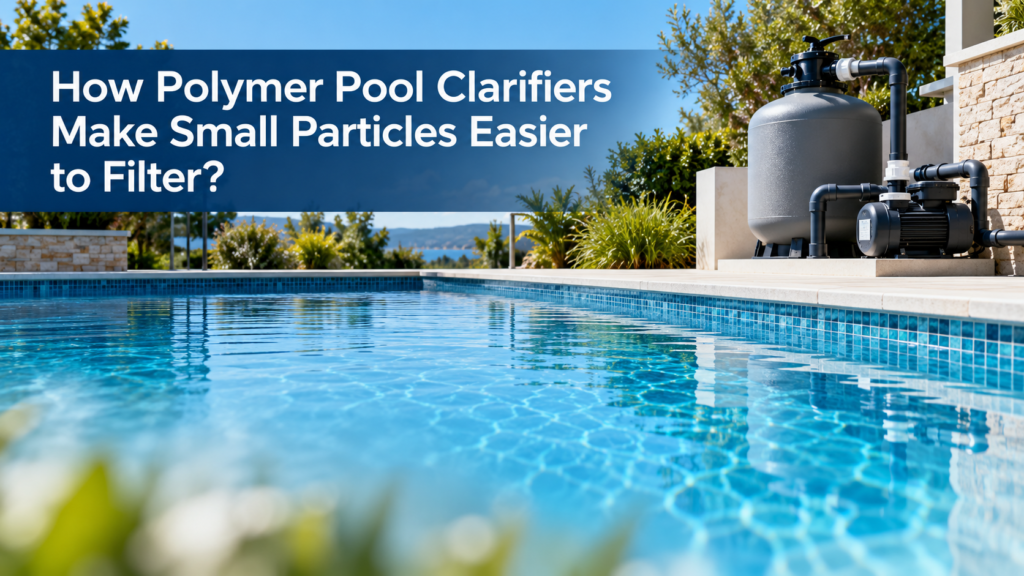
Hero image alt text: Outdoor swimming pool with blue water and pool filtration equipment, beneath the title “How Polymer Pool Clarifiers Make Small Particles Easier to Filter?”
Frequently Asked Questions
1. How do polymer pool clarifiers help filters capture very small particles?
They help suitable suspended particles gather into clusters by reducing surface-charge repulsion and, in some systems, linking particles. Those aggregates can be easier for a compatible filter to retain than separate fine particles.
2. Does a PolyDADMAC pool clarifier make individual particles larger?
No. It helps particles form larger groups. The original particles remain, but their combined structure can improve capture during filtration.
3. Can I use a polymer pool clarifier with a cartridge filter?
Use it only if the finished product’s label supports cartridge filters and the filter manufacturer permits it. Monitor flow and clean the cartridge according to its maintenance instructions.
4. Why is my pool still cloudy after adding polymer clarifier?
Possible causes include poor circulation, filter faults, incorrect dosing, ongoing algae growth, or mineral precipitation. Allow the label’s treatment period, then reassess the water and equipment before adding more.
5. Does polymer pool clarifier remove dissolved salts or replace chlorine?
No. A standard pool clarifier targets suitable suspended matter; it is not a general treatment for dissolved salts. It also does not replace chlorine or another approved pool sanitation program.