
GET IN TOUCH
Ask For Sample?
How PolyDADMAC Is Used in Polymer Pool Clarifier Formulations?
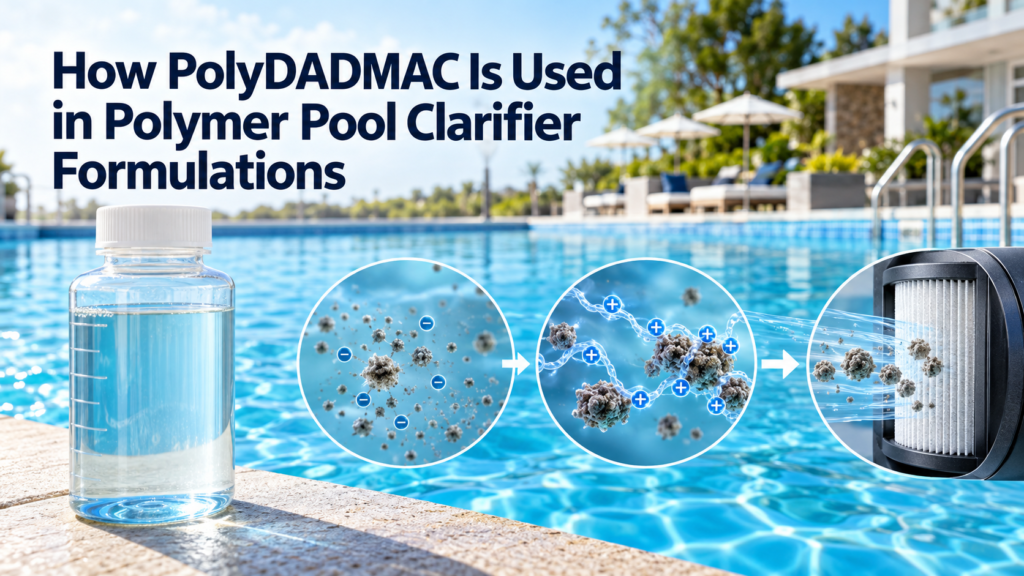
Cloudy pool water often looks like a chemistry problem. Sometimes it is. Yet a pool can have acceptable chlorine, pH, and alkalinity readings and still appear dull, hazy, or slightly milky.
Why? The water may contain thousands of fine suspended particles that are too small for the filter to capture efficiently.
This is where PolyDADMAC can help.
PolyDADMAC is a positively charged, water-soluble polymer commonly used in liquid pool clarifier formulations. It does not replace chlorine, correct poor circulation, or repair a damaged filter. Its job is more specific: it helps tiny suspended particles gather into larger clusters that the filtration system can remove more easily.
That sounds simple. Formulating a reliable PolyDADMAC pool clarifier, however, requires more than pouring polymer into a bottle and adding water. Raw material concentration, viscosity, dilution water, mixing conditions, storage stability, dosing instructions, and packaging all influence how the finished product performs.
Let’s explain how the process works—and where formulators need to be careful.
What Is PolyDADMAC?
PolyDADMAC is the common name for poly(diallyldimethylammonium chloride), a cationic polymer identified by CAS No. 26062-79-3.
“Cationic” means the polymer carries a positive electrical charge. This charge remains along its polymer chain and gives PolyDADMAC a strong attraction to many negatively charged particles suspended in water.
These particles may include:
- Fine dust and soil
- Pollen
- Dead algae
- Small organic fragments
- Cosmetic residues
- Body oils bound to other debris
- Mineral particles
- Material that passes through or escapes the pool filter
Individually, many of these particles are almost invisible. Together, they scatter light and give the water a cloudy appearance.
PolyDADMAC is usually supplied as an aqueous liquid rather than a dry powder. Commercial grades may have different active contents, viscosities, molecular-weight ranges, and impurity profiles. Those differences matter. Two materials sold under the same general chemical name may not behave identically in a pool clarifier.
For that reason, a formulator should evaluate the actual raw material specification—not just its CAS number.
Why Do Fine Particles Remain Suspended?
Most fine particles in pool water carry a negative surface charge. Because particles with similar charges repel one another, they tend to remain separated.
Think of several magnets held with the same poles facing each other. They resist coming together. Suspended particles behave in a comparable way, though the water chemistry is more complex than the magnet example suggests.
A conventional swimming pool filter performs well when particles are large enough to be trapped by its media. Very fine particles may pass through the filter or circulate for a long time before being removed.
The result can be frustrating. The sanitizer level appears normal. The pump is running. The filter has been cleaned. Still, the deep end lacks that crisp, polished look.
A cationic polymer clarifier changes the way these particles interact.
So, What Does PolyDADMAC Actually Do?
PolyDADMAC works mainly through charge neutralization and particle aggregation.
When the positively charged polymer enters the water, it is attracted to negatively charged suspended matter. Sections of a polymer chain can adsorb onto particle surfaces. This reduces the electrical repulsion that keeps the particles apart.
The destabilized particles can then collide and gather into larger clusters. Depending on the polymer grade, water conditions, and dose, some degree of polymer bridging may also occur. A polymer chain attaches to more than one particle, helping connect them.
These clusters do not necessarily become large, heavy flocs that immediately fall to the pool floor. A routine clarifier is normally intended to produce filterable aggregates while the circulation system continues operating.
That distinction is important.
A clarifier supports filtration. A drop-out flocculant is normally used to create heavier material that settles and is later vacuumed to waste. The two products can overlap in general coagulation chemistry, but their application methods are not the same.
For routine pool maintenance, controlled aggregation is usually more useful than dramatic settling.
The Basic Structure of a PolyDADMAC Pool Clarifier
A simple PolyDADMAC clarifier generally contains:
- A suitable PolyDADMAC grade
- Treated or demineralized water
- Any justified formulation aid
- A carefully selected active-polymer concentration
- Clear dosing and filtration instructions
The formula may look short on paper. That does not mean it is automatically easy to manufacture.
The performance of the finished clarifier depends on several connected decisions: which polymer grade is selected, how much active material is present, how the concentrate is diluted, and how the product behaves after months in a warehouse.
In many cases, keeping the formulation simple is an advantage. Every additional ingredient creates another compatibility question.
Choosing the Right PolyDADMAC Grade
PolyDADMAC grades can differ in ways that are easy to miss when comparing quotations.
Active content
The active content tells the formulator how much actual polymer is present in the supplied liquid. The remaining portion is largely water, along with permitted residual components associated with the manufacturing process.
Formulation calculations should be made on an active basis.
For example, suppose the target is a finished clarifier containing 10% active PolyDADMAC. If the raw material contains 40% active polymer, the theoretical raw-material requirement for a 100-kilogram batch would be:\[ \frac{10\text{ kg target active}}{0.40}=25\text{ kg raw material} \]
The remaining formulation weight would not automatically be 75 kilograms of untreated tap water. The complete batch still needs to account for the water quality, processing losses, permitted formulation aids, and final quality adjustments.
If a different PolyDADMAC grade contains 20% active matter, twice as much supplied liquid would be required to deliver the same active-polymer amount. That change can affect viscosity, freight economics, preservation strategy, and manufacturing time.
Molecular weight and viscosity
Higher viscosity does not always mean better pool clarification.
Viscosity can give useful information about the polymer grade, but it is not a complete performance measurement. Molecular-weight distribution, charge density, concentration, temperature, and the test method all influence the reported value.
A very high-molecular-weight polymer may create larger aggregates, yet it may also be harder to dilute and disperse. A lower-viscosity grade may offer easier handling and more predictable dosing.
The right balance depends on the intended product:
- A concentrated professional clarifier
- A lower-strength retail product
- A weekly maintenance treatment
- A recovery treatment for moderately cloudy water
- A private-label product designed around a specific dose rate
Jar testing and real-pool trials are more reliable than judging the polymer by viscosity alone.
Appearance and odor
A pool clarifier is often expected to be clear, uniform, and visually clean. Raw-material color can therefore affect the finished product.
Acceptable appearance limits should be established before commercial production. The formulator should also check for unusual odor, visible particles, sediment, or changes after storage.
Residual impurities
A pool-treatment chemical should be selected with its intended market and regulatory obligations in mind. Raw material documentation may need to cover residual monomers, trace impurities, heavy metals, manufacturing consistency, and other locally regulated parameters.
The CAS number alone does not establish that a particular commercial grade is suitable for every pool market.
Selecting the Finished Active Concentration
There is no single PolyDADMAC concentration that suits every clarifier brand.
Some products are formulated as concentrated treatments for professional pool operators. Others are diluted for easier household dosing. A manufacturer may also develop different strengths for weekly maintenance, seasonal opening, high-bather-load recovery, or private-label positioning.
A 10% active PolyDADMAC clarifier is one possible commercial format, but it should not be treated as a universal standard. The useful concentration depends on:
- The raw polymer grade
- The desired dose per cubic metre or gallon
- Target customer experience
- Bottle size
- Pump or measuring-cap design
- Product viscosity
- Filtration system
- Water conditions
- Local chemical regulations
- Shipping and storage requirements
The relationship between product concentration and application dose must be considered together.
A highly concentrated product may reduce packaging and shipping costs, but small dosing errors become more significant. A more diluted product may be easier for homeowners to measure, though it requires larger bottles and moves more water through the supply chain.
There is a commercial decision hiding inside the technical decision. Honestly, that is often where formulation projects become interesting.
Dilution Water Is Part of the Formula
Water may be the largest component of a liquid clarifier, so its quality deserves attention.
Untreated water can introduce hardness salts, metals, suspended matter, microorganisms, or variable conductivity. These can affect product appearance, stability, odor, or compatibility.
Depending on the formula and production requirements, manufacturers may use:
- Deionized water
- Demineralized water
- Reverse-osmosis water
- Another controlled-quality process water
The selected water should have a written specification. Useful checks may include conductivity, hardness, pH, appearance, microbial condition, and metal content.
If one batch is made with soft, low-conductivity water and the next with hard process water, the finished products may not behave the same way. Consistency begins before the polymer reaches the mixing tank.
Mixing PolyDADMAC Without Creating Problems
PolyDADMAC is water-soluble, but concentrated polymer solutions still require controlled mixing.
A typical manufacturing sequence may involve charging the mixing vessel with a measured amount of treated water, beginning moderate agitation, and slowly adding the PolyDADMAC raw material. The remaining water and any validated compatible ingredients can then be added according to the approved batch procedure.
Several principles matter here.
Avoid uncontrolled high shear
Aggressive mixing is not always helpful. Excessive shear may generate air, produce foam, increase heating, or affect some polymer structures.
The goal is uniform dispersion, not a violent vortex.
Add the concentrate gradually
Pouring a large amount of viscous polymer into a poorly moving tank can create local concentration zones. These may take longer to disperse and can cause inconsistent sampling.
Slow, controlled addition gives the polymer time to distribute through the water.
Consider temperature
Cold polymer solutions can become more viscous and harder to transfer. Excess heat, meanwhile, may influence stability or encourage unwanted reactions involving other ingredients.
A validated manufacturing temperature range helps keep batch-to-batch viscosity and mixing time under control.
Allow entrained air to escape
Air bubbles can make a clear product appear hazy and can interfere with filling accuracy. After blending, the batch may need a controlled rest period or low-shear recirculation before final inspection and filling.
There is no prize for filling the bottles five minutes earlier if the finished product looks cloudy on the shelf.
Should a PolyDADMAC Clarifier Contain Other Polymers?
It can, but only when the combination has a clear technical purpose.
Some clarifier formulations use a single cationic polymer. Others combine polymers or include compatible coagulant aids to broaden performance under varying water conditions.
Blending polymers is not automatically better. Cationic and anionic ingredients can interact strongly. If incompatible materials are combined in the concentrate, they may form haze, gel, precipitate, or stringy deposits before the product ever reaches a pool.
Nonionic ingredients may offer more compatibility in certain systems, but that must still be confirmed through testing.
Any multi-polymer system should be evaluated for:
- Immediate clarity
- Viscosity change
- Sedimentation
- Gel formation
- Performance after dilution
- Stability at high and low temperatures
- Compatibility with packaging
- Performance in representative pool water
A formula that looks acceptable on the day it is made can fail after several weeks. Accelerated stability testing helps reveal that risk, though it should be supported by real-time storage data.
Can Color Be Added?
Yes, some private-label pool clarifiers use a light blue color because customers associate it with clean pool water.
The color should be stable, suitable for the target market, and compatible with the polymer. It should also be used at a low enough level that the product does not stain surfaces or create unnecessary residue.
Color is a marketing feature, not the clarification mechanism. A deeper blue liquid is not a stronger clarifier.
The same caution applies to fragrance. Pool clarifiers generally do not need a heavy perfume, and an added fragrance may complicate compatibility, labeling, or customer perception.
For many professional products, a clear, low-odor formula communicates quality more effectively than decorative additives.
Preservatives and Microbial Stability
Whether a preservative is required depends on the complete formulation, active concentration, raw-material quality, manufacturing hygiene, water quality, packaging, and intended shelf life.
The cationic nature of PolyDADMAC may discourage some microbial growth, but that should not be treated as proof that every formulation is self-preserving.
A suitable microbial assessment should be performed. If a preservative is considered, it must be compatible with the polymer and permitted for the intended market.
This is another reason not to copy a formula from an online discussion and send it directly into production. A formulation is a system. Change one ingredient, and several other properties may shift.
How the Finished Clarifier Is Used in Pool Water?
A properly formulated PolyDADMAC clarifier is normally added while the pool circulation system is operating.
The product disperses through the water and contacts suspended particles. As the particles destabilize and gather, the filter begins capturing the larger aggregates.
Application instructions commonly address:
- Checking and correcting basic water balance.
- Ensuring the filter and circulation system are working correctly.
- Adding the measured clarifier dose.
- Circulating the pool water for the specified period.
- Monitoring filter pressure.
- Backwashing or cleaning the filter when needed.
The exact instructions must be based on product testing. They should not be copied from a product with a different active concentration.
A commercial pool with heavy daily use may also require a different maintenance strategy from a small residential pool. More swimmers bring more sunscreen, sweat, cosmetic residue, fibres, and fine organic matter into the water. The clarifier dose and filter-cleaning schedule may therefore need adjustment.
Dose Carefully—More Is Not Always Better
Polymer clarification has an effective dose range. Below that range, there may not be enough cationic charge to destabilize the suspended particles.
But adding too much can also cause problems.
An excessive PolyDADMAC dose may coat particles with surplus positive charge. Instead of continuing to aggregate, the particles may become stabilized again with a reversed surface charge. The pool can remain hazy or even look worse.
Overdosing may also:
- Increase filter loading
- Shorten filter runs
- Leave the water with an undesirable feel
- Create residue on some surfaces
- Waste product
- Confuse the operator, who may add an even larger second dose
This is why the label should state both a routine dose and, where validated, a higher recovery dose. The instructions should also tell users how long to wait before repeating treatment.
Clarifiers reward patience. The polymer needs time to disperse, contact particles, and send them toward the filter.
Filter Type Changes the Result
PolyDADMAC does not remove particles by itself. It prepares them for removal.
The final result therefore depends heavily on the pool filter.
Sand filters
Clarifiers can improve the capture of fine particles that would otherwise pass between sand grains. Filter pressure should be monitored because particle loading may rise after treatment.
Cartridge filters
A cartridge can capture fine aggregates effectively, but it may require earlier cleaning after a clarifier treatment. Excess polymer should be avoided because it can contribute to rapid cartridge fouling.
Diatomaceous earth filters
DE filters already offer fine filtration. A clarifier may still help under certain conditions, but the dose should be conservative and supported by testing. Heavy polymer treatment can increase filter resistance.
A product label that simply says “works with all filters” may not give the operator enough guidance. Better instructions explain what the user should observe and when the filter may need cleaning.
What PolyDADMAC Does Not Do?
PolyDADMAC can improve water clarity, but it is not a complete pool-care program.
A clarifier does not:
- Replace an approved sanitizer
- Maintain a chlorine residual
- Correct an unsuitable pH
- Remove dissolved salts
- Repair poor circulation
- Fix damaged filter media
- Remove heavy debris from the pool floor
- Cure an active algae problem by itself
- Replace oxidation when organic contamination is high
This distinction protects both the customer and the supplier.
If a pool is green because sanitizer control has failed, adding clarifier alone treats the visible symptom—not the cause. The algae problem must be addressed with legally permitted products and proper water-management procedures. Clarification can then help remove fine dead material left behind.
Laboratory Testing Before Commercial Production
A promising beaker sample is only the beginning.
Formulation development should include water from more than one source because hardness, alkalinity, temperature, salt content, and organic load can influence polymer performance.
Useful development work may include:
- Bench-scale jar tests
- Turbidity measurements
- Visual clarity comparisons
- Filterability trials
- Overdose testing
- Dilution behavior
- Foam observation
- pH measurement
- Viscosity testing
- Freeze–thaw cycles
- Elevated-temperature storage
- Low-temperature storage
- Packaging compatibility
- Real-time stability studies
- Field trials in operating pools
Overdose testing deserves special attention. A product should not only perform at its recommended dose; the manufacturer should understand what happens when a customer accidentally adds two or three times that amount.
That scenario is not rare. Measuring caps disappear, gallons are confused with litres, and a frustrated operator may think, “A little more should clear it faster.” The formulation and label need to anticipate real human behaviour.
Quality Control for the Finished Product
A practical quality-control specification may include:
- Appearance
- Color
- Odor
- Active content or an appropriate validated control
- pH
- Density
- Viscosity
- Clarity
- Microbial condition, where relevant
- Fill weight
- Packaging integrity
Acceptance ranges should reflect meaningful manufacturing control. Extremely narrow limits can create unnecessary batch rejection, while limits that are too broad may allow noticeable performance differences.
A retained sample from each production batch can support complaint investigations and shelf-life monitoring.
Raw-material traceability is just as important. If polymer viscosity changes from one delivery to another, the manufacturer should be able to identify which finished batches used each lot.
Packaging a PolyDADMAC Clarifier
PolyDADMAC clarifiers are commonly packed in plastic bottles, jerry cans, or drums selected for chemical compatibility.
Possible retail and professional sizes include:
- 1-litre bottles
- 5-litre jerry cans
- 20- or 25-litre containers
- Larger industrial packaging for professional repacking or institutional use
Before selecting packaging, manufacturers should check:
- Container compatibility
- Cap and liner resistance
- Leakage during transport
- Label adhesion
- Pouring control
- Measuring-cap accuracy
- Stability under warehouse temperatures
- Stack strength
- Customer handling needs
A thin liquid and a viscous concentrate do not pour in the same way. Package design should reflect the real product.
Private-label buyers may focus first on bottle shape and artwork, but the cap, seal, dosing instructions, and batch code are just as important. A beautiful bottle that leaks during sea freight is not a successful product.
Labeling and Regulatory Positioning
Claims determine how a pool chemical may be classified and regulated.
A clarifier claim such as “helps remove suspended particles” is different from a claim that the product kills algae, controls bacteria, or sanitizes water. Antimicrobial claims may place the product under pesticide, biocide, or other regulatory frameworks, depending on the destination market.
Manufacturers and private-label customers should agree on:
- Intended use
- Permitted claims
- Ingredient disclosure
- Hazard classification
- Safety wording
- Transport classification
- Directions for use
- Batch traceability
- Local language requirements
- Required technical documents
The Safety Data Sheet, technical data sheet, label, and sales material should tell the same story. Contradictory claims create regulatory and commercial risk.
Local review is essential because approval in one country does not guarantee acceptance in another.
Why PolyDADMAC Is Attractive for Private-Label Clarifiers?
PolyDADMAC offers several practical advantages for pool chemical brands.
It can be supplied in a stable liquid format, diluted to different commercial strengths, and adapted to various packaging sizes. The finished product can be positioned for routine maintenance, professional service routes, hotels, resorts, residential pools, or commercial aquatic facilities.
It is also compatible with straightforward product messaging: the clarifier gathers tiny particles so the filter can remove them.
Still, differentiation should involve more than changing the label color. A strong private-label program may include:
- A tested active concentration
- Consistent raw-material specifications
- Market-specific dosing instructions
- Packaging suited to local buying habits
- Stability verification
- Technical documentation
- Batch traceability
- Controlled custom color
- Small or large commercial pack sizes
A reliable clarifier is not defined only by what is inside the bottle. Documentation, manufacturing control, and sensible customer guidance are part of the product too.
PolyDADMAC Clarifiers Work Best as Part of a System
Water clarity comes from several processes working together:
- Balanced water chemistry
- Effective sanitation
- Adequate circulation
- Sufficient filtration time
- Clean filter media
- Controlled bather contamination
- Periodic oxidation when required
- Correct clarifier dosing
PolyDADMAC strengthens one part of that system. It makes fine suspended particles easier for the filter to capture.
That is a modest role, perhaps—but an important one. In a well-maintained pool, the difference between “clean” and “crystal clear” often comes down to the smallest particles.
A well-designed polymer clarifier handles those particles quietly. It does not need to produce dramatic settling or a chemical spectacle. It simply helps the existing filtration system do a better job.
And when the formulation, dose, and filtration conditions are right, the result is easy to see: sharper water, better depth visibility, and the polished appearance that pool owners and professional operators expect.
Frequently Asked Questions
1. What concentration of PolyDADMAC is used in a pool clarifier?
The concentration varies by product design, raw-material active content, intended dose, packaging, and market requirements. A finished clarifier may contain around 10% active PolyDADMAC, but this is not a universal formula. Performance and overdose trials should establish the final concentration.
2. Is PolyDADMAC pool clarifier the same as a pool flocculant?
Not necessarily. A PolyDADMAC clarifier normally gathers fine particles into filterable clusters while circulation continues. A drop-out flocculant is generally designed to form heavier material that settles and is vacuumed to waste.
3. Can PolyDADMAC replace chlorine in swimming pools?
No. PolyDADMAC is used for particle clarification, not routine pool sanitation. The pool must still maintain an approved sanitizer residual and follow local water-treatment requirements.
4. Can too much PolyDADMAC make pool water cloudy?
Yes. Overdosing may cause charge reversal, restabilize suspended particles, or overload the filter. Users should follow the tested dose and allow enough circulation time before considering another treatment.
5. Does a PolyDADMAC clarifier work with sand and cartridge filters?
It can work with both when properly formulated and dosed. The aggregated particles increase filter loading, so sand filters may require backwashing and cartridge filters may need earlier cleaning after treatment.